

Clothing Production in Porto: The 2026 Guide for Premium Startup Brands
What if the greatest threat to your brand isn't a lack of capital, but the 40% margin loss caused by inefficiencies in clothing production in Porto? Many founders assume that achieving luxury-tier craftsmanship requires a massive investment or a physical presence on the factory floor. It's a common anxiety, especially when you're trying to manage technical requirements like tech packs from thousands of miles away. You want the prestige of European manufacturing without the traditional barriers that keep small businesses out of the market.
We agree that launching a premium brand should be empowering, not overwhelming. This guide reveals why Porto remains the heart of European textile excellence in 2026, offering a unique balance of ethical standards and accessible entry points. You'll discover how to leverage low MOQs of 60 pieces per style to scale your vision without the burden of excess inventory. We provide a clear roadmap for finding a partner for clothing production in Porto that handles both custom and white-label options. This ensures your journey from logo to legacy is profitable and efficient.
Key Takeaways
- Understand why the "Textile Triangle" surrounding Porto is the premier destination for brands seeking "Made in Portugal" quality that rivals Italian craftsmanship.
- Learn how to navigate the choice between full custom manufacturing for unique designs and flexible white-label models to launch your brand with lower risk.
- Master the essential ethical certifications, such as OEKO-TEX® and GOTS, that will define premium apparel standards for the 2026 market.
- Follow a proven step-by-step roadmap for clothing production porto, starting with professional tech pack development and local fabric sourcing.
- Discover how to bridge the gap between your startup vision and high-end manufacturing through a supportive, scalable production partnership.
Why Porto is the Global Hub for Premium Clothing Production
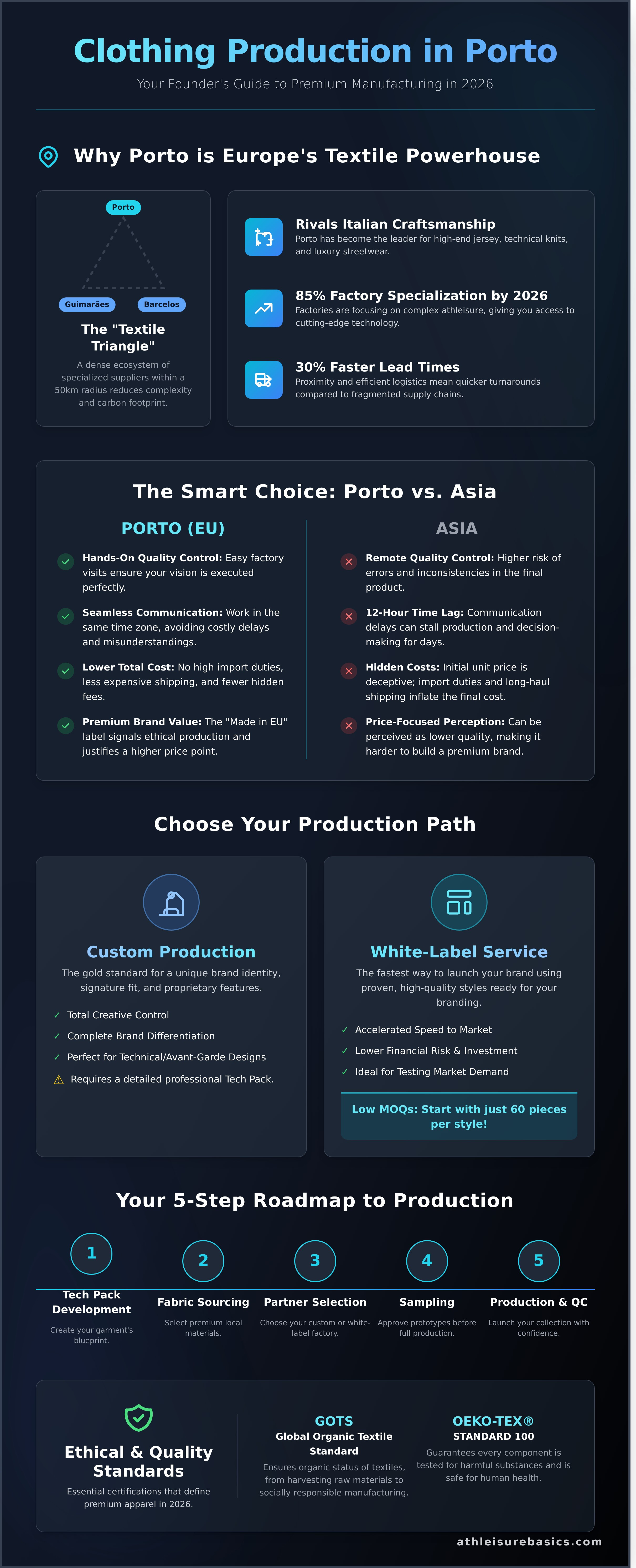
Porto isn't just a scenic destination for travelers; it's the industrial engine of the European fashion industry. For founders seeking premium clothing production porto offers a strategic advantage that few global regions can match. The city serves as the primary gateway to the "Textile Triangle," a manufacturing powerhouse formed by Porto, Barcelos, and Guimarães. This region accounts for a massive portion of the manufacturing sector within the Portuguese economy, providing a dense network of specialized suppliers that handle every stage of the garment lifecycle. The "Made in Portugal" label now rivals "Made in Italy" in terms of prestige and technical execution. While Italy remains a leader in formal suiting, Porto has claimed the throne for high-end jersey, technical knits, and luxury streetwear. By 2026, industry data suggests that 85% of Porto’s leading factories will have completed a shift toward hyper-specialization. These facilities are moving away from general manufacturing to focus on complex athleisure and performance wear. This evolution ensures your brand has access to the latest bonding, laser-cutting, and seamless technologies. Logistics play a vital role in your brand's ability to scale. Porto Airport (OPO) handles over 15 million passengers and significant cargo annually, ensuring that samples reach London, Berlin, or Paris in under 24 hours. The proximity to major European shipping lanes and the Port of Leixões allows for efficient bulk distribution. You don't have to wait weeks for a container to cross the ocean. This speed allows you to react to market trends with agility and precision.The Northern Portugal Textile Ecosystem
The concentration of knitting, dyeing, and sewing facilities within a 50-kilometer radius of Porto is a massive competitive weapon. This regional proximity allows a single garment to move from raw yarn to finished product with minimal transport. It reduces lead times by an average of 30% compared to fragmented supply chains in other countries. For your brand, this means a significantly lower carbon footprint and a transparent production cycle. Porto functions as the central business hub where design and strategy meet the raw power of the manufacturing belt.Porto vs. Asia: The Real Cost of Quality
Many founders focus on the initial unit price but ignore the hidden costs of manufacturing in Asia. Long-distance shipping, high import duties, and the 12-hour communication lag can drain your resources and delay your launch. Porto offers a different value proposition based on transparency and accessibility. You can fly in for a factory visit on a Tuesday and be back in your office with approved samples by Thursday. Quality control is hands-on rather than remote. In the 2026 market, "EU-made" is a powerful marketing tool that justifies a higher retail price point. It signals ethical labor practices and superior durability to your customers. Choosing clothing production porto means you're investing in a partnership that values your brand's long-term legacy over short-term savings. This proximity ensures your vision is executed perfectly every time.Custom vs. White Label: Navigating Porto Production Models
Choosing the right manufacturing path determines your brand's trajectory and financial health. In Northern Portugal, the industry offers two distinct routes: custom cut-and-sew or white label services. Each model serves a specific business stage. When planning your clothing production porto strategy, you must decide between complete creative control and speed to market. This region has solidified its position as a global leader because of this versatility. Recent global textile trade data shows Portugal's textile exports reached over $6 billion in 2022, proving the region's massive capacity for both boutique and large-scale orders.
Custom Production: Building from Scratch
Custom manufacturing is the gold standard for brands requiring a signature fit or unique functional features. You control every stitch, fabric weight, and hardware choice. This process is essential if you're developing technical activewear or avant-garde silhouettes that don't exist in standard catalogs. It allows for total brand differentiation. You aren't just selling a shirt; you're selling a proprietary fit that customers can't find elsewhere.
The ecosystem for clothing production porto supports this high level of detail through expert pattern makers. However, custom work requires a comprehensive tech pack. This document acts as your blueprint. It includes graded measurements, material BOMs (Bill of Materials), and stitching instructions. Without a professional tech pack, production often stalls or results in costly errors. For custom cut-and-sew projects in Porto, expect a Minimum Order Quantity (MOQ) of approximately 250 pieces per style. This volume allows factories to justify the labor-intensive process of creating new patterns and setting up specialized machinery.
White Label & Luxury Blanks
White label services are the "Startup Shortcut." This model allows you to launch a collection with significantly lower risk and capital. Instead of developing patterns from zero, you choose from a factory's existing library of high-end garments. These aren't basic wholesale items found in discount catalogs. Porto's white label offerings are luxury blanks, often crafted from 100% organic cotton or OEKO-TEX® certified recycled polyesters. They outperform standard wholesale options because they use the same premium fabrics as the world's leading fashion houses.
Customization is still a core part of this model. You can personalize these blanks through several methods:
- Private Labeling: Swapping factory tags for your own branded neck labels.
- High-Density Printing: Adding logos or graphics via screen printing or DTG.
- Intricate Embroidery: Utilizing Porto's advanced machinery for 3D or flat embroidery.
- Custom Dyeing: Requesting specific Pantone colors for a unique seasonal palette.
The primary advantage here is the MOQ. Many Porto partners offer white label entry points as low as 70 pieces per style. This lower barrier to entry helps you test market demand before committing to larger inventories. By utilizing existing patterns, you often reduce your development costs by up to 40% compared to custom routes. If you're ready to see how these models look in practice, you can explore our custom clothing options to compare different finishes.
Northern Portugal is famous for its flexibility. While Asian manufacturing hubs often demand 1,000 pieces per color, the Porto cluster caters to the "Premium Small Batch" market. This agility allows you to scale at a sustainable pace. Whether you choose the 250-piece custom route or the 70-piece white label path, you're tapping into a legacy of ethical, high-quality craftsmanship that defines European fashion.
The Ethical Edge: Quality Standards in Porto Factories
Ethical manufacturing is the primary benchmark for brand success as we approach 2026. Recent market data indicates that 66% of consumers are now willing to pay a premium for products from transparent supply chains. Porto factories excel in this area because they operate under some of the most stringent labor and environmental regulations in the world. Unlike offshore alternatives, clothing production porto offers a secure environment where fair wages and safe conditions are legally mandated by EU law. The Portuguese minimum wage increased to €820 in January 2024; this reflects a national commitment to elevating worker standards and ensuring a stable, motivated workforce for your brand.
The environmental impact of your supply chain is equally critical. Many textile mills in the Porto region have implemented advanced water treatment facilities that recycle up to 95% of the water used during the dyeing and finishing stages. This prevents the chemical runoff often seen in unregulated manufacturing hubs. By choosing a partner in this region, you're not just buying a product; you're investing in a legacy of integrity and premium craftsmanship. This level of accountability provides a significant marketing advantage, allowing you to share a story of genuine sustainability with your customers.
Certifications That Matter
Reliable factories back their ethical claims with recognized international certifications. The OEKO-TEX® Standard 100 is the baseline requirement you should look for; it guarantees that every component of your garment, from the fabric to the sewing thread, is free from 1,000+ harmful substances. For brands focused on eco-conscious athleisure or basics, the GOTS (Global Organic Textile Standard) is the gold standard. It requires that garments contain at least 70% organic fibers and meet strict social criteria. You should always verify these credentials by requesting a factory's unique license number and checking it against the official GOTS or OEKO-TEX® public databases before you sign a production contract.
The Sustainable Sourcing Advantage
Porto provides immediate access to high-end Portuguese cotton and innovative recycled synthetics that meet the highest industry standards. If you're a startup founder looking to minimize risk, many local suppliers offer deadstock fabric options. These are premium leftover rolls from luxury production runs, which allow you to launch ultra-low MOQ sustainable collections of 60 pieces or fewer without the lead times of custom milling. This approach helps you test the market while maintaining an eco-friendly profile.
Using localized clothing production porto also slashes your brand's carbon footprint through reduced logistics. Shipping a pallet of finished goods from Porto to London covers approximately 1,600 kilometers by road. In contrast, shipping the same goods from Shanghai involves a journey of over 10,000 kilometers by sea or air. This proximity doesn't just save time and reduce shipping costs; it drastically lowers the CO2 emissions associated with your brand's growth. When you manufacture in Portugal, you're choosing a partner that values your brand's reputation as much as you do.
Step-by-Step: Preparing for Your First Porto Production Run
Launching your first collection in Northern Portugal requires a disciplined approach to bridge the gap between a creative vision and a retail-ready product. The ecosystem for clothing production porto is built on five distinct phases that ensure your brand maintains the high standards expected of European manufacturing. By following a structured workflow, you reduce the risk of costly mistakes and ensure your "Made in Portugal" label represents genuine quality.
- Phase 1: Concept and Tech Pack development. This is your foundation.
- Phase 2: Fabric sourcing. Porto sits at the heart of a textile cluster where 90% of suppliers are within a 50km radius.
- Phase 3: The sampling process. This is where you refine fit, drape, and finish.
- Phase 4: Bulk production. Factories move into high gear with integrated quality control checkpoints.
- Phase 5: Logistics. Porto's proximity to major European hubs allows for 3 to 5 day transit times by road.
Mastering the Tech Pack
Your tech pack is the most critical document in the manufacturing process. It must include a comprehensive Bill of Materials (BOM), detailed size charts with grading increments, specific construction notes like stitches per inch, and a clear list of trims. A professional tech pack prevents 90% of production errors by removing guesswork for the factory floor. If your documentation is vague, your samples will be inaccurate. You can learn how to create a tech pack for clothing to ensure your first submission meets the highest industry standards.
The Sampling Cycle
Expect the sampling phase to take between 14 and 28 days depending on fabric availability. When you receive your "First Fit" sample from a Porto factory, don't just look at the aesthetics. Check the seam strength, the drape of the fabric, and the accuracy of the measurements against your spec sheet. Communicate revisions using clear, annotated photos and specific measurements. Portuguese makers value directness; if a sleeve is 1.5cm too short, state it clearly. Most brands go through two rounds of samples before moving to a "salesman sample" used for marketing photography. This cycle ensures that when bulk production begins, the factory has a perfect "gold seal" sample to follow.
Once samples are signed off, bulk production typically takes 6 to 10 weeks. During this time, your factory will perform quality control checkpoints at the cutting, sewing, and final pressing stages. Many Porto facilities use a 4-point inspection system to catch defects before they reach the packing area. For shipping, Porto's Leixões port and Francisco Sá Carneiro Airport provide global reach. If you're selling in Europe, road freight is the most cost-effective and eco-friendly choice, often arriving at your warehouse within 72 to 120 hours. By following this structured path, your clothing production porto experience will be both profitable and scalable.
Partner with Athleisurebasics: Your Porto Production Experts
Launching a successful brand requires more than just high-level design; it demands a logistics partner that understands the technical nuances of clothing production porto. We bridge the gap between your initial creative vision and the premium manufacturing standards found in Northern Portugal. Our team provides the infrastructure you need to compete with established luxury labels from your very first drop. By combining local craftsmanship with modern communication, we ensure your brand's voice is never lost in translation during the manufacturing process.
Our dual-service model is built for scalability and versatility. We offer a white label service with minimums starting at exactly 60 pieces per style, allowing for rapid market entry with minimal upfront investment. For founders requiring a unique signature, our custom production path handles everything from initial pattern making to final size grading. This allows you to start small and expand your catalog as your revenue grows, ensuring you never pay for more inventory than your current stage requires.
The 2026 apparel market demands extreme agility and lean inventory management. Consumer trends now shift in weeks rather than months, making massive production runs a significant financial liability. We've structured our entire operation to support this high-speed environment. Our low MOQ approach reduces your initial financial risk by approximately 45% compared to typical mass-market sourcing. This flexibility lets you test new designs and colorways without the fear of deadstock, keeping your brand profitable and your collections fresh.
The Athleisurebasics promise is rooted in premium quality and uncompromising ethical standards. We prioritize the use of OEKO-TEX® certified materials and maintain 100% transparency in our supply chain. You receive expert guidance at every stage, from selecting the correct fabric GSM to choosing the right sustainable packaging. We believe that high-quality manufacturing should be accessible to visionaries, not just corporations with massive budgets. Our goal is to provide the stability you need to build a lasting legacy in the fashion industry.
From Logo to Legacy
We act as a strategic extension of your internal team rather than a simple transactional vendor. One of our recent partners began their journey with a single 70-piece drop of organic cotton hoodies. Within 18 months, they successfully scaled to a full seasonal collection featuring 15 distinct styles. This rapid growth is possible because we maintain strict EU labor standards and prioritize high-performance materials. Every garment we produce for clothing production porto meets the highest safety benchmarks, ensuring your brand remains ethically sound as you scale.
Start Your Production Journey Today
Beginning your manufacturing process is a straightforward, three-step journey. First, you'll submit your project details or tech packs through our digital portal for a preliminary review. Within 48 business hours, our production specialists analyze your requirements to ensure technical feasibility and material availability. Following this review, we schedule an initial brand strategy consultation to discuss specific hardware options and realistic timeline projections. We're here to demystify the technical hurdles of the industry and get your products to market efficiently.
Scale Your Vision with Porto's Manufacturing Excellence
Porto remains the gold standard for luxury apparel as we move into 2026. You've seen how the region's ethical factories and top-notch craftsmanship provide the necessary foundation for long-term brand success. By prioritizing clothing production porto, you gain immediate access to OEKO-TEX® certified premium fabrics and EU-regulated labor standards. These elements ensure your products meet the highest global benchmarks from your very first run. It's the most reliable way to build a brand that stands for quality and integrity.
Launching a startup shouldn't involve massive inventory risks or complex logistics. Our White Label solutions offer low MOQs starting at 70 pieces per style, which allows you to scale efficiently while staying profitable. We provide expert production consulting to help you navigate every technical hurdle from fabric selection to final stitching. It's time to move beyond the planning phase and start creating products that your customers will truly value.
Launch Your Premium Brand with Porto's Best Manufacturer
We're ready to help you transform your creative vision into a high-quality reality. Let's start building your brand's legacy together today.
Frequently Asked Questions
Why is Porto considered a top location for clothing production in 2026?
Porto remains a premier hub in 2026 because it combines 100 years of textile heritage with modern EU sustainability standards. The region accounts for over 80% of Portugal's textile exports. Brands choose Porto to comply with the 2026 EU Digital Product Passport requirements. It's a strategic choice for high-quality, ethical manufacturing that meets new environmental laws. We help you navigate these regulations easily.
What is the typical minimum order quantity (MOQ) for Porto factories?
Typical MOQs in Porto range from 50 to 100 pieces per style or color for specialized startup partners. While traditional industrial factories might require 500 units, our white label service starts at just 60 pieces. This low MOQ approach allows you to test 3 or 4 designs without overextending your initial budget. It's the most cost-effective way to launch a premium collection with minimal risk.
Do I need to visit the factory in Porto personally to manage production?
You don't need to visit Porto personally because 95% of our clients manage their entire production run through digital tech packs and physical sampling. We provide high-definition photos and video calls to bridge the gap. We ship physical samples via DHL within 3 to 5 business days so you can verify the superior quality from your own office. We act as your trusted partner and eyes on the ground.
How long does a standard production run take in Portugal?
A standard clothing production porto run typically takes between 8 and 12 weeks from the final sample approval. This timeline includes 3 weeks for fabric sourcing and 5 to 7 weeks for cutting and sewing. If you choose our ready-to-wear white label options, we can often reduce this lead time to just 4 weeks. Efficiency is a core part of our manufacturing process to help you scale quickly.
Can Porto factories handle sustainable and organic fabric sourcing?
Yes, over 70% of Porto's textile manufacturers are now OEKO-TEX® or GOTS certified to meet global demand for ethical fashion. We source premium organic cotton, recycled polyester, and Tencel directly from local mills. These materials meet the highest industry standards for 2026. You can build a sustainable brand legacy by utilizing Portugal's established green supply chain. We make it easy to source ethical materials.
What is the difference between CMT and Full Package production in Porto?
CMT stands for Cut, Make, and Trim, where you provide the fabric and we handle the assembly. Full Package Production (FPP) is a comprehensive service where we manage everything from fabric sourcing to final packaging. For 90% of startups, FPP is the better choice because it simplifies the logistics. We handle the complex details so you can focus on your vision and growing your brand.
How much does it cost to produce a sample with a Porto-based manufacturer?
Sampling costs in Porto generally range from €150 to €350 per style, depending on the complexity of the garment. This fee covers the pattern making, fabric sourcing, and the labor for one physical prototype. While this is 2 or 3 times the cost of a production unit, it's a vital investment. A perfect sample ensures your final bulk order meets your vision exactly and maintains our highest quality standards.
Is it cheaper to manufacture in Porto than in China for a startup?
While unit prices in China might be 30% lower, clothing production porto is often more cost-effective for European startups when you calculate the total cost. You'll save 15% on shipping fees and avoid the 12% EU import duties applied to Chinese goods. Shorter transit times mean you can restock 4 weeks faster. This flexibility helps you maintain a profitable, lean inventory and react to market trends.


Leave a comment
This site is protected by hCaptcha and the hCaptcha Privacy Policy and Terms of Service apply.