
What is a Fábrica Têxtil? The Benefits of Nearshore Production in Portugal
Launching your clothing brand is an exciting vision, but the path to production can feel overwhelming. You're faced with a global sea of potential manufacturers, confusing industry jargon, and the legitimate fear of long lead times and inconsistent quality from faraway factories. For startups and emerging brands, finding a partner willing to support smaller volumes can seem almost impossible, leaving you unsure where to even begin.
The solution is often closer and more reliable than you think. It starts with understanding a key term: fabrica textil. This is the Portuguese phrase for a textile factory, and partnering with one in Portugal can give your brand a decisive competitive edge. In this article, we will demystify the manufacturing process and guide you through the significant benefits of nearshore production. You will discover how working with a Portuguese partner ensures superior quality, ethical standards, and the flexibility you need to launch and scale your brand with confidence and less risk.
Demystifying 'Fábrica Têxtil': More Than Just a Factory
When launching a clothing brand, you will frequently encounter the term 'fábrica têxtil', the Portuguese phrase for a textile factory. However, this term is not a one-size-fits-all description. It represents a crucial distinction in the supply chain that every brand founder must understand to make efficient and profitable sourcing decisions. Mistaking one type of facility for another can lead to wasted time and resources.
Understanding the two primary types of textile factories is the first step toward building a reliable and high-quality production partnership. This knowledge empowers you to seek the right services and communicate your needs with clarity and confidence.
Type 1: The Fabric Mill
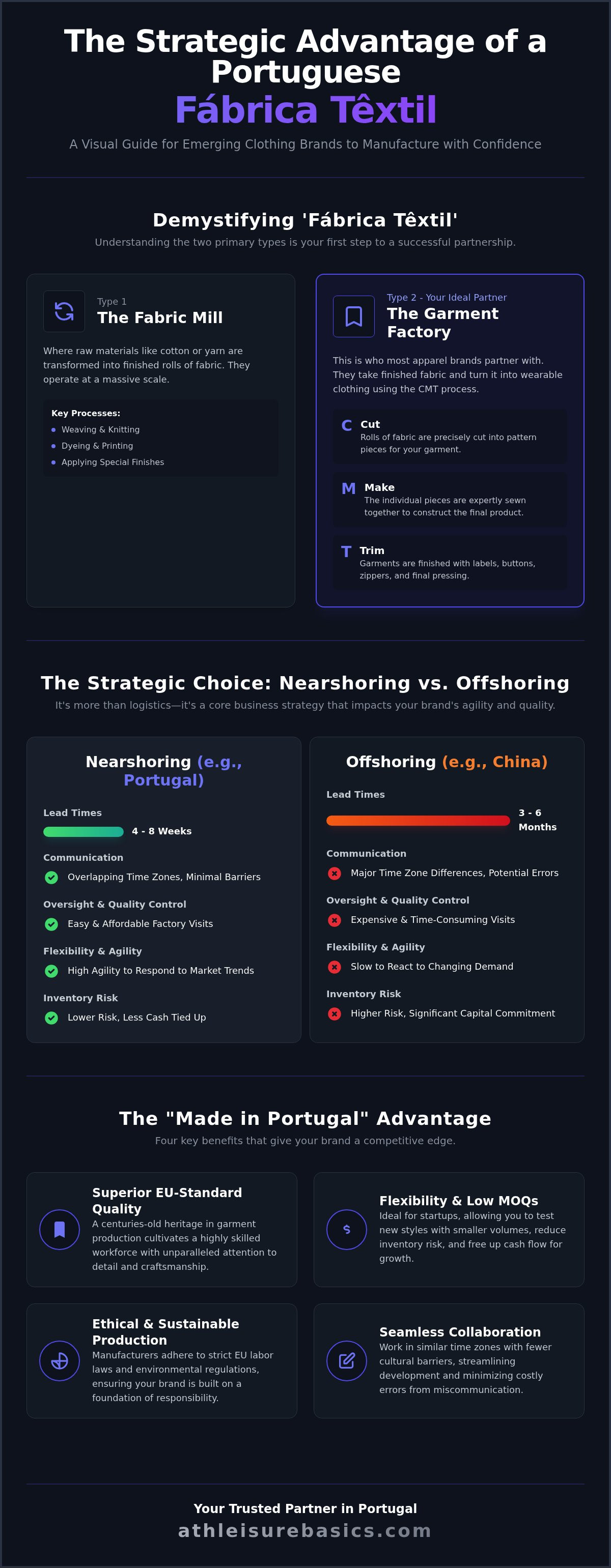
A fabric mill is where the magic of textile creation begins. These facilities take raw materials-like bales of cotton or spools of polyester yarn-and transform them into finished rolls of fabric. Their operations cover the foundational stages of the textile manufacturing process, including weaving, knitting, dyeing, and applying special finishes. Due to their focus on raw material conversion, mills operate at a massive scale. As a result, brands typically do not work directly with them unless they require exceptionally large, custom fabric orders.
Type 2: The Garment Factory (CMT Production)
This is the type of fabrica textil most apparel brands partner with to bring their vision to life. A garment factory takes the finished fabrics produced by mills and turns them into wearable clothing. The core service they provide is known as CMT, which stands for:
- Cut: Rolls of fabric are laid out and precisely cut into the pattern pieces for a specific garment.
- Make: These individual pieces are expertly sewn together to construct the final product.
- Trim: The garment is finished with details like trimming loose threads, attaching labels, adding buttons or zippers, and pressing.
As your trusted production partner, Athleisurebasics operates as a premier garment factory, specializing in this CMT process. We provide the top-notch craftsmanship and end-to-end service needed to turn your designs into superior quality products, efficiently and with the flexibility of low MOQs.
The Strategic Choice: Why Nearshoring Beats Offshoring
When launching or scaling a clothing brand, one of the most critical decisions you'll make is where to produce your garments. For decades, offshoring-manufacturing in distant countries like China or Vietnam-was the default choice. Today, a more strategic and agile model has emerged: nearshoring. Nearshoring involves partnering with a manufacturer in a nearby country, such as choosing a fabrica textil in Portugal for European and US-based brands.
This isn't just a logistical preference; it's a fundamental business strategy that impacts your brand's flexibility, quality, and profitability. The global textile industry increasingly sees nearshoring production as a powerful way to build more resilient and responsive supply chains. Let's break down the key differences.
Nearshoring (e.g., Portugal)
- Lead Times: 4-8 weeks
- Communication: Overlapping time zones, minimal language barriers
- Oversight: Easy and affordable factory visits
- Flexibility: High agility to respond to market trends
- Inventory Risk: Lower, less cash tied up
Offshoring (e.g., China)
- Lead Times: 3-6 months
- Communication: Major time zone differences, potential for error
- Oversight: Expensive and time-consuming visits
- Flexibility: Slow to react to changing demand
- Inventory Risk: Higher, significant capital commitment
Lead Times and Supply Chain Agility
With nearshoring, shipping takes weeks, not months. This dramatic reduction in lead time allows your brand to be incredibly agile. You can test new styles with low MOQs, quickly restock best-sellers, and react to emerging trends without committing huge amounts of capital. For startups, this is a game-changer. It reduces inventory risk and frees up cash flow, allowing you to invest in marketing and growth instead of sitting on unsold stock.
Communication and Collaboration
Effective collaboration is essential for turning your vision into a high-quality product. Nearshoring to a location like Portugal means working in similar time zones and with fewer cultural or language barriers. This seamless communication streamlines the entire development process, from sampling to production. Quick video calls and easy factory visits ensure that feedback is understood and implemented correctly, minimizing costly errors and delays.
Quality Control and Oversight
Ensuring superior quality requires oversight. With a nearshore partner, you can easily and affordably visit your fabrica textil to approve samples, inspect production runs, and build a strong relationship with the team. This direct involvement is nearly impossible with offshoring, where brands often rely on third-party agents. Being hands-on gives you ultimate control over the final product, guaranteeing the top-notch craftsmanship your customers expect and deserve.
The Top 4 Benefits of a Portuguese Fábrica Têxtil
While nearshoring in Europe offers many advantages, Portugal has firmly established itself as the premier hub for brands seeking to produce premium apparel. The "Made in Portugal" label is more than a geographic marker; it’s a globally recognized seal of quality, reliability, and ethical production. For startup and emerging brands, partnering with a Portuguese fabrica textil isn't just a strategic move-it's a competitive advantage. Here are the four key benefits that set Portugal apart.
1. Superior EU-Standard Quality and Craftsmanship
Portugal has a rich, centuries-old heritage in garment production. This deep-rooted history has cultivated a highly skilled workforce with an unparalleled attention to detail and a passion for craftsmanship. Unlike mass-production facilities, Portuguese factories excel at creating high-quality, intricate garments. According to AICEP, Portugal's textile and clothing industry is known for its innovation and technical expertise. This commitment is reinforced by strict adherence to EU quality and safety standards, ensuring every product is not only beautifully made but also safe, durable, and ready for the premium market.
2. Speed, Flexibility, and Low MOQs
One of the greatest challenges for new brands is managing inventory and cash flow. Portuguese manufacturers are structured to support this reality. They specialize in offering:
- Low Minimum Order Quantities (MOQs): Launch new styles or test market response without committing to thousands of units. This flexibility is crucial for minimizing risk and staying agile.
- Faster Turnaround Times: Proximity to major European and North American markets dramatically cuts down shipping times compared to Asia.
- Quick Re-orders: React swiftly to sales data. If a product sells out, you can place a new order and have it in stock in weeks, not months, capitalizing on market trends instantly.
3. Ethical and Sustainable Production
Today's consumers demand transparency and hold brands accountable for their supply chains. A Portuguese fabrica textil provides a clear and compelling story. Production is governed by stringent EU labor laws, which guarantee fair wages, safe working conditions, and workers' rights. Furthermore, there is a strong and growing focus on sustainability. Many facilities are OEKO-TEX® certified, meaning textiles are free from harmful substances, and increasingly use eco-friendly materials and processes. This offers a transparent, ethical alternative to the often-opaque supply chains of far-shore locations.
4. Seamless Integration with Western Markets
Doing business with Portuguese partners is efficient and straightforward. There is a deep cultural alignment and a sophisticated understanding of European and American fashion trends, which minimizes communication gaps and ensures your vision is executed precisely. The business environment is stable, with robust intellectual property (IP) protection and reliable trade agreements. This removes the uncertainty and risk often associated with offshoring, allowing you to focus on building your brand with a trusted production partner. See how our process leverages these benefits for your brand.
How to Choose the Right Manufacturing Partner in Portugal
You understand the benefits of nearshore production; now it’s time to take action. Choosing the right fabrica textil is one of the most critical decisions you'll make for your brand. This isn't just about finding a supplier-it's about securing a long-term partner dedicated to your growth and quality standards. Use this checklist to vet potential manufacturers and ensure you find the perfect fit for your vision.
Verify Their Specialization and Expertise
Not all factories are created equal. Ensure their production specialty aligns perfectly with your product line. If you're launching an athleisure brand, you need a partner with deep experience in stretch fabrics, complex seams, and performance finishes. Don't hesitate to ask for a portfolio, client case studies, or samples of past work to verify their top-notch craftsmanship and ability to handle premium, technical materials.
Clarify MOQs, Pricing, and Lead Times
Operational transparency is non-negotiable. A reliable partner will be upfront about the key metrics that impact your business plan. Before committing, get clear answers on:
- Minimum Order Quantities (MOQs): Can they support your launch with a low MOQ? This flexibility is crucial for startups to test the market without over-investing in inventory.
- Pricing Structure: Request a transparent cost breakdown, such as a CMT (Cut, Make, Trim) price, so you understand exactly what you are paying for.
- Lead Times: Get firm timelines for both the sampling phase and bulk production to manage your launch schedule effectively.
Look for a True Partnership Approach
The ideal manufacturing relationship goes beyond fulfilling orders. A true partner invests in your success by offering support that helps you scale efficiently. Does the factory provide guidance on fabric sourcing, tech pack development, or sustainable options? A quality fabrica textil communicates clearly and professionally, acting as an extension of your own team. They should be as committed to your brand’s legacy as you are.
Finding a manufacturer that ticks all these boxes is the key to turning your vision into a profitable brand. At Athleisurebasics, we are built to be that partner for startups and established brands alike, offering end-to-end support to make your launch seamless and successful.
Your Strategic Partner for Portuguese Textile Manufacturing
Choosing to manufacture in Portugal means leveraging more than just a factory; it is a strategic partnership with a legacy of textile excellence. As we have explored, the benefits of nearshoring-from superior EU quality standards and ethical production to streamlined communication and faster turnarounds-offer a significant competitive edge. This decision empowers your brand with reliability, transparency, and a foundation built on premium craftsmanship.
Finding the right fabrica textil is the crucial next step in turning your brand vision into reality. At Athleisurebasics, we are an expert partner for athleisure and streetwear brands looking to launch and scale. We provide ultimate flexibility with low MOQs from just 70 pieces and ensure every garment is crafted from premium, OEKO-TEX® certified fabrics, meeting the highest industry standards for quality and safety.
Ready to transform your designs into high-quality apparel with a trusted partner? Let us help you build a lasting brand legacy with efficiency and confidence. Start Production in Portugal. Get Your Free Quote Today.
Frequently Asked Questions About Nearshore Production
What is the difference between a fabric mill and a garment factory?
A fabric mill, or fabrica textil, is where the raw material is created-they spin yarn and then weave or knit it into finished rolls of fabric. A garment factory, in contrast, takes that fabric and performs the cut-and-sew process to construct the final apparel. While some large facilities integrate both, they are typically separate, specialized partners in your supply chain. Understanding this helps you manage sourcing and production more efficiently.
Why is Portugal often considered better for manufacturing than China or Turkey?
Portugal provides a superior balance of premium quality, ethical oversight, and logistical efficiency. Portuguese manufacturers adhere to strict EU labor and environmental standards, ensuring responsible production. The country is renowned for its top-notch craftsmanship and expertise with high-quality materials. For brands, this means a more reliable supply chain, faster lead times, and a final product that consistently meets the highest industry standards for luxury and durability, building a stronger brand legacy.
What is a typical MOQ for a clothing manufacturer in Portugal?
Portugal is known for its flexibility, making it an ideal partner for startups and growing brands. While MOQs (Minimum Order Quantities) can vary, many factories offer accessible minimums between 100-250 pieces per style. As a partner dedicated to helping brands launch, we provide even greater flexibility, with white-label services starting as low as 60 pieces per style. This low-risk approach allows you to test your vision and scale efficiently.
How does nearshoring production to Portugal reduce risks for a startup brand?
Nearshoring to Portugal significantly minimizes risk for new brands. The geographical proximity leads to shorter shipping times, lower logistics costs, and a much smaller carbon footprint. Working in a similar time zone streamlines communication, reducing the chance of costly errors. Furthermore, operating under stable EU regulations ensures transparency and protects your investment, while accessible MOQs prevent you from tying up capital in excess inventory before validating your products with the market.
What does the 'Made in Portugal' label really mean for quality?
The 'Made in Portugal' label is a globally recognized mark of superior quality and ethical production. It signifies that your garments were produced by skilled artisans in a country with a rich textile heritage and a commitment to top-notch craftsmanship. It also assures customers that the product meets stringent EU safety and quality standards, including certifications like OEKO-TEX®. This label inherently builds brand trust and justifies a premium positioning in the market.
Can a Portuguese factory help me with sourcing sustainable fabrics?
Absolutely. Portuguese manufacturers are leaders in sustainable and innovative textiles. A reliable production partner will have a well-established network of certified fabric suppliers, offering materials like GOTS-certified organic cotton, recycled polyester, TENCEL™ Lyocell, and other eco-conscious options. We can guide you through the best choices for your product, provide necessary certifications, and help you build a transparent and sustainable supply chain that resonates with modern consumers.



Leave a comment
This site is protected by hCaptcha and the hCaptcha Privacy Policy and Terms of Service apply.