
Wholesale Athleisure Wear: The 2026 Guide to Sourcing & Manufacturing
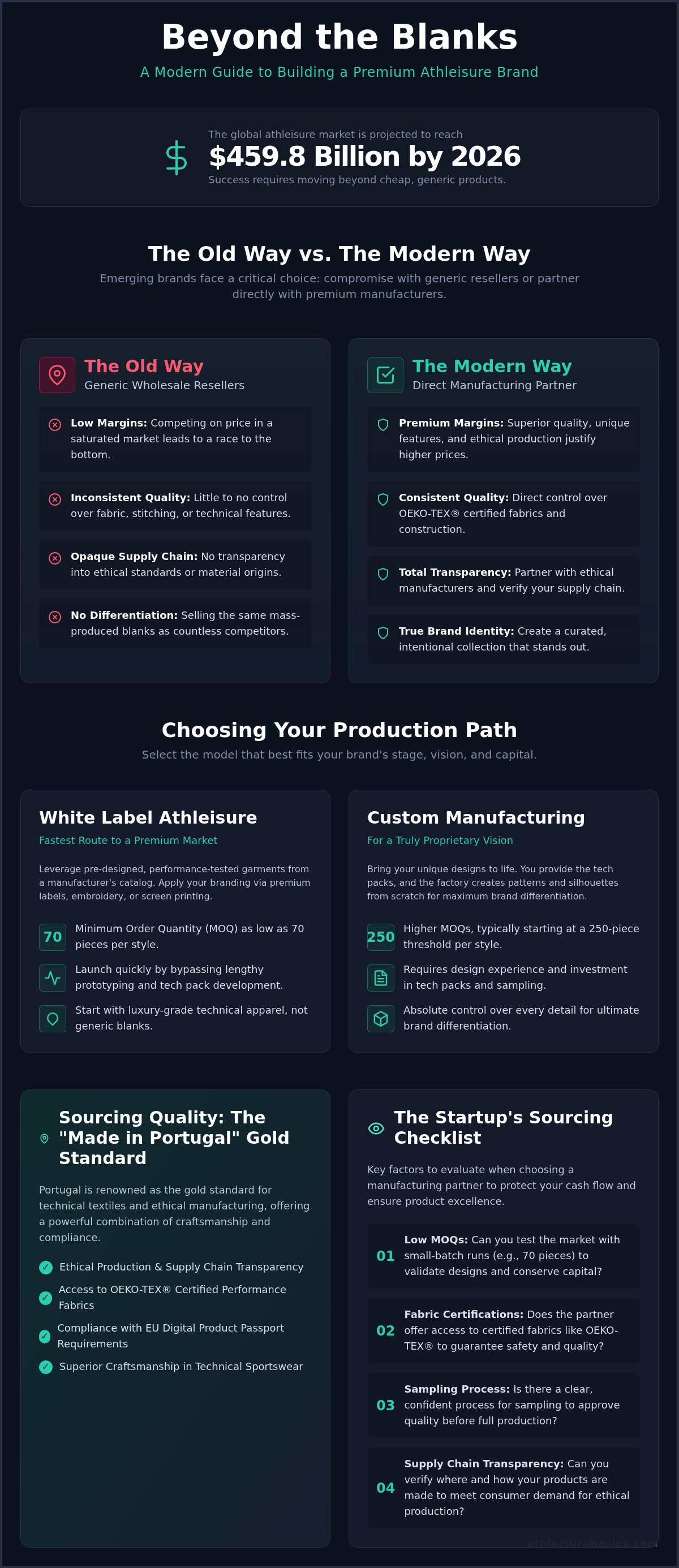
The global athleisure market is projected to reach $459.8 billion in 2026, but the era of building a brand on cheap, generic blanks is officially over. You've likely felt the frustration of choosing between massive minimum order quantities from traditional factories or settling for low-quality fabrics from standard wholesale sites. It's a difficult position that often forces emerging labels to sacrifice their margins and their ethical standards just to get a foot in the door.
You don't have to choose between accessibility and excellence. This guide will show you how to leverage premium white label athleisure to build a brand that commands higher prices through superior craftsmanship and total supply chain transparency. We'll explore how to source OEKO-TEX certified fabrics and partner with ethical Portuguese manufacturers while maintaining MOQs as low as 70 pieces to protect your cash flow. From the new EU Digital Product Passport requirements to US safety filing updates, we'll break down everything you need to scale your operations with total confidence.
Key Takeaways
- Identify the strategic advantages of a direct manufacturing partnership over generic wholesale resellers to command higher market margins.
- Learn how to accelerate your market entry by applying your branding to premium white label athleisure and luxury blanks.
- Explore why "Made in Portugal" remains the gold standard for technical textiles, offering ethical transparency and OEKO-TEX® certified quality.
- Master the sourcing checklist for startups, including how to evaluate low MOQs and navigate the sampling process with confidence.
Beyond the Bulk Rack: Why Your Brand Needs a Wholesale Manufacturing Partner
Building a successful brand requires moving away from the "middleman" model. A wholesale reseller simply stocks mass-produced items from external brands, leaving you with little room for differentiation. In contrast, a direct manufacturing partner provides the industrial infrastructure you need to create something proprietary. This distinction is vital for anyone looking to scale a white label athleisure brand. Working directly with a producer ensures your supply chain is transparent and your quality is consistent. It's the difference between buying a finished White-label product from a catalog and collaborating on a garment that meets specific technical requirements.
The market landscape has shifted significantly. In 2026, the global athleisure market is projected to reach $459.8 billion. This growth isn't just about volume; it's about value. Modern consumers prioritize ethical production and high-performance features like moisture-wicking and four-way stretch. Generic blanks often lack these specialized technical specifications. By working with a manufacturing partner, you gain access to OEKO-TEX® certified fabrics and specialized construction techniques that "bulk rack" resellers simply cannot offer.
The Commodity Trap: Why Reselling Blanks Isn’t a Long-Term Strategy
The Rise of Micro-Collections and Agility
Traditional manufacturing once forced startups to place massive bets on unproven designs. Ordering 1,000 pieces per style was a standard requirement that often led to dead stock and wasted capital. Today, low MOQs have democratized the fashion industry. Launching with as few as 70 pieces allows you to test the market with high-quality, small-batch runs. This agility lets you experiment with specialized textiles and niche designs without the traditional risks. You can scale your operations based on real customer data, building a sustainable business model from day one.
Understanding Wholesale Athleisure Models: White Label vs. Custom Manufacturing
Choosing the right production model is the most critical decision an emerging brand makes. It dictates your initial capital requirements, speed to market, and unique value proposition. Most founders find themselves choosing between two primary paths: leveraging pre-developed luxury blanks or investing in entirely proprietary designs. Understanding the logistical differences between these models helps you mitigate risk while ensuring your product meets the high standards of the 2026 market.
White Label: The Fastest Route to Market
For many startups, white label athleisure represents the most efficient entry point into the industry. This model allows you to select pre-designed, high-performance garments from a manufacturer's catalog and apply your specific branding. Because the patterns and fabric sourcing are already finalized, you can bypass the lengthy prototyping and tech pack development phases. At Athleisurebasics, this means you can launch a professional collection with as few as 70 pieces per style. You aren't limited to a generic look; customization options include premium woven labels, high-end embroidery, and specialized screen printing. Choosing private label Portugal ensures your "blanks" are actually luxury-grade technical apparel, far exceeding the quality and ethical standards of standard wholesale sites.
Custom Production: Building a Unique Silhouette
Custom manufacturing is the path for brands that have a specific, proprietary vision. This model requires a higher level of design experience and a larger initial investment. You provide the tech packs, and the factory creates unique patterns and silhouettes from scratch. This gives you absolute control over every seam, functional hardware choice, and fit detail. While this offers the highest level of brand differentiation, it typically requires a 250-piece threshold per style to be cost-effective. When reviewing apparel manufacturing industry data, it's clear that successful brands often use custom production to protect their intellectual property and brand identity once they've proven their market fit through smaller runs.
Many founders struggle to decide which model fits their current stage of growth. If you're a non-designer or have limited capital, starting with luxury blanks is often the safer, more pragmatic choice. You can test colors and fits with minimal risk. As your brand grows and you identify specific customer needs, you can transition into full custom manufacturing. Athleisurebasics bridges this gap by offering both models under one roof, alongside clothing production consulting services to help you navigate these technical choices. This integrated approach ensures you don't have to switch partners as you scale from your first 70 pieces to a fully proprietary collection.
Sourcing Quality: Why Made in Portugal is the Gold Standard for Athleisure
Portugal is the fifth largest textile producer in Europe and the third largest apparel exporter in the EU. In 2025, the nation's textile exports reached €5.5 billion, driven by a highly specialized ecosystem centered around the city of Porto. For a white label athleisure brand, this regional concentration is a significant strategic asset. Unlike fragmented manufacturing hubs, the Portuguese cluster offers a seamless integration of spinning, weaving, and finishing facilities. This proximity reduces logistical friction and ensures that high-performance technical garments meet rigorous European quality standards before they ever reach your warehouse.
The "Made in Portugal" tag has become a powerful marketing tool for brands aiming for a luxury or premium position. Consumers in 2026 demand more than just a logo; they want proof of ethical labor and environmental responsibility. Manufacturing within the EU provides an inherent level of security through strict labor regulations and the new Ecodesign for Sustainable Products Regulation (ESPR). These laws mandate total transparency in the supply chain, turning your manufacturing origin into a verifiable quality seal that justifies higher retail margins.
The Textile Advantage: OEKO-TEX® and Sustainability
Technical performance in activewear depends entirely on the integrity of the knit. Premium athleisure requires specific features like four-way stretch and moisture-wicking capabilities that don't degrade after a few washes. In Portugal, over 90% of major activewear suppliers are OEKO-TEX® Standard 100 certified. This certification ensures that every component of the garment is tested for harmful substances, making it safe for skin contact during intense physical activity. Leading clothing manufacturers in Portugal utilize these certifications to meet the strict transparency requirements of the 2026 EU Digital Product Passport, allowing your brand to provide customers with a full digital history of their apparel.
Portugal vs. Asia: A Strategic Comparison
While unit prices in Southeast Asia might appear lower, the total cost of ownership often tells a different story. The shift toward data-driven production is streamlining sourcing and procurement across the European Union, making regional manufacturing more competitive. Portugal offers lead times of 4 to 8 weeks, compared to the 16 to 24 weeks typical of Asian hubs. This agility allows you to respond to trends without overstocking, which is critical now that the EU has banned the destruction of unsold goods. Working in a similar time zone also simplifies quality control and communication, reducing the risk of costly production errors. The Portugal Quality Seal represents an industry-standard commitment to technical precision, ethical labor, and environmental accountability that justifies the premium margins of modern white label athleisure collections.
The Startup’s Sourcing Checklist: Evaluating Wholesale Partners
Vetting a partner for white label athleisure requires looking past the unit price. You need to ensure the Minimum Order Quantity (MOQ) is transparent from the first conversation. Some factories claim low MOQs but hide development fees, pattern-making surcharges, or "small run" penalties in the fine print. Ask for a comprehensive cost breakdown that includes labeling and packaging. Transparency is the foundation of a reliable partnership; if a manufacturer is vague about costs at the start, they'll likely be unreliable during the production phase.
The sampling process is your primary tool for risk mitigation. You shouldn't commit to a full production run without first testing the fit, fabric recovery, and seam strength of a physical prototype. A professional partner should provide a clear timeline for sample development and a structured feedback loop. This stage is also the best time to evaluate their consulting services. If you don't have an internal design team, check if the factory offers support for tech pack development and pattern refinement. Their expertise can prevent costly mistakes in sizing and technical functionality before the fabric is cut.
Vetting for Technical Capability
Performance apparel demands specialized machinery that standard garment factories often lack. For high-end athleisure, you must verify that the facility uses flatlock stitching to create chafe-free seams and heat-sealing technology for functional finishes. Your partner should also provide material sourcing support to help you find specific technical knits, such as recycled nylons or high-compression blends. Understanding the garment production process from the initial prototype to final shipping allows you to identify potential bottlenecks. A factory that can't explain their quality control checkpoints at each stage of this process is a risk to your brand's reputation.
Logistics and Scaling
A manufacturer's value extends beyond the sewing floor to their logistical expertise. Verify their export experience by asking which major markets they currently serve. They should be able to manage global shipping and provide the necessary customs paperwork to ensure your goods aren't delayed at the border. Scaling potential is equally important. While you might start with a run of 70 pieces, your partner must have the industrial capacity to grow with you as your orders increase to 7,000 pieces or more. Review production agreements for clear lead time guarantees and defined protocols for handling manufacturing defects. Establishing these terms early protects your cash flow and ensures your brand can maintain a consistent market presence.
If you're ready to move beyond generic blanks and build a proprietary line with a partner that understands the needs of emerging labels, explore our custom clothing manufacturing services to see how we can support your growth.
Launching Your Collection with Athleisurebasics: From Concept to Production
Transitioning from a brand concept to a finished product requires more than just a vendor; it requires a strategic collaborator. We provide end-to-end support designed specifically for emerging premium labels that need to navigate the complexities of the manufacturing world. Whether you're a non-designer with a strong vision or an industry professional looking for better agility, our infrastructure is built to support your growth. Our production consulting services help you refine your brand identity, ensuring your technical choices and material selections align with your long-term commercial goals.
We don't just supply garments; we help you build a sustainable business model. By removing the traditional barriers to entry, such as excessive MOQs and opaque supply chains, we empower you to focus on marketing and scaling. Our approach is grounded in transparency, providing you with the logistical facts you need to make informed decisions about your collection's future.
Our White Label Solution for Rapid Growth
Custom CMT Production in Portugal
For founders ready to introduce proprietary designs, our Cut, Make, and Trim (CMT) services bring your unique vision to life. This model allows for total control over every pattern, seam, and functional detail. Emphasizing made in Portugal clothing adds a significant layer of ethical prestige and technical integrity to your brand's story. Our expert seamstresses and technical teams work closely with you to ensure your tech packs are executed with precision. Custom production runs initiate at 250 pieces, providing an accessible bridge for brands ready to scale into fully proprietary silhouettes.
Initiating your first production run starts with a clear and direct consultation. You can reach out for a custom manufacturing quote by providing your specific requirements and design goals. We'll provide a transparent breakdown of the process, from initial prototyping to final delivery. This collaborative partnership ensures you're never navigating the industrial landscape alone, giving you the confidence to grow from a small idea into a lasting commercial presence.
Future-Proof Your Athleisure Brand with Strategic Sourcing
The shift toward ethical, high-performance apparel is no longer a trend; it's a market requirement. By choosing a partner that prioritizes quality over mass-market volume, you position your brand to command premium margins and long-term customer loyalty. We have detailed how moving beyond generic blanks allows you to leverage the "Made in Portugal" seal of excellence. This ensures your products meet the highest technical and environmental standards from day one.
Success in the 2026 market depends on operational agility and material integrity. Whether you're starting with a curated white label athleisure collection or developing proprietary silhouettes, the right infrastructure removes the traditional risks of scaling. You can protect your capital with low 70-piece MOQs while ensuring your garments use OEKO-TEX® certified fabrics that prioritize skin safety and technical performance.
Launch your premium athleisure brand with Athleisurebasics today to access expert production consulting and a transparent supply chain. We're ready to help you navigate the manufacturing process and build a commercial presence that lasts.
Frequently Asked Questions
What is the minimum order quantity (MOQ) for wholesale athleisure?
Minimum order quantities depend on the production model you select for your collection. For white label athleisure, the threshold starts at 70 pieces per style, while custom manufacturing requires 250 pieces. These accessible volumes are designed to help emerging brands test the market and scale without the financial risk of carrying excessive inventory.
How do I know if a wholesale athleisure manufacturer is ethical?
You can verify ethical standards by checking for OEKO-TEX® certifications and regional manufacturing origins. Factories located in the EU must comply with strict labor laws and the 2026 Ecodesign for Sustainable Products Regulation. A transparent partner will always provide clear details about their supply chain, factory locations, and fabric safety standards.
Can I customize wholesale athleisure with my own brand labels?
You can fully customize our luxury blanks with your own woven labels, high-end embroidery, or screen printing. This relabeling process is the standard way to transform pre-vetted silhouettes into a proprietary brand collection. It allows you to maintain a professional identity and command higher margins while benefiting from our established technical patterns.
What is the difference between white label and private label athleisure?
White label involves adding your branding to existing, pre-designed silhouettes from a manufacturer's catalog. Private label is a broader term that often includes these services but can also imply more exclusive modifications. Both white label athleisure and private label models allow you to enter the market quickly without the high cost of original pattern development.
Why is Portugal considered a top location for athleisure manufacturing?
Portugal is a global leader due to its concentrated textile ecosystem and commitment to technical innovation. The region offers significantly shorter lead times and higher ethical transparency than most global manufacturing hubs. Proximity to major markets also reduces your brand's carbon footprint, which is a key requirement for the 2026 consumer.
Do I need a tech pack to start manufacturing athleisure wear?
A tech pack isn't required if you're launching with our white label solution, as we've already finalized the technical patterns. However, custom manufacturing requires a detailed tech pack to ensure your unique designs are executed accurately. If you don't have a design background, our production consulting services can guide you through the technical development process.
How long does the production process take for a wholesale order?
Production in Portugal typically ranges from 4 to 8 weeks, depending on the complexity of your order. This is a major advantage compared to the 16 to 24 week lead times common in Southeast Asian hubs. Faster turnaround times allow your brand to stay agile and respond to real-time market data without overstocking.
What fabrics are best for high-performance wholesale athleisure?
High-performance activewear requires technical knits like recycled nylon or polyester blends with high elastane content for four-way stretch. Look for fabrics that offer moisture-wicking properties and long-term durability. Using OEKO-TEX® certified materials ensures your garments are safe for skin contact and meet the increasing demand for sustainable manufacturing practices.


Leave a comment
This site is protected by hCaptcha and the hCaptcha Privacy Policy and Terms of Service apply.