
Beyond the Label: A Founder's Guide to Building a Successful Clothing Brand
That brilliant idea for a clothing line-the one sketched in your notebook or saved on your mood board-often feels worlds away from a finished product. The world of successful clothing brands can seem impenetrable, a competitive landscape with its own language of tech packs, MOQs, and a complex network of manufacturers. For many aspiring founders, the biggest challenge isn't the creative vision; it's knowing the first practical step to take when the industry feels too expensive and confusing to enter.
These categories often intersect. A brand can be both sustainable and focused on streetwear, or serve a specific cultural niche with a direct-to-consumer model. For those interested in culturally-specific apparel, you can find out more about Abaya as an example of a garment with deep heritage that anchors a brand's identity.
This guide is designed to be your roadmap. We will deconstruct what makes iconic brands succeed and provide a practical, step-by-step blueprint for launching your own from scratch. You will gain a clear understanding of the entire process, from initial design concepts to finding a reliable, high-quality manufacturing partner. By the end, you'll have the confidence and the plan needed to turn your vision into a premium, market-ready collection and begin building a brand with a lasting legacy.
Key Takeaways
- Define your brand's core promise and niche before designing a single product to ensure market relevance and a strong identity.
- Discover the three essential pillars that separate iconic brands from the competition to build a lasting foundation for your business.
- For new clothing brands, your manufacturer is more than a vendor-they are a strategic partner crucial to your product quality and scalability.
- Follow a practical 5-step blueprint that guides you from a final concept to your first successful production run, removing the guesswork from launching.
Deconstructing the World of Clothing Brands: Finding Your Niche
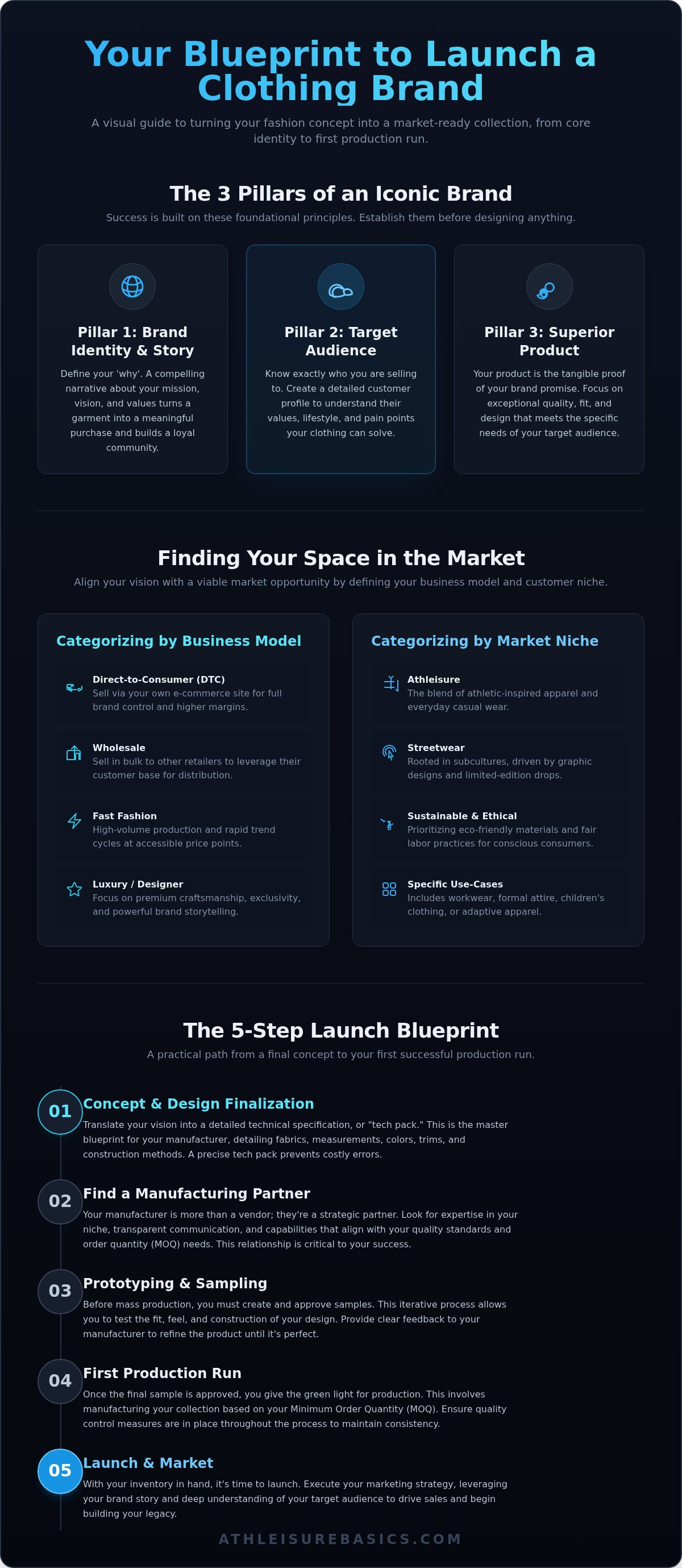
The world of clothing brands is a vast and competitive landscape. This guide is crafted for the visionary entrepreneur-the builder, not the shopper. Before you design a single piece, it’s crucial to understand that a brand is far more than a logo or a catchy name. It is a promise to your customer-a commitment to a certain quality, style, and identity. For a foundational overview of what a fashion brand is, you can explore its core components, but our focus here is on strategic action. Success begins with understanding the market and deliberately choosing your battlefield. Let's deconstruct the main categories to help you find your unique space.
Categorizing Brands by Business Model
Your business model dictates how you reach your customers and generate revenue. Each path has distinct operational requirements and challenges, especially for startups.
- Direct-to-Consumer (DTC): You build a direct relationship with your audience through your own e-commerce site, retaining full control over your brand message and margins.
- Wholesale: You sell products in bulk to other retailers, leveraging their customer base for broader distribution but sacrificing some margin and control.
- Fast Fashion: Characterized by high-volume production, rapid trend cycles, and accessible price points. This model requires a highly efficient and cost-effective supply chain.
- Luxury/Designer: Focuses on premium craftsmanship, exclusivity, and brand storytelling. This path demands significant investment in superior quality materials and marketing.
Categorizing Brands by Market Niche
Beyond the business model, your brand must serve a specific customer need or community. This is your market niche-the focused segment where you can become a leader.
- Athleisure: The dominant blend of athletic-inspired apparel and everyday casual wear, focusing on comfort, performance, and style.
- Streetwear: Rooted in subcultures like skate and hip-hop, often driven by graphic-heavy designs, limited-edition drops, and community building.
- Sustainable & Ethical: Brands that prioritize eco-friendly materials, transparent supply chains, and fair labor practices, appealing to the conscious consumer.
- Specific Use-Cases: This includes everything from professional workwear and formal attire to children's clothing or adaptive apparel for individuals with disabilities.
How to Choose Your Niche: The Founder's Checklist
Choosing the right niche is the most critical decision you'll make. It aligns your vision with a viable market opportunity. Use this checklist to guide your strategy:
- Assess Your Passion: Which market genuinely excites you? Authenticity is a powerful brand asset that customers can feel.
- Identify a Market Gap: What are competitors overlooking? Is there an underserved customer or an unmet need you can fulfill with superior quality or design?
- Define Your Ideal Customer: Create a detailed profile of who you are selling to. Understand their values, lifestyle, and purchasing habits.
- Align with Your Capabilities: Be realistic. Does your chosen niche match your budget and production capabilities? A white label model, for instance, is ideal for launching premium basics with a low MOQ.
The 3 Pillars of Every Strong Clothing Brand
The apparel market is saturated with labels, but only a few truly successful clothing brands become iconic. This success isn't accidental; it's built on a solid, strategic foundation. Before you select a single fabric or sketch a design, you must establish these three pillars. They will act as the blueprint for your vision, guiding every decision from your supply chain to your marketing campaigns.
Pillar 1: A Crystal-Clear Brand Identity & Story
Your brand is more than just a name and logo; it's your promise to the customer. Start by defining your mission (why you exist) and vision (what you aim to achieve). This core purpose informs your visual identity and, most importantly, your brand story. A compelling narrative-whether it's about sustainability, performance, or self-expression-is what transforms a simple garment into a meaningful purchase and builds a loyal community.
Pillar 2: A Deep Understanding of Your Target Audience
You cannot build a successful brand in a vacuum. The most profitable brands are those that deeply understand who they are selling to. Develop a detailed customer persona: Who are they? What do they value? What problems can your clothing solve for them? This foundational step is covered in nearly every comprehensive guide to starting a clothing business for a reason: it prevents costly mistakes. Use social media polls, forum discussions, and competitor analysis to gather insights without a large budget. Always design for your audience, not just for yourself.
Pillar 3: Uncompromising Product Quality & Design
Your brand identity makes a promise, but your product is what delivers on it. In the competitive world of fashion, uncompromising quality is the ultimate form of customer retention. The difference between a good idea and a great product lies in execution-the choice of premium fabrics, the precision of the stitching, and the durability of the construction. Your product must be a tangible representation of your brand's values. Superior quality not only builds trust but also justifies your price point and ensures customers return.
The Engine Room: How Clothing Brands Actually Make Their Products
This is the pivotal step where your vision becomes a physical reality. For any founder, a solid understanding of the production process is non-negotiable-it’s the engine that drives your business forward. We’ll demystify the journey from a simple sketch to a finished, retail-ready garment. Choosing the right production method is one of the most critical decisions you'll make, directly impacting your launch speed, initial investment, and long-term scalability.
The Manufacturing Spectrum: Key Models Explained
Your production choice defines how your brand operates. White Label (or Private Label) manufacturing allows you to customize premium, pre-designed garments with your branding, offering a fast, low-risk path to market. In contrast, Custom Manufacturing (CMT/FPP) involves creating a completely unique product from scratch-a process that offers total creative control but requires more time, expertise, and investment. Most successful startups begin with a manufacturing partner to leverage existing infrastructure and expertise, minimizing risk while maximizing quality. See how our White Label service helps brands launch fast with superior, ethically-made products.
Essential Terminology for Founders
Navigating conversations with suppliers requires a basic understanding of industry language. Here are the core terms you need to know:
- Tech Pack: This is the master blueprint for your garment. It contains every technical detail, from measurements and materials to stitching and label placement.
- Minimum Order Quantity (MOQ): The smallest number of units a factory will produce in a single run. Finding a partner with a low MOQ is crucial for managing startup capital.
- Sampling: The process of creating a prototype. This allows you to test the fit, feel, and quality of your design before committing to a full production order.
- Lead Time: The total time it takes from placing your order to receiving the finished products at your warehouse.
Finding a Manufacturer vs. Finding a Partner
The distinction is vital for emerging clothing brands. A simple manufacturer follows your tech pack and delivers a product. A true partner, however, invests in your success. They provide expert guidance on materials, offer stringent quality control, and support you with sourcing. A great partner understands the entire entrepreneurial journey, from product development to the broader operational steps outlined in the SBA's 10 steps to start a business. Look for a team with proven experience supporting startups; they will be an invaluable asset in building a profitable and lasting brand legacy.
Your 5-Step Blueprint to Launching a Clothing Brand
With your brand foundation in place, it’s time to connect the dots. This practical blueprint is designed to take your concept to your first professional production run, turning careful preparation into decisive action. Follow these steps to ensure a smooth and efficient launch process, as each stage builds directly upon the last.
Step 1: Finalize Your Designs & Create a Tech Pack
Your tech pack is the single most important document in the production process. It translates your vision into a detailed technical specification for the manufacturer, including precise measurements, fabric types, color codes (like Pantone), and branding details such as label placement. A professional tech pack is non-negotiable; it minimizes costly errors, streamlines communication, and ensures your final product matches your exact standards.
Step 2: Source Premium Fabrics & Materials
The fabric you choose fundamentally defines the feel, perceived quality, and price point of your garments. Look beyond aesthetics and consider factors like durability, comfort, and sustainability. To build one of the leading clothing brands in your niche, work with partners who can source high-quality, certified materials like OEKO-TEX® fabrics, which are free from harmful substances. Always request fabric swatches to feel the quality for yourself before committing.
Step 3: Choose the Right Manufacturing Partner
For emerging brands, selecting the right partner is critical. Prioritize manufacturers that offer a low MOQ (Minimum Order Quantity) to reduce initial financial risk and allow for greater flexibility. Look for partners renowned for top-notch craftsmanship, like those in Portugal, and verify their experience with your specific product type, such as athleisure. A good partner acts as an extension of your team. Ready to find yours? Get a quote from a trusted low MOQ Portuguese manufacturer.
Step 4: The Sampling & Production Phase
Never proceed to mass production without approving a final, perfect sample. This is your chance to test the fit, feel, and construction of your garment and provide clear, consolidated feedback for any necessary revisions. A reliable manufacturing partner will maintain strict quality control throughout the entire production run, but the final sign-off is your responsibility. Understanding the production timeline and communicating clearly ensures a predictable and successful launch.
Why Your Manufacturer is Your Most Important Business Partner
For new clothing brands, your manufacturer isn't just a vendor-they are the foundation of your entire operation. The quality of your products, your ability to scale, and your brand's reputation all depend on this single relationship. The right partnership can accelerate your growth and help you avoid costly mistakes, while the wrong one can sink your business before it even has a chance to launch. Choosing a partner invested in your vision is the most critical decision you'll make.
The Low MOQ Advantage: Launch Lean, Grow Smart
Low Minimum Order Quantities (MOQs) are the single biggest advantage for a startup brand. Instead of tying up your capital in thousands of units of an unproven design, low MOQs allow you to test new styles with minimal financial risk. This preserves your budget for what truly matters in the early stages: marketing and brand building. It gives you the ultimate flexibility to listen to your customers and pivot your collection based on real-world sales data, not guesswork.
The 'Made in Portugal' Mark of Quality and Ethics
Choosing a manufacturing partner in Portugal instantly elevates your brand. Renowned for its premium textiles and top-notch craftsmanship, Portugal offers a mark of quality you can build a powerful brand story around. You benefit from transparent, ethical production under strict EU labor standards, giving your customers a reason to trust you. This choice also ensures smoother logistics, faster communication, and a more collaborative process than with many overseas factories.
Beyond Production: A Partner Who Supports Your Vision
The best manufacturers do more than just sew garments; they act as a strategic partner. Look for a team that offers end-to-end support, from tech pack development and fabric sourcing to production consulting. A valuable partner understands the unique challenges that new clothing brands face and proactively offers solutions to help you navigate the complexities of the industry. They are invested in helping you turn your creative vision into a profitable reality.
Ready to work with a partner who can help you launch and scale? Let's build your brand together. Submit your project today.
Transform Your Vision into a Thriving Clothing Brand
Building a successful brand goes far beyond designing a logo. As we've explored, it requires a distinct niche and a solid strategic foundation. This strategic approach is what separates fleeting labels from enduring clothing brands. Ultimately, your success hinges on finding a manufacturing partner who can translate your creative vision into tangible, high-quality products.
At Athleisure Basics, we specialize in empowering founders like you. We remove traditional barriers with low MOQs starting from just 70 pieces, ensuring you can launch without massive risk. Our commitment to premium 'Made in Portugal' quality guarantees your products meet the highest ethical and craftsmanship standards. We are more than a factory; we are your dedicated partner, guiding you from the first design sketch to final delivery.
The blueprint is in your hands, and the right partner is ready to help you build. Your brand legacy starts today.
Ready to build your brand? Submit your project for a free quote.
Frequently Asked Questions
How much money do you need to start a clothing brand?
The required investment varies, but a white label approach significantly lowers the financial barrier. Instead of tens of thousands for custom development, you can launch with a few thousand. This budget typically covers initial inventory (e.g., 60 pieces per style), branding applications like custom labels, professional photography, and initial marketing efforts. This cost-effective model allows you to test the market with premium products without committing substantial capital, making it the ideal path for startups.
Do I need to be a designer to start a clothing brand?
Absolutely not. This is a primary advantage of a white label service. We provide a curated collection of premium, market-tested styles for you to choose from. Your focus shifts to building your brand's unique identity through logos, color palettes, and compelling marketing. You supply the vision, and we provide the high-quality, ready-to-brand garments. This partnership empowers entrepreneurs to launch successful clothing brands without a background in fashion design or garment construction.
What is a 'tech pack' and why is it so important?
A tech pack is the official blueprint for a garment. This comprehensive document details every specification a manufacturer needs for production, including precise measurements, fabric types, color codes (Pantone), stitch details, and label placements. It is absolutely essential for custom manufacturing because it eliminates ambiguity, ensures product consistency across every unit, and acts as a definitive quality control standard. A professional tech pack is crucial for turning your vision into a tangible, high-quality product efficiently.
What's the difference between private label and custom manufacturing?
Private label (or white label) involves selecting pre-designed, unbranded products from our catalog and applying your own branding. This option is fast, cost-effective, and offers a very low MOQ. In contrast, custom manufacturing (cut and sew) involves creating a unique garment from scratch based on your tech pack. While it provides complete creative freedom, it requires a higher investment, longer lead times, and larger minimum order quantities. We offer both services to support brands at every stage of their growth.
Why is a low MOQ (Minimum Order Quantity) so crucial for startups?
A low MOQ is one of the most powerful strategic advantages for a new brand. It minimizes your upfront financial risk, preventing you from tying up essential capital in large volumes of inventory that may or may not sell. This flexibility allows you to launch with a wider variety of styles or colors to test market demand effectively. Our low MOQ of just 60 pieces empowers you to launch a premium brand leanly and scale intelligently as you gather customer data.
Is it better to manufacture in Europe or Asia?
While Asia can offer lower initial costs, manufacturing in Europe, specifically Portugal, delivers unparalleled advantages in quality, ethics, and efficiency. You benefit from superior craftsmanship, access to premium OEKO-TEX® certified fabrics, and adherence to strict EU labor and environmental standards. Furthermore, communication is streamlined and shipping times to Western markets are significantly faster. For brands building a legacy on premium quality and transparency, European manufacturing is the superior choice.
How long does it take to produce a clothing collection?
Production timelines depend entirely on your chosen manufacturing path. With our white label service, the process is exceptionally efficient; after you approve the final sample, bulk production typically takes just 4-6 weeks. Custom manufacturing is a more detailed process involving pattern making and multiple sampling stages. For a fully custom project, you should realistically plan for a timeline of 3-5 months from tech pack submission to the final delivery of your collection.


Leave a comment
This site is protected by hCaptcha and the hCaptcha Privacy Policy and Terms of Service apply.