
Clothing Production Cost: A Complete Breakdown for Startup Brands
Transforming your clothing brand from a vision to a tangible product is an exciting journey. But for many founders, understanding the true clothing production cost is a major hurdle that can turn excitement into uncertainty. The fear of hidden fees from manufacturers, the difficulty in deciphering industry quotes, and the constant pressure to balance a startup budget with premium quality can feel overwhelming, leaving you unsure of the total investment required to launch successfully.
We believe building your brand should be an empowering process, not an intimidating one. As your trusted partner in manufacturing, we're here to provide the clarity you need to move forward with confidence. That is why we have created this complete breakdown-to demystify every expense involved in apparel production, from the first stitch to the final delivery.
In this guide, you will gain a realistic budget framework for your first collection, learn to identify and manage every potential cost, and develop the confidence to negotiate effectively with any factory. Let's build a solid financial foundation for your brand, ensuring you can launch efficiently without ever sacrificing the superior quality your customers deserve.
Key Takeaways
- Accurately budget for your launch by understanding the three core stages of production costs-from initial samples to final delivery.
- Every design decision, from fabric choice to stitching complexity, directly impacts your final unit price, making early choices critical for cost control.
- Order quantity and factory location are the two most powerful levers you can pull to influence your total clothing production cost.
- Implement actionable strategies before manufacturing begins to significantly lower your per-unit cost and maximize your brand's profitability.
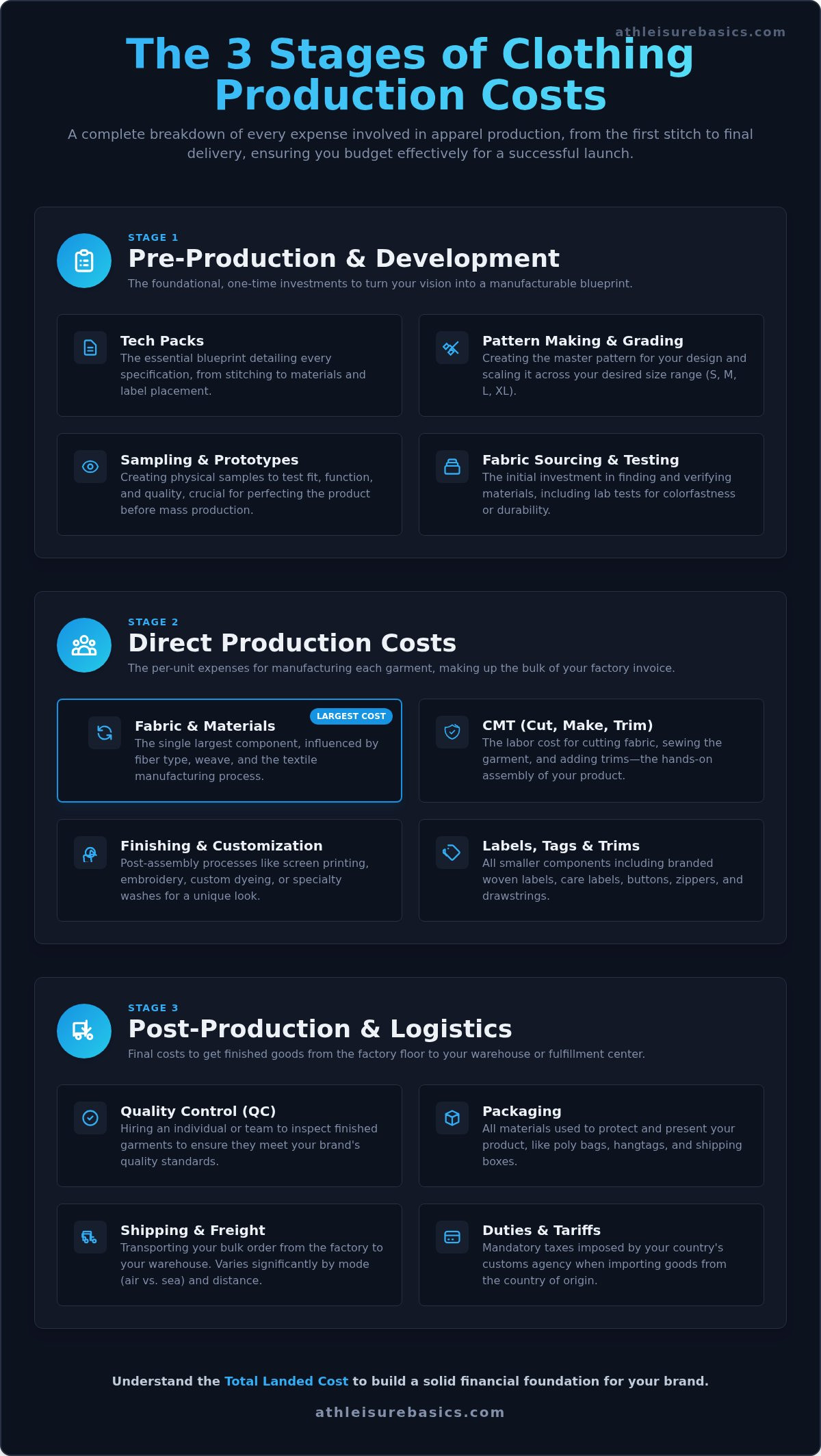
The 3 Stages of Clothing Production Costs: A Full Breakdown
When launching a clothing brand, one of the most common pitfalls is underestimating the true cost of bringing a product to market. The price your factory quotes per garment is just one piece of the puzzle. To budget effectively, you must understand the total landed cost-the final price you pay to get a finished, packaged product into your warehouse. A clear grasp of the total clothing production cost prevents unexpected expenses that can derail your launch.
Think of it like building a house: there are architect fees to create the blueprint, the direct cost of materials and labor to build it, and finally, the finishing and moving-in costs. Clothing production follows a similar path, broken down into three distinct stages.
Stage 1: Pre-Production & Development Costs
These are the foundational, one-time investments required to turn your vision into a manufacturable blueprint. Just like an architect’s plan, getting this stage right is critical for a smooth and cost-effective production run. These costs are incurred before your main production even begins.
- Tech Packs: The essential blueprint for your garment, detailing every specification from stitching and measurements to materials and label placement.
- Pattern Making & Grading: Creating the master pattern for your design and then scaling it across your desired size range (e.g., S, M, L, XL).
- Sampling & Prototypes: The cost of creating physical samples to test fit, function, and quality. This iterative process is crucial for perfecting your product before mass production.
- Fabric Sourcing & Testing: The initial investment in finding and verifying the perfect materials, which may include lab testing for colorfastness or durability.
Stage 2: Direct Production Costs (The Cost Per Garment)
This stage covers the per-unit expenses directly tied to manufacturing each piece. These costs are what most people think of as the core production expenses and will make up the bulk of your invoice from the factory.
- Fabric & Materials: Typically the largest single cost component. The price is influenced by the fiber type, weave, and the complexity of the textile manufacturing process required to create it.
- CMT (Cut, Make, Trim): This is the labor cost for cutting the fabric, sewing the garment, and adding trims. It represents the hands-on assembly of your product.
- Finishing & Customization: Any post-assembly processes like screen printing, embroidery, custom dyeing, or specialty washes that give your garment its unique look.
- Labels, Tags & Trims: All the smaller components, including branded woven labels, care labels, buttons, zippers, and drawstrings.
Stage 3: Post-Production & Logistics Costs
Once your garments are manufactured, there are several final costs associated with getting them from the factory floor to your customers. Forgetting to budget for these expenses can quickly erode your profit margins.
- Quality Control (QC): The cost of hiring an individual or team to inspect your finished garments to ensure they meet your brand’s high-quality standards.
- Packaging: All materials used to protect and present your product, such as poly bags, hangtags, tissue paper, and shipping boxes.
- Shipping & Freight: The expense of transporting your bulk order from the factory to your warehouse or fulfillment center. This can vary significantly based on mode (air vs. sea) and distance.
- Duties & Tariffs: Taxes imposed by your country's customs agency when importing goods. These are mandatory and vary based on the product type and country of origin.
How Your Product Decisions Directly Influence Manufacturing Costs
As a brand founder, you are in the driver's seat of your production budget. Every single decision-from the type of cotton you choose to the style of zipper you specify-has a direct and measurable impact on your final unit price. The key to launching a profitable brand is making informed, strategic choices before your tech pack is finalized, allowing you to design for your target price point without sacrificing quality.
Understanding these trade-offs empowers you to balance a unique design vision with a scalable, cost-effective product. Let's break down the core components that shape your total clothing production cost.
Fabric Choice: The Foundation of Your Garment and Budget
Your fabric is typically the single largest material expense. The choice here sets the standard for your garment's quality, feel, and price. Key factors include:
- Natural vs. Synthetic Fibers: Premium long-staple cotton or specialty wools will cost more than standard polyester blends. However, they also deliver a superior hand-feel and perceived value.
- Fabric Weight (GSM): Heavier fabrics, like a 400 GSM fleece for a hoodie, use more raw material and naturally cost more than a lightweight 180 GSM jersey for a t-shirt.
- Certifications: Fabrics with OEKO-TEX® or organic certifications undergo rigorous testing, which adds to the cost but provides a powerful selling point for conscious consumers.
- Color: Opting for stock colors from a supplier's existing library is the most cost-effective route. Custom dyeing to match a specific Pantone requires higher minimums and adds a significant premium.
Design Complexity: Why Simplicity Scales for Startups
After materials, labor is the next major factor in your production budget. The more time it takes for a skilled sewer to construct your garment, the higher the cost. Analyzing the total cost of ownership of a garment shows that construction labor is a critical variable. Simpler designs are faster to produce, reducing your per-unit cost.
- Seamwork & Paneling: A t-shirt with standard side seams is far quicker to produce than a complex jacket with multiple panels, pockets, and topstitching.
- Hardware & Trims: Every zipper, button, custom-tipped drawstring, and rivet adds both a material cost and a labor cost for application.
- Construction Techniques: Advanced methods like flatlock stitching or French seams require specialized machinery and more time than a standard overlock stitch, increasing the unit price.
Customization & Branding: Adding Value (and Cost)
The finishing touches that make a product uniquely yours also contribute to the final clothing production cost. These elements are vital for brand building but should be budgeted for carefully.
- Printing & Embroidery: Screen printing is economical for large runs with few colors, while Direct-to-Garment (DTG) is better for complex, low-volume designs. Embroidery costs are calculated by the stitch count-the larger and more dense the design, the higher the price.
- Branded Elements: Custom-woven neck labels, printed satin care labels, and branded hang tags elevate your product from a blank to a professional retail item. While each component may only add cents, they accumulate across a full production run.
Navigating these choices to create a premium, yet cost-effective, product is our expertise. Need help engineering your design to meet your budget goals? Our experts can guide you.
Quantity & Location: The Two Biggest Levers on Your Production Cost
Once you have finalized your garment's design and materials, the next critical decisions impacting your budget are how many you produce and where you produce them. These two factors can dramatically alter your final clothing production cost per unit. It's a common mistake for startups to chase the lowest factory price, only to discover hidden expenses later. Choosing the right manufacturing partner isn't just a sourcing decision; it's a strategic financial one that defines your brand's profitability and scalability.
Understanding MOQ (Minimum Order Quantity)
MOQ is the minimum number of units a factory requires to produce an order. Manufacturers have MOQs to cover their fixed costs-like machine setup, labor, and materials sourcing-and operate profitably. This is where economies of scale come into play: producing a higher quantity lowers the cost per unit because those fixed costs are spread across more items. This principle is a foundational element of the U.S. Textile and Apparel Industries Cost Structure. However, meeting a high MOQ can be a trap for new brands, leading to excess inventory and tying up crucial capital. Low MOQ partners like Athleisurebasics allow you to launch with a smaller investment, test the market, and scale intelligently.
Manufacturing Location: Portugal vs. Asia
The "Made in..." label carries significant weight for both quality and cost. While factories in Asia may offer a lower initial price per garment, it's essential to calculate the Total Landed Cost-the true final price per unit once it's in your warehouse.
- Factory Price: Asia often appears cheaper on the initial quote.
- Quality & Ethics: Manufacturing in Portugal guarantees adherence to strict EU standards for superior craftsmanship and ethical labor practices, enhancing your brand's value.
- Speed & Shipping: Portugal's proximity to EU and US markets means significantly faster lead times and lower shipping costs, getting your product to customers quicker.
- Communication: Fewer time zone and language barriers lead to smoother collaboration and fewer costly errors.
CMT vs. FPP: Understanding Different Pricing Models
Finally, your manufacturing model affects your costs and workload. With CMT (Cut, Make, Trim), you are responsible for sourcing and delivering all fabrics and trims to the factory. This offers control but requires deep industry knowledge and complex logistics. In contrast, FPP (Full Package Production) means the factory manages the entire process from sourcing materials to final delivery. For most startups, FPP is the most efficient and risk-averse path. At athleisurebasics.com, our FPP model means we act as your trusted production partner, handling the complexities so you can focus on building your brand.
4 Actionable Strategies to Reduce Clothing Production Costs
Controlling your clothing production cost from day one is essential for a new brand's profitability and long-term survival. The key isn't to cut corners on quality, but to make strategic, upfront decisions that build efficiency into your process. These actionable strategies focus on lowering your per-unit cost without compromising the premium feel your customers expect. A supportive manufacturing partner will be instrumental in guiding you through these choices, ensuring you launch a successful and financially viable collection.
Strategy 1: Start with White Label or Premium Blanks
The fastest and most cost-effective way to launch is by leveraging a manufacturer's existing styles. This approach eliminates the expensive and time-consuming pre-production phase of pattern making, tech pack creation, and multiple rounds of sampling. You get to launch a proven, high-quality product in a fraction of the time.
- Eliminate Development Costs: Skip pattern and sample fees entirely.
- Launch Faster: Go from concept to market-ready product in weeks, not months.
- Lower Fabric Costs: Benefit from your manufacturer's bulk fabric purchasing power.
- Test the Market: Validate your brand concept with a very low initial investment.
Strategy 2: Simplify Designs for Your First Collection
Complexity directly translates to cost. Every seam, zipper, button, or intricate panel adds to the labor time and material expense for each garment. For your first run, focus on executing simple, timeless designs perfectly. Prioritize a superior fit and premium fabric over complex construction. For example, choose a high-quality screen print over a multi-color embroidery, and limit each style to one or two core colorways to meet Minimum Order Quantities (MOQs) more easily.
Strategy 3: Partner with a Low MOQ Manufacturer
One of the biggest financial risks for a startup is tying up capital in excess inventory that might not sell. Partnering with a low MOQ (Minimum Order Quantity) manufacturer is the most powerful strategy to mitigate this risk. It allows you to produce smaller batches, test more styles to see what resonates with your audience, and maintain healthy cash flow. This flexibility is crucial for reducing your overall clothing production cost and making data-driven decisions for future collections. Athleisurebasics specializes in low MOQ production to help you launch with confidence. See how we can help.
Your Next Step: Bringing Your Vision to Life
Mastering your clothing production cost is the first and most critical step toward building a profitable, sustainable brand. As we've detailed, these costs are not random; they are a direct result of your decisions across pre-production, manufacturing, and post-production. From your choice of fabrics and design complexity to your order quantity, every element plays a role. By understanding these levers, you gain the power to launch your brand with clarity and financial confidence.
But knowledge is only half the battle. Putting it into practice requires a reliable manufacturing partner who understands the challenges facing startups. At Athleisurebasics, we are that partner. We specialize in transforming your vision into premium, ethically-produced apparel. We offer the superior craftsmanship of 'Made in Portugal' quality that sets your brand apart, with the flexibility of low MOQs designed to help you launch and scale efficiently.
Ready to get a clear and accurate cost for your vision? Request a Free Quote Today.
Let's build your brand's legacy, together.
Frequently Asked Questions About Clothing Production Costs
What is a realistic production cost for a premium t-shirt or hoodie?
For a premium garment made in Portugal, a realistic cost for a high-quality t-shirt (approx. 220 GSM) is typically between €15-€25. A luxury hoodie using premium fleece (approx. 400 GSM) would range from €30-€50 per unit. These figures depend on factors like fabric choice, order quantity, and the complexity of details such as printing or embroidery. A higher order volume will generally result in a lower cost per piece.
How much should I budget for samples before starting a full production run?
Budgeting for samples is a critical investment to ensure your vision is executed perfectly. We recommend allocating between €300 and €600 for the initial sampling phase. This cost typically covers pattern creation, sourcing of premium materials, and the labor for one to two prototype iterations. This step prevents costly errors and guarantees the final product meets the highest industry standards before committing to a full production run.
What's the difference between CMT (Cut, Make, Trim) and FPP (Full Package Production)?
CMT means you, the brand owner, are responsible for sourcing and providing all fabrics, labels, and trims to the factory, which only handles the cutting and sewing. FPP is an all-inclusive service where your production partner, like us, manages the entire process from sourcing materials and developing patterns to manufacturing and finishing the final garment. For startups, FPP is the most efficient and secure path to launching a professional product.
Do I have to pay for the entire production order upfront?
No, you are not typically required to pay the full amount upfront. The standard industry payment structure involves a deposit, usually 50%, to begin production. This initial payment allows your manufacturing partner to secure the premium fabrics and materials needed for your order. The remaining 50% balance is then due upon completion of the production run, just before your finished garments are shipped. This approach provides security for both the brand and the producer.
How do shipping costs and import duties affect my final cost per garment?
Shipping costs and import duties are separate from the production price and must be factored into your budget. Depending on your location and the shipping method, these expenses can add an additional 10-20% to your final cost per garment. Understanding these variables is essential for accurately calculating your total clothing production cost and setting a profitable retail price. We always advise getting a shipping quote early in the process.
Is it cheaper to produce clothing in Portugal than in China when all costs are included?
While the initial unit price from China may seem lower, producing in Portugal is often more cost-effective and provides superior value overall. When you account for higher shipping fees from Asia, significant import duties to the EU or US, and the potential costs of delays or quality issues, the price gap narrows considerably. Manufacturing in Portugal guarantees EU quality standards, ethical production, and a more predictable, transparent supply chain for your brand.


Leave a comment
This site is protected by hCaptcha and the hCaptcha Privacy Policy and Terms of Service apply.