

Clothing Production for Online Boutiques: The 2026 Strategy Guide for Scaling Your Brand
What if the greatest threat to your boutique's growth isn't your advertising spend, but the reality that your inventory looks identical to your competitors? You likely started your business to offer something unique, yet you often find yourself trapped by high minimum order quantities and generic designs from overseas wholesalers. It's frustrating to see your capital tied up in stock that lacks the premium quality your customers expect. We understand that finding reliable clothing production for online boutiques is the most critical hurdle to clear when you're ready to scale from a small shop to a recognized brand.
In this guide, you'll learn how to transition from basic wholesale to a sophisticated, low-MOQ production model that prioritizes craftsmanship and brand identity. We'll show you how to partner with ethical manufacturers in regions like Portugal to secure high-quality inventory that grows with your business. By the end of this article, you'll have a clear roadmap for 2026 to build a resilient, scalable supply chain that finally sets your brand apart from the competition.
Key Takeaways
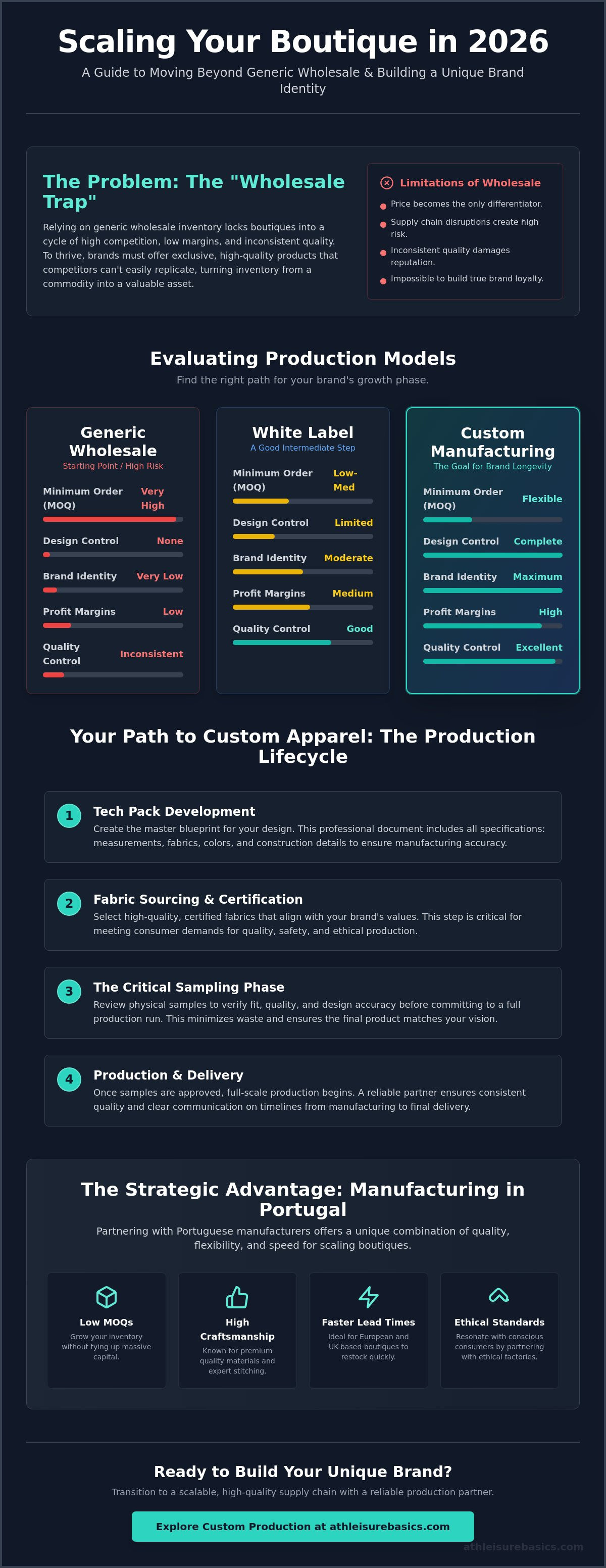
- Discover why the 2026 market is moving away from generic wholesale and how to protect your margins with unique, brand-aligned inventory.
- Compare white label luxury blanks and custom manufacturing to determine which production model best supports your brand's current growth phase.
- Learn how to manage clothing production for online boutiques by selecting certified fabrics that meet modern consumer demands for quality and safety.
- Master the production lifecycle from professional tech pack development to the critical sampling phase to ensure design accuracy and minimize waste.
- Explore the advantages of manufacturing in Portugal, including low minimum order requirements and faster lead times for European and UK-based boutiques.
The Evolution of Boutique Inventory: Moving Beyond Generic Wholesale
The market for online fashion has reached a saturation point where consumers can easily identify mass-produced items. Relying on generic wholesale inventory is no longer a viable long-term strategy for those seeking to scale. In 2026, shoppers value authenticity and unique silhouettes over the "cookie-cutter" styles found on every major retail platform. This shift has fundamentally changed how entrepreneurs approach clothing production for online boutiques, forcing a move toward more intentional, original designs. The global clothing industry is increasingly bifurcated between fast-fashion giants and specialized, brand-driven boutiques that offer something truly different.
The Limitations of the Wholesale Model
Traditional wholesale models often trap boutique owners in a cycle of low margins and high competition. When you purchase from a common wholesaler, you're essentially buying the same inventory as dozens of other retailers. This lack of exclusivity means price becomes your only differentiator. It leads to a race to the bottom that erodes your profits. Additionally, the financial risk of relying on third-party wholesalers is significant; you're at the mercy of their fluctuating prices and supply chain disruptions.
Quality inconsistency remains a major hurdle in the wholesale world. Wholesale lots often vary because these items are produced in massive batches where fabric weight and stitching quality aren't strictly monitored for each small buyer. This "Wholesale Trap" results in high return rates and a damaged brand reputation, making it difficult to achieve sustainable growth. If you can't guarantee that a hoodie bought today will feel the same as one bought next month, you can't build customer loyalty.
The Strategic Advantage of Custom Apparel
Transitioning to original brand products allows you to build a "moat" around your business. When you control the design and production, you create an exclusive aesthetic that competitors can't simply buy off a shelf. This control extends to your marketing as well. You can confidently promote your brand's ethical standards or highlight the craftsmanship of being "Made in Portugal," which resonates deeply with modern, conscious consumers. Custom manufacturing serves as the essential cornerstone for boutique longevity in 2026 by securing brand identity and operational independence.
Custom production provides the ultimate level of quality assurance. You decide the fabric weight, the specific thread type, and the exact fit. This results in higher brand equity and significantly better profit margins, as customers are willing to pay a premium for high-quality, unique pieces they can't find elsewhere. By owning the process, you turn your inventory from a commodity into a valuable asset.
- Exclusive Designs: Own your silhouettes and prints to eliminate direct price comparisons.
- Higher Margins: Remove the middleman wholesaler and invest that capital into better materials.
- Brand Equity: Build a recognizable name based on consistent quality and original style.
- Operational Control: Manage your own lead times and inventory levels without relying on third-party stock availability.
Evaluating Production Models: White Label vs. Custom Manufacturing
Selecting the appropriate framework for clothing production for online boutiques is a strategic choice that balances creative control with operational speed. Many boutique owners feel forced to choose between low-quality wholesale or impossibly high manufacturing minimums. However, the 2026 landscape offers flexible pathways that allow you to scale at a pace that suits your capital. Whether you're testing a new market niche or establishing a signature silhouette, understanding the distinction between white label and custom manufacturing is essential for long-term profitability.
The U.S. textile and apparel industry remains a massive market for growth, but competing within it requires a clear supply chain strategy. Your choice between these models will depend on your current budget, design expertise, and how quickly you need to get products in front of your customers. If you're unsure which path fits your current scale, our team at Athleisurebasics can help you evaluate your production readiness.
White Label: The Fast Track for Boutique Startups
White label production involves adding your own branding to pre-designed, high-quality luxury blanks. This model is often the ideal entry point for influencer brands or boutiques launching their first in-house collection because it requires less technical design knowledge. In Portugal, white label minimum order quantities (MOQs) can start as low as 70 pieces per style. This accessibility allows you to test designs without tying up excessive capital in unproven inventory.
Customization options remain professional and extensive. You can integrate custom labels, hangtags, and screen printing or embroidery onto premium fabrics. Leveraging private label Portugal services ensures that even though the garment shape is pre-existing, the final product reflects your brand's specific quality standards and aesthetic.
Custom Manufacturing: For the Distinctive Brand Identity
When your brand requires unique silhouettes and proprietary fits, custom clothing manufacturing provides total creative freedom. This process involves creating garments from scratch based on your specific tech packs. While the development phase is longer, the long-term ROI is significant. You own your unique patterns and fits, creating a product that customers cannot find elsewhere.
Custom manufacturing in Portugal typically requires a minimum of 250 units. This is a strategic sweet spot for scaling boutiques that have outgrown white label options but aren't ready for the massive volumes demanded by many Asian factories. It allows for rigorous quality control and specialized material sourcing. Key benefits of moving to custom clothing production for online boutiques include:
- Proprietary Fits: Develop a signature "perfect fit" that keeps customers coming back to your brand specifically.
- Material Innovation: Source unique fabrics or custom colors that aren't available in white label catalogs.
- Design Exclusivity: Ensure that no other boutique can stock the exact same garment shape or style.
Transitioning to custom production is a clear signal that your boutique is evolving into a serious, design-led fashion brand. It requires more upfront investment in tech packs and sampling, but it builds the brand equity necessary to dominate your niche in 2026.
Quality Standards That Sell: Fabric Sourcing and Certifications
Fabric quality is the most common reason for customer returns in the boutique sector. If a garment loses its shape after one wash or feels rough against the skin, your brand reputation suffers immediately. When you're finding suppliers, you must prioritize textile integrity over the lowest possible price. This is where clothing production for online boutiques differentiates itself through regional expertise. Portugal’s deep textile heritage ensures a finished product that surpasses mass-market hubs in every technical metric, from seam strength to dye fastness. A garment's "hand-feel" is often the deciding factor in whether a customer keeps an item or initiates a return.
Understanding OEKO-TEX® and Ethical Production
OEKO-TEX® Standard 100 is a vital certification for 2026. It proves that every component of your garment, from the thread to the buttons, has been tested for harmful substances. Modern customers are health-conscious and demand this level of transparency in their clothing. Brands that can verify their materials are safe for the skin and the environment build trust faster than those using uncertified fabrics. There is also a direct link between ethical labor standards and the physical quality of the garment; skilled artisans in regulated Portuguese factories produce superior work compared to high-volume, unregulated environments. Premium boutique apparel is defined by the safety and sustainability of its fibers.
Materials Sourcing Support
Navigating the complex world of textiles requires expert guidance. Most emerging brands struggle to distinguish between low-grade "off-the-shelf" fabrics and high-performance, custom-developed materials. Our materials sourcing support helps you identify luxury blends that provide the specific durability and breathability your customers expect from premium athleisure. This specialized knowledge is the backbone of successful clothing production for online boutiques, allowing you to move beyond basic commodities to proprietary textile solutions.
Choosing the right blend involves balancing aesthetics with performance. While off-the-shelf options are faster to acquire, custom-developed materials allow you to specify the exact weight, stretch, and finish of your collection. Your production partner should help you evaluate these key attributes:
- Durability: High-quality fibers resist pilling and retain their original shape through repeated wear and washing.
- Breathability: Essential for activewear and lifestyle pieces to ensure comfort across different climates.
- Tactile Luxury: A premium "hand-feel" provides the immediate impression of high value that justifies boutique pricing.
- Color Consistency: Professional dye houses ensure that your brand’s signature colors remain identical across different production batches.
By prioritizing these standards, you reduce the financial drain of returns and build a loyal customer base that associates your brand with lasting quality. Investing in superior fabric is not just a production cost; it's a long-term marketing strategy.
Navigating the Production Lifecycle: From Concept to Delivery
Success in clothing production for online boutiques depends on a structured, technical approach. It's not enough to have a creative vision; you need a repeatable process that ensures every garment meets your brand's specific standards. This lifecycle moves through four distinct stages: technical development, sampling, manufacturing, and logistics. Skipping any of these steps creates unnecessary risk for your capital and your brand reputation. By following a logical progression, you move from a vague concept to a finished product that is ready for the retail market.
The Importance of Tech Pack Development
A tech pack is the essential blueprint for your garment. Without it, your manufacturer is simply guessing at your requirements. A professional tech pack includes detailed construction notes, a Bill of Materials (BOM), and specific grade rules for sizing. These documents ensure that a medium fits exactly as intended across every production run and that every component, from zippers to thread, is accounted for. Investing in clothing production consulting early in this phase can save thousands of dollars by preventing costly sampling errors and material waste. It's the most effective way to communicate complex design needs to a factory with precision.
Sampling and Quality Assurance
The prototyping phase is the "make or break" moment for your collection. Once your tech pack is finalized, the factory produces a pre-production sample (PPS). You must evaluate this sample with extreme precision before green-lighting a full production run. Look for common red flags such as uneven stitching, incorrect fabric tension, or inconsistencies in color matching. A high-quality PPS should be an exact replica of what your customers will receive. If the sample doesn't meet your standards, you must address the issues immediately before the Cut, Make, Trim (CMT) phase begins.
Choosing a partner in a region with high standards simplifies this quality assurance process. For many boutique owners, "Made in Portugal" acts as a built-in quality seal. Portuguese factories are known for their rigorous internal quality control checkpoints during the production phase. This means that by the time your goods reach the logistics stage, they have already been vetted by industry experts who prioritize craftsmanship over speed. This level of oversight ensures that your clothing production for online boutiques remains consistent and high-end.
The final stage involves moving your inventory from the factory floor to your warehouse. A reliable production partner manages these logistics, ensuring that shipping timelines are met and that all customs documentation is accurate. This end-to-end oversight allows you to focus on marketing and sales while your manufacturing remains on track. If you're ready to start your first technical blueprint, explore our tech pack development services to ensure your designs are production-ready.
- Step 1: Develop a comprehensive tech pack to eliminate manufacturing guesswork.
- Step 2: Evaluate your pre-production sample for fit, finish, and material accuracy.
- Step 3: Monitor the CMT process with scheduled quality control checkpoints.
- Step 4: Coordinate logistics to ensure a seamless transition from factory to boutique.
Scaling Your Boutique with a Strategic Partner in Portugal
Portugal has established itself as the premier manufacturing hub for 2026 because it offers a rare balance of technical expertise and logistical efficiency. For UK and EU-based brands, the geographical proximity provides a significant competitive edge. Shorter transit times allow you to restock popular items faster than competitors relying on Asian supply chains. This proximity also reduces your brand's carbon footprint, a factor that is increasingly important to modern consumers. When you choose clothing production for online boutiques in this region, you're investing in a supply chain that is both agile and responsible. It's a strategic move that aligns your brand with the future of sustainable fashion.
The Portugal Advantage: Quality Over Quantity
The artisan heritage of Portuguese garment workers stands in stark contrast to the assembly lines of mass-production hubs. In Portugal, manufacturing is a respected trade passed down through generations. This results in a level of craftsmanship that justifies premium retail pricing. You'll find that factories here are often smaller and more flexible, allowing for a collaborative relationship rather than a purely transactional one. Transparency is another key benefit; manufacturing within the EU means you benefit from strict labor laws and high environmental standards. You can leverage the Made in Portugal clothing mark as a quality seal to communicate value to your customers. Communicating with these partners is straightforward, reducing the risk of the misunderstandings that often plague global production.
Partnering with Athleisurebasics
Athleisurebasics acts as your dedicated ally in the manufacturing process. We bridge the gap between small-scale boutique startups and industrial-scale quality. Our operational model is designed specifically to remove the barriers to entry that many new brands face. We offer accessible minimum order requirements that allow you to scale without overextending your capital. Our services are comprehensive, ensuring you have expert guidance at every stage of development. We provide:
- White label production: Access high-quality luxury blanks with minimums starting at just 70 pieces.
- Custom manufacturing: Develop unique silhouettes with a 250-piece minimum.
- End-to-end support: We manage everything from tech pack development and materials sourcing to full CMT production.
- Quality assurance: Benefit from rigorous Portuguese production standards and ethical certifications.
Initiating your first production run is a straightforward process when you have a partner that understands the boutique model. We guide you through every technical decision to ensure your finished product matches your original vision. This collaborative approach turns the complex world of manufacturing into a manageable, predictable part of your business growth. Ready to take the next step in your brand's journey? Get a custom apparel manufacturing quote today to begin building your unique collection. Our team is ready to help you transition from generic wholesale to a premium, scalable inventory that truly represents your brand.
Future-Proof Your Boutique with Strategic Manufacturing
Transitioning from generic wholesale to a dedicated production model is the most effective way to secure your brand's longevity in an increasingly competitive market. By selecting the right balance between white label speed and custom manufacturing flexibility, you gain full control over your inventory's quality and exclusivity. Implementing professional standards like OEKO-TEX® certified materials and expert tech pack development ensures your garments meet the high expectations of modern consumers. Establishing a reliable system for clothing production for online boutiques allows you to focus on growth while your manufacturing partner maintains the integrity of your collection.
Athleisurebasics specializes in supporting emerging brands through low-MOQ requirements and expert production consulting. We provide access to premium fabrics and the artisan craftsmanship of Portuguese manufacturing to help you scale with confidence. Launch your boutique collection with Athleisurebasics today and move beyond the limitations of generic stock. It's time to transform your creative vision into a premium, recognizable brand that stands out on every digital shelf. You have the potential to build a lasting presence; we have the technical expertise to make it happen.
Frequently Asked Questions
How much does it cost to start clothing production for an online boutique?
Starting clothing production for online boutiques requires a strategic budget that covers tech pack development, sampling fees, and the initial bulk order. Your total investment depends on the number of styles in your collection and the complexity of the designs. It's essential to account for fabric sourcing and logistics costs to ensure your retail margins remain healthy as you scale your brand.
What is the minimum order quantity (MOQ) for boutique clothing manufacturers?
Minimum order quantities vary significantly by region and manufacturer. In Portugal, boutique owners can access white label production with minimums as low as 70 pieces per style. For fully custom manufacturing, the threshold typically begins at 250 units. These lower requirements allow emerging brands to test the market without the heavy financial burden of high-volume Asian production models.
Do I need a tech pack to start manufacturing my boutique line?
A professional tech pack is absolutely necessary for successful garment manufacturing. It serves as the master blueprint that communicates every technical detail, from stitch types to grade rules, to the factory floor. Without this document, you risk significant errors during the sampling phase. A well-executed tech pack ensures that your final product matches your vision and fits your customers perfectly.
How long does the clothing production process take for small orders?
The production timeline for small orders generally spans 60 to 90 days after the final sample is approved. This period includes fabric procurement, the Cut, Make, Trim process, and final quality control checks. White label orders can often be delivered faster, sometimes within 4 to 8 weeks, as the base patterns and fabrics are already established and ready for branding.
Can I manufacture custom designs if I am not a fashion designer?
You don't need a background in fashion design to launch a successful custom collection. Many boutique owners collaborate with production consultants to translate their ideas into technical drawings and tech packs. By partnering with a full-service manufacturer, you receive the technical guidance needed to select appropriate fabrics and silhouettes that align with your brand's aesthetic and target audience.
Why should my boutique choose manufacturing in Portugal over Asia?
Manufacturing in Portugal offers superior quality control, ethical labor standards, and faster shipping for European and UK-based boutiques. Unlike high-volume hubs in Asia, Portuguese factories specialize in luxury-level craftsmanship and smaller production runs. This proximity also reduces your brand's carbon footprint and simplifies communication, ensuring that your production remains transparent and highly responsive to market trends.
What is the difference between white label and custom manufacturing for boutiques?
White label manufacturing involves adding your own branding and labels to pre-designed, high-quality luxury blanks. It's a faster, lower-risk way to launch a collection. Custom manufacturing is the process of creating unique garments from scratch based on your proprietary patterns. This model offers total creative freedom but requires a higher upfront investment in development and slightly larger minimum orders.
How do I ensure the quality of my boutique’s clothing production?
Ensuring quality requires a multi-step approach that begins with a detailed tech pack and ends with rigorous final inspections. You must evaluate a pre-production sample to verify fit and finish before bulk manufacturing begins. Choosing a production partner in a region known for textile heritage, such as Portugal, provides an added layer of security through their established internal quality control protocols and skilled workforce.

Leave a comment
This site is protected by hCaptcha and the hCaptcha Privacy Policy and Terms of Service apply.