
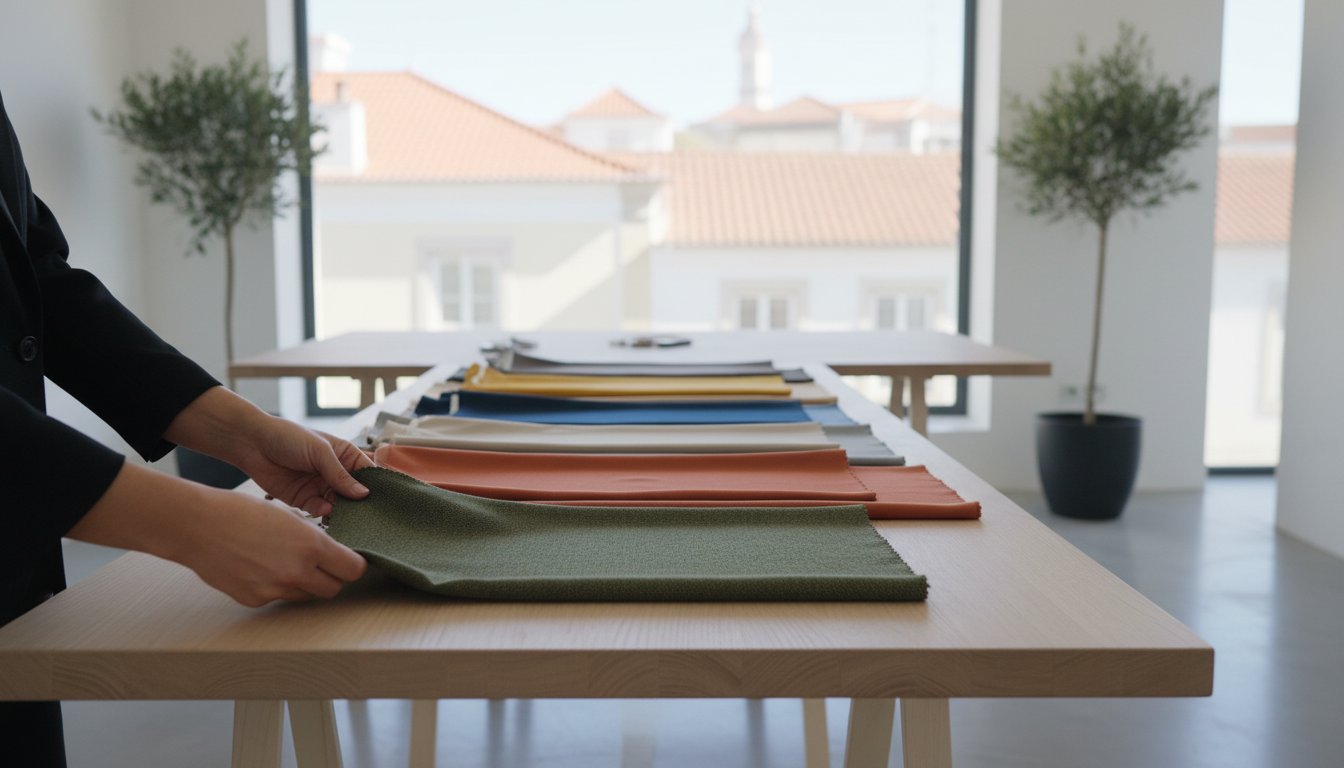
Fabric Sourcing in Portugal: A 2026 Guide for Premium Apparel Brands
Scaling a premium apparel brand in 2026 requires more than just a creative vision; it demands a supply chain that prioritizes ethical transparency over mass production. You likely recognize that the old model of high-volume manufacturing is broken for modern startups. It's exhausting to face 1,000 unit minimums or wait 14 weeks for custom developments when you're first exploring fabric sourcing portugal. You need a partner that understands the balance between luxury quality and operational agility.
This guide ensures you master the complexities of the local market to secure OEKO-TEX certified materials and high-end textiles without the burden of massive inventory. We'll show you how to identify local mills that offer low MOQ solutions to protect your cash flow and keep your brand lean. You'll learn exactly how to reduce your development lead times by 25% while verifying every "eco-friendly" claim with total confidence. We're outlining the specific steps to turn Portuguese craftsmanship into your brand's greatest competitive advantage.
Key Takeaways
- Discover why Northern Portugal’s vertically integrated textile cluster is the strategic choice for brands seeking EU-compliant, high-end materials in 2026.
- Identify the non-negotiable sustainability certifications, such as GOTS and GRS, required to meet the premium standards of eco-conscious consumers.
- Learn how a partner-led model simplifies fabric sourcing portugal by providing access to elite textile libraries without the burden of high mill minimums.
- Master the technical steps of the sourcing process, from defining GSM in your Tech Pack to evaluating "fabric hangers" for the perfect hand-feel.
- Find out how to bridge the gap between world-class Portuguese mills and your emerging brand to turn your vision into a high-quality reality.
What is Fabric Sourcing in Portugal and Why Does it Matter in 2026?
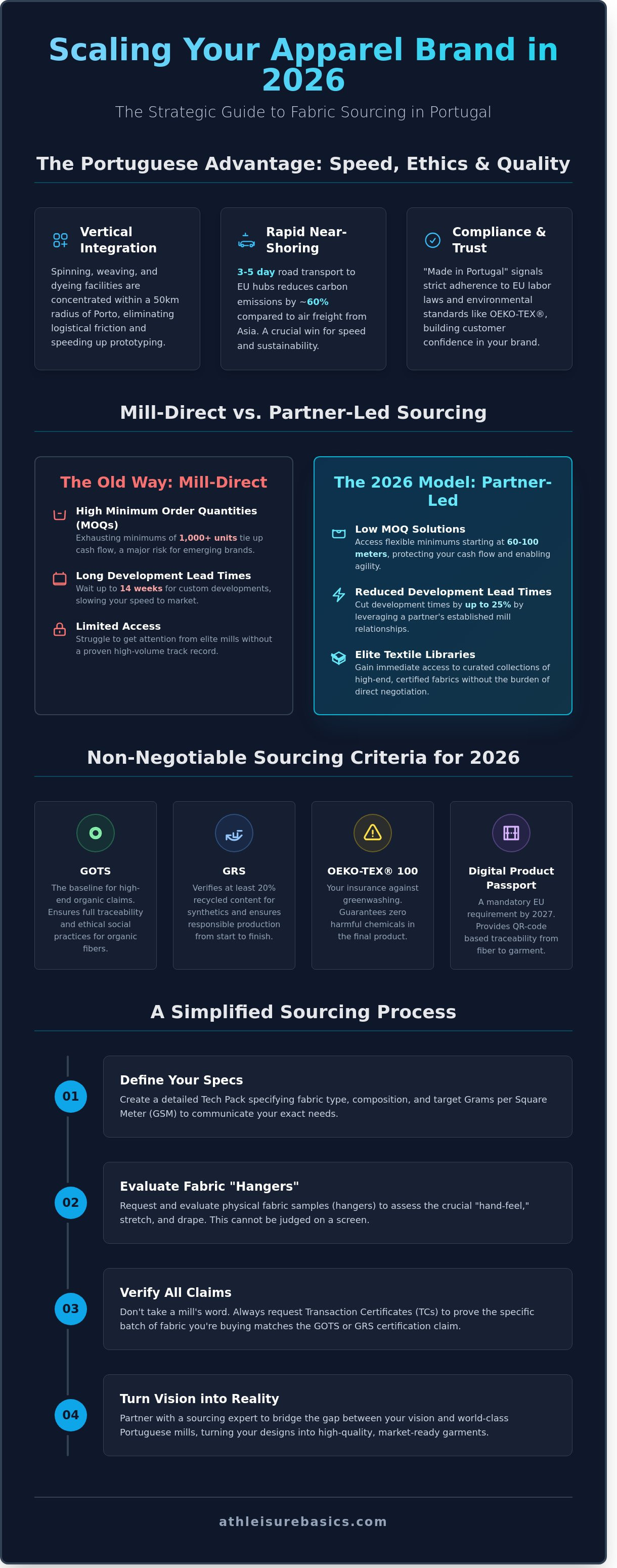
Fabric sourcing in Portugal is the strategic procurement of high-end, EU-compliant textiles from a region famous for its 150-year textile heritage. For premium brands, it's no longer just about finding a supplier; it's about securing a partnership within a vertically integrated cluster. In 2026, fabric sourcing portugal has become the definitive choice for labels that prioritize speed to market and ethical certainty. Because the spinning, weaving, and dyeing facilities are often located within a 50-kilometer radius of Porto, your brand benefits from a "Vertical Integration" advantage that eliminates the logistical friction found in fragmented supply chains.
The shift toward near-shoring is a central pillar of 2026 business strategies. Brands are moving away from long-haul sea freight to reduce their environmental impact. Road transport from Northern Portugal to major European hubs takes only 3 to 5 days, which reduces carbon emissions by approximately 60% compared to air freight from Asia. Choosing a "Made in Portugal" origin acts as a premium brand asset, signaling to your customers that your garments meet strict EU labor laws and environmental certifications like OEKO-TEX and GOTS.
The Portuguese Textile Cluster: Porto and Beyond
The concentration of industry in Northern Portugal, specifically around Porto, Guimarães, and Braga, creates a unique manufacturing speed. Over 90% of the country's textile companies are located here, allowing for rapid prototyping and face-to-face quality control. This region holds world-class expertise in jersey, interlock, and technical knits. You'll find that the proximity of dye houses to knitting mills means color matching and lab dips are completed in days rather than weeks. It's a system built on EU-regulated ethical labor, ensuring your brand's legacy isn't tarnished by poor factory conditions.
Performance vs. Aesthetics: The Athleisure Requirement
Modern athleisure demands a "Luxury Performance" profile where the fabric feels like a second skin but performs like high-grade gear. In 2026, the market has moved past basic polyester. Brands now seek recycled polyamides and bio-based fibers that offer a soft, buttery hand-feel without losing compression. Technical sourcing is the specialized procurement of textiles engineered for specific physical outputs, prioritizing high stretch recovery and long-term durability over simple aesthetics. This balance ensures your leggings or hoodies don't just look premium on a shelf but maintain their shape after 100 wash cycles.
- Low MOQs: Many Portuguese mills now offer flexible minimums starting at 60 to 100 meters for specialized colors.
- Transparency: Digital product passports are becoming the 2026 standard in Portugal, providing full traceability from fiber to finished garment.
- Innovation: Access to moisture-wicking and anti-bacterial finishes that meet the highest industry standards.
Performance and Sustainability: The 2026 Sourcing Criteria
By 2026, fabric sourcing in Portugal requires more than just a soft hand-feel. It's about verifiable data. The European Union's Ecodesign for Sustainable Products Regulation (ESPR) makes the Digital Product Passport (DPP) a mandatory reality for premium brands. You'll need to provide a QR code that tracks a garment's journey from raw fiber to finished product. Brands that ignore this readiness will struggle to enter the EU market by the 2027 deadline.
Premium brands must demand OEKO-TEX® Standard 100 to ensure zero harmful chemicals across the supply chain. For organic claims, GOTS (Global Organic Textile Standard) is the only baseline that matters for high-end positioning. If you're using recycled polyester or nylon, the Global Recycled Standard (GRS) ensures at least 20% recycled content and ethical social practices at the mill. These aren't just badges; they're your insurance policy against greenwashing claims.
Sustainable Textiles: Beyond the Buzzwords
Organic cotton provides natural breathability for lifestyle pieces, but recycled synthetics lead in durability for high-impact sports. Tencel™ and Lyocell are the 2026 favorites for premium activewear because they offer 50% better moisture absorption than standard cotton. Don't take a mill's word for it. Always ask for Transaction Certificates (TCs). These documents prove the specific batch of fabric you bought matches the certification claim.
Technical Performance Specs to Look For
Technical specs define your brand's longevity and customer loyalty. Look for 4-way stretch with at least 15% to 22% spandex for compression leggings. Check for a pilling resistance rating of 4 or higher on the ISO 12945-2 scale to ensure the fabric doesn't degrade after three washes. For startups, deadstock sourcing is a smart move. It allows you to access high-end fabrics at 30% lower costs while fulfilling low MOQ requirements. If you're unsure which GSM fits your vision, our team helps you select the right technical fabrics for your first collection.
Success in 2026 relies on balancing these technical weights. A 180 GSM fabric might be perfect for a lightweight running tee, while a 300 GSM interlock is necessary for "squat-proof" leggings. Understanding these numbers before you begin fabric sourcing in Portugal prevents costly sampling errors and ensures your product meets the highest industry standards.
Mill Direct vs. Partner-Led Sourcing: A Comparison
Most founders think going straight to the source saves money. In reality, approaching a Portuguese mill directly often creates more problems than it solves for brands producing under 5,000 units per year. While mills offer the lowest price per meter, they require massive commitments. You'll likely face Minimum Order Quantities (MOQs) of 500 to 1,000 meters per color. If you're a startup, that's enough fabric for 1,500 t-shirts in a single shade. This ties up your capital in inventory that might not sell.
It's rarely cheaper for startups to manage fabric sourcing portugal independently. Beyond the fabric price, you'll absorb costs for freight from the mill to the factory, customs documentation, and independent quality inspections. These logistics can add 20% to your raw material costs. A partner-led model, like the one we provide at Athleisure Basics, eliminates these layers. We give you access to our curated fabric library, where the sourcing, testing, and logistics are already handled. This allows you to focus on design while we manage the technical supply chain.
The MOQ Trap: Why Startups Struggle with Mills
Large mills prioritize contracts from global retailers. This leaves smaller brands with two difficult options: buy 500 meters or settle for "stock colors" that don't match your brand identity. We solve this by aggregating orders. By combining the needs of multiple clients, we lower the barrier to entry significantly. This allows you to access premium Portuguese textiles with garment MOQs as low as 60 pieces per style. For a deeper dive into these requirements, read our MOQ Explained for Startups guide.
Quality Control and Lab Dips
Fabric consistency is the backbone of a premium brand. When you source directly, you're responsible for approving lab dips. This process ensures your "Midnight Blue" leggings match your "Midnight Blue" sports bra across different fabric compositions. A local partner in Portugal manages this physically. We inspect rolls for knitting defects or dye lot variations before they reach the cutting table. This oversight prevents the 15% waste margin often seen when startups try to manage remote production alone. Our team ensures every meter meets OEKO-TEX® standards before a single stitch is made.
How to Source Fabric in Portugal: A Step-by-Step Guide
Successful fabric sourcing portugal depends on a structured, technical approach rather than guesswork. Portuguese mills are famous for their precision, but they require clear data to deliver the premium results your brand expects. Following a standardized five-step process ensures you minimize waste and maintain high quality standards from the first sample to the final bulk shipment.
Starting with the Tech Pack
You can't begin sourcing effectively without a detailed Tech Pack. This document acts as your blueprint, translating your creative vision into a language the mill understands. If you're still in the design phase, read our guide on what is a Tech Pack to ensure your specs are ready. You must define the GSM (grams per square meter), the exact fiber composition, and the specific finish. It's vital to remember that "soft" isn't a technical specification; a "brushed finish" or "enzyme wash" is the specific instruction a Portuguese supplier needs.
Evaluating Swatches and Hangers
Once your specs are set, request a "fabric hanger" or swatches. Portuguese suppliers typically deliver these via express courier within 3 to 5 business days to most international offices. When they arrive, don't just feel the texture. Perform a "stretch test" to check the recovery rate and a "squat test" for leggings to ensure at least 95% opacity. Look closely for "grin-through," which occurs when the white elastane fibers become visible through the dyed fabric when stretched. If the fabric fails these tests at the swatch stage, it won't work for high-performance apparel.
- Validate Certifications: Confirm the mill provides current OEKO-TEX Standard 100 or GOTS certificates. These documents ensure the materials comply with strict EU safety and environmental regulations for 2026.
- Order Sample Yardage: Never skip to bulk production. Order 5 to 10 meters of fabric for prototyping. This allows you to see how the material reacts to heat presses, embroidery, or flatlock stitching.
- Finalize Bulk Purchase: Only sign off on a bulk order after your wear-test samples are approved. This reduces the risk of costly errors when scaling to larger quantities.
By following these steps, you build a reliable supply chain that supports your brand's growth. Portugal's textile industry is built on this type of technical transparency, making it the ideal partner for brands that value quality over fast-fashion shortcuts.
Ready to find the perfect textile for your next collection? Get a Quote for your custom project today.
Elevate Your Brand with Athleisurebasics Sourcing Support
Finding the right textile partner is often the biggest hurdle for new founders. Athleisurebasics acts as your strategic bridge, connecting premium Portuguese mills with emerging brands that demand high-end quality without the massive overhead. We've built a curated fabric library that simplifies fabric sourcing portugal, ensuring you don't have to spend months cold-calling factories or managing complex logistics alone.
Our "Low MOQ" philosophy is the foundation of our service. While many European mills require thousands of meters per order, we leverage our long-standing relationships to offer flexibility. We've helped brands launch successful collections with as few as 60 pieces per style. This approach reduces your financial risk and allows for faster testing of new designs in the market without the burden of excess inventory.
A recent success story involved a London-based startup looking to disrupt the yoga space. They needed high-performance, OEKO-TEX certified recycled nylon for their January 2024 launch. Within three weeks, we sourced a 220 GSM Italian-engineered fabric from a Portuguese mill that met every technical requirement. They launched their first drop of 150 leggings with full confidence in their supply chain's integrity and quality.
Our Materials Sourcing Support Service
You gain instant access to a pre-vetted network of Portuguese textile manufacturers specializing in circular knits, organic cottons, and technical synthetics. Our expert guidance on fabric sourcing portugal ensures your materials meet EU quality standards from day one. If you're looking for an even faster route to market, our Luxury Blanks Catalog offers immediate access to premium fabrics already cut into our most popular silhouettes. This service eliminates the 4 to 6 week lead time typically associated with custom fabric dyeing.
From Logo to Legacy: Your Sourcing Partner
We're your partner, not just a producer. Our goal is to help you build a profitable business that lasts. Whether you're refining a signature hoodie or developing a proprietary blend, our team provides the technical guidance you need to scale. We invite you to share your vision with us today. Submit your project details, and we'll provide a custom fabric consultation tailored to your brand's specific price points and quality standards.
Ready to start your production journey? Get a Materials Sourcing Quote and let's build your legacy together.
Build Your 2026 Collection with Portuguese Excellence
Choosing the right partner for fabric sourcing portugal defines your brand's trajectory for the 2026 season. You've seen how Portugal successfully combines high-performance textiles with strict EU ethical standards. By prioritizing OEKO-TEX® certified materials, you ensure your apparel meets the highest safety and sustainability benchmarks. This isn't just about finding a supplier; it's about securing a legacy of quality that resonates with modern consumers. Our team provides the expert sourcing support you need to navigate the complexities of performance athleisure with total confidence.
Scaling a premium brand shouldn't feel like an impossible risk. Our flexible manufacturing model supports your growth with low MOQs starting at just 70 to 250 pieces per style. This accessibility allows you to test new designs and launch quickly without the burden of massive inventory overhead. We're here to turn your creative vision into a profitable, high-quality reality. You have the vision; we have the technical expertise and local connections to make it happen. Launch your brand with premium Portuguese fabrics; Get a Quote. We look forward to helping you scale your business to new heights.
Frequently Asked Questions
What is the typical MOQ for fabric sourcing in Portugal?
Typical MOQs for custom fabric production in Portugal range from 300 to 500 meters per color. If you're looking for stock fabrics, we often source options with minimums as low as 10 meters. This flexibility allows smaller brands to access premium materials without high upfront costs. Choosing stock fabrics is a strategic way to launch with 60 to 100 units per style while maintaining high quality.
Can I source sustainable or organic fabrics in Portugal for a small brand?
You can certainly source sustainable and organic fabrics in Portugal, as 85% of local mills now offer GOTS or GRS certified materials. Small brands benefit from the region's specialized green clusters that cater to low-volume orders. We help you navigate these suppliers to find organic cotton or recycled polyester that meets your specific brand standards. It's a key advantage of fabric sourcing Portugal for eco-conscious startups.
How do I know if a Portuguese mill is truly ethical?
Verify a mill's ethical status by requesting their latest SMETA audit or OEKO-TEX® STeP certification documents. Portugal operates under strict EU labor laws, ensuring fair wages and safe working conditions across all 6,000 textile companies in the region. We personally vet every partner to ensure they meet our transparency requirements. This rigorous screening process protects your brand's reputation from the very first sample.
What is the difference between a mill and a clothing manufacturer in sourcing?
A mill produces the raw textile from yarn, while a clothing manufacturer cuts and sews that fabric into finished garments. In the context of fabric sourcing Portugal, you'll often deal with both entities separately unless you use a full-service partner like Athleisure Basics. We bridge the gap by coordinating between the textile mill and the sewing floor. This integrated approach reduces lead times by 15% on average.
Does Athleisure Basics provide fabric swatches before production?
We provide comprehensive fabric swatch books and "headers" before you commit to full production. These physical samples allow you to test the hand-feel, stretch, and color accuracy in your own studio. Seeing the 250gsm or 300gsm weights in person is essential for premium brand development. We ensure you're 100% confident in the material choice before we cut a single inch of cloth.
What are the shipping costs for fabric within the EU vs. internationally?
Shipping fabric within the EU typically costs between €1.50 and €3.00 per kilogram, while international rates to the US or UK range from €5.00 to €12.00. EU shipments benefit from zero customs duties and 3 to 5 day transit times. For international brands, we manage the export documentation to prevent delays at the border. These predictable logistics help you calculate your landed cost with 98% accuracy.
How long does the fabric sourcing process take in Portugal?
The initial fabric sourcing process in Portugal takes 2 to 4 weeks for stock selection and lab dip approvals. If you require custom-made textiles, production lead times generally span 6 to 10 weeks. We streamline this timeline by maintaining a library of pre-vetted premium materials. Starting your project in January typically results in a finished fabric delivery by mid-March, keeping your collection on schedule.
What is OEKO-TEX® certification and why is it important for athleisure?
OEKO-TEX® Standard 100 is a global certification that proves every component of the fabric is free from 100 or more harmful substances. It's vital for athleisure because sweat and friction increase the skin's absorption of chemicals. By choosing certified materials, you ensure your leggings and sports bras are safe for high-intensity use. This certification is a non-negotiable standard for 90% of the premium brands we support.



Leave a comment
This site is protected by hCaptcha and the hCaptcha Privacy Policy and Terms of Service apply.