

How to Not Look Like a Beginner to a Clothing Manufacturer: The 2026 Pro Guide
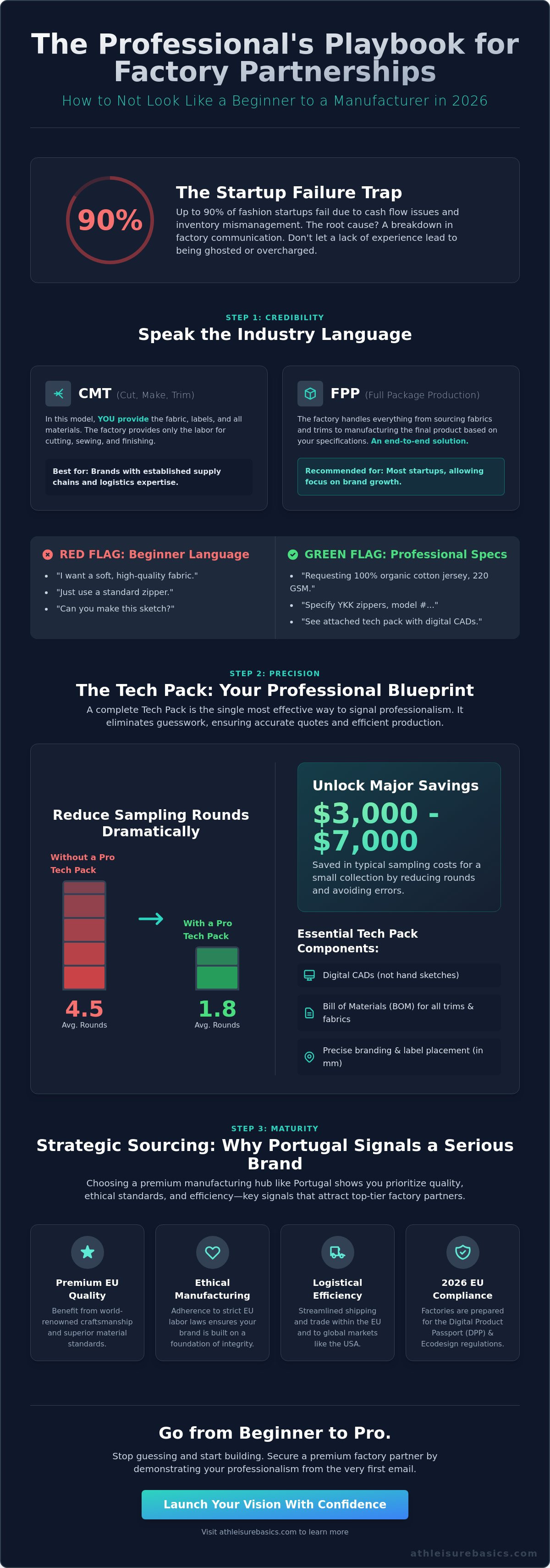
Up to 90% of fashion startups fail because of cash flow issues and inventory mismanagement, but the root cause is often a breakdown in factory communication. It's natural to feel intimidated when approaching high-quality factories in Portugal, especially when you're worried that a lack of experience might lead to being ghosted or overcharged. You've likely spent hours wondering if your inquiry sounds professional enough to secure a premium partner.
This guide will show you exactly how to not look like a beginner to a manufacturer by mastering the technical requirements and business logic that factories expect in 2026. We'll show you how to signal your status as a serious brand owner, ensuring you receive professional quotes and build long-term partnerships. We'll explore the new EU Digital Product Passport (DPP) regulations, the impact of the 2026 Ecodesign for Sustainable Products Regulation, and why a professional tech pack can reduce your sampling rounds from 4.5 to just 1.8. By the end, you'll have the tools to launch your vision with the confidence of an industry veteran.
Key Takeaways
- Master essential industry terminology like CMT and FPP to establish immediate credibility and ensure you select the right production model for your brand.
- Understand why a comprehensive Tech Pack serves as your professional blueprint, reducing sampling rounds and securing accurate factory quotes.
- Learn how to not look like a beginner to a manufacturer by including specific "green flag" data—such as technical specs and realistic timelines—in your initial outreach.
- Navigate Minimum Order Quantities (MOQs) with confidence by applying the "sampling with intent" strategy to align with factory business logic.
- Discover the strategic advantage of sourcing from Portugal to benefit from premium EU quality standards, ethical manufacturing, and logistical efficiency.
Mastering the Industry Language: Essential Vocabulary for Brand Owners
Industry insiders speak a specific dialect. If you want to know how to not look like a beginner to a manufacturer, you must speak it too. When you use the correct terminology, you signal that you've done your homework and understand the factory's operational flow. Factory managers are busy; they prioritize clients who communicate with technical precision because it reduces the risk of costly production errors. Using vague descriptions like "stretchy" or "high quality" is a red flag that suggests you'll require hand-holding, which often leads to higher quotes or outright ghosting.
Understanding where your brand sits within the clothing industry value chain allows you to communicate with clarity and authority. You should be able to distinguish between different stages of the sampling process before you ever send an email. A prototype is your first rough draft for fit; a Sales Man Sample (SMS) is the high-quality version used for marketing or trade shows; and the Pre-Production Sample (PPS) is the final "golden sample" that serves as the contractually binding standard for your bulk run.
The Production Models: CMT vs. FPP
You must decide which manufacturing model fits your current infrastructure. CMT (Cut, Make, Trim) means you provide the fabric, labels, and zippers, while the factory only provides the labor. This requires significant logistics knowledge and local sourcing contacts. For most startups, FPP (Full Package Production) is the smarter choice. In this model, the factory handles the sourcing of materials based on your specifications. It’s a streamlined, end-to-end service that lets you focus on brand growth while we manage the supply chain complexities in Portugal.
Fabric and Trim Specs: Speaking in Technicalities
Precision is your best tool for building "street cred." Never tell a manufacturer you want "soft fabric." Instead, specify the weight and composition. Requesting a "100% organic cotton jersey, 220 GSM" tells the producer exactly what they need to source. GSM (Grams per Square Meter) is the universal metric for fabric thickness. In the premium athleisure market, mentioning OEKO-TEX® certifications is a major green flag. It proves you value ethical standards and chemical safety, which are legal necessities under the 2026 EU regulations.
Don't leave "trims" as an afterthought. This category includes everything from YKK zippers to recycled polyester care labels. To ensure you know how to not look like a beginner to a manufacturer, include these details in your initial inquiry. A professional brand owner knows that a garment is the sum of its technical parts, not just a creative vision. By defining these specs early, you demonstrate a level of maturity that earns respect from the highest-quality factories.
The Tech Pack: Your Professional Passport to Production
Think of a tech pack as the architectural blueprint for your garment. Without it, a factory cannot provide an accurate quote because they don't know the exact consumption of materials or the complexity of the construction. If you want to know how to not look like a beginner to a manufacturer, arriving with a complete tech pack is the most effective strategy. Data from ExploreTex in 2026 shows that a high-quality tech pack can reduce the average number of sampling rounds from 4.5 to just 1.8. This efficiency saves you thousands in sampling costs, which typically range from $3,000 to $7,000 for a small collection.
Professional factories in Portugal prioritize brands that provide digital CADs (Computer-Aided Design) over hand-drawn sketches. Digital files ensure precision and are easily integrated into the factory's pattern-making software. While the tech pack provides the data, a physical reference sample provides the "feel." Sending a garment that has the exact fit or seam finish you desire clarifies your expectations and bridges the gap between technical data and tactile reality. This combination of digital precision and physical benchmarks is how to not look like a beginner to a manufacturer during your very first meeting.
The Bill of Materials (BOM) Breakdown
A BOM is an exhaustive list of every physical item required to finish the product. This includes the primary fabric, thread weight, brand labels, care instructions, and even the specific recycled polybag for shipping. Unlike basic guides that only focus on measurements, a professional BOM specifies branding placement down to the millimeter. This includes the exact position of your neck label or the distance of an embroidered logo from the side seam. A complete BOM allows you to visualize the garment production process from start to finish. If you need support in creating these documents, we offer professional tech pack development to ensure your brand is production-ready.
Grading and Sizing Charts
One of the most common mistakes beginners make is asking a factory to "make it a standard medium." There is no universal "standard" in the apparel industry. You must provide a "Base Size" with specific measurements for every point of measure, such as chest width, sleeve length, and neck drop. You also need a clear grading rule for how those measurements change for sizes S through XL. Grading is the mathematical scaling of a garment's base size to other sizes. Providing these charts prevents the factory from guessing your fit profile and ensures your luxury standards are met across the entire size range.
Crafting the Professional Outreach: The First Email Strategy
Your first email is a high-stakes filter. Premium factories in Portugal receive dozens of inquiries every day, and they use the first few sentences to decide if you're a serious professional or a high-risk hobbyist. Learning how to not look like a beginner to a manufacturer starts with providing the data they need to assess your project's viability without a long back-and-forth chain. If your message lacks technical depth, it will likely be ignored. Manufacturers look for specific "green flags" that signal a ready-to-go project: clear quantities, a realistic timeline, and the technical specifications we discussed in the previous section.
Professionalism extends beyond the text of your message. Your email signature and the "About Us" section of your brand's digital presence are vital. A factory manager will likely click your website link or social media profile to verify your brand's legitimacy. If these are under construction or look amateur, it undermines your technical inquiry. In the premium European market, reputation is currency. Factories want to work with brands that have a clear vision and a professional footprint—similar to the cohesive digital identity of Love Couture. It's also important to set realistic expectations for response times. High-quality partners are often managing complex production cycles; a response within 3 to 5 business days is standard for a detailed quote.
The Anatomy of a Pro Inquiry Email
To ensure your inquiry is prioritized, follow a structured template. Your subject line should be a data-heavy summary: "[Brand Name] - [Product Type] - [MOQ] - Inquiry for [Season/Year]." This allows the production manager to categorize your request instantly. Start with a hook that positions your brand, such as "We are a premium athleisure startup focusing on luxury basics." Instead of asking vague questions, use a direct call to action. Ask for a specific quote based on the attached tech pack. This shows you understand the workflow and are ready to move into the sampling phase immediately.
What NOT to Say in Your First Message
There are certain phrases that act as immediate red flags for factory owners. Never admit that you're "just starting out and have no idea what you're doing." Even if you're a first-time founder, maintain a professional distance and rely on your technical documents to speak for you. Avoid asking for prices without providing fabric specs or quantities; a factory cannot give an accurate estimate without knowing the GSM or the total units. Finally, don't promise "massive orders in the future" to negotiate lower prices today. This is a common mistake that signals a lack of understanding of factory business logic. To know how to not look like a beginner to a manufacturer, you must focus on the professional execution of your current order rather than hypothetical future volume.
Understanding Factory Business Logic: MOQs and Timelines
Factories are high-overhead businesses that rely on machine efficiency and labor optimization. When you ask how to not look like a beginner to a manufacturer, you must first acknowledge that Minimum Order Quantities (MOQs) aren't arbitrary hurdles. They exist because setting up a production line takes the same amount of time for 50 units as it does for 5,000. Setup costs, fabric mill minimums, and machine downtime are real economic pressures. If you approach a factory manager with an understanding of these constraints, you move from being a "risky lead" to a "strategic partner."
Negotiating these numbers requires a "Sampling with Intent" approach. Instead of simply asking for a lower MOQ, present a clear growth plan. Tell the manufacturer you're launching with a specific quantity to validate market fit, supported by the professional tech pack you've already developed. Standard industry payment terms in 2026 remain a 50% deposit to begin production and the remaining 50% before the goods leave the factory. Accepting these terms without hesitation signals that you have the necessary capital and respect standard business practices.
The Real Cost of Low MOQs
There is a direct inverse relationship between order volume and unit price. A 70-piece order requires the same pattern development and machine calibration as a 250-piece run, which means the fixed costs are spread across fewer units. Understanding clothing manufacturing MOQ logic is essential for your retail pricing strategy. If your startup needs to test the market with minimal risk, our white label service starts at just 60 pieces per style/color. This allows you to launch premium products without the heavy development costs of a fully custom run.
Lead Times and Production Windows
Professional brand owners work at least six months ahead of their desired launch date. You must distinguish between "Sampling Lead Time," which covers the creation of your physical prototypes, and "Bulk Production Lead Time." In the premium market, "ASAP" is not a deadline; it's a sign of poor planning. Use specific months or weeks when discussing your 2026 production calendar to show you have a marketing and fulfillment strategy in place. Production lead times in Portugal typically range from 6 to 12 weeks depending on complexity. If you're ready to start your journey with a reliable partner, Get a Quote for your project today.
Strategic Sourcing: Why Choosing Portugal Signals Maturity
Experienced founders understand that sourcing is a strategic decision rather than a simple search for the lowest unit price. When you choose to produce in Europe, you demonstrate a long-term vision for brand equity and supply chain stability. If you want to know how to not look like a beginner to a manufacturer, you must move past the "lowest cost" mindset. Beginners often focus on high-volume, high-risk regions in Asia, where rising tariffs on Chinese and Vietnamese imports have reached between 20% and 40% as of 2026. Mature brands prioritize clothing manufacturers Portugal because they offer a sophisticated balance of premium quality, ethical compliance, and logistical efficiency.
Your understanding of logistics also signals your level of expertise. Beginners frequently accept EXW (Ex Works) terms without realizing they are responsible for the entire shipping and customs process. Professional brand owners often negotiate DDP (Delivered Duty Paid) or have established freight forwarding partners. Manufacturing in the EU simplifies these hurdles significantly. With Portugal's textile industry reporting a positive trade balance of €35 million in January 2026, the country remains a stable, world-class hub for luxury apparel production. Choosing this region proves you are building a legacy, not just a one-off product run.
Ethical Standards as a Brand Asset
In 2026, sustainability is no longer a marketing choice; it is a legal requirement. The EU Ecodesign for Sustainable Products Regulation (ESPR) now mandates a Digital Product Passport (DPP) for every garment sold in the EU. Working with a factory that already adheres to these standards is how to not look like a beginner to a manufacturer. High-quality made in portugal clothing is produced under strict EU labor laws and OEKO-TEX® certifications, providing you with the transparency required for modern compliance. Nearshoring your production also reduces your carbon footprint and shipping times, allowing you to respond to market trends with greater agility than competitors sourcing from across the globe.
The Partnership Approach
The most successful brands view their manufacturer as a trusted partner rather than a mere supplier. This shift in perspective is the ultimate sign of professional maturity. At Athleisurebasics, we bridge the gap between your startup vision and professional execution. We support first-time founders through low MOQ white-label options and full custom CMT production, ensuring your first run meets the highest industry standards. By focusing on quality over quantity and ethics over shortcuts, you establish a brand that is built to scale profitably. Ready to start your professional production journey? Get a quote from Athleisurebasics today.
Turn Your Brand Vision into a Professional Reality
Launching a clothing brand in 2026 requires more than a creative spark; it demands technical precision and strategic alignment with your production partners. By mastering industry terminology and providing digital tech packs that reduce sampling rounds from 4.5 to 1.8, you establish immediate authority. Choosing to manufacture in Portugal further signals your commitment to premium quality and ethical standards, ensuring your brand is compliant with the latest EU Digital Product Passport requirements. Understanding how to not look like a beginner to a manufacturer is the first step in protecting your capital and securing a reliable supply chain.
We specialize in supporting startups and first-time founders from our base in the heart of Portugal's textile industry. Whether you need low MOQ white label solutions or full custom production using premium OEKO-TEX® certified fabrics, we are here to support your growth. Launch your brand with a professional Portuguese partner, Get a quote today. Your journey from a simple logo to a lasting legacy is within reach, and we are ready to help you build it with confidence.
Frequently Asked Questions
What is the most important thing to have before contacting a manufacturer?
A comprehensive tech pack is the single most critical document you need before making contact. This digital blueprint contains your Bill of Materials (BOM) and grading charts; which allows a factory to provide an accurate quote. According to ExploreTex 2026; arriving with these documents reduces sampling rounds from 4.5 to 1.8. It is the most effective way to demonstrate how to not look like a beginner to a manufacturer during your first interaction.
Will a manufacturer steal my design if I send them a tech pack?
Established factories in regions like Portugal are focused on production volume and long-term partnerships rather than stealing intellectual property. Their business model relies on manufacturing fees; not the risks of entering the retail market. While you can request a Non-Disclosure Agreement (NDA); your professional behavior and technical preparation are your best forms of protection. Factories value their reputation as ethical partners within the EU market.
Why do some manufacturers ignore my emails?
Manufacturers often ignore emails that lack technical data or fail to specify a realistic Minimum Order Quantity (MOQ). If your inquiry doesn't include fabric weights; such as 220 GSM; or a clear timeline; it signals a lack of preparation. Factories prioritize leads that are ready for immediate production to maximize their machine efficiency. Providing a clear subject line with your brand name and intended MOQ ensures your message stands out.
How do I know if a manufacturer's price is fair?
You determine fairness by comparing quotes that use identical technical specifications and materials. A fair price accounts for the quality of Portuguese craftsmanship and adherence to EU labor standards. Research from 2026 indicates that optimizing pattern efficiency can reduce production costs by 3% to 5% in bulk runs. Always ask for a breakdown of costs to ensure you aren't paying for inefficiencies in the construction process.
Can I start a clothing brand with just 50 pieces?
You can certainly launch a brand with low quantities by utilizing white label services or specialized startup partners. While traditional custom production might require higher minimums; our white label service starts at 60 pieces per style or color. This strategy allows you to test your market fit with minimal financial risk. It is a proven method for how to not look like a beginner to a manufacturer while building your initial brand legacy.
What is the difference between a manufacturer and a wholesaler?
Do I need to visit the factory in person to be taken seriously?
In-person visits are not strictly required; but they can strengthen a partnership-based relationship. Most professional communication in 2026 happens digitally; supported by the transparency of the Digital Product Passport (DPP) regulations. You can be taken seriously from a distance if your technical documents are flawless and your payment terms are met promptly. Digital tools now allow for high-level supply chain oversight without the need for constant travel.
How long does it take to get a sample made?
The sampling process typically takes between 2 and 4 weeks depending on the complexity of your garment and the availability of materials. This timeframe includes pattern making; fabric sourcing; and the actual construction of the prototype. Remember that sampling costs are usually 2 to 5 times the bulk production price. Planning your 2026 production calendar with these lead times in mind prevents rushed orders and costly errors.



Leave a comment
This site is protected by hCaptcha and the hCaptcha Privacy Policy and Terms of Service apply.