
How to Protect Your Clothing Designs with a Manufacturer: A 2026 Guide
What if your best-selling design appeared on a competitor's store before you even finished your first production run? It's a valid fear that often stalls the growth of emerging brands. You've spent months perfecting every detail of your collection, and now you need to know how to protect my design with a manufacturer without losing sleep over intellectual property theft. You want to scale your business, but the legal complexities of global production can feel overwhelming.
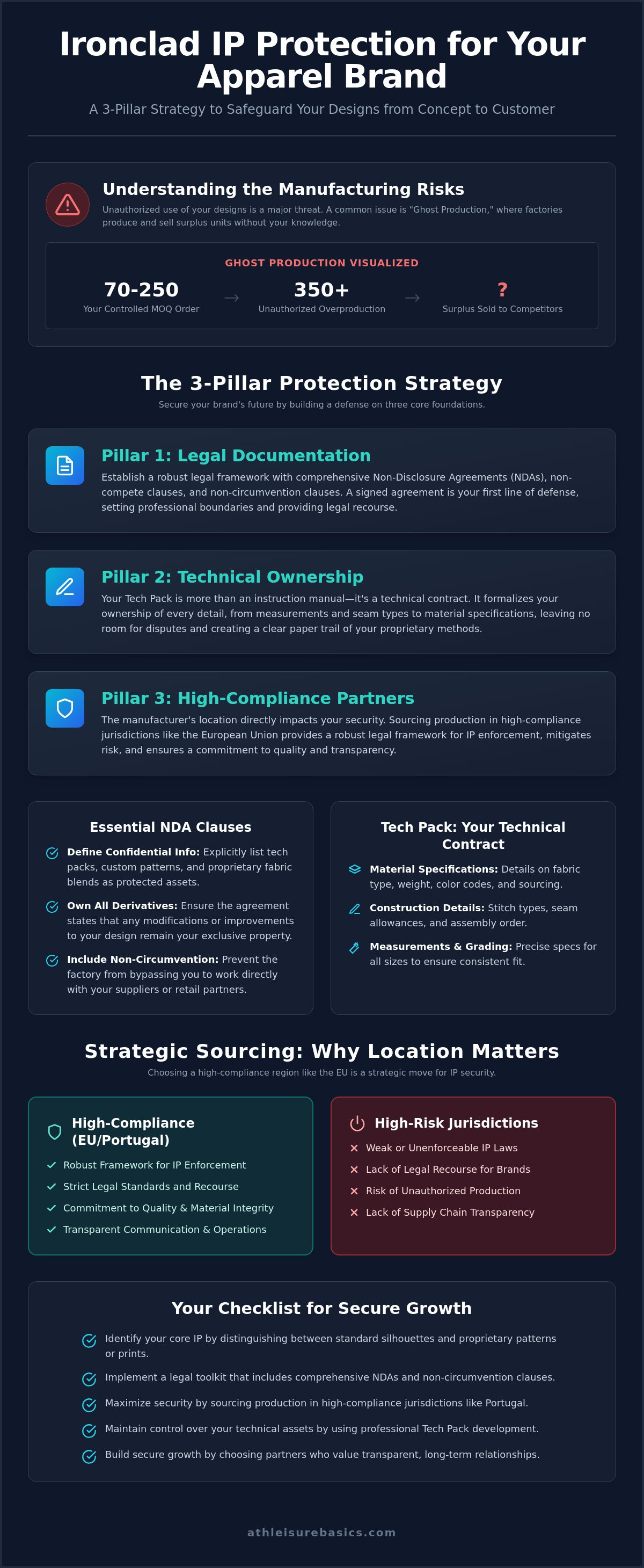
We believe that your creativity deserves ironclad protection. This guide shows you exactly how to safeguard your intellectual property by using a three-pillar strategy: legal documentation, technical ownership, and selecting high-compliance partners. You will learn how to navigate the shift toward increased supply chain transparency while keeping your patterns and prints secure from the moment you start sampling.
We provide a clear checklist of the documents you need and explain how professional Tech Pack development anchors your ownership of every stitch. We also highlight the strategic advantages of manufacturing in the European Union, where strict legal standards help mitigate risk and ensure quality. By the end of this article, you'll have the tools to build a lasting commercial presence with total peace of mind.
Key Takeaways
- Identify your core intellectual property by distinguishing between standard silhouettes and proprietary patterns or prints.
- Discover how to protect my design with a manufacturer by implementing a legal toolkit that includes comprehensive NDAs and non-circumvention clauses.
- Maximize security by sourcing production in high-compliance jurisdictions like Portugal, where EU laws provide a robust framework for IP enforcement.
- Maintain control over your technical assets by using professional Tech Pack development to formalize your ownership of every production detail.
- Build a secure foundation for growth by choosing manufacturing partners who value transparent communication and long-term collaborative relationships.
Understanding Intellectual Property Risks in Apparel Manufacturing
Protecting a clothing brand requires more than just a creative eye; it demands a technical understanding of where your value lies. In the apparel industry, a design is rarely just a single concept. It's a combination of unique silhouettes, proprietary textile prints, and specific construction patterns. Distinguishing between general inspiration and actionable fashion design copyright infringement is the first step for any entrepreneur asking how to protect my design with a manufacturer. While trends are often shared across the market, your specific technical execution is your intellectual property.
The risks in manufacturing often stem from a lack of transparency. When you hand over your concepts, you're trusting a partner with your brand's future. Common threats include design leaks to competitors or the unauthorized use of your unique patterns for other clients. Building a defense against these copycats starts with choosing a partner who operates under a strict legal framework and maintains clear records of every production step. This transparency is the foundation of a secure partnership.
The "Ghost Production" Threat
The most common risk isn't always a direct copycat. It's often unauthorized overproduction, sometimes called ghost production. This occurs when a factory produces more units than you ordered and sells the surplus to third-party retailers or wholesalers. Choosing a manufacturer with high ethical standards and transparent inventory management is the only way to mitigate this risk. We focus on low minimum order quantities (MOQs), typically ranging from 70 to 250 pieces. These smaller, controlled production runs make it much easier to track fabric usage and finished garment counts, leaving no room for unauthorized sales.
Why Your Tech Pack is Your First Line of Defense
Your technical files are more than just assembly instructions. A comprehensive tech pack acts as a technical contract between you and your production partner. It defines every measurement, seam type, and material specification. When these details are clearly documented, they leave no room for accidental variations that a factory might claim were standard practice. This documentation is essential when considering how to protect my design with a manufacturer, as it establishes a paper trail of your proprietary methods. You can learn more about how this fits into the broader guide for clothing brands on tech packs and the production lifecycle.
By manufacturing in a high-compliance region like Portugal, you benefit from strict EU regulations that protect creators. This regional pride and commitment to material integrity ensure that your designs aren't just produced; they're protected within a legal framework that values your brand's long-term growth and security.
The Legal Toolkit: NDAs and Intellectual Property Rights
Establishing a robust legal framework is a critical step in learning how to protect my design with a manufacturer. While a handshake might start a conversation, only a signed agreement provides the security needed to scale a business. These documents do more than just prevent theft; they set the professional boundaries for a long term partnership. It's vital to remember that a legal agreement is only as strong as the jurisdiction where it is enforced. Manufacturing within the European Union, for instance, offers a level of legal recourse and intellectual property protection that is often absent in other global hubs.
Beyond the standard Non-Disclosure Agreement (NDA), you must understand the difference between non-compete and non-circumvention clauses. A non-compete clause prevents the manufacturer from producing similar items for your direct competitors. A non-circumvention clause is perhaps even more vital for apparel brands; it stops the factory from bypassing you to work directly with your fabric suppliers or retail partners. Combining these tools creates a comprehensive shield around your brand's operational secrets.
Crafting an Enforceable NDA for 2026
A generic template often fails to cover the specific technicalities of garment production. To ensure your agreement is effective, include these three essential clauses:
- Definition of Confidential Information: Explicitly list tech packs, proprietary fabric blends, and custom patterns as protected assets.
- Ownership of Derivatives: State clearly that any improvements or variations made to the design during the sampling process remain your property.
- Jurisdiction and Dispute Resolution: Specify that the agreement is governed by the laws of a high-compliance region, such as Portugal, to ensure clear enforcement paths.
We recommend using mutual NDAs. This approach protects both parties and signals that you value a professional, equitable relationship. While a template can serve as a starting point for initial discussions, consulting a legal professional is wise when you are developing "hero" products that define your brand's market position.
Trademarks and Design Copyrights
Registering your brand identity is the first layer of defense. In 2026, the base government filing fee for a U.S. trademark application in Class 25 is $350. This protects your logo and brand name before you even send a file to a factory. However, copyright law has limits in fashion; you generally cannot copyright the functional shape of a standard garment like a basic hoodie or t-shirt. This is where design patents become valuable for truly unique innovations. A design patent is a legal protection for the unique, non-functional aesthetic features of a garment, such as a proprietary waistband construction or a specific decorative pocket configuration. Obtaining one typically costs between $1,500 and $4,000, but it offers a high allowance rate of nearly 90 percent.
If you are looking for a partner who prioritizes these standards, you can explore our custom manufacturing services to see how we integrate security into every production phase. By layering trademarks, patents, and clear contracts, you build a foundation that allows your brand to grow with confidence.
Strategic Sourcing: Why Manufacturing Location Impacts Security
Choosing a production partner is often treated as a simple cost exercise, but it's actually a strategic legal decision. The geographic location of your factory dictates the inherent level of protection your intellectual property receives. While many brands look toward large scale manufacturing hubs in Asia for lower costs, the legal risks associated with IP theft can be significantly higher in regions with less stringent enforcement. In contrast, European manufacturing centers operate under a unified legal framework that prioritizes the rights of the creator. When you consider how to protect my design with a manufacturer, looking beyond the contract to the local legal jurisdiction is essential.
The European Union provides a robust security blanket for emerging businesses. Regulations like the Ecodesign for Sustainable Products Regulation (ESPR), which comes into force on July 19, 2026, demonstrate the region's commitment to high operational standards and transparency. These laws don't just cover environmental impact; they foster a culture of compliance that extends to how intellectual property is handled on the factory floor. A manufacturer operating in a high compliance environment is fundamentally less likely to risk their reputation by mismanaging your proprietary designs.
Manufacturing in Portugal: A Safe Haven for Brands
Portuguese factories are world renowned for their technical expertise and ethical standards. By manufacturing in Portugal, your brand operates within the EU legal jurisdiction, which offers clear and enforceable paths for IP protection. This proximity also allows for easier site visits and closer production monitoring. Being able to physically visit your partner and see your designs on the line creates a level of accountability that is difficult to replicate across continents. For a deeper look at why this region is the preferred choice for premium labels, see our ultimate 2026 guide to clothing manufacturers in Portugal.
Evaluating Factory Reputation and Ethics
A factory's respect for labor standards is often a direct reflection of their respect for your intellectual property. When a manufacturer invests in OEKO-TEX® certifications and maintains ethical working conditions, they demonstrate a principled approach to business. You can vet a potential partner's reputation by asking for their client history or checking their standing within regional textile associations. A partner that offers custom manufacturing for unique designs is more likely to have established protocols for design confidentiality. These factories understand that their success is tied to the long term growth of your brand, making them a dedicated ally rather than just a service provider. Choosing a principled partner ensures that your patterns and silhouettes remain your exclusive assets throughout the entire lifecycle of your business.
How to Manage Your Technical Assets and Production Files
Managing your technical files is like guarding the source code of a software company. It requires precision and a clear protocol. When you transition from a creative concept to a physical product, your digital assets become your brand's most valuable currency. Knowing how to protect my design with a manufacturer involves more than just signing papers; it requires a structured approach to technical asset management. You must differentiate between a conceptual design and the actual production patterns. While a design is the visual idea, the patterns are the technical blueprints that dictate exactly how a garment is cut and assembled across all sizes.
A common mistake for emerging brands is allowing the manufacturer to retain the only copy of the production files. If you don't own your patterns, you don't truly own your product. Always ensure that your agreement specifies your ownership of all technical drawings, grading files, and marker layouts created during the development phase. This transparency ensures that you can move your production to another facility if necessary without starting the design process from scratch.
Owning Your Patterns and Grading
Many factories offer "free" pattern development as part of an all inclusive production package. This can be a trap for new entrepreneurs. If you don't pay for pattern development as a separate, transparent service, the manufacturer may claim ownership of those files. We recommend paying for pattern making and grading as distinct services. This practice ensures that the resulting technical assets belong to you. Always request your final graded patterns in universal formats such as DXF or ASTM. These files are compatible with most industry standard CAD software, giving you the freedom to scale your business elsewhere if needed.
If you are unsure how to audit your technical files or structure your handovers, utilizing clothing production consulting services can provide the expert oversight you need. Consulting helps you identify gaps in your documentation before they become a liability. Leaving your "source code" in the hands of a factory you haven't fully vetted is a significant business risk that can be avoided with professional guidance.
Controlled Launches with Low MOQs
Security is also a matter of strategic timing. Starting with low minimum order quantities (MOQs), such as 70 to 250 pieces, allows you to test a manufacturer's reliability and integrity with minimal exposure. These smaller batches act as a trial period for the partnership. You can monitor the market for unauthorized replicas after your first release while maintaining a manageable inventory. Being a "big fish" in a smaller, premium factory often leads to more protective relationships. A dedicated partner values your business and is more likely to implement strict internal controls to prevent design leaks. This psychological benefit of partnership often outweighs the perceived savings of high volume facilities.
Ready to build your brand on a foundation of security and expertise? Partner with us for custom production and maintain full control over your technical assets from day one.
Partnering for Protection: The Athleisurebasics Approach
Securing your intellectual property is a continuous process that requires the right collaborator. While legal documents and technical files provide the foundation, the integrity of your production partner determines the actual safety of your brand. When you choose Athleisurebasics, you aren't just finding a factory; you're discovering how to protect my design with a manufacturer through a relationship built on transparency and mutual respect. We position ourselves as a dedicated ally for emerging businesses, simplifying industrial complexities so you can focus on growth.
Our commitment to excellence is rooted in our Portuguese heritage. Operating within the European Union means we adhere to some of the world's strictest labor and intellectual property regulations. This regional origin serves as a quality seal, ensuring that your designs are produced in an environment that values material integrity and ethical standards. We believe that a manufacturer's respect for the law should be as high as their standard for craftsmanship.
A Collaborative Production Model
We've developed a structured onboarding process designed to safeguard your creative assets from day one. When you bring a custom design to us, we begin with a thorough review of your tech pack to ensure all technical specifications are clearly defined and owned by you. Our team handles your digital data and physical samples with the highest level of security, limiting access to only the essential personnel involved in your project. We treat our clients as long-term partners, not just transactions.
Our production model is specifically tailored to mitigate the risks faced by new entrepreneurs. By offering accessible minimum order requirements of 70 to 250 pieces, we allow you to maintain tight control over your inventory and design exclusivity. This low MOQ approach reduces the incentive for unauthorized overproduction and ensures that your "hero" products remain unique to your brand. We provide the end-to-end support needed to transition from a technical concept to a finished luxury product with total confidence.
Launch Your Protected Collection Today
The journey from a small idea to a lasting commercial presence should be empowering, not anxiety-inducing. Manufacturing in Portugal offers the peace of mind that comes with a high-compliance jurisdiction and a culture of craftsmanship. By combining ironclad EU legal protections with our partnership-driven approach, you create a defensive shield around your brand that allows you to scale without fear. This collaborative strategy is the ultimate answer to the question of how to protect my design with a manufacturer.
Don't let the fear of intellectual property theft stall your brand's development. Our expert team is ready to help you navigate the complexities of apparel production while keeping your designs secure. Start your premium production journey with Athleisurebasics and experience the security of professional Portuguese manufacturing.
Build a Secure Foundation for Your Fashion Brand
Protecting your creative vision requires a proactive blend of legal foresight and technical ownership. By implementing robust NDAs and maintaining control over your graded patterns, you eliminate the ambiguity that often leads to intellectual property theft. Choosing a production partner in a high-compliance jurisdiction like Portugal ensures that your assets are protected by strict EU laws; this provides a level of security that other manufacturing hubs simply cannot match.
This guide has outlined the essential steps for any entrepreneur asking how to protect my design with a manufacturer while scaling their operations. We specialize in supporting startup growth through transparent, OEKO-TEX® certified production and accessible MOQs. You don't have to navigate the transition from concept to finished product alone. Secure your brand’s future with premium manufacturing in Portugal today. Your designs are the heart of your business, and they deserve a partner who values them as much as you do.
Frequently Asked Questions
Do I really need an NDA to talk to a clothing manufacturer?
Yes, you should always sign a Non-Disclosure Agreement before sharing proprietary information. An NDA establishes a legal boundary and signals that you take your intellectual property seriously. It's the most basic step in learning how to protect my design with a manufacturer during the initial consultation phase. This document ensures that your tech packs and mood boards remain confidential while you evaluate the partnership.
Can a factory steal my design if I don’t have a patent?
A factory can replicate your design if you lack legal protection, but an NDA and trade secret laws still offer recourse. Design patents are often slow for seasonal trends, taking 12 to 18 months to process. Instead of relying solely on patents, focus on technical documentation and choosing a manufacturer in a high-compliance jurisdiction. This approach creates a practical barrier against unauthorized replication of your silhouettes.
What should I do if I find a copy of my design online?
You should immediately document the evidence and consult a legal professional to issue a cease and desist letter. If the copy is on a major retail platform, you can use their internal IP reporting tools or file a DMCA takedown notice. You should also audit your manufacturing agreement to see if there was a breach of confidentiality. Taking swift action protects your brand's market value and reputation.
Is it safer to manufacture in Europe than in Asia for IP protection?
Manufacturing in Europe, specifically Portugal, offers a more robust legal framework for IP protection than many Asian hubs. EU laws are highly protective of creators and offer clear enforcement paths for contract breaches. This regional commitment to transparency and ethical production significantly reduces the risk of design leaks. It's a strategic choice for brands that prioritize security over the lowest possible production costs.
How much does it cost to legally protect a clothing design?
The cost varies depending on the level of protection you choose. In 2026, a U.S. trademark application costs approximately $350 per class of goods. A design patent is more expensive, typically ranging from $1,500 to $4,000 including professional drawings and filing fees. These investments are foundational when you are researching how to protect my design with a manufacturer and building a long term brand presence.
Who owns the patterns if the manufacturer develops them for me?
Ownership of patterns is determined by your production contract. If you pay for pattern making as a separate service, you should own the final files. We recommend requesting these in a universal format like DXF to ensure you can move production if needed. Always clarify this ownership in writing before the development phase begins to avoid future disputes over technical assets.
What is the difference between a design patent and a trademark?
A trademark protects your brand's identity, such as your logo and brand name, to prevent consumer confusion. A design patent protects the unique, non-functional aesthetic appearance of the garment itself. While trademarks are essential for every brand, design patents are best reserved for "hero" products with a long shelf life. Both are critical tools in a multi-layered intellectual property strategy.
Can I protect a specific fabric or material I developed?
You can protect a unique fabric through trade secret agreements with your mill or by filing a utility patent if the material has a novel functional purpose. This is particularly important for innovators like The Living Fabric, whose use of mycelium and frequency technology in living garments necessitates clear IP boundaries. Most brands rely on exclusive supply agreements to ensure that a custom fabric isn't sold to competitors, using detailed tech packs to establish ownership.


Leave a comment
This site is protected by hCaptcha and the hCaptcha Privacy Policy and Terms of Service apply.