

Common Pitfalls for New Clothing Brands: A 2026 Production & Strategy Guide
Your most innovative designs won't save a business model built on fragile logistics. While the global apparel market is projected to reach $1.92 trillion in 2026, many startups fail before they ship their first order because they focus on aesthetics while ignoring the complexities of the supply chain. It's a common struggle to face high minimum order quantities and inconsistent quality from distant factories that don't share your standards.
We understand that the path from concept to rack is often filled with uncertainty. This guide identifies the common pitfalls for new clothing brands and provides a strategic roadmap to secure your production. You'll learn how to manage the manufacturing landscape with confidence, ensuring your capital is invested in quality rather than wasted on over-inventory or production errors.
We will break down the critical mistakes that sink startups, from tech pack confusion to poor sourcing choices. By the end of this article, you'll have a clear plan for finding reliable partners and balancing premium craftsmanship with the operational agility your brand needs to scale effectively in a competitive market.
Key Takeaways
- Master the technical side of production by creating comprehensive tech packs to avoid costly manufacturing errors and unsellable stock.
- Identify common pitfalls for new clothing brands, specifically the "cheapest price" mirage that often leads to high defect rates.
- Learn how to balance quality and cost by choosing ethical manufacturing partners in Portugal that offer transparency and premium standards.
- Optimize your financial planning by calculating the full cost of goods sold and integrating marketing strategies early in the production cycle.
- Reduce your initial risk with accessible minimum order requirements that prevent over-inventory while you're establishing your market presence.
The Reality of Launching in 2026: Why Most New Clothing Brands Stumble
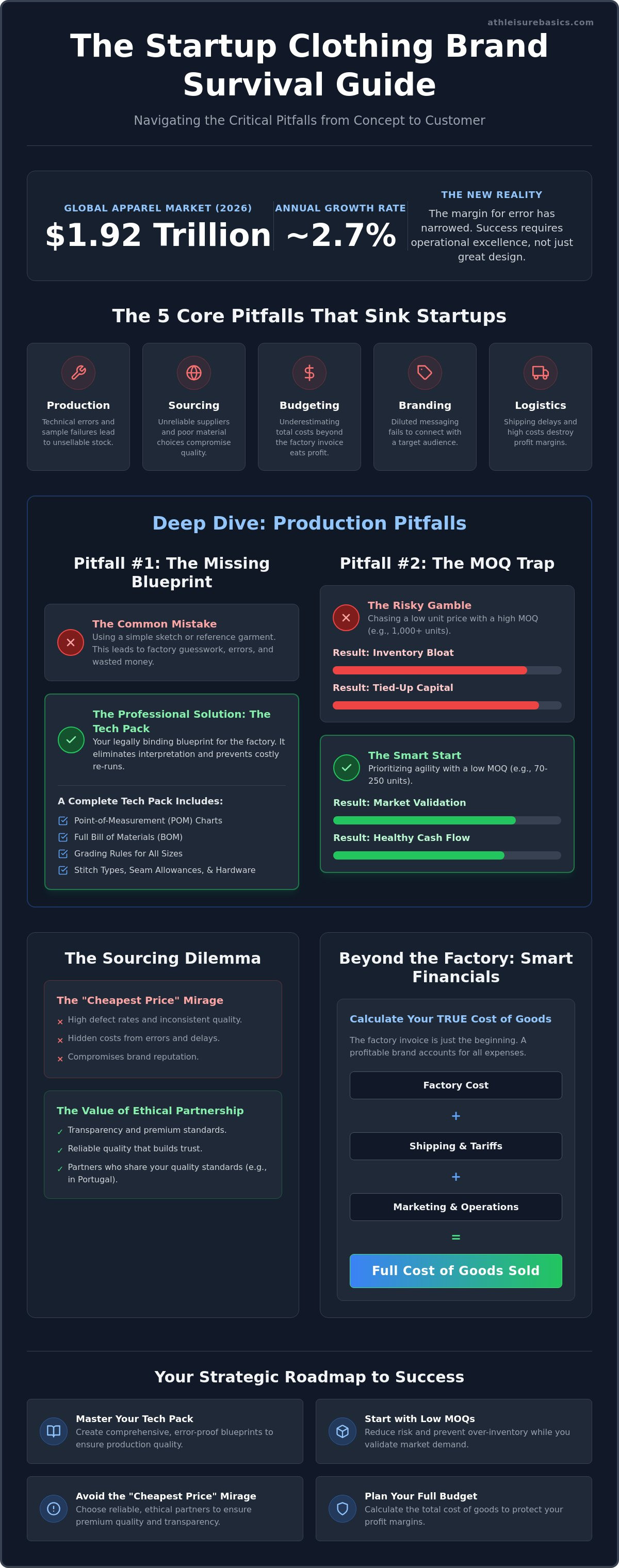
A clothing brand pitfall is more than just a bad design; it's a strategic or operational error that exhausts your capital before you find market fit. In 2026, the global apparel market is worth approximately $1.92 trillion, but growth has slowed to about 2.7% annually. This shift marks the end of the era where rapid, unfocused growth was possible. To transition from a small idea to a lasting commercial presence, you must understand that the margin for error has significantly narrowed.
High consumer expectations for quality and transparency are the new industry standards. Modern buyers are increasingly moving away from the challenges of the fast fashion model, where speed often came at the cost of ethical manufacturing and material integrity. We identify five core categories where these errors typically cluster:
- Production: Technical errors and sample failures that lead to unsellable stock.
- Sourcing: Poor material choices and unreliable suppliers that compromise brand reputation.
- Budgeting: Underestimating total costs beyond the factory invoice, including shipping and tariffs.
- Branding: Failing to resonate with a specific audience through diluted messaging.
- Logistics: Delays and high shipping costs that eat into profit margins.
These are the common pitfalls
Production Pitfalls: Technical Errors That Drain Your Budget
Technical errors represent some of the most common pitfalls for new clothing brands because they lead to immediate financial loss. While a design might look exceptional on a mood board, the transition to a physical product requires precision that many startups overlook. Vague instructions are the primary cause of unsellable inventory. A garment that doesn't meet specifications is a liability, not an asset.
The Tech Pack: Your Most Important Document
A simple sketch or a physical reference garment isn't enough to guide a factory through complex production. You need a comprehensive tech pack. A tech pack is the legally binding blueprint for your factory. It details every technical specification, including point-of-measurement charts, a full Bill of Materials (BOM), and grading rules for different sizes.
Without this document, manufacturers are forced to make assumptions about seam allowances, stitch types, or hardware placement. These guesses rarely align with your vision. Investing in professional tech pack development ensures that the factory has no room for interpretation, which prevents the need for expensive production re-runs. It's the difference between a high-end garment and a pile of fabric that doesn't fit correctly.
The MOQ Trap and Inventory Bloat
It's a common mistake to commit to high Minimum Order Quantities (MOQs) just to secure a lower unit price. Ordering 1,000 units of a single style might look good on a spreadsheet, but it often kills startups before they gain momentum. If the market doesn't respond to that specific color or the fit isn't perfect, you're stuck with capital tied up in dead stock. This inventory bloat limits your ability to pivot or release new designs.
Prioritize agility over bulk discounts during your first year. The "true cost" of unsold inventory includes storage expenses and the risk of total loss if the product doesn't sell. Instead of chasing the lowest possible invoice, look for manufacturing partners that support lower entry barriers. Starting with production runs of 70 to 250 pieces allows you to test market demand and refine your offering based on real customer feedback. This lean approach keeps your cash flow healthy.
Understanding the garment production process is essential for setting realistic expectations. This includes acknowledging that "standard" sizing doesn't actually exist in the industry. Every brand must develop its own unique size chart through wear-testing and multiple sampling rounds. If you skip these steps to hit a rush deadline, your return rates will skyrocket. If you're looking for a reliable partner to navigate these technical stages, our custom clothing manufacturing
Sourcing and Manufacturing: The Cost of Poor Supplier Choice
Selecting a manufacturing partner based solely on the lowest quote is one of the most dangerous common pitfalls for new clothing brands. In the 2026 market, the "cheapest price" mirage often hides high defect rates and ethical liabilities that can destroy a brand's reputation before its first anniversary. While low labor costs in distant hubs might seem attractive, the hidden expenses of quality control failures and shipping surcharges often negate those initial savings. Recent geopolitical volatility has led to container surcharges ranging from $1,500 to $4,000, making regional manufacturing a more pragmatic financial choice.
Communication breakdowns also present a significant operational risk. Relying on factories in distant time zones often leads to delayed responses and misunderstood technical requirements. By choosing clothing manufacturers in Portugal, you gain the advantage of working within European time zones and business cultures that prioritize transparency. This proximity allows for faster sampling iterations and a more collaborative relationship, which is essential for scaling a premium brand.
Fabric and Material Oversight
Many entrepreneurs focus on the final look of a garment but ignore the "invisible" supply chain. It's a mistake to overlook exactly where your textile originates. Relying on "hand-feel" is not a professional substitute for rigorous fabric testing. In 2026, consumers expect verified standards, and failing to confirm OEKO-TEX® or organic certifications can lead to legal and marketing disasters. Additionally, avoid the trap of using non-repeatable "deadstock" fabric for your core collection. While it may seem eco-friendly, it prevents you from scaling successful products when you can't source the same material for a second production run.
Ethical and Geographical Risks
The logistical nightmare of 12-week shipping lead times from overseas factories often results in missed seasonal windows and depleted cash flow. Modern premium consumers now view "Made in Europe" as a mandatory requirement for quality and ethical assurance. Manufacturing in Portugal ensures full compliance with strict EU labor standards and environmental regulations. This regional pride acts as a quality seal for your brand. It provides a sense of security for your customers, knowing their clothing was produced under fair conditions using high-end craftsmanship. Transitioning to a nearshoring model reduces your carbon footprint and provides the operational agility needed to respond to 2026's rapid trend cycles.
Business and Marketing Strategy: Beyond the Design Phase
Designing a collection is the emotional heart of your brand, but the business foundation requires cold calculation. One of the common pitfalls for new clothing brands is the "Build It and They Will Come" fallacy. Entrepreneurs often exhaust their energy on the design phase and treat marketing as an afterthought. In 2026, where social media advertising costs have increased by up to 25% since 2024, you cannot afford to launch into a vacuum. Your brand's visibility must be built alongside your garments.
Ignoring "White Label" options is another strategic error for startups. While custom CMT production is ideal for unique silhouettes, white-label services offer a fast-track market entry with significantly lower risk. This approach allows you to test your branding and customer service models using proven, high-quality styles before investing heavily in custom technical development. It's a pragmatic way to establish cash flow and brand recognition in your first year.
Budgeting for the "Unseen" Costs
Startups often calculate their potential profit based solely on the factory invoice. This oversight ignores the heavy weight of the total Cost of Goods Sold (COGS). For a realistic 2026 budget, you must factor in import duties, professional photography, and shipping costs, which typically represent about 12.73% of total order revenue. You also need to account for e-commerce returns. With return rates projected to be between 20% and 24.5% this year, failing to price your products for these reversals is a common pitfall for new clothing brands that leads to rapid capital depletion.
Your marketing budget should ideally equal your production budget. Don't try to compete on price with established fast-fashion giants. They have economies of scale you can't match. Instead, focus on premium positioning and the value of ethical production. If you're ready to launch a collection that balances quality with operational efficiency, explore our white label clothing options to get your brand to market faster.
Building Anticipation Early
Don't wait for "perfect" final inventory to launch your social presence. Use your initial samples to create "behind the scenes" content that documents the development and wear-testing process. This transparency builds a waitlist and creates an emotional connection with your audience before you open for sales. It also allows you to identify which styles generate the most excitement, helping you refine your final order quantities. Pre-orders are the best way to de-risk a first drop by validating demand and securing capital before the full production run is finished. Plan your launch around the traditional fashion calendar to ensure your seasonal drops align with peak consumer buying periods.
Launching with Confidence: How Athleisurebasics De-risks Your Brand
Launching a brand requires more than just creative vision; it demands a partner who can bridge the gap between startup dreams and industrial reality. We provide the infrastructure needed to bypass the common pitfalls for new clothing brands by offering flexible production models that prioritize your cash flow. Our Portuguese facility operates with the transparency and precision required for premium market entry, ensuring your designs are executed to world-class standards.
The Private Label Portugal advantage allows for significantly faster launches compared to traditional custom development. By utilizing our white-label services, you can enter the market with a low 70-piece MOQ. This accessible entry barrier directly solves the over-inventory trap that often drains a startup's capital before they find their audience. For brands ready to scale with unique silhouettes, our full CMT support provides the capability to manufacture custom patterns with manageable 250-piece MOQs.
Our Partnership Model
Our collaboration begins long before the first garment is sewn. We provide end-to-end support, from professional tech pack development to the sourcing of OEKO-TEX® certified fabrics. This comprehensive approach ensures that every piece meets industry-leading craftsmanship standards and ethical requirements. The transparency of Portuguese manufacturing is a core differentiator; you'll know exactly who makes your clothes and the labor standards of the facility. Our production consulting services act as a secret weapon for new founders, offering the expert guidance needed to navigate complex technical choices without making the common pitfalls for new clothing brands that lead to financial loss.
Ready to Avoid the Pitfalls?
The journey to a successful brand follows a clear roadmap: define your niche, develop precise tech packs, start with low MOQs, and secure a quality manufacturing partner. By following this structure, you protect your investment and build a foundation for long-term growth. Don't let operational hurdles or technical uncertainty stall your brand's progress. We are committed to removing the barriers to entry for emerging entrepreneurs.
You can start your journey immediately by viewing our catalog of luxury blanks, designed for brands that demand premium quality without the long lead times of custom development. When you're ready to bring your unique vision to life with custom manufacturing, book a consultation with our team to discuss your CMT requirements. We're here to ensure your transition from concept to finished product is seamless, secure, and professionally managed.
Building a Resilient Apparel Brand for 2026
Success in the apparel industry requires a shift from purely creative thinking to operational excellence. We've explored how technical precision through tech packs and the strategic use of flexible production volumes are essential for protecting your initial capital. By prioritizing ethical sourcing and regional manufacturing pride, you align your brand with the premium standards modern consumers now expect as a default. Navigating the common pitfalls for new clothing brands is significantly easier when you have a reliable partner to manage the industrial complexities on your behalf.
Our team is dedicated to simplifying these processes so you can focus on scaling your business with confidence. Launch your brand with low MOQs and premium Portuguese quality. We provide direct access to OEKO-TEX® certified fabrics and ethical production in Portugal, starting with a low 70-piece MOQ for startups. Your journey from a small concept to a lasting commercial presence starts with these smart strategic choices. We're ready to help you build a brand that stands for quality, integrity, and long-term growth.
Frequently Asked Questions
What is the #1 mistake new clothing brands make?
The most common mistake is rushing into bulk production without a verified tech pack or market-tested samples. This haste often leads to high-cost inventory that doesn't fit correctly or fails to resonate with the target audience. It's one of the most frequent common pitfalls for new clothing brands. Startups often prioritize speed over technical accuracy, which results in unsellable stock and exhausted capital before the brand even gains momentum.
How much does it realistically cost to start a clothing line?
Costs vary based on your scale, but a professional startup must budget for design, sampling, production, and marketing. While we don't provide flat estimates, working with low-MOQ partners like Athleisurebasics significantly lowers the initial entry barrier for emerging entrepreneurs. You should ensure your marketing budget is at least equal to your production costs to ensure your first drop reaches enough potential customers to be viable.
Do I really need a tech pack for my designs?
Yes. A tech pack is the legally binding blueprint that ensures your factory produces exactly what you envisioned. Without this document, manufacturers are forced to guess measurements, stitch types, and material specifications. This guesswork leads to inconsistency across batches and costly production errors. A professional tech pack acts as your primary protection against manufacturing defects and ensures the high-end quality your customers expect.
Why should I manufacture in Portugal instead of Asia?
Portugal provides faster lead times, lower shipping costs, and strict adherence to EU ethical labor standards. Regional manufacturing in Portugal ensures high-quality craftsmanship and uses OEKO-TEX® certified materials. This proximity allows for better communication and faster sampling iterations. These advantages are critical for premium brand positioning and maintaining a resilient supply chain in the volatile 2026 market landscape.
What is the difference between white label and custom manufacturing?
White label involves branding existing high-quality designs with your own labels, whereas custom (CMT) manufacturing requires creating unique patterns from scratch. White-label services offer a faster market entry with low MOQs of 70 pieces. Custom CMT manufacturing is better for brands ready to scale with proprietary fits and requires a higher MOQ of 250 pieces per style to accommodate the specialized production setup.
How can I avoid over-ordering inventory?
Start with a focused "Capsule Collection" and partner with a manufacturer that offers low minimum order quantities. This strategy allows you to test market demand with real customers rather than relying on projections. You can then restock based on actual sales data. It's a pragmatic way to avoid the common pitfalls for new clothing brands related to dead stock and restricted cash flow during the first year of operation.



Leave a comment
This site is protected by hCaptcha and the hCaptcha Privacy Policy and Terms of Service apply.