

Avoiding Production Delays: A 2026 Strategic Guide for Clothing Brands
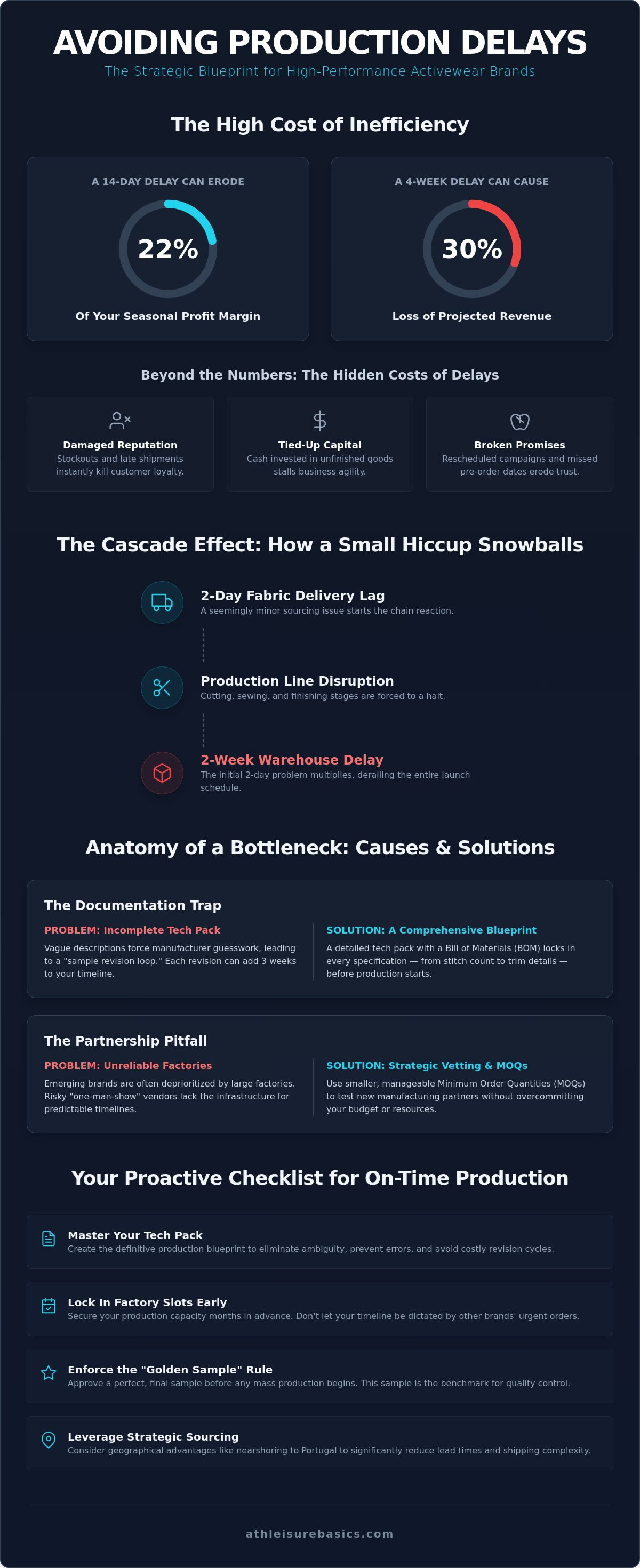
A 14-day delay in high-performance activewear production can erode as much as 22% of a seasonal profit margin in 2026. If you've ever watched a critical launch window slip away while your capital remains tied up in unfinished goods, you know that timing isn't just a logistical detail. It's the heartbeat of your brand's commercial success. It's frustrating to manage customer dissatisfaction due to out-of-stock items, especially when you've invested heavily in the creative process and market entry.
Mastering the art of avoiding production delays is about shifting from a reactive mindset to a proactive, structured approach to supply chain management. We're here to help you eliminate manufacturing bottlenecks so you can achieve predictable timelines and faster time-to-market for your new designs. This guide provides a strategic roadmap to stabilize your production cycle and protect your margins. We'll examine how precise tech pack development, ethical sourcing, and navigating the latest EU regulatory requirements can transform your operations into a reliable engine for long-term growth.
Key Takeaways
- Quantify the financial impact of missed launch windows and learn how consistent stock availability protects your brand reputation in the social media era.
- Identify the primary causes of manufacturing bottlenecks, such as incomplete tech packs, to master the art of avoiding production delays before the first stitch is sewn.
- Leverage the geographical advantages of nearshoring to Portugal to significantly reduce lead times and benefit from specialized regional manufacturing clusters.
- Implement a proactive production schedule by locking in factory slots months in advance and strictly adhering to the "Golden Sample" approval rule.
- Streamline your brand’s growth by choosing integrated manufacturing partners that offer real-time transparency and a smooth transition from private label to custom production.
The High Cost of Production Delays in the 2026 Fashion Market
A four-week delay in the delivery of a seasonal collection can result in a 30% loss of projected revenue. In the competitive 2026 fashion market, timing is often the difference between a successful sell-through and heavy discounting. When your inventory arrives late, you miss the peak demand period, forcing you to compete for attention when consumers have already moved on to the next trend. Avoiding production delays isn't just about logistics; it's a vital strategy for protecting your bottom line and ensuring your brand's financial health.
Brand reputation is another significant cost that's often overlooked. In the social media era, stockouts and late shipments kill customer loyalty instantly. If a customer sees an influencer wearing your design but finds it out of stock or delayed, they won't wait for your restock. They'll find a similar style from a competitor within minutes. This is why retailers like PeakMarket emphasize the importance of maintaining a diverse and consistent inventory of consumer goods. This loss of trust is difficult to rebuild and can stall your brand's growth before it truly begins. Reliable delivery is the foundation of a premium brand experience.
Beyond lost sales, there's the heavy opportunity cost of tied-up capital. Money spent on raw materials and deposits for unfinished goods is capital you can't use to market your current line or develop your next designs. Implementing robust supply chain management allows you to keep your capital moving. By transitioning from reactive firefighting to proactive production planning, you ensure that every dollar invested is working toward your next successful launch. Avoiding production delays keeps your cash flow liquid and your business agile.
Why Apparel Startups are Especially Vulnerable
Emerging brands often struggle with unorganized factories that prioritize larger clients. If a massive retailer places an urgent order, a smaller brand's production slot is frequently the first to be pushed back. Relying on "one-man-show" vendors who lack established infrastructure increases this risk significantly. However, using low MOQs strategically can mitigate these dangers. Smaller batches are easier to track and allow you to test manufacturing partners without overcommitting your resources or your budget.
The Ripple Effect: From Factory Floor to Customer Door
Production is a sequence of strict dependencies. A two-day lag in fabric delivery cascades through the cutting, sewing, and finishing stages, eventually turning into a two-week delay at the warehouse. This disruption forces you to reschedule marketing campaigns and can lead to broken pre-order promises. Having a thorough understanding of the garment production process is your best defense. It enables you to identify potential bottlenecks early and communicate transparently with your production partners and your customers.
The Root Causes of Manufacturing Bottlenecks in Clothing Production
Identifying why production stalls is the first step toward avoiding production delays. While many brands blame the factory floor, bottlenecks usually originate in the planning phase long before the first garment is cut. Incomplete documentation and material sourcing lags are the most common culprits in the 2026 market. McKinsey & Company provided an in-depth analysis on how current global volatility requires brands to be significantly more precise in their technical planning to maintain supply chain resilience.
The Documentation Trap: Why Your Tech Pack Matters
A tech pack serves as the definitive blueprint for your garment. When brands rely on general descriptions instead of technical specifications, manufacturers are forced to make assumptions. This leads to the dreaded sample revision loop, where you spend months correcting basic errors that should've been clarified on day one. Each revision can add three weeks to your timeline. Using a comprehensive tech pack ensures that every seam, stitch count, and measurement tolerance is locked in. You must also include a detailed Bill of Materials (BOM). A missing trim or a delayed shipment of custom buttons can stop a production line just as effectively as a fabric shortage.
Material Sourcing and Supply Chain Visibility
Relying on just-in-time fabric ordering is risky in the current climate. Global shipping remains volatile, and waiting for specialized OEKO-TEX® fabrics from distant suppliers can halt your production entirely. Choosing local European textiles drastically reduces raw material lead times and simplifies your logistics. You should identify long-lead items, such as custom-dyed yarns or branded hardware, early in the design phase. If you're feeling overwhelmed by these technical requirements, our clothing production consulting services can help you map out these dependencies and secure your supply chain.
The communication gap is another silent killer of productivity. In offshore manufacturing, a simple question about a zipper placement can result in a 24-hour delay due to time zone differences. These small interruptions accumulate, pushing your final delivery date back by weeks. Language barriers often complicate this further, leading to confirmed instructions that aren't actually understood on the factory floor. Pair this with unrealistic lead times, and you have a recipe for failure. Many vendors offer aggressive quotes to win your business, knowing they can't meet them. Trusting established partners who provide transparent, data-backed timelines is essential for avoiding production delays and maintaining a healthy launch schedule.
Reducing Lead Times Through Strategic Sourcing in Portugal
Geographical distance is a significant risk factor that many brands fail to quantify until a shipment is stuck at a port for weeks. When your manufacturing base is thousands of miles away, you lose the ability to intervene quickly when issues arise. Avoiding production delays is fundamentally easier when you nearshore your operations to a stable, proximate hub like Portugal. The country's textile industry is concentrated in Northern Portugal, creating a specialized cluster where fabric suppliers, printers, and sewing facilities operate in close proximity. This structure minimizes internal transit times and ensures that your materials aren't sitting in a warehouse waiting for cross-country transport.
Communication synergy is another critical benefit of European production. Working within similar time zones means you receive same-day responses to urgent queries. You don't have to wait 24 hours for a simple clarification on a stitch detail. Shared business standards and strict EU labor laws provide a level of ethical oversight that protects your brand. In an era where social compliance is non-negotiable, manufacturing in a region with transparent labor practices prevents the sudden factory shutdowns that often plague unmonitored offshore vendors. It's a partnership built on reliability rather than just cost-cutting.
Why Portugal is the Hub for Premium Athleisure
Portugal has built a global reputation for its expertise in technical knits and high-performance activewear. For emerging brands, the Made in Portugal seal provides a competitive edge in both brand positioning and operational speed. You can source high-quality, sustainable fabrics within a 50km radius of the production facility, which is vital for complying with the 2026 EU Ecodesign for Sustainable Products Regulation. This local access ensures that your supply chain remains agile and responsive to the fast-paced athleisure market.
The Logistics of Speed: From Porto to the World
The logistics of nearshoring offer a drastic reduction in lead times compared to traditional offshore models. While sea freight from Asia typically involves a 6-week lag, road freight from Porto can reach major European cities in less than a week. This speed is essential for avoiding production delays that can derail a seasonal launch. Nearshoring also minimizes customs complications through Intra-EU trade agreements, ensuring your goods move freely across borders without the unpredictable hold-ups often found at international ports. By cutting thousands of miles from your supply chain, you gain the certainty needed to launch on schedule.
A Proactive Checklist for Preventing Production Stoppages
Securing your manufacturing window 3 to 6 months in advance is the single most effective way of avoiding production delays. In 2026, high-quality factories are booked well ahead of peak seasonal windows. If you wait until your designs are finalized to search for a production slot, you've already lost your competitive edge. Proactive brands treat factory capacity as a limited commodity and lock it in early to ensure their place in the queue.
Buffer management is another essential tool for supply chain stability. You should always add a 20% buffer to any factory's estimated lead time. If a manufacturer quotes a 10-week turnaround, you should build your marketing calendar around 12 weeks. This cushion absorbs minor hiccups, such as machine maintenance or temporary transit lags, without jeopardizing your launch date. It's better to have stock sitting in your warehouse for two weeks than to have a marketing campaign running with no product to sell.
Maintaining visibility during the CMT process is vital for long-term success. You must implement a system for weekly production reports that track progress from the initial cutting stage to final finishing. This transparency allows you to spot potential issues before they become terminal bottlenecks. Finally, adhere strictly to the 'Golden Sample' rule. Never authorize bulk production without a physically signed-off prototype. This sample serves as the definitive quality benchmark for every piece that follows, preventing costly errors across the entire batch.
Phase 1: Pre-Production Readiness
Phase 2: During Production Monitoring
Implement a formal quality control check at the 20% production mark. This early audit catches systemic errors before the entire batch is completed. For brands new to the industry, having a dedicated production consultant is often the difference between a successful launch and a total loss. They act as your expert eyes and ears on the ground, ensuring standards are met. Most importantly, manage your design team to prevent change orders. Late-stage design tweaks are effectively delay suicide. Even a minor change to a pocket placement can reset the entire manufacturing timeline. If you need expert guidance to navigate these stages, our clothing production consulting services ensure your brand remains on track and on schedule.
Scaling with Certainty: The Athleisurebasics Integrated Approach
At Athleisurebasics, we recognize that the journey from a creative concept to a commercial collection is filled with technical hurdles. Our Portugal-based facility is designed to remove these barriers by offering an integrated approach that prioritizes speed, quality, and ethical standards. By centralizing our operations in the heart of Europe's textile hub, we provide the infrastructure necessary for avoiding production delays while maintaining the high-end craftsmanship your brand requires. We position ourselves as a dedicated ally, ensuring your transition from private label to custom manufacturing is seamless and transparent.
Our commitment to transparency is a core pillar of our service model. We provide real-time updates on your production status, allowing you to manage your marketing and launch calendars with absolute confidence. This visibility eliminates the "black hole" of offshore manufacturing where brands often lose track of their goods for weeks at a time. Additionally, our low MOQ flexibility allows you to scale at a pace that suits your capital. By offering accessible entry points, we reduce the financial risk of large-scale production errors and help you maintain a lean, agile inventory. You also gain direct access to premium, OEKO-TEX® certified fabrics sourced locally in Portugal, ensuring your products meet the highest environmental and safety standards.
Custom Manufacturing Without the Chaos
We help startups build bulletproof timelines through our specialized clothing production consulting services. Our team works with you to identify potential bottlenecks before they occur, providing expert guidance on everything from material lead times to seasonal factory capacity. To ensure technical precision, we offer in-house tech pack development support. This ensures that your blueprints are factory-ready, effectively avoiding production delays caused by sample revision loops. We've found that 250 pieces per style is the "sweet spot" for emerging brands, balancing the benefits of high-quality industrial production with the speed and agility needed to respond to market trends.
Launch Faster with White Label Solutions
If you need to enter the market quickly, our white label solutions allow you to bypass the traditional 6-month development cycle. By leveraging our luxury blanks, you can skip the prototyping phase and move straight to customization. Our pre-designed styles are engineered for performance and comfort, meeting the rigorous standards of the premium athleisure market. You can customize these existing silhouettes with your branding and unique trims in as little as 4-6 weeks. This accelerated timeline is an ideal strategy for testing new market segments or launching a foundational collection without the typical manufacturing lead times. Start your production journey with Athleisurebasics today.
Secure Your Brand's Growth with Reliable Manufacturing
Building a successful apparel brand in 2026 requires more than just creative vision; it demands operational excellence. By focusing on detailed technical documentation and leveraging the logistical advantages of nearshoring to Portugal, you can protect your seasonal margins. Avoiding production delays is possible when you shift from reactive troubleshooting to a structured, proactive supply chain strategy. Locking in your production slots early and maintaining high standards for material integrity ensures that your collections arrive exactly when your customers expect them.
Athleisurebasics is here to simplify these industrial complexities for you. We specialize in premium Portuguese manufacturing and offer OEKO-TEX® certified fabric sourcing to keep your brand compliant and high-quality. Whether you're interested in our custom services or looking for faster market entry with white label low MOQs starting at just 70 pieces, we provide the security you need to scale. Book a Production Consultation with Athleisurebasics to stabilize your timeline and launch with certainty. Your journey from a small idea to a lasting commercial presence starts with the right partner.
Frequently Asked Questions
What is the most common cause of clothing production delays?
The most common cause is incomplete or inaccurate technical documentation, specifically tech packs. When a factory lacks precise stitch details, measurements, or trim specifications, they must pause production to ask for clarification. These back-and-forth communications can add weeks to your timeline, often leading to missed seasonal launch windows and tied-up capital.
How can a tech pack help avoid manufacturing errors?
A tech pack acts as a definitive blueprint that defines every technical aspect of your garment. By specifying exact seam types, fabric weights, and measurement tolerances, you eliminate the need for factory guesswork. This precision significantly reduces the number of sample revision rounds required, which is a critical step in avoiding production delays and ensuring high quality control.
Is it faster to manufacture clothing in Portugal than in Asia?
Manufacturing in Portugal is typically faster for European brands due to geographical proximity and shorter transit times. While production in Asia often involves a 6-week sea freight journey, road freight from Portugal can reach major European hubs in less than a week. The concentration of specialized textile clusters in Northern Portugal also reduces internal material transit times significantly.
How much buffer time should I include in my production schedule?
You should include a minimum buffer of 20% on top of your manufacturer's estimated lead time. If a facility quotes a 10-week turnaround, plan your marketing and launch activities for a 12-week window. This cushion absorbs minor disruptions like machine maintenance or material shipping lags without forcing you to reschedule your entire collection launch or disappoint waiting customers.
Can low minimum order quantities (MOQ) reduce production risks?
Low MOQs reduce risks by allowing you to test manufacturing partners and market demand without a massive capital commitment. Smaller batches are easier to audit for quality control and are less likely to face significant delays caused by complex raw material shortages. This agility allows emerging brands to pivot quickly if a specific design requires technical adjustments or market changes.
What should I do if my manufacturer tells me there is a delay?
Immediately request a detailed root cause analysis and a revised, firm delivery date. Transparency is essential; you must determine if the delay is a one-time material shortage or a systemic factory issue. Once you have an updated timeline, communicate honestly with your customers to manage expectations and protect your brand's long-term reputation and customer satisfaction.
How do OEKO-TEX® certifications affect production timelines?
Sourcing OEKO-TEX® certified fabrics can add 2 to 4 weeks to your initial lead time because these specialized materials often require specific testing and certification verification. However, using these materials is vital for avoiding production delays related to the 2026 EU sustainability regulations. Investing this time upfront prevents your goods from being rejected at customs or banned from sale under new ecodesign rules.
What is the difference between CMT and full-service manufacturing for delays?
CMT (Cut, Make, Trim) manufacturing requires the brand to source and deliver all raw materials, which increases the risk of delays if your fabric supplier misses a deadline. In contrast, full-service manufacturing involves the factory managing the entire supply chain, including material sourcing. While full-service offers more convenience and streamlined communication, CMT provides greater control over material quality for brands with established sourcing partners.



Leave a comment
This site is protected by hCaptcha and the hCaptcha Privacy Policy and Terms of Service apply.