

How to Communicate With a Garment Factory: A Guide for Emerging Brands
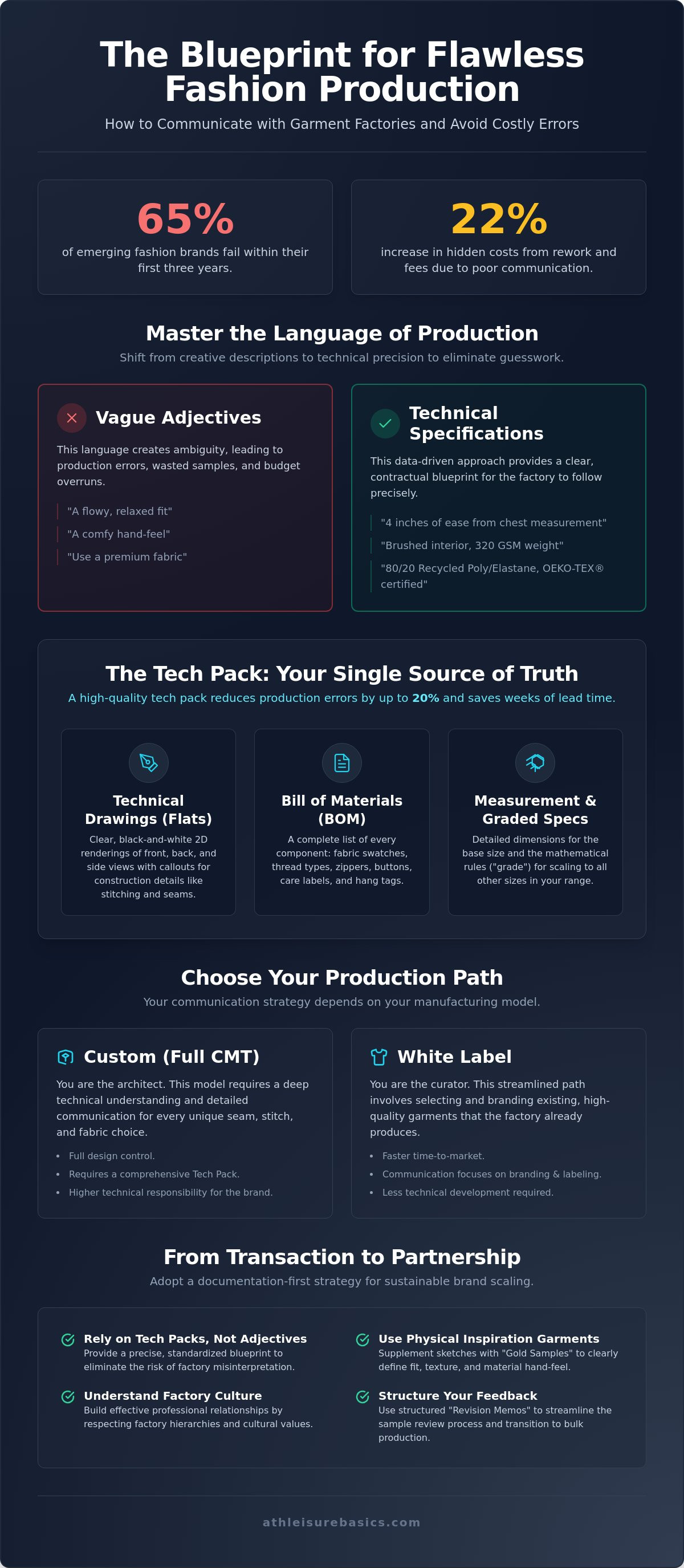
Did you know that 65% of emerging fashion brands fail within their first three years? Research indicates that poor communication at the start of a project often leads to a 22% increase in hidden costs from rework and air-freight fees. Learning how to communicate with a garment factory isn't just about exchanging emails; it's about mastering a professional, technical language that protects your budget and your creative vision.
It's natural to feel anxious about being misunderstood or overwhelmed by industry jargon like CMT, MOQ, and graded specs. You want a manufacturing partner who respects your designs, yet the fear of a production error wasting your limited capital is a constant pressure. This guide provides the professional protocols and technical requirements you need to turn your concepts into premium apparel without the stress of communication breakdowns. We'll walk through the relationship strategies and documentation standards that help you secure a professional manufacturing partnership, ensuring your samples match your vision on the first or second try. By the end of this article, you'll have the confidence to manage your production with the authority of an industry insider.
Key Takeaways
- Replace vague adjectives with a standardized tech pack to provide a precise blueprint that eliminates the risk of factory interpretation.
- Supplement your design sketches with physical inspiration garments to clearly define expectations for fit, texture, and material hand-feel.
- Build more effective professional relationships by understanding factory hierarchies and the specific cultural values of premium European manufacturing hubs.
- Learn how to communicate with a garment factory through structured Revision Memos that streamline the transition from initial samples to bulk production.
- Transition from a simple transaction to a collaborative partnership by adopting a documentation-first strategy that supports sustainable brand scaling.
Mastering the Language of Production: Why Preparation is Everything
Knowing how to communicate with a garment factory begins with a mindset shift from creative description to technical precision. In the apparel industry, the language of fashion isn't descriptive; it's data-driven. Using vague adjectives like "flowy," "comfy," or "premium" creates room for interpretation that lead to production errors. Factories operate on measurements, tolerances, and material specifications. If you describe a fit as "relaxed," a pattern maker in a different country might interpret that as two inches of ease, while you intended four. This gap is where most emerging brands lose their budget to rework.
Professional preparation signals to a manufacturer that you're a serious, long-term partner rather than a hobbyist. High-end factories prioritize clients who minimize their operational friction. By providing standardized documentation, you prove that you understand the industrial process. Before diving into design, understanding the textile manufacturing process helps you grasp how fibers become finished goods, allowing you to ask better questions and set realistic expectations for your production team.
The Essential Components of a Professional Tech Pack
In 2026, the Tech Pack remains your most vital communication tool. It functions as a single source of truth for everyone on the factory floor. Research shows that a high-quality tech pack can reduce production errors by 20%, saving weeks of lead time. A Tech Pack is the contractual blueprint for your garment. A professional document must include:
- Technical Drawings (Flats): Clear, black-and-white 2D renderings showing front, back, and side views with callouts for specific construction details.
- The Bill of Materials (BOM): A comprehensive list of every component required, including fabric swatches, thread types, zippers, buttons, and brand labels.
- Measurement Charts and Graded Specs: Detailed dimensions for your base size and the mathematical "grade" for scaling up or down to other sizes.
Communicating for Custom vs. White Label Manufacturing
The way you approach a factory depends on your chosen production model. Custom manufacturing, or Full CMT (Cut, Make, Trim), requires you to dictate every unique seam, stitch type, and fabric weight. You're responsible for the technical integrity of the design. Conversely, White Label communication is more streamlined. It focuses on branding, labeling, and selecting from existing, high-quality blanks that the factory already produces. This path is often faster and requires less technical development from the brand owner. Whether you're looking for full custom development or premium Athleisurebasics support, choosing the right path depends on your technical expertise and budget. Effective production management relies on how to communicate with a garment factory through these standardized models to ensure your vision translates perfectly to the final product.
Defining Every Detail: Moving Beyond Basic Sketches
A common mistake for emerging brands is relying on artistic sketches to convey complex designs. While a sketch captures the aesthetic vision, it lacks the technical depth required for an industrial production line. Without specific data, the factory floor is forced to interpret your intentions. This ambiguity often results in samples that miss the mark, wasting both time and capital. Mastering how to communicate with a garment factory requires a shift from visual concepts to precise technical specifications.
Physical references are among the most effective ways to eliminate guesswork. Sending "inspiration garments" or "Gold Samples" allows the manufacturer to touch and measure an existing product that matches your desired fit and hand-feel. This tangible reference point provides a baseline for texture, drape, and construction that a digital file cannot fully replicate. It bridges the gap between your creative vision and the reality of textile engineering.
Sourcing and Material Communication
Describing the performance characteristics of athleisure fabrics, such as moisture-wicking properties or compression levels, requires technical terminology. In Portugal, the textile industry is renowned for high-quality craftsmanship and ethical standards, making it a preferred hub for luxury brands. Your material choices directly dictate your final retail price point. If you are unsure which technical fabrics align with your brand's luxury positioning, working with a partner like Athleisurebasics can simplify the sourcing process through expert consulting and materials support.
The Importance of Clear Labeling and Branding Specs
Branding extends beyond the garment's silhouette. You must provide exact placement coordinates for neck labels, care labels, and hangtags. Compliance is a non-negotiable factor; your labels must adhere to U.S. import regulations and EU standards regarding fiber content and country of origin. Finally, specify your desired branding techniques, whether you prefer the tactile depth of 3D Puff embroidery or the high detail of Direct-to-Garment (DTG) printing. Clear documentation ensures your branding remains consistent across every production run, further refining how to communicate with a garment factory for long-term success.
Professional Etiquette and Relationship Building with Factory Managers
Successful production relies on identifying the correct points of contact within a factory's hierarchy. In most professional facilities, you'll interact with an Account Manager for logistics and a Production Manager for technical execution. Directing technical questions to the sales team or logistical concerns to the floor manager creates bottlenecks. Understanding how to communicate with a garment factory effectively means respecting these boundaries to ensure information flows to the right department without distortion.
Cultural intelligence is a significant competitive advantage when manufacturing in Europe. Portuguese manufacturing culture deeply values transparency, craftsmanship, and mutual respect. Unlike high-volume hubs that prioritize speed above all else, Portuguese partners view themselves as an extension of your brand. This relationship is strengthened by financial reliability. On-time payments are the most direct way to signal your professionalism. Factories operate on tight margins; consistent, prompt financial communication ensures your brand remains a high-priority client during peak seasons.
Setting realistic timelines is equally vital. The entire process from initial inquiry to final delivery typically takes between 16 and 24 weeks. Attempting to rush this timeline without understanding the factory's existing capacity often leads to friction. Professional brands align their calendars with seasonal peaks and respect the factory's internal scheduling.
Establishing a Communication Rhythm
Choosing the right channel is essential for maintaining clarity. Use email for formal records, tech pack updates, and financial agreements. Use instant messaging platforms like WhatsApp or Slack for quick, informal status checks. While you should avoid micromanagement, over-communicating technical details is better than making assumptions, especially before the first sample is approved. Always account for time zones and local Portuguese holidays to avoid sending urgent requests when the facility is closed.
Managing Conflicts and Production Delays
Errors are an inevitable part of complex manufacturing. When a mistake occurs, adopt a solution-first approach. Instead of assigning blame, ask the factory for their expert recommendation on how to rectify the issue. This demonstrates that you value their technical expertise. Maintaining a professional tone during delays preserves the partnership for future collections. This collaborative spirit is increasingly important as new EU supply chain directives require higher levels of transparency and cooperation between brands and manufacturers. Learning how to communicate with a garment factory through a lens of partnership rather than conflict will always yield better long-term results.
Managing the Feedback Loop: From Prototypes to Bulk Production
The sampling phase is where your technical preparation meets physical reality. It's rare for a "First Fit" sample to be perfect on the first attempt. This stage functions as a diagnostic tool designed to identify gaps between your tech pack and the factory's execution. Understanding how to communicate with a garment factory during this phase requires a structured feedback framework known as a Revision Memo. This document replaces subjective comments with objective data, ensuring the production manager understands exactly what needs to change.
A successful Revision Memo relies on precise photo documentation. Don't simply tell a factory that a garment "fits poorly." Instead, take high-resolution images of the sample on a fit model. Use digital annotations like arrows and text boxes to point out specific tension lines, pulling, or sagging. Pair these images with the original measurement specs from your tech pack to show exactly where the deviation occurred. The Pre-Production (PP) sample is your final checkpoint. Once you approve this version, it becomes the "Gold Sample" that governs the entire bulk run. Any communication errors at this stage will be magnified across your entire inventory, making clarity your highest priority.
How to Evaluate and Critique a Sample
Begin by measuring the garment against your original tech pack. If your spec called for a 50cm chest width and the sample measures 52cm, document the variance immediately. Beyond measurements, test the performance of the fabric. For premium athleisure, check the four-way stretch, recovery after tension, and opacity. Inspect the internal finish with an expert eye. Look for consistent overlock stitches, secure seam tape, and the absence of loose threads. These details define the high standards of luxury apparel.
The Approval Process: Getting it in Writing
Bulk production should never begin without explicit, written "Final Approval." This protects both your brand and the manufacturer from costly misunderstandings. You must also manage "Graded Samples" to ensure fit consistency across the entire size range. Small errors in the base size can lead to significant distortions in an XL or XS. Following a detailed garment production process ensures that quality control remains a constant through-line from the first prototype to final delivery. If you need assistance refining your sampling strategy or developing a professional feedback loop, Athleisurebasics provides the technical consulting needed to ensure your vision translates perfectly to the final product.
Streamlining Your Brand’s Success with Athleisurebasics’ Communication Model
Athleisurebasics operates as a dedicated consultant-partner rather than a traditional vendor. We recognize that for many founders, learning how to communicate with a garment factory is the most significant barrier to market entry. Our model is built specifically to bridge this gap, providing the technical expertise needed to turn a creative vision into a commercial reality. By offering end-to-end support, we manage the complexities of Tech Pack development and material sourcing, allowing you to focus on scaling your brand. This collaborative approach ensures that technical requirements are met with precision from the very first inquiry.
We prioritize accessibility through low MOQ flexibility, which is a central theme of our service model. This approach allows startups to test the market and scale their operations organically without the financial burden of excessive inventory. Our production consulting services ensure that even if you're new to the apparel industry, you have a knowledgeable ally helping you navigate technical choices, material integrity, and logistical hurdles. We don't just manufacture clothes; we provide a structured roadmap for your brand's long-term commercial presence.
Why Manufacturing in Portugal Simplifies Communication
Portugal is a global leader in premium apparel manufacturing because of its unwavering commitment to craftsmanship and ethical standards. For international brands, the proximity to European markets and shared business hours facilitate a seamless communication rhythm. Portuguese facilities are known for high English proficiency, which effectively eliminates the risk of technical details being lost in translation. This cultural and linguistic alignment ensures that your production remains transparent and compliant with evolving EU business standards. Choosing this region means you're investing in a quality seal that resonates with luxury consumers. To understand the full scope of these regional advantages, you can learn more about why clothing manufacturers portugal are the top choice for premium brands.
Getting Started: Your First Inquiry
Your first email sets the professional tone for the entire manufacturing partnership. To receive an accurate quote and demonstrate your brand's readiness, you should include your Tech Pack, desired quantities, and specific fabric requirements like GSM and composition. If you don't have these documents ready, our production consulting services can guide you through the development phase to create a professional blueprint. We provide a clear path from your initial inquiry to final delivery, ensuring every stitch meets your high standards. Mastering how to communicate with a garment factory shouldn't be a source of anxiety; it should be the foundation of your success. Our team is ready to help you navigate this journey with confidence and technical authority.
Contact Athleisurebasics for a custom manufacturing quote today.
Scale Your Brand With Professional Production Management
Transitioning from a creative concept to a commercial collection requires more than just vision; it demands technical discipline. By mastering how to communicate with a garment factory through standardized tech packs and objective revision memos, you eliminate the ambiguity that leads to production errors. Professionalism in your documentation and etiquette signals to high-end manufacturers that your brand is ready for a long-term, scalable partnership.
Athleisurebasics is dedicated to simplifying this industrial journey for emerging entrepreneurs. We provide expert production consulting and end-to-end support to ensure your first collection meets premium standards. Our facilities specialize in low MOQ flexibility for startups and utilize OEKO-TEX® certified premium fabrics to protect your brand's integrity. You don't have to navigate the complexities of manufacturing alone.
Start your production journey with Athleisurebasics – Enquire Now
Take the first step toward building a lasting commercial presence today. Your designs deserve the precision of expert craftsmanship.
Frequently Asked Questions
What is the most common communication mistake new clothing brands make?
The most frequent error is relying on subjective, descriptive language instead of technical data. Terms like "soft" or "oversized" are open to interpretation by the factory floor. Successful brands provide a detailed Tech Pack with specific measurements, fabric weights in GSM, and Pantone color codes. This technical precision removes guesswork and ensures the final product aligns with your creative vision.
Do I need a fashion degree to talk to a garment factory?
You don't need a formal degree to work with a manufacturer, but you must understand industrial terminology. Familiarizing yourself with concepts like CMT (Cut, Make, Trim) and the Bill of Materials (BOM) is essential. Leveraging professional production consulting services can also bridge the gap, allowing you to manage the process with the authority of an industry insider.
How often should I check in with my production manager during bulk manufacturing?
A weekly status update is the professional standard for most bulk production runs. Daily check-ins can disrupt the factory's operational flow and lead to communication fatigue. Establish a clear reporting rhythm at the start of the project. Use email for formal documentation and reserve instant messaging for urgent, time-sensitive queries that require immediate attention.
What should I do if the sample I received doesn't match my tech pack?
Document the discrepancies immediately using an objective Revision Memo. Use high-resolution photos with digital annotations to show exactly where the garment deviates from your original specifications. Compare the physical measurements against your graded specs and present this data to your production manager. This solution-oriented approach helps the factory identify and correct the error in the next sampling round.
Is it better to communicate via phone calls or email with a factory?
Email is the superior channel for technical specifications and financial agreements because it creates a permanent record. While phone calls are useful for building rapport or resolving complex conflicts, you must always follow up with a written summary. Maintaining a documented paper trail is a critical part of how to communicate with a garment factory to ensure accountability for both parties.
How do I communicate my brand's sustainability requirements to a manufacturer?
Specify your required environmental certifications, such as OEKO-TEX® or GOTS, directly within your Bill of Materials. Professional manufacturers in premium regions like Portugal are highly experienced with these standards. Requesting specific sustainable fiber compositions and ethical labor documentation ensures that your brand's principled values are technically integrated into every stage of the manufacturing process.
What information does a factory need to give me an accurate price quote?
A manufacturer requires a completed Tech Pack, estimated order quantities, and your desired production timeline. Providing a comprehensive list of trims, hardware, and fabric specifications allows the factory to calculate material and labor costs with precision. Without these technical details, any quote you receive will be a rough estimate that is likely to change once production begins.
Can a factory help me create my tech pack if I only have a sketch?
Full-service manufacturers often provide tech pack development as part of their end-to-end consulting services. While a sketch captures your aesthetic vision, the factory will help translate it into technical drawings and graded specs. This collaborative step is a vital part of how to communicate with a garment factory and ensures your design is optimized for industrial production.



Leave a comment
This site is protected by hCaptcha and the hCaptcha Privacy Policy and Terms of Service apply.