

The Value of the 'Made in Europe' Tag: A Strategic Asset for Clothing Brands in 2026
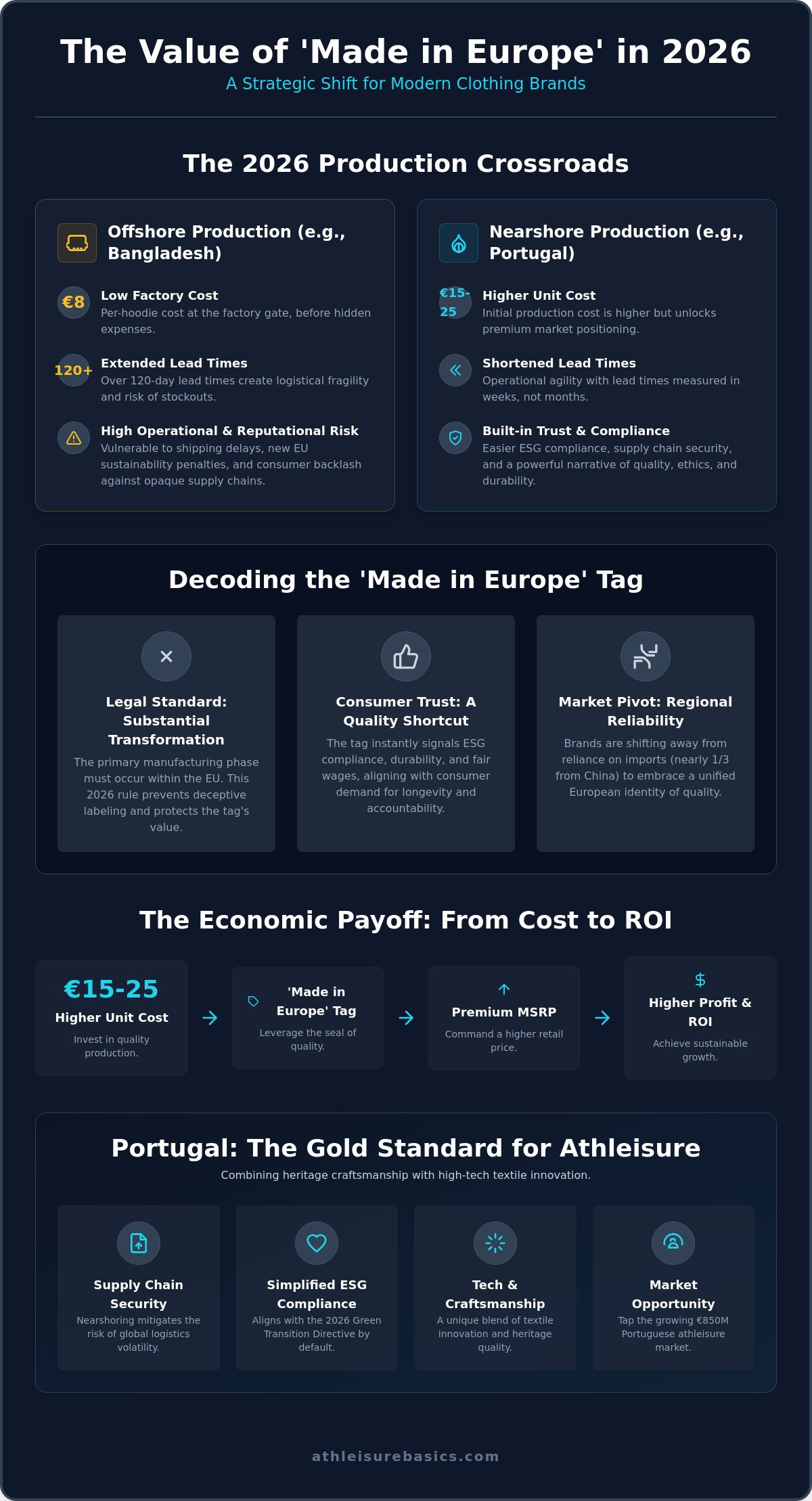
In 2026, a hoodie manufactured in Bangladesh might cost €8 at the factory gate, but the hidden costs of 120-day lead times and new EU sustainability penalties can quickly erase those margins. You've likely felt the sting of stockouts caused by shipping delays or the growing consumer backlash against opaque global supply chains. The pressure to remain ethical while maintaining a healthy bottom line has never been higher for emerging clothing brands. Understanding the value of 'made in europe' tag is no longer just about luxury branding; it's a critical de-risking strategy for your business's future.
We're here to show you how shifting production closer to home transforms your brand's operational agility and ethical credibility. You'll discover how to justify premium pricing to your customers while ensuring full compliance with the September 2026 Green Transition Directive. This guide previews the strategic shift toward regional manufacturing hubs like Portugal, where shorter lead times and transparent labor standards help you build a resilient, high-quality brand that's ready to scale in a regulated market. By the end of this article, you'll have a clear roadmap for leveraging European craftsmanship to secure your place in the future of fashion.
Key Takeaways
- Understand the legal criteria of "substantial transformation" to ensure your labels meet 2026 EU standards and avoid regulatory penalties.
- Discover how to maximize the value of 'made in europe' tag to command premium pricing and significantly improve your brand's profit margins.
- Secure your supply chain by utilizing nearshoring advantages that reduce lead times and mitigate the risks of global logistics volatility.
- Simplify your compliance with 2026 ESG regulations by partnering with regional manufacturers that prioritize ethical production and environmental transparency.
- Learn why Portuguese factories are the strategic choice for brands looking to combine high-tech textile innovation with heritage craftsmanship.
What Does the 'Made in Europe' Tag Mean in 2026?
In 2026, the "Made in Europe" label has evolved from a simple geographical indicator into a comprehensive trust signal. It represents a commitment to high manufacturing standards, environmental stewardship, and supply chain transparency. For emerging brands, the value of 'made in europe' tag lies in its ability to communicate these complex values instantly to a discerning market. While the industry saw a flood of imports in previous years, with nearly one-third of garments sold in Europe originating from China according to 2026 EURATEX data, the mid-2020s have seen a sharp pivot toward regional pride. Brands are moving away from country-specific marketing to embrace a broader European identity that signifies reliability across the entire continent.
Legal Standards and Provenance
Understanding the technicalities of Country of origin labeling rules is essential for any brand owner. The 2026 revision of the EU Textile Labelling Regulation has tightened these definitions to prevent deceptive practices. It's no longer enough to simply sew a button on an imported garment to claim European origin. The value of 'made in europe' tag is protected by the requirement for "substantial transformation," meaning the garment must undergo its primary manufacturing phase within the EU. In 2026, the legal threshold for the 'Made in Europe' tag requires that the final, substantial, and economically justified process of garment assembly occurs within the European Union's borders. This clarity helps eliminate the "greenwashing" that plagued the industry earlier in the decade, providing a clear legal framework for your brand's claims.
The Trust Factor: Consumer Psychology
Consumer psychology in 2026 is driven by a demand for longevity and ethical accountability. Fast fashion's reputation has suffered significantly since the Empowering Consumers for the Green Transition Directive began applying in September 2026. This directive bans sustainability labels that aren't backed by certified schemes. Because European factories are already subject to these strict regional regulations, the label itself acts as a psychological shortcut for ESG compliance.
The impact of this label extends to the physical unboxing experience. When a customer sees the tag, it confirms the brand's narrative of durability and fair wages. 2026 market trends show that consumers are increasingly willing to pay more for transparent supply chains. They associate European manufacturing with a lower environmental cost and higher craftsmanship. This shift isn't just about aesthetics; it's about the security of knowing a garment was produced under humane conditions and will last for years rather than weeks. By leveraging this trust, you can build a more resilient brand story that resonates with the modern, conscious shopper.
The Economic Value: Premium Pricing and ROI
In 2026, many brands view manufacturing costs through a narrow lens, focusing only on the price per unit. This approach ignores the value of 'made in europe' tag as a tool for increasing your Manufacturer's Suggested Retail Price (MSRP). While a hoodie might cost €15 to €25 to produce in Portugal compared to a lower base price in Bangladesh, the "European Premium" allows you to position your brand in a higher market tier. Consumers in the streetwear and athleisure sectors don't just see a garment; they see a commitment to quality that justifies a significantly higher retail price. When you produce locally, you aren't just buying fabric and labor; you're acquiring a narrative that lowers your customer acquisition costs (CAC) through built-in trust and prestige.
MSRP vs. Production Cost: The Real Margin
The markup potential for European garments often exceeds that of offshore alternatives because the label functions as a luxury seal. For instance, made in portugal clothing is now the industry standard for high-end jersey and activewear. This regional reputation allows you to move away from the "race to the bottom" on pricing. Instead of competing with fast-fashion giants, you can target the growing €850 million Portuguese athleisure market where consumers prioritize durability. By positioning your brand as a premium choice, you protect your margins from the inflationary pressures affecting global shipping. If you're looking to scale, our team can help you optimize your production strategy to capture these higher margins from day one.
Lowering Total Cost of Ownership (TCO)
A true ROI calculation must account for the hidden costs of offshore manufacturing. Long lead times often result in "dead stock" because trends shift before the container arrives. By utilizing smaller, more frequent production runs, you keep your inventory lean and responsive to real-time demand. This agility is vital for meeting the goals of the EU Strategy for Sustainable and Circular Textiles, which increasingly penalizes brands for overproduction and textile waste.
- Reduced Shipping and Duties: Intra-EU trade eliminates the complex import taxes and high maritime freight costs associated with Asian factories.
- Quality Control: Proximity allows for easier oversight, reducing the percentage of defective units that can't be sold.
- Cash Flow Management: Low minimum order quantities (MOQs) mean you don't have to sink your entire capital into a single massive shipment.
Manufacturing within Europe ensures your stock arrives in days rather than months, effectively reducing the amount of capital tied up in transit. This liquidity allows you to reinvest in marketing or product development faster than your competitors. Beyond manufacturing, many businesses also rely on Wholesale B2B Fashion Distribution to source high-quality branded stock lots, further diversifying their inventory while maintaining efficiency. Ultimately, the value of 'made in europe' tag is found in this combination of higher perceived value and a more efficient, less wasteful business model.
Supply Chain Security vs. Global Volatility
Global logistics in 2026 remain unpredictable, with maritime bottlenecks and shifting trade policies making long-distance sourcing a high-risk gamble. For brands that rely on seasonal hits, a delay of just three weeks can result in missed windows and heavy discounting. This environment is where the value of 'made in europe' tag shifts from a marketing asset to a fundamental survival strategy. Nearshoring production within the EU provides a buffer against geopolitical trade wars and shipping disruptions that frequently plague Asian supply routes. By moving manufacturing closer to your primary market, you replace vulnerability with operational agility.
Proximity and Lead Times
The most immediate advantage of European manufacturing is the drastic reduction in transit time. While ocean freight from Asian hubs typically requires six weeks or more, European road logistics can deliver finished goods to your warehouse in under two weeks. This speed allows you to react to 2026 fashion trends in real-time rather than guessing demand months in advance. The garment production process is inherently more efficient when communication happens in the same or adjacent timezones. You don't have to wait 24 hours for an email response regarding a pattern adjustment. Faster restocks directly impact your annual revenue growth by ensuring your bestsellers are never out of stock for long, keeping your customers engaged and your cash flow moving.
Quality Control and Physical Access
Oversight is the cornerstone of brand integrity, and proximity makes that oversight accessible. Performing on-site inspections shouldn't require intercontinental travel or expensive third-party agencies. When your factory is a short flight away, you can verify the consistency of a textile batch or the precision of a technical seam firsthand. This level of access ensures that the final product matches your tech pack exactly, reducing the risk of costly bulk defects.
- Direct Collaboration: Work alongside factory managers to refine fit and finishing without the barrier of extreme distance.
- Artisan Partnerships: Build long-term relationships with European artisans who take pride in heritage craftsmanship and material integrity.
- Transparent Standards: Verify labor conditions and environmental practices personally to ensure they align with your brand's ethical promises.
This physical connection fosters a partnership-driven approach rather than a purely transactional one. European manufacturers often act as collaborators, offering technical advice that improves product durability and performance. By securing your supply chain through regional manufacturing, you protect your brand from the volatility of global shipping while maintaining the high standards your customers expect in 2026.
Ethical and Environmental Compliance in 2026
Compliance in 2026 is no longer an optional badge of honor; it's a mandatory requirement for market entry. The 2026 EU Corporate Sustainability Due Diligence Directive (CSDDD) requires brands to identify and mitigate environmental and social risks across their entire supply chain. the value of 'made in europe' tag lies in its ability to simplify this complex process. Because European factories operate under the world's most stringent environmental and labor laws, sourcing within the EU provides an immediate baseline of compliance. This regional alignment also prepares your brand for the upcoming Digital Product Passport (DPP) mandate, which will require detailed traceability for every garment sold in the Union.
Adopting European manufacturing allows you to leverage established certifications like OEKO-TEX® and GOTS, which are native to the region's production ecosystem. These aren't just labels; they are proof of a transparent journey from raw material to finished product. If you're ready to align your production with these high standards, explore our custom clothing manufacturing services to secure your supply chain's future.
Labor Standards and Human Rights
In an era of instant social media accountability, your brand's reputation is only as strong as your factory's labor practices. Sourcing within Europe guarantees that your products are made by workers protected by EU law, ensuring fair wages, regulated working hours, and safe conditions. This ethical foundation protects your business from the PR crises and "cancel culture" movements that frequently target brands linked to exploitative global factories. Stringent EU labor laws act as a regulatory insurance policy that safeguards your brand's reputation against the ethical failures often found in unregulated global markets.
Sustainable Manufacturing Practices
Environmental impact is now a core metric for consumer purchasing decisions. Manufacturing in European textile hubs significantly reduces your carbon footprint by utilizing localized logistics and renewable energy grids. Furthermore, European facilities must adhere to strict water treatment and chemical management standards, preventing the toxic runoff common in less regulated regions.
- Chemical Safety: Use OEKO-TEX® certified fabrics to ensure your garments are free from harmful substances, a critical factor for premium athleisure brands.
- Carbon Reduction: Truck-based logistics within the EU emit significantly less CO2 than transcontinental maritime or air freight.
- Resource Efficiency: Many European factories now integrate solar power and water recycling systems as standard practice to meet 2026 ESG targets.
By choosing regional production, you aren't just buying a product; you're investing in a manufacturing process that respects the planet. This commitment to sustainability becomes a powerful marketing tool, allowing you to speak authentically to a customer base that values environmental integrity as much as style. the value of 'made in europe' tag is ultimately measured by this long-term brand safety and the trust it builds with your community.
Manufacturing in Portugal: The Gold Standard for Athleisure
Portugal has emerged as the definitive hub for clothing brands that prioritize agility, quality, and ethical transparency. While other regions focus on traditional luxury, clothing manufacturers portugal have secured their dominance in the technical apparel and athleisure sectors. This success is rooted in a unique industrial "cluster" located primarily in Northern Portugal. Within this ecosystem, spinning mills, dye houses, and sewing facilities operate in close proximity, driving an level of operational efficiency that is difficult to replicate elsewhere. For a new venture, the value of 'made in europe' tag is realized most effectively through this integrated network, which seamlessly balances heritage craftsmanship with state-of-the-art textile innovation.
The Portuguese Advantage
Portuguese factories are world-renowned for their specialization in jersey, fleece, and high-performance technical fabrics. This expertise makes them the natural choice for a market that increasingly demands both comfort and durability. By sourcing in Portugal, you gain immediate access to OEKO-TEX® certified production, ensuring your garments meet the strict environmental and chemical safety standards required in 2026. The ability to pivot quickly is a core feature of this region; lead times of 4 to 8 weeks allow you to restock bestsellers while the trend is still peaking. This speed, combined with the "Made in Portugal" seal, positions your brand as a premium player in the competitive athleisure landscape.
Partnering with Athleisurebasics
Athleisurebasics acts as your dedicated ally in the Portuguese manufacturing landscape. We recognize that high entry barriers often prevent innovative ideas from reaching the market. Our service model is designed to remove these obstacles by offering accessible production volumes that empower emerging brands to scale at their own pace. We provide a sense of security and capability by simplifying the transition from a design concept to a finished, retail-ready product.
- Custom Clothing Manufacturing: Develop unique designs from scratch with manageable 250-piece minimum order quantities (MOQs).
- White Label Clothing: Launch your brand faster by utilizing our luxury blanks, available with MOQs as low as 70 pieces.
- End-to-End Support: Benefit from our expertise in tech pack development and materials sourcing support to ensure your vision is executed perfectly.
We believe in building long-term relationships rather than simple transactions. Our commitment to transparency and quality ensures that your brand's growth is built on a solid, ethical foundation. In 2026, the value of 'made in europe' tag represents your most strategic asset for building trust and securing your supply chain. Start your European production journey with Athleisurebasics today and create a lasting commercial presence defined by excellence and integrity.
Future-Proof Your Brand with Strategic Regional Manufacturing
Transitioning your production to Europe is no longer a luxury; it's a necessary step to ensure long-term growth and regulatory compliance. By prioritizing nearshoring, you eliminate the risks of global shipping volatility while gaining the agility to react to 2026 market shifts in real-time. You've seen how the value of 'made in europe' tag translates directly into higher pricing power and consumer trust. This label serves as a shorthand for ethical integrity and high-end craftsmanship, positioning your brand in a premium tier that justifies your investment.
Athleisurebasics is your dedicated partner in this journey. We specialize in premium athleisure and offer OEKO-TEX® certified manufacturing in Portugal to guarantee the highest industry standards. Our end-to-end support model includes low MOQs starting at just 70 pieces, making high-quality production accessible for emerging businesses ready to scale. Request a Custom Manufacturing Quote from Athleisurebasics today to start building a resilient, ethical supply chain. We're ready to help you transition your vision into a lasting commercial presence.
Frequently Asked Questions
Is 'Made in Europe' better than 'Made in China' for a startup?
European production is often superior for startups that prioritize speed to market and lower inventory risk. While unit costs in China may be lower, European factories offer significantly shorter lead times and accessible minimum order quantities. This allows emerging brands to test designs and restock bestsellers in weeks rather than months, preserving vital cash flow during the early stages of growth.
What are the legal requirements to use the 'Made in Europe' label?
To legally use the label, a garment must undergo its last substantial transformation within an EU member state. This means the primary manufacturing process, such as the assembly of the garment, must take place in Europe. Simply adding finishing touches or labels to an imported product does not meet the legal threshold for European origin under current customs regulations.
How does the 'Made in Europe' tag affect my clothing brand's pricing?
The tag functions as a luxury seal that allows your brand to command higher retail prices. Highlighting the value of 'made in europe' tag justifies a premium MSRP by signaling superior craftsmanship and ethical production to your customers. In the 2026 market, consumers are increasingly willing to pay more for the durability and transparency associated with regional manufacturing hubs.
Does 'Made in Europe' guarantee ethical labor practices?
Manufacturing within the European Union ensures that your production adheres to some of the world's most stringent labor laws. These regulations mandate fair wages, regulated working hours, and safe conditions for all employees. While you should always perform due diligence, the legal framework in Europe provides a level of brand safety and ethical assurance that is often missing in unregulated global markets.
Can I use the 'Made in Europe' tag if only the assembly is done in the EU?
Yes, you can use the tag if the assembly constitutes a substantial transformation of the materials. Under EU law, the country of origin is defined by where the final, economically justified manufacturing stage occurred. If your tech pack is executed and the garment is sewn within the EU, it qualifies for the label, even if the raw fabrics were sourced from outside the continent.
How much more does it cost to manufacture clothing in Europe vs. Asia?
Direct unit costs are typically higher in Europe, but the total cost of ownership is often comparable for modern brands. When you factor in the elimination of import duties, lower shipping costs, and reduced waste from smaller production runs, the price gap narrows significantly. Many brands find that the ability to restock quickly and avoid dead stock provides a better return on investment.
What are the specific benefits of manufacturing in Portugal for athleisure?
Portugal offers a specialized industrial cluster that excels in technical performance fabrics and high-quality jersey. The concentration of spinning mills and sewing facilities in Northern Portugal drives operational efficiency and ensures consistent quality. Portuguese manufacturers are also known for their flexibility, offering the low MOQs that emerging athleisure brands need to scale their operations responsibly.
Will a 'Made in Europe' tag help my brand comply with new EU regulations?
Sourcing within the EU significantly simplifies your compliance with the 2026 Corporate Sustainability Due Diligence Directive. Because regional factories already follow EU environmental and social mandates, you have the necessary documentation for future requirements like the Digital Product Passport. This alignment maximizes the value of 'made in europe' tag by serving as a comprehensive de-risking tool for your business.



Leave a comment
This site is protected by hCaptcha and the hCaptcha Privacy Policy and Terms of Service apply.