
How to Start a Clothing Brand in 2026: The Definitive Guide for Ambitious Entrepreneurs
In 2026, the era of disposable fashion is officially over; your brand's survival now depends on ethical integrity and regulatory compliance rather than just aesthetic appeal. With the suspension of the $800 de minimis duty exemption and new laws like California’s SB 707, the barrier to entry has shifted. You likely realize that a creative vision isn't enough without a structured clothing brand business plan that accounts for these global supply chain changes. It's natural to feel overwhelmed by industry jargon like CMT or MOQ, especially when you're searching for a manufacturing partner that offers premium quality without demanding massive initial orders.
We understand the risks involved in moving from a technical concept to a finished product. This guide provides a comprehensive roadmap for ambitious entrepreneurs, offering a clear launch checklist and insights into ethical material sourcing. You'll discover how to leverage the craftsmanship of Portuguese manufacturing and find a partner that supports your growth. We'll show you exactly how to navigate the complexities of production so you can focus on building a lasting commercial presence.
Key Takeaways
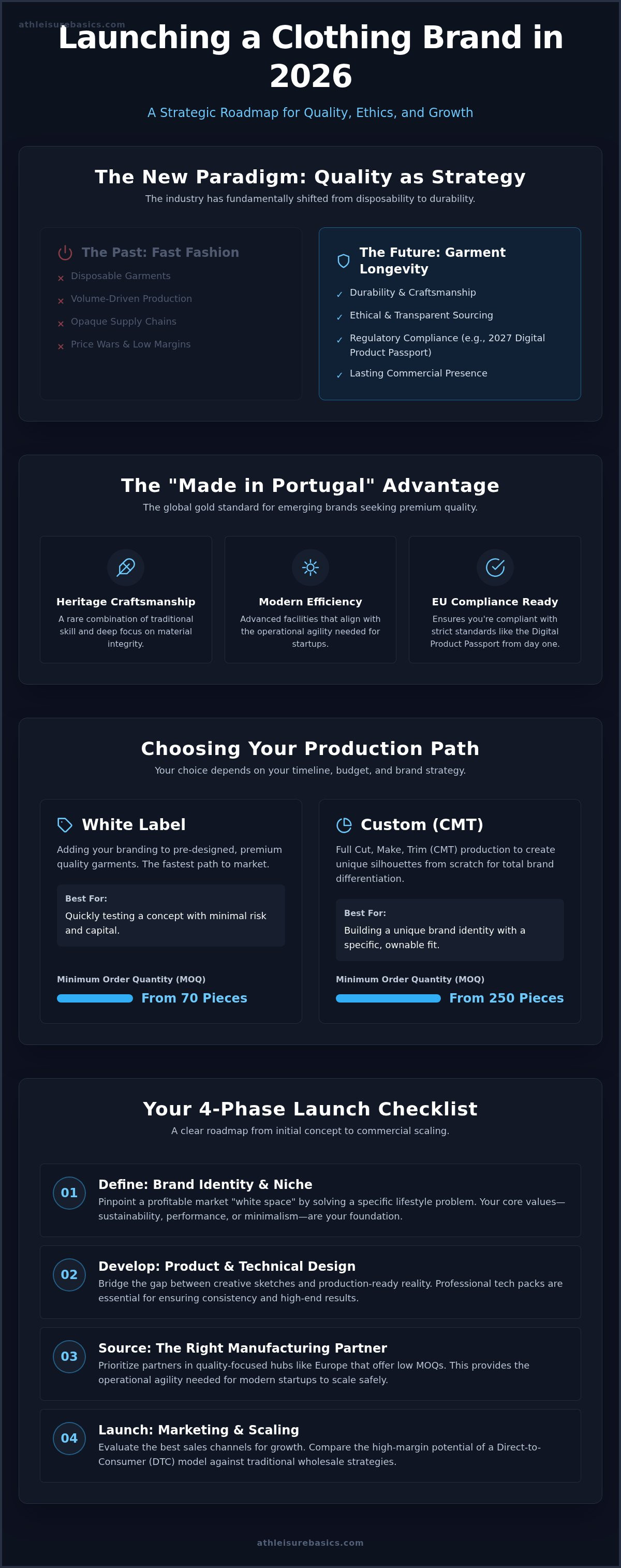
- Understand the 2026 shift toward garment longevity and why "Made in Portugal" serves as a global gold standard for premium quality.
- Learn to develop a comprehensive clothing brand business plan that identifies profitable market niches and unique brand DNA.
- Discover how professional tech pack development bridges the gap between creative sketches and consistent, high-end production results.
- Compare manufacturing hubs to see why low-MOQ partners in Europe provide the operational agility needed for modern startups to scale safely.
- Evaluate the best sales channels for your growth, from the high-margin potential of Direct-to-Consumer models to traditional wholesale strategies.
The 2026 Fashion Landscape: Why Quality is Your Best Marketing Strategy
The 2026 fashion market has fundamentally shifted. Disposable garments are out; longevity is the new luxury. Consumers now demand pieces that survive more than a few wash cycles. This transition from "fast" to "slow" fashion means your clothing brand business plan must prioritize durability over volume. Quality isn't just a technical spec anymore. It's your most potent marketing tool. When your products last, your customers become your most reliable brand ambassadors.
Portugal has emerged as the global gold standard for emerging brands. The region offers a rare combination of heritage craftsmanship and modern efficiency. Unlike massive hubs that prioritize speed at any cost, Portuguese factories focus on material integrity. This regional pride aligns perfectly with new EU sustainability regulations. The 2027 Digital Product Passport mandates full traceability for textiles across the global clothing industry. Starting your production in Portugal ensures you're compliant with these strict standards from day one.
A common misconception is that high-end manufacturing requires a massive budget. It doesn't. You don't need a six-figure investment to access premium facilities. Modern production models have lowered the entry barriers. You can now launch a premium line with manageable volumes, allowing you to test the market without depleting your capital. This accessibility is a cornerstone of a smart clothing brand business plan for the 2026 landscape.
The Rise of Ethical Consumerism
Custom vs. White Label: Choosing Your Path
Your manufacturing choice depends on your timeline and budget. Both paths lead to high-quality results, but they serve different strategic goals.
- White Label Clothing: This involves adding your branding to pre-designed luxury blanks. It's the fastest way to market. Minimum order quantities (MOQs) for white label often start as low as 70 pieces.
- Custom Manufacturing: This is full CMT (Cut, Make, Trim) production. You create unique silhouettes from scratch for total brand differentiation. MOQs typically start around 250 pieces for custom runs.
Choose white label if you want to test a concept quickly with minimal risk. Opt for custom manufacturing if your brand identity relies on a specific, unique fit that can't be found elsewhere. Align this choice with your current capital and long-term growth targets.
Phase 1: Defining Your Brand Identity and Niche
Successful brands in 2026 don't just sell clothes; they sell solutions to specific lifestyle friction points. Maybe you've noticed a lack of high-performance athleisure that looks professional enough for a boardroom. This is your "white space." When you develop a business plan, you must pinpoint exactly where competitors are falling short. A generic approach leads to price wars you can't win. Instead, focus on a specific problem that resonates with the modern, conscious consumer. Your clothing brand business plan should clearly articulate this niche to attract both investors and loyal customers.
Establishing core values is no longer optional. Whether you prioritize luxury minimalism, extreme performance, or radical sustainability, these values must be the foundation of your story. Today's consumers are highly literate in supply chain ethics. They can tell when a brand's commitment to "green" practices is just surface-level. A cohesive story that links your design choices to your manufacturing partners creates the authenticity required to scale in a crowded market.
Finding Your Profitable Niche
General apparel brands often fail because they try to be everything to everyone. In 2026, specialized niches are where the sustainable growth lies. You need to analyze your target demographic deeply. What do they value? Are they looking for OEKO-TEX® certified fabrics or garments that transition seamlessly between daily activities? Understanding these nuances is vital for your long-term success. For a deeper look at how regional manufacturing supports these niche goals, see our Private Label Portugal: The Ultimate Guide for Clothing Brands.
The Visual and Emotional DNA
Your brand's DNA is the emotional connection you build with your audience. It moves far beyond a simple logo. It's the consistency of your aesthetic across your website, packaging, and the physical feel of the fabric itself. Material choice is a primary driver of perceived value. If you claim to be a luxury brand but use low-grade synthetics, your pricing strategy will eventually collapse. High-end materials justify premium margins and build the trust necessary for repeat purchases. If you're unsure how to begin this process, our clothing production consulting services can help you align your creative vision with the right technical standards.
Finally, your pricing strategy must account for the reality of premium manufacturing. Do not undersell your products to compete with fast fashion. Instead, use your clothing brand business plan to demonstrate how your quality and ethical standards provide more value over time. Healthy margins are essential for reinvesting in your brand's growth and maintaining the high standards your customers expect.
Phase 2: Product Development and Technical Design
Creative ideas are the spark, but they don't produce high-quality garments. You'll need to move from a mood board to technical specifications that a factory can actually execute. This phase is often where ambitious entrepreneurs struggle, yet it's a vital component of your clothing brand business plan. Without technical precision, you risk inconsistent sizing and poor fit across your collection. These errors lead to high return rates and damaged brand reputations. Professional factories cannot work from creative sketches alone; they require a standardized language to ensure your vision is realized accurately.
Prototyping is the most critical stage of the development cycle. It allows you to catch errors before they become expensive mass-production failures. However, you must avoid the "sample trap." This happens when you get stuck in endless iteration cycles without a clear goal. Each sample costs time and money. Set strict criteria for your samples and only move to the next version if the previous one fails a specific functional or aesthetic test. Managing these costs effectively ensures you have enough capital left for your actual production run.
Creating a Professional Tech Pack
A professional tech pack is a comprehensive document that includes a Bill of Materials (BOM), graded measurements for every size, and specific stitch instructions. It acts as your legal contract with a clothing manufacturer. If a finished garment doesn't match the specifications in the tech pack, you have a clear basis for a dispute. It's the only way to guarantee that your 250th piece is identical to your first. A Tech Pack is the blueprint that translates a designer’s vision into a factory’s language. Our tech pack development services can help you convert your concepts into factory-ready files.
Fabric Sourcing and Material Integrity
As noted in this guide to starting a clothing business, getting the product right is just one step in a larger journey. Once your technical design is locked and your materials are sourced, you can confidently approach manufacturing partners. Your clothing brand business plan should now reflect a product that is technically sound and ready for the commercial market.
Phase 3: Sourcing the Right Manufacturing Partner
Choosing a manufacturing partner is the most consequential decision in your clothing brand business plan. It's the engine that powers your growth. In 2026, the global supply chain is volatile, and the old strategy of simply finding the lowest unit cost in Asia is often a recipe for failure. With the suspension of de minimis duty exemptions in 2025, the price gap between global hubs has narrowed significantly. You must now weigh the unit price against the logistical overhead and the risk of poor quality control. It's a trap to focus only on the invoice total while ignoring the reliability of the producer.
High Minimum Order Quantities (MOQs) are a primary reason why startups fail. If you're forced to order 1,000 units of a single style, you're locking up your cash flow in inventory that might not sell. Modern entrepreneurs prioritize agility. They look for partners that allow for smaller, more frequent production runs. This approach minimizes risk and lets you respond to market feedback in real time. Your clothing brand business plan should prioritize these flexible production models to maintain a healthy cash reserve.
Watch out for hidden costs that aren't on the initial quote. Shipping fees, import duties, and the time spent managing communication gaps can quickly erode your margins. Even worse is the "cost of poor quality." A single shipment of defective garments can bankrupt a new brand. Vetting your partner for transparent communication and proven certifications is essential. Red flags include slow response times, a lack of physical factory addresses, or a refusal to share OEKO-TEX® certifications.
Why Portugal is the Strategic Choice for 2026
Portugal has become the preferred hub for brands that value material integrity and ethical labor. The region's proximity to major European and North American markets reduces shipping times and carbon footprints. Beyond logistics, the "Made in Portugal" label carries significant weight with consumers. It's a premium marketing asset that justifies your pricing and reinforces your brand's commitment to excellence. For a deeper look at the regional advantages, see our Clothing Manufacturers Portugal: The Ultimate 2026 Guide for Brands.
Evaluating Factory Capabilities
You need to decide between CMT (Cut, Make, Trim) and Full Package production. CMT is ideal if you've already sourced your own fabrics and developed your tech packs. Full Package is better if you want the factory to handle the entire lifecycle. In 2026, a supportive partner is always better than a faceless, massive factory. You want a collaborator who understands your growth trajectory. Athleisurebasics supports this journey by offering accessible entry points. We provide low MOQs starting at 70 pieces for white label collections and 250 pieces for custom production.
If you're ready to transition from a concept to a finished product, secure a partner that scales with you by exploring our custom clothing production in Portugal.
Phase 4: Launch, Marketing, and Scaling Your Production
Your clothing brand business plan reaches its ultimate test when you finally present your products to the world. A successful launch isn't just about turning on your website; it's about the months of community building that precede it. Use "behind the scenes" manufacturing content from your Portuguese factory to build anticipation. Showing the craftsmanship and ethical labor behind each garment provides the social proof modern shoppers demand. It transforms a simple transaction into a shared value system that resonates with conscious consumers.
Deciding between Direct-to-Consumer (D2C) and Wholesale models will define your operational structure. When you execute your clothing brand business plan, D2C allows for higher profit margins and direct control over the customer experience. However, it requires a robust marketing engine to drive consistent traffic. Wholesale can build volume and brand awareness quickly, but you'll sacrifice a portion of your margin to the retailer. Many successful 2026 startups begin with a D2C-first approach to gather customer data before expanding into selective wholesale partnerships.
Fulfillment logistics are often an afterthought but can determine your brand's longevity. You need a system for packaging, shipping, and managing sustainable returns. In a market focused on circularity, how you handle a return is just as important as how you handle a sale. Use the data from your first launch to refine your second run. Look at which sizes sold out fastest and which styles had the highest return rates. This intelligence allows you to scale your production runs with confidence rather than guesswork.
The Power of "Slow" Marketing
Build long-term loyalty by emphasizing quality and ethical production in your storytelling. Instead of broad celebrity endorsements, leverage micro-influencers who genuinely align with your sustainability values. Their smaller, highly engaged audiences trust their recommendations more than polished corporate ads. Use your manufacturing process as a content pillar. Seeing the fabric being cut and sewn in a high-standard Portuguese facility builds community trust that flashy marketing cannot replicate. It proves you're not just selling a logo; you're selling material integrity.
Scaling Without Breaking Your Brand
Scaling requires a strategic transition in your production model. You might start with white-label luxury blanks to test your brand's aesthetic with low MOQs of 70 pieces. Once you've proven the concept, move into full custom production runs with MOQs of 250 pieces to achieve total differentiation. Managing inventory levels is a balancing act; you must avoid overstock while maintaining availability for your growing customer base. To understand how these stages fit together, consult The Garment Production Process: A Step-by-Step Guide for Clothing Brands. This roadmap ensures you grow at a pace that maintains your high standards.
Build Your Lasting Fashion Legacy in 2026
Launching a successful venture in the modern fashion industry is no longer about chasing fast trends; it's about building a foundation of quality and ethical integrity. You've learned that a solid clothing brand business plan must integrate technical precision, transparent sourcing, and a scalable production model. By prioritizing premium Portuguese craftsmanship and OEKO-TEX® certified sustainable fabrics, you position your brand as a leader in the longevity movement.
The journey from an initial sketch to a sellable collection is complex, but you don't have to navigate it alone. Strategic partnerships allow you to bypass high entry barriers and mitigate the risks of mass production. Partner with Athleisurebasics to launch your premium clothing line today and access low MOQs starting at just 70 pieces. We are committed to helping you bridge the gap between creative vision and commercial success. Your ambitious goals are within reach; it's time to turn your concept into a lasting reality.
Frequently Asked Questions
How much does it cost to start a clothing brand in 2026?
Startup costs depend heavily on your chosen business model and production scale. A lean startup launching a small first collection typically requires an investment between $2,000 and $5,000, while a standard brand launch most commonly ranges from $5,000 to $15,000. If you're pursuing a full brand launch with custom cut-and-sew manufacturing and extensive marketing, costs can reach $30,000 to $75,000 or more.
How do I find a reliable clothing manufacturer for a startup?
Reliability starts with regional reputation and transparent communication. Focus your search on manufacturing hubs like Portugal, which is recognized globally for high ethical standards and premium craftsmanship. Look for partners that offer end-to-end support, including tech pack development and material sourcing, and always verify their environmental certifications to ensure they align with your brand values.
What is the minimum order quantity (MOQ) for most factories?
While many global factories require minimums of 1,000 units or more, specialized partners offer much lower entry barriers for emerging businesses. At Athleisurebasics, we provide accessible MOQs starting at 70 pieces for our white label luxury blanks and 250 pieces for custom manufacturing. These lower thresholds are essential for your clothing brand business plan as they help protect your initial cash flow.
Do I need a degree in fashion design to start my own line?
No, a formal design degree is not a prerequisite for launching a successful brand. Your primary role is to define the creative vision, identify a profitable niche, and manage the clothing brand business plan. You can bridge any technical gaps by partnering with experts who provide clothing production consulting services and professional tech pack development to ensure your designs meet industry standards.
How long does the production process take from design to delivery?
The entire lifecycle from initial concept to final delivery typically spans three to six months. Technical design and the sampling phase usually require four to eight weeks of iteration to perfect the fit. Once the samples are approved, the actual production run in Portugal generally takes an additional eight to twelve weeks, depending on the complexity of the garments and fabric availability.
What is the difference between custom manufacturing and white label?
White label production involves adding your own branding to pre-designed luxury blanks, which is the fastest way to enter the market. Custom manufacturing, or Full CMT, involves creating unique silhouettes from scratch based on your specific technical specifications. Custom production offers total brand differentiation, while white label focuses on operational speed and lower initial investment risks.
Is it better to manufacture clothing in Europe or Asia?
In 2026, manufacturing in Europe, particularly Portugal, is often the superior choice for premium brands. European production offers shorter lead times, lower shipping costs to major markets, and easier compliance with strict EU sustainability regulations. While Asian manufacturing may offer lower unit prices, those savings are often offset by higher duties, longer transit times, and the increased risk of quality control issues.
What is a tech pack and why do I need one?
A tech pack is a professional blueprint that contains all the technical specifications required to produce a garment accurately. It includes a Bill of Materials, graded measurement charts, and specific construction details. You need a tech pack because it serves as a legal contract with your factory, ensuring that every piece in your production run matches your original design and fit requirements.

Leave a comment
This site is protected by hCaptcha and the hCaptcha Privacy Policy and Terms of Service apply.