
Low MOQ Sweatshirt Manufacturer: The 2026 Guide for Emerging Brands
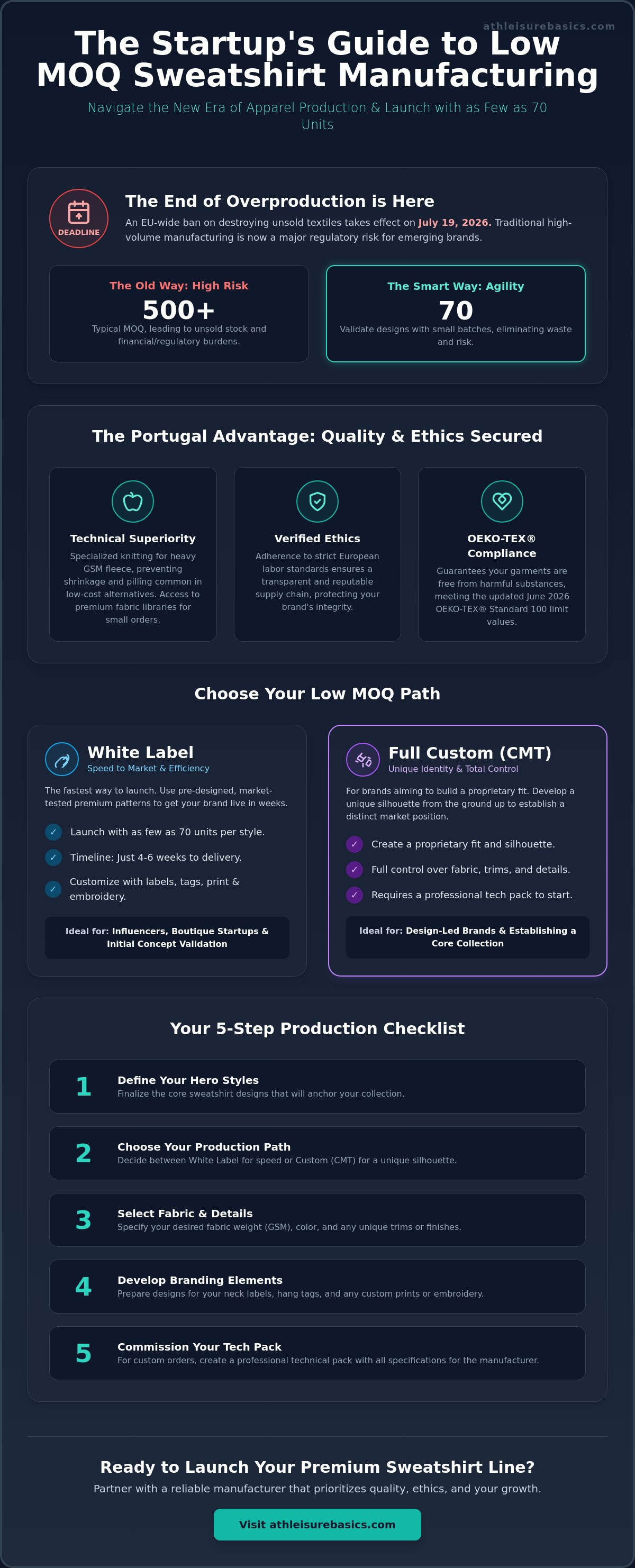
With the EU's ban on destroying unsold textiles taking effect on July 19, 2026, the era of mass overproduction is officially over for emerging apparel brands. You likely feel the weight of this shift, knowing that traditional MOQs of 500 pieces are no longer just a financial burden; they're now a regulatory risk. It's a common struggle to find a low moq athleisure manufacturer that offers the premium hand-feel your customers demand while navigating the complexities of the new Digital Product Passport requirements. You shouldn't have to choose between ethical European craftsmanship and the agility your startup needs to survive.
This guide provides a clear path to launching your premium sweatshirt line with production runs as small as 70 units. You'll discover how to leverage Portuguese manufacturing expertise to ensure your garments meet the updated June 2026 OEKO-TEX Standard 100 limit values. We'll break down the transition from white label blanks to full CMT production, ensuring you can scale your brand with confidence and complete transparency. By the end of this article, you'll understand how to secure a reliable manufacturing partnership that prioritizes quality, ethics, and your long-term growth.
Key Takeaways
- Learn why heavy GSM fleece requires specialized knitting runs and how to navigate the technical hurdles of small-scale production.
- Evaluate the strategic choice between rapid market entry with white label patterns or building a unique identity through custom silhouettes.
- Discover why a low moq athleisure manufacturer based in Portugal is a reliable way to secure ethical certifications and technical superiority.
- Master the essential five-step planning process, from defining your hero styles to commissioning a professional tech pack.
- Find out how it's possible to transition from small 70-unit batches to large-scale production while maintaining strict European quality standards.
What is Low MOQ Sweatshirt Manufacturing and Why is it Tricky?
In 2026, low Minimum Order Quantity (MOQ) manufacturing typically refers to production runs ranging from 50 to 250 pieces per style. For an emerging brand, identifying a reliable low moq athleisure manufacturer is the most effective way to validate a design concept without the financial risk of heavy inventory. While the concept sounds simple, sweatshirt manufacturing presents unique technical challenges that generic factories often fail to address. The barrier isn't just the sewing; it's the material science behind the garment.
The primary hurdle is the fabric minimum. High-quality sweatshirts require heavy GSM (grams per square meter) fleece, which is produced on specialized circular knitting machines. Most fabric mills require massive yarn volumes to start a knitting run, often equivalent to 500 or more garments. A specialized manufacturer in Portugal overcomes this by maintaining a consistent library of premium fleece or by aggregating smaller orders into "master" knitting runs. This allows you to access custom-level quality even on a 70-unit order. Choosing this path prevents the quality variance found in "stock blanks," which are often mass-produced with lower-grade cotton that loses its shape after three washes.
The Economics of Small Batch Production
Common Pitfalls of Low-Cost Manufacturers
Many low-cost factories outside the EU over-promise on flexibility but under-deliver on consistency. It's common for these facilities to outsource small orders to lower-tier "shadow" workshops to save on overhead. This leads to significant fabric shrinkage and pilling issues because the fleece wasn't properly pre-shrunk or treated. Transparency is another major risk. Without strict European labor standards and OEKO-TEX® certifications, you risk your brand's reputation on unverified supply chains. A professional low moq athleisure manufacturer in Portugal provides a transparent ethical trail, ensuring your premium price point is backed by verified labor practices and chemical safety.
Custom vs. White Label: Choosing Your Low MOQ Path
Deciding between custom and white label production is a pivotal moment for any emerging brand. This choice dictates your initial investment, your speed to market, and the degree of exclusivity your brand offers. A professional low moq athleisure manufacturer provides both paths, but each serves a different strategic purpose depending on your current business stage and long-term goals. Understanding the trade-offs in timelines and creative control is essential for a successful launch.
White Label: Launching in Weeks, Not Months
White label production is the most efficient entry point for influencers and boutique startups. By using pre-designed premium patterns, you bypass the lengthy development phase of pattern making and sampling. This path allows you to launch with as few as 70 pieces per style. While the silhouettes are established, you still possess the tools to create a distinct brand feel. Customization options include bespoke neck labels, hang tags, and high-quality screen printing or embroidery. Our private label Portugal services prioritize the use of OEKO-TEX® certified fabrics. This ensures your first collection meets the rigorous safety and quality standards expected by 2026 consumers. The timeline is remarkably fast, typically taking only 4 to 6 weeks from the initial order to final delivery.
Custom Manufacturing: Building a Unique Silhouette
Full custom manufacturing is the preferred route for brands aiming to establish a proprietary fit or technical advantage. This model allows you to develop unique silhouettes, specify exact GSM weights for your fleece, and even source custom hardware like branded aglets or specialized zippers. The 250-piece threshold is generally the sweet spot for this level of production. It provides the volume necessary for factories to accommodate specialized fabric blends and precise Pantone matching. Success in custom production relies heavily on a professional tech pack. This document acts as a technical blueprint, ensuring every seam and measurement is executed with industrial precision. Because this process involves creating new patterns and conducting multiple fit samples, the timeline usually ranges from 3 to 5 months.
Many successful founders treat white label garments as a strategic market test. By starting with a 70-unit run, you can validate your color palettes and branding with real customers before committing to the higher costs of custom molds or proprietary fabric developments. This phased approach mitigates risk while building the capital needed for larger custom runs. If you want to see the quality of our pre-developed patterns, you can browse our luxury blanks collection to find the ideal foundation for your brand.
The Portugal Advantage: Quality, Ethics, and OEKO-TEX®
Choosing a low moq athleisure manufacturer often leads founders to a crossroads between cost and quality. Portugal is the definitive answer for those who refuse to compromise. The "Made in Portugal" label acts as a powerful marketing asset. It signals to your customers that they aren't just buying a sweatshirt; they're investing in a garment produced under some of the world's strictest labor and environmental regulations. This regional prestige allows your brand to command a higher price floor and builds immediate trust with a discerning audience.
Portuguese mills are renowned for luxury fleece knitting techniques. They utilize high-grade cotton to produce fabrics that maintain their structure and softness over hundreds of washes. In the 2026 market, OEKO-TEX® Standard 100 compliance is non-negotiable. With stricter requirements for upstream supplier certifications effective as of June 1, 2026, your manufacturing partner must provide rigorous documentation. This transparency is essential for the EU's Digital Product Passport, which tracks material origin and chemical presence for every garment you sell. Shorter shipping distances to the EU and US also mean reduced lead times and a significantly lower carbon footprint compared to sourcing from East Asian hubs.
Ethical Manufacturing as a Brand Pillar
Transparency is a core requirement for modern consumers. When you produce in Portuguese hubs like Porto or Braga, you can verify the working conditions of the people who sew your garments. The national minimum wage in Portugal reached €920 per month in January 2026, ensuring a regulated and fair labor environment. This level of made in portugal clothing justifies a higher retail markup because it aligns with the values of socially responsible buyers. It supports your brand's ethical pillar, which is increasingly scrutinized by today's informed shoppers.
Sourcing Premium Materials
The durability of a sweatshirt begins with the yarn. We distinguish between carded and combed cotton. Combed cotton undergoes an extra refining process to remove short fibers and impurities. This results in a stronger, smoother yarn that won't pill. For that heavyweight luxury feel, you'll want to aim for a GSM (Grams per Square Meter) between 400 and 500. This density provides the "structure" that high-end streetwear brands demand. Many brands also opt for sustainable alternatives like organic cotton or recycled polyester blends to meet the demand for circular fashion. Partnering with a low moq athleisure manufacturer in this region ensures your brand is built on a foundation of quality that lasts.
Planning Your Sweatshirt Production: A 5-Step Success Checklist
Planning a production run requires more than just a creative vision. It demands a structured approach to ensure your designs translate perfectly from a digital sketch to a physical garment. When you partner with a low moq athleisure manufacturer, following a standardized checklist prevents the most common errors that derail emerging brands. This process ensures that your 70-unit run carries the same prestige as a collection from a global luxury house. Precision at this stage is what separates a hobbyist from a commercial brand.
Mastering the Tech Pack
A professional tech pack is the foundation of your production. It must include a comprehensive bill of materials (BOM), detailed measurement charts for every size, and specific stitch instructions. A Tech Pack is the legally binding technical contract between your brand and the manufacturing facility. Without this document, factories are forced to make assumptions. This often leads to costly mistakes in fabric tension or seam placement that can ruin a small batch. Providing a complete blueprint ensures your low moq athleisure manufacturer delivers exactly what you envisioned without expensive revisions.
The Sampling Process
Never skip the fit sample stage. This is your opportunity to evaluate how the fleece drapes and how the ribbing responds to movement. Reviewing these samples allows you to provide constructive, data-driven feedback to your production manager. You might find that the hood needs more structure or the shoulder drop requires a two-centimeter adjustment. Understanding the garment production process helps you navigate the transition from a single prototype to a consistent bulk run. It's the only way to guarantee that the final product matches your premium standards.
Use this 5-step checklist to streamline your sweatshirt launch and maintain operational efficiency:
- Define your Hero style: Determine if your brand identity requires an oversized streetwear fit, a modern cropped silhouette, or a classic athletic cut. This choice dictates your pattern making costs.
- Commission a Tech Pack: Hire an expert to create the technical blueprint that governs every measurement and material choice.
- Request a pre-production sample: Verify the hand-feel of the fleece and the accuracy of the construction before the machines start the full run.
- Review size grading: Ensure the proportions remain consistent as the pattern scales from XS to XXL. Grading is where many low-cost factories fail, resulting in poor fits for larger or smaller sizes.
- Finalize branding details: Confirm the placement of woven labels and the density of embroidery. Ensure your packaging meets the 2026 EU requirements for recyclability.
If you're ready to move from concept to creation, start your production journey by reviewing our luxury blank templates for your first tech pack.
Partnering with Athleisurebasics for Your Premium Sweatshirt Line
Launching a brand is a complex undertaking. We've designed our services to support your journey from your first 70 units to your first 7,000. As a specialized low moq athleisure manufacturer, we provide the industrial infrastructure typically reserved for established fashion houses. This partnership allows you to focus on marketing and community building while we manage the technical complexities of Portuguese production. We don't just supply garments; we provide the operational stability needed to scale a sustainable business.
Our Luxury Blanks collection offers immediate access to high-end garments without the long development cycles of custom patterns. These pieces are designed with premium fits and heavy GSM fabrics that serve as the perfect canvas for your branding. For founders seeking total exclusivity, our full CMT production services allow for unique designs and proprietary fits tailored to your specific vision. We also provide dedicated consulting to help you navigate the intricate landscape of clothing manufacturers portugal, ensuring your sourcing strategy is optimized for both cost and quality.
Why We Start at 70 Pieces
Our 70-piece minimum for white-label orders is a strategic choice. It's high enough to maintain factory efficiency and low enough to be accessible for emerging entrepreneurs. We don't believe small orders should mean lower standards. Every garment we produce adheres to strict OEKO-TEX® requirements, ensuring your brand is built on a foundation of safety and ethics from day one. We view ourselves as a production partner invested in your long-term evolution. By lowering the entry barrier, we help you test the market and refine your brand identity without the burden of excess inventory. This agility is your greatest competitive advantage as a low moq athleisure manufacturer collaborator.
Get Started Today
To provide an accurate quote, we need your tech pack, desired quantities, and specific branding requirements. If you don't have a tech pack yet, our consulting team can assist in developing the necessary blueprints for your collection. Our 2026 production calendar is already filling up for seasonal drops. We recommend initiating your project at least four months before your target launch date. This lead time ensures every detail of your premium sweatshirt line is perfected during the sampling and grading stages.
Ready to build your legacy? Get a quote for your custom sweatshirt project.
Build Your Legacy in Premium Athleisure
Success in the 2026 apparel market requires a strategic blend of operational agility and uncompromising quality. You've learned that navigating the technical hurdles of heavy fleece production becomes manageable when you choose the right manufacturing path. Whether you opt for the rapid market entry of white label patterns or the unique identity of custom silhouettes, your brand's foundation must be built on transparency and ethical excellence.
A reliable low moq athleisure manufacturer acts as more than just a vendor; they're a dedicated partner in your growth. By leveraging Made in Portugal craftsmanship and OEKO-TEX® Certified Fabrics, you ensure your sweatshirts meet the highest global standards. With accessible low 70-piece minimums for White Label, the barrier to entry has never been lower for ambitious entrepreneurs.
Don't let high MOQs or complex supply chains stall your vision. It's time to transition from concept to commercial presence with a partner who understands the startup-to-scale journey. Launch your premium sweatshirt line with Athleisurebasics today and take the first step toward a lasting brand presence. Your journey to industry-leading standards starts here.
Frequently Asked Questions
What is the typical MOQ for custom sweatshirts in Portugal?
The typical MOQ for a full custom sweatshirt project is 250 pieces per style. This volume allows your low moq athleisure manufacturer to source specialized fabric blends and execute unique silhouettes with industrial precision. If you require smaller volumes for a market test, our white-label path offers an entry point of just 70 units per style. This flexibility helps you manage inventory while maintaining high European standards.
Can I get a sample before committing to a low MOQ order?
Yes, you should always request a pre-production sample to verify the fit and fabric quality. This prototype serves as the final check before the factory initiates the bulk run. It's the most effective way to provide feedback on specific details like hood structure or shoulder drop. Reviewing a physical sample ensures the final product aligns perfectly with your brand's technical requirements.
Is it more expensive per unit to order a low MOQ batch?
It's standard for per-unit costs to be higher on smaller batches due to fixed setup fees like pattern making and machine calibration. While the price per garment is slightly elevated, the total financial risk is significantly lower. Ordering 70 units prevents the accumulation of unsold inventory, which is crucial given the EU's 2026 regulations prohibiting the destruction of unsold textiles.
What is the difference between screen printing and embroidery for small orders?
Screen printing involves creating stencils for each color, which can lead to higher setup costs for small runs. Embroidery often provides a more premium feel and is highly durable for heavyweight sweatshirts. For orders under 100 pieces, embroidery is frequently more cost-effective and offers a luxury aesthetic that resonates with athleisure customers. We can advise on the best method based on your specific graphic complexity.
Do you provide sustainable and organic fabric options for sweatshirts?
We offer a variety of sustainable materials, including organic cotton and recycled polyester blends. These fabrics meet the growing consumer demand for circular fashion and environmentally responsible production. As a principled low moq athleisure manufacturer, we ensure these materials comply with the latest chemical safety standards. This focus on sustainability helps your brand stand out in a competitive market while adhering to ethical principles.
How long does the production process take for a low MOQ sweatshirt order?
Production timelines vary based on the level of customization required for your collection. White-label orders typically take 4 to 6 weeks from the time you finalize your branding details. Full custom projects require a longer lead time of 3 to 5 months because they involve pattern development and multiple sampling stages. Planning your order at least four months in advance is recommended for seasonal drops.
Can I customize the labels and tags on white-label sweatshirts?
Yes, you can fully customize the neck labels, hang tags, and packaging for white-label garments. This allows you to build a cohesive brand identity without the high development costs of custom silhouettes. You can choose between woven labels or high-quality heat transfers to match your brand's aesthetic. These small details are essential for creating a premium unboxing experience that builds customer loyalty.
What certifications should I look for in a sweatshirt manufacturer?
The most important certification for 2026 is the OEKO-TEX Standard 100, which ensures fabrics are free from harmful substances. You should also verify that the manufacturer complies with EU labor standards and can provide data for the Digital Product Passport. These certifications prove that your garments are safe, ethical, and ready for the European market. Partnering with a certified factory protects your brand's reputation and ensures long-term compliance.



Leave a comment
This site is protected by hCaptcha and the hCaptcha Privacy Policy and Terms of Service apply.