
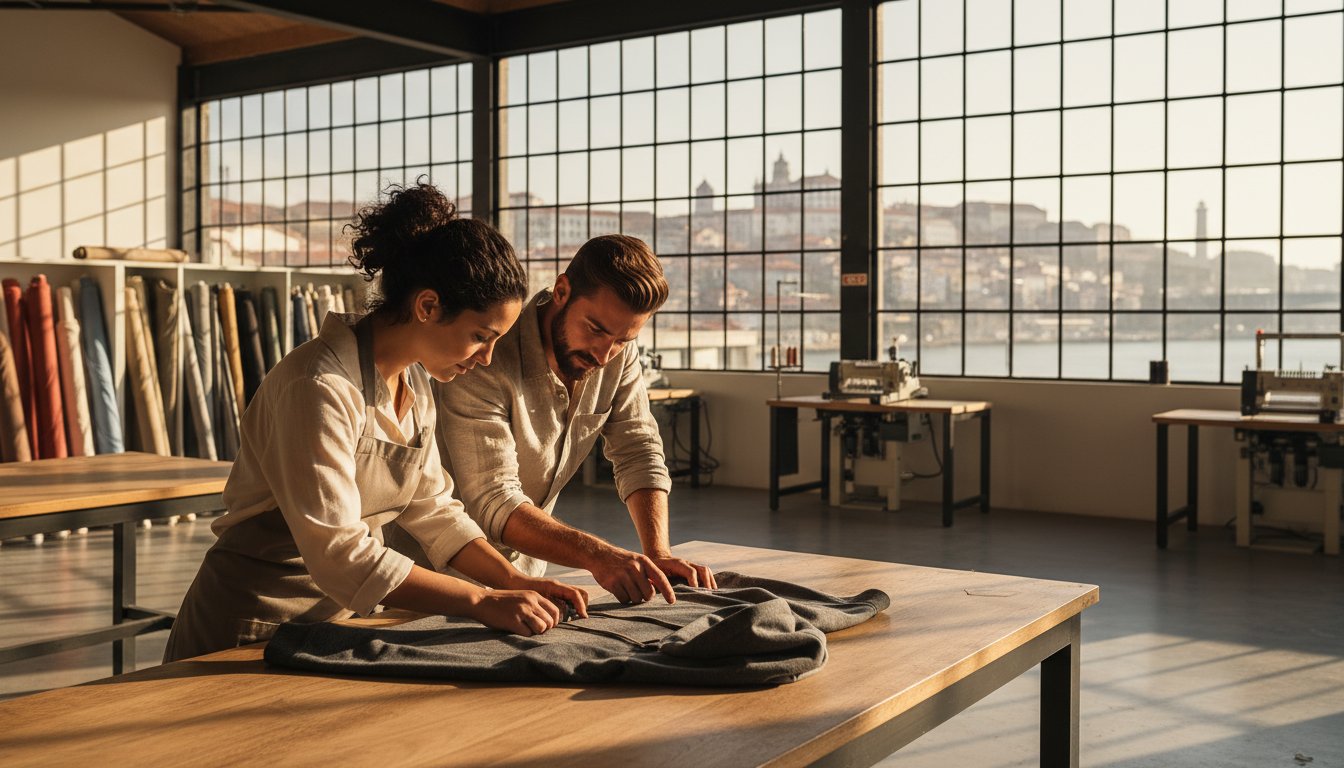
Made in Portugal Clothing for Brands: The 2026 Guide to Premium Manufacturing
What if you could cut your production lead times by 40% while finally eliminating the ethical headaches of offshore manufacturing? You've likely felt the frustration of waiting 12 weeks for a shipment from Asia, only to find that 15% of the garments fail your quality checks. We agree that your brand deserves better than inconsistent stitching and opaque labor practices. Choosing made in portugal clothing for brands isn't just a trend for 2026; it's a strategic move to regain control over your supply chain and brand reputation.
This guide shows you why the world's most successful apparel brands are moving production to Portugal and how to navigate the manufacturing landscape to scale your own label. You'll learn how to find partners offering MOQs as low as 60 pieces per style and how to source OEKO-TEX® certified materials that your customers value. We'll provide a clear roadmap for shortening your supply chain, accessing premium craftsmanship, and turning your creative vision into a profitable legacy.
Key Takeaways
- Understand how to slash lead times from months to weeks by leveraging Portugal’s proximity to major global markets and its premium manufacturing "halo effect."
- Learn to protect your reputation by sourcing made in portugal clothing for brands that guarantees 100% sweatshop-free production and OEKO-TEX® certified quality.
- Discover why calculating the Total Cost of Ownership (TCO) reveals that Portuguese manufacturing is often more cost-effective than Asian production when factoring in duties and shipping volatility.
- Navigate the world of Minimum Order Quantities (MOQs) and learn how to use luxury white label blanks to launch a high-end collection in record time.
- Identify how a "Partner, not just Producer" philosophy can bridge the gap between a startup vision and professional luxury standards to scale your brand’s legacy.
Why 'Made in Portugal' is the Strategic Choice for Global Apparel Brands in 2026
The global fashion industry is undergoing a massive shift as we approach 2026. High-end labels and startups alike are moving away from high-volume, low-quality production in favor of localized excellence. Choosing made in portugal clothing for brands has become the primary strategy for those targeting the premium athleisure and luxury sectors. This choice provides a powerful "halo effect," where the origin of the garment serves as a silent guarantee of ethical standards and superior quality. When customers see that label, they immediately associate it with the same craftsmanship found in the world's top fashion houses.
Buyers in 2026 demand transparency and longevity. The transition from disposable fast fashion to "slow fashion" isn't a trend; it's a structural change that rewards brands prioritizing durability. Portugal leads this movement by combining sustainable materials with fair labor practices. Within Portugal's economic landscape, the textile sector has transformed into a high-tech powerhouse that accounts for a significant portion of the nation's exports. Portuguese textile heritage is a blend of traditional craftsmanship and Industry 4.0 automation.
Proximity to major European and US markets is no longer just a convenience; it's a competitive necessity. Shipping from Southeast Asia can take 12 to 16 weeks, leaving brands vulnerable to shifting trends and inventory bottlenecks. In contrast, Portuguese facilities reduce lead times to just 4 to 6 weeks. This speed allows you to respond to market demands in real-time without the risk of holding dead stock. It's about being lean, fast, and responsive to what your customers actually want.
The Prestige of the Portuguese Textile Industry
Northern Portugal, specifically the region around Guimarães and Braga, has earned its reputation as the Silicon Valley of textiles. This area isn't just a manufacturing hub; it's an innovation center where engineers and artisans work side-by-side. Factories here possess historical expertise in jersey and high-performance knitwear, making them the first choice for premium athleisure brands. By using made in portugal clothing for brands, you can justify a higher retail price ceiling. Consumers are often willing to pay a 25% to 40% premium for garments that carry the Portuguese mark of quality compared to mass-produced alternatives from other regions.
Supply Chain Agility: Responding to 2026 Trends
Overstocking is the most significant financial drain on modern apparel businesses. Industry data shows that up to 30% of mass-produced garments end up in landfills or heavily discounted due to over-forecasting. Portuguese factories solve this by enabling "Just-in-Time" production. This model supports smaller, frequent drops rather than massive seasonal hauls that tie up your capital.
- Low MOQ Flexibility: Options often start at just 60 pieces per style, allowing you to test new designs with minimal financial risk.
- Carbon Footprint Reduction: Localized European logistics reduce the carbon footprint of your supply chain by up to 60% compared to transcontinental shipping.
- Rapid Prototyping: Advanced tech integration ensures your vision moves from a digital tech pack to a physical sample in days, not months.
We don't just act as your producer; we act as your trusted partner in this journey. Our goal is to help you scale your brand from a single logo to a lasting legacy. By leveraging the efficiency of the Portuguese supply chain, you can focus on growth and community building while we handle the complexities of premium manufacturing. It's the most reliable way to turn your vision into high-quality products, quickly and efficiently.
Technical Superiority: OEKO-TEX®, Ethics, and EU Standards
Choosing made in portugal clothing for brands isn't just about the label; it's about rigorous compliance. Portugal operates under strict EU labor laws that mandate fair wages, regulated working hours, and safe environments. This ensures your supply chain remains 100% sweatshop-free. By 2026, the OEKO-TEX® Standard 100 will become a non-negotiable benchmark for consumer trust. This certification guarantees that every thread, zipper, and button is tested for up to 1,000 harmful substances. Brands that prioritize these certifications now will lead the market in two years as consumer awareness regarding chemical safety peaks.
Transparency is a built-in feature of the Portuguese textile industry. You can fly into Porto or Braga and visit several factories in a single afternoon. This ease of visiting and auditing production creates a level of traceability that offshore manufacturing simply cannot match. Manufacturing within the EU automatically satisfies most global ESG reporting requirements, simplifying your corporate compliance significantly. This alignment with the EU Strategy for Sustainable and Circular Textiles ensures your brand stays ahead of upcoming regulations regarding textile waste and product durability.
Material Innovation in Portuguese Factories
Portuguese mills offer unparalleled access to premium long-staple cotton and GRS-certified recycled synthetic blends. Factories here don't treat sustainability as an add-on; it's the default operating mode. For instance, over 80% of major Portuguese textile plants now utilize advanced water recycling systems or solar-powered energy grids to reduce their carbon footprint. Advanced finishing techniques, such as carbon brushing and specialized enzyme washes, give garments that distinct luxury feel. This technical edge allows made in portugal clothing for brands to compete directly with high-end designer labels on both touch and long-term durability.
Quality Control and Communication
Working with Portuguese management teams removes the friction common in global sourcing. Most factory directors and project managers hold high English proficiency, which is vital for executing complex tech packs without errors. You'll operate in the same or similar time zones, meaning questions get answered in minutes rather than days. This proximity leads to significantly lower defect rates across the board. While offshore factories might see defect rates ranging from 5% to 10%, Portuguese facilities often maintain rates below 1.5%.
This precision saves your brand thousands in backend costs, logistics, and customer returns. High-quality output is the result of a culture that values craftsmanship over raw volume. If you're ready to see how these standards can elevate your next collection, you can explore our custom manufacturing options to get started. By choosing a partner in Portugal, you're investing in a system designed for reliability and premium results. You won't have to worry about the hidden costs of poor communication or sub-par quality control when your production is handled by experts who understand the global market.
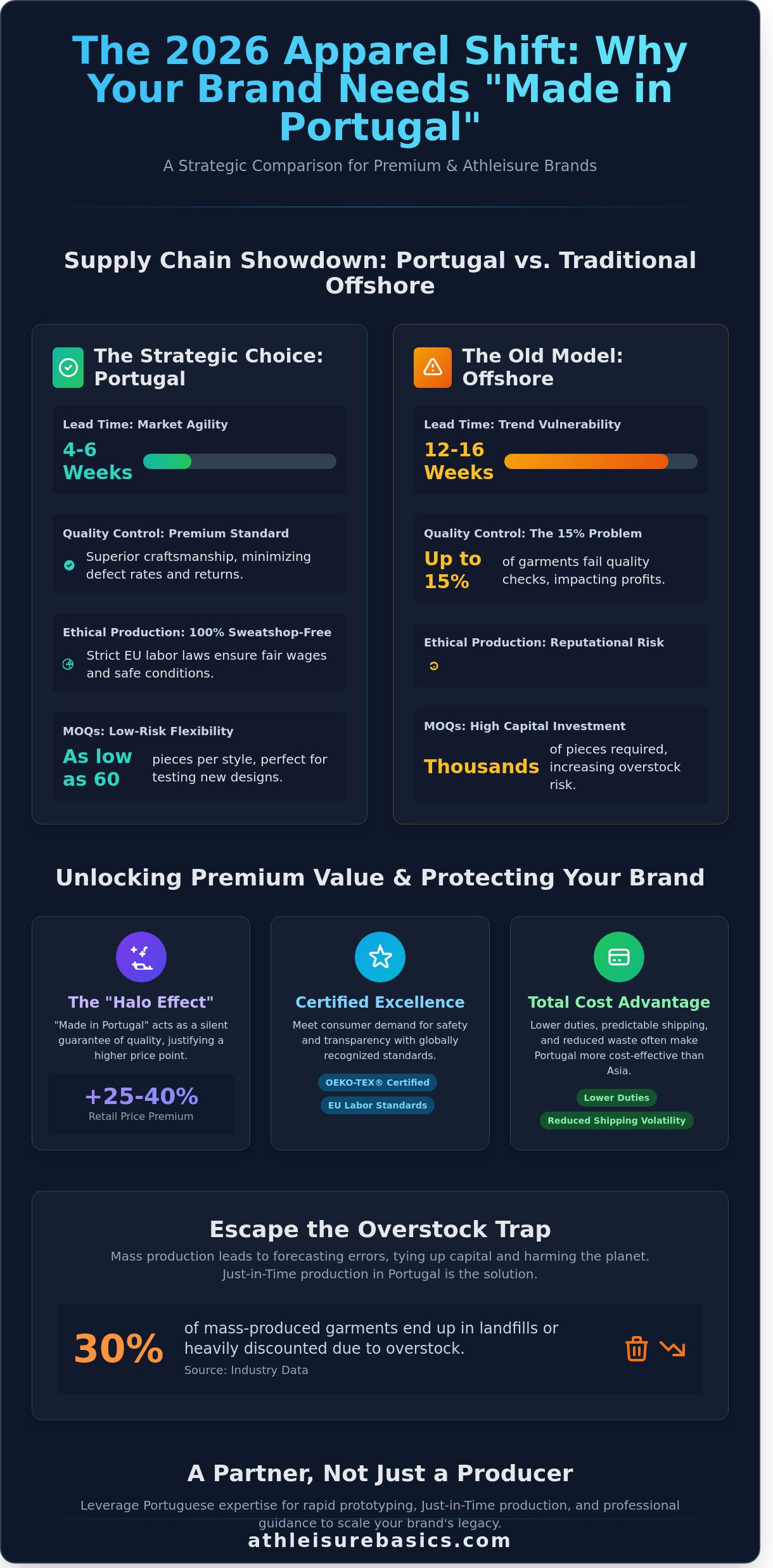
Portugal vs. Asia: A 2026 Cost-Benefit Analysis
In 2026, the decision to manufacture offshore often rests on a single, misleading number: the Free on Board (FOB) price. This figure only represents the cost of the garment at the factory gate. Professional brand owners now calculate the Total Cost of Ownership (TCO) to understand the real impact on their profit margins. When you source from distant markets, you face a 12% EU import duty on most synthetic garments and shipping surcharges that can fluctuate by 300% in a single quarter. These variables turn a "cheap" $5 t-shirt into an $11 liability by the time it reaches your warehouse.
Portugal offers a more stable financial logic. According to global textile export data, the country is the 22nd largest textile exporter in the world, proving its capacity to handle high-volume demand without sacrificing quality. While production in Asia typically requires a lead time of 12 to 16 weeks, choosing made in portugal clothing for brands allows for a much faster turnaround of 4 to 6 weeks. This 10-week difference means you can react to trends in real-time rather than guessing what your customers will want four months in advance.
Hidden Costs of Offshore Manufacturing
Inventory carrying costs are a silent profit killer for growing labels. When your capital is tied up in shipping containers for 90 days, you lose the agility to reinvest in digital ads or new product development. A 2,500-unit order floating in the Indian Ocean is dead weight on your balance sheet that prevents you from scaling.
Communication gaps also carry a heavy price tag. A single misinterpreted tech pack can result in 1,000 units of leggings with incorrect seam tension. These errors often require local rework costing $3 to $5 per garment or deep discounts to move the faulty stock. There's also the 25% "brand risk" factor. In 2026, consumers demand radical transparency; one discovery of unethical labor in your supply chain can destroy your brand's reputation permanently. Portugal’s strict adherence to EU labor laws eliminates this risk entirely.
The ROI of Premium Production
Investing in made in portugal clothing for brands shifts your business model from volume-based to value-based. Premium Portuguese manufacturing allows for higher retail markups, typically ranging from 4x to 6x, compared to the thin 2x or 3x margins seen with mass-produced goods. Customers gladly pay $95 for an organic cotton hoodie that maintains its structure after 40 washes, whereas a $35 version often ends up in a landfill after one season.
The "Return Rate" factor is where the ROI becomes most visible. Brands manufacturing in Portugal often see return rates drop by as much as 15% because the fit and fabric quality match the online marketing photos. This consistency builds customer loyalty and increases your Lifetime Value (LTV). You also gain marketing leverage by using factory transparency as a core story. Documenting the artisans and the OEKO-TEX® certified processes builds a "logo to legacy" narrative that justifies your premium positioning and keeps customers coming back for every new drop.
Navigating MOQs: Custom Manufacturing vs. White Label Blanks
Minimum Order Quantities (MOQs) often act as the biggest hurdle for emerging labels. In Portugal, the manufacturing landscape is uniquely designed to support both lean startups and established fashion houses. While traditional factories in many regions demand 500 or 1,000 units per style, Portuguese partners offer a tiered approach. This flexibility allows you to manage cash flow while securing the premium "Made in Portugal" status. Understanding these tiers is vital for your growth strategy as you move from a concept to a profitable reality.
White Label: The Startup Shortcut
Choosing white label blanks is the most efficient way to enter the market. You're using pre-developed, luxury-grade silhouettes that have already passed rigorous quality controls. At Athleisurebasics, our white label program starts at just 70 pieces per style. This low entry point lets you test a new colorway or fit without committing $15,000 in upfront inventory costs.
Low MOQs don't mean you sacrifice your brand identity. You can customize these premium blanks through several high-end techniques:
- 3D Embroidery: Adds a tactile, premium feel to logos and branding.
- High-Density Screen Printing: Ensures durable, vibrant designs that don't crack after five washes.
- Custom Woven Labels: Replaces factory tags with your own branded neck labels and hem tags.
This path is a strategic move for founders who want to launch in under 35 days while maintaining a luxury feel. You get the benefit of proven fits without the development lead times associated with custom patterns. It's the ideal way to validate your made in portugal clothing for brands before investing in unique molds or exclusive fabric weaves.
Custom Manufacturing: Building a Unique Brand Identity
Once your brand finds its voice and consistent sales, you'll likely move toward Cut, Make, and Trim (CMT) services. This is where you build unique silhouettes from the ground up. The process begins with your Tech Pack; we translate your specific measurements into a "Golden Sample" within 15 to 21 days for your final approval.
Custom manufacturing typically requires a higher commitment, usually starting at 250 pieces per style. This volume unlocks access to exclusive fabric mills and custom-dyed pantones that set your brand apart from generic competitors. You aren't just buying clothes; you're developing proprietary intellectual property. Unlike mass-produced items from high-volume regions, custom made in portugal clothing for brands focuses on artisanal precision and ethical EU standards.
Managing a 250-unit run requires a lead time of 7 to 9 weeks. During this period, we handle everything from sourcing specialized hardware like RiRi zippers to ensuring the fabric meets OEKO-TEX® standards. This transition from 70 pieces to 250+ marks a significant milestone. It represents a shift from market validation to market penetration. By starting small, you gather real-world data on what your customers love. When you finally hit that 250-unit threshold, you've already minimized the risk of sitting on dead stock. You're ready to scale with confidence and a partner that understands your vision.
Scaling Your Legacy with Athleisurebasics: Your Portuguese Partner
Building a successful fashion label requires more than just a creative eye. It demands a bridge between your design vision and the technical precision of luxury manufacturing. Athleisurebasics serves as this bridge, specializing in made in portugal clothing for brands that refuse to settle for fast-fashion shortcuts. We treat every project as a legacy in the making. Our team doesn't just operate sewing machines; we function as your technical consultants. We analyze your designs for durability and scalability long before the first needle drops, ensuring your brand is built on a foundation of excellence.
Our end-to-end support model removes the friction points common in overseas production. We manage everything from initial material sourcing to comprehensive tech pack development. If your technical documents aren't ready, our in-house experts refine them to ensure 100% accuracy during the sampling phase. This precision reduces fabric waste and prevents the costly errors that often plague new founders. Choosing made in portugal clothing for brands through our facility means gaining access to a 10-point quality control system that covers every seam and stitch.
Quality isn't a vague promise at Athleisurebasics; it's a certified standard. Every garment we produce utilizes OEKO-TEX® Standard 100 certified fabrics. This certification guarantees your products are free from harmful substances and meet the strict EU health and environmental regulations your customers demand. We focus on premium finishing techniques, such as reinforced flatlock stitching and high-density embroidery, to ensure your apparel stands up to the rigors of both performance and daily wear. This attention to detail transforms a simple garment into a luxury staple that justifies a premium price point.
Why Startups Trust Us
Startups often face a steep "minimum order" barrier that stifles growth. We've removed that hurdle by offering low MOQ flexibility, starting at just 60 pieces per style or color. This allows you to test market demand without overextending your initial capital. Our pricing remains transparent and fixed; you won't encounter hidden fees or unexpected "European premium" surcharges. You'll also get direct access to production consulting. This support helps founders avoid the 30% failure rate typically seen in first-run productions due to incorrect fabric selection or poor sizing specifications.
Ready to Start Your Production Journey?
Launching your collection is a structured three-step process. First, compile your designs, tech packs, or physical samples for our review. We seek partners who share our commitment to ethical manufacturing and superior quality standards. If your brand values long-term sustainability over disposable trends, we're the right fit for your vision. To begin, simply Get a Custom Apparel Manufacturing Quote Today. Our team will review your project details and provide a comprehensive cost breakdown within 48 business hours, helping you move from concept to closet with total confidence.
Secure Your Brand’s Global Competitive Edge for 2026
Building a successful apparel line in 2026 requires more than just a creative vision; it demands a supply chain that prioritizes technical excellence and ethical transparency. By choosing made in portugal clothing for brands, you're opting for Red Dot level technical craftsmanship and OEKO-TEX® certified fabrics that meet the highest EU environmental standards. This strategic shift away from mass-market Asian production reduces your carbon footprint and ensures every garment reflects premium quality through every single stitch.
The landscape of fashion is changing, and flexibility is now your greatest asset. Whether you're starting with our signature low MOQ of 60 pieces per style or scaling a full custom collection, these manageable entry points allow you to protect your capital while testing the market with luxury-grade products. You don't have to navigate the complexities of international manufacturing alone when you have a dedicated partner to guide you from the initial tech pack to final delivery. It's time to stop worrying about production hurdles and start focusing on your brand's growth. Launch Your Premium Brand with Athleisurebasics today and turn your design concepts into a lasting market legacy.
Frequently Asked Questions
Why is Portugal considered the best place for clothing manufacturing for brands?
Portugal offers a unique blend of high-end craftsmanship, ethical EU labor standards, and proximity to major global markets. It's a top choice because factories here combine 100 years of textile heritage with modern sustainable technology. You'll find that 95% of Portuguese factories operate under strict EU environmental regulations. This ensures your brand maintains a premium, ethical reputation while benefiting from a transparent supply chain.
What is the typical MOQ for clothing manufacturers in Portugal?
Typical Minimum Order Quantities in Portugal range from 50 to 150 pieces per style or color. Our white label service specifically starts at 60 pieces, which helps startups manage their cash flow while testing new designs. This low MOQ approach allows you to launch your collection without the risk of holding 5,000 units of unsold inventory. It's a pragmatic solution for scaling your brand safely.
How much more expensive is it to manufacture in Portugal than in China?
Manufacturing in Portugal generally costs 20% to 35% more than in China, but the total cost of ownership is often lower. You'll save significantly on shipping fees and import duties within the EU; you also avoid the 10% defect rates common in budget mass-production. Most founders find that the superior quality and "Made in Portugal" label justify the higher unit price for their premium customers.
Do I need a Tech Pack to start manufacturing in Portugal?
You need a professional Tech Pack to ensure your designs are executed with 100% accuracy. This document acts as a blueprint, including measurements, fabric types, and stitching details. If you don't have one yet, our team guides you through the development process. We'll help translate your vision into a high-quality physical product that meets the highest industry standards for fit and finish.
Can I visit the factories in Portugal before I place an order?
We encourage you to visit our facilities in the Porto and Braga regions to see our craftsmanship firsthand. Most factories welcome brand owners for scheduled tours to inspect working conditions and review fabric samples. Seeing the ethical production environment and meeting the people behind your garments builds a foundation for a long-term partnership. It's the best way to gain confidence in your supply chain.
What types of clothing are Portuguese factories best at producing?
Portuguese factories excel at producing premium jersey items like t-shirts, hoodies, and sweatshirts, as well as high-performance activewear. Portugal currently accounts for over 15% of Europe's total textile exports, focusing on luxury basics and circular knitting. If you're looking for made in portugal clothing for brands that requires durability and a soft hand-feel, this region is the global gold standard for your collection.
How long does shipping take from Portugal to the UK or USA?
Shipping from Portugal to the UK typically takes 3 to 5 business days via road freight. For our clients in the USA, air shipping usually arrives within 5 to 8 days. These fast turnaround times mean you can restock your bestsellers quickly and respond to market trends. You won't have to wait 12 weeks for a shipping container to cross the ocean from Asia.
Is Portuguese clothing manufacturing truly sustainable?
Portugal is a leader in sustainable fashion, with over 80% of factories utilizing renewable energy sources like solar power. Many facilities hold OEKO-TEX® and GOTS certifications, ensuring that fabrics are free from harmful chemicals. Choosing made in portugal clothing for brands allows you to market a truly ethical product. You can confidently tell your customers that your garments meet the rigorous 2024 environmental standards set by the EU.


Leave a comment
This site is protected by hCaptcha and the hCaptcha Privacy Policy and Terms of Service apply.