
Minimum Order Quantity (MOQ): The Ultimate Guide for Apparel Brands in 2026
What if your next collection didn't require a 15,000 dollar upfront investment just to get through the factory door? Most founders believe that premium European manufacturing is reserved for established giants with massive budgets. You've likely felt the sting of a rejection from high-end factories because your initial minimum order quantity didn't meet their 500 piece threshold. It's frustrating to watch your vision stall because of a rigid spreadsheet and the fear that 40 percent of your inventory will end up as unsold deadstock.
This guide will show you how to master the math behind these requirements and leverage low minimums to scale your brand profitably in 2026. You'll learn how to secure luxury-grade production in Portugal, where services can start at just 60 pieces per style, without the crushing weight of excess inventory. We'll break down the specific cost structures of small-batch production and provide a roadmap to launch your first collection with significantly reduced financial risk. By the end, you'll have the tools to turn your creative vision into a profitable legacy.
Key Takeaways
- Understand the critical distinction between minimum order quantity per style and per order to accurately plan your production budget and avoid common manufacturing pitfalls.
- Uncover the hidden logic of factory setup times to see why smaller runs cost more and how to leverage this knowledge during price negotiations.
- Identify the "inventory trap" to protect your brand's capital, choosing a volume strategy that balances unit price against the risk of excess stock.
- Learn actionable tactics to lower entry barriers, such as utilizing stock fabrics and shared components to bypass high material minimums.
- Discover how to launch a high-end, OEKO-TEX® certified collection with just 70 pieces per style using flexible Portuguese manufacturing solutions.
What is Minimum Order Quantity (MOQ) in Fashion Manufacturing?
In the world of fashion manufacturing, the minimum order quantity represents the lowest number of units a factory is willing to produce for a single production run. If a manufacturer sets their limit at 100 units, they won't accept a project for 99. This isn't an arbitrary hurdle; it's a calculated threshold based on machine setup times, labor costs, and material waste. For brands launching in 2026, understanding this metric is vital for effective cash flow management and long-term scaling.
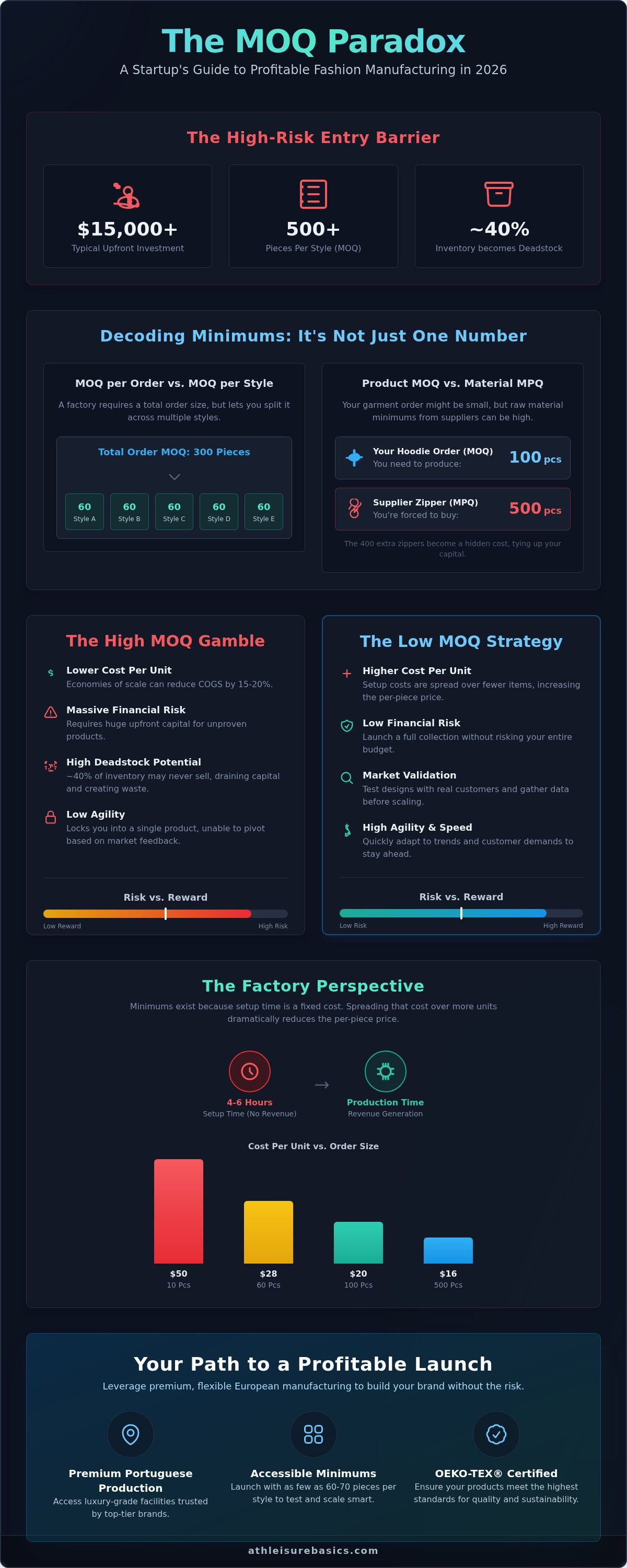
You'll encounter two distinct levels: MOQ per order and MOQ per style. A factory might require a total "per order" minimum of 300 pieces to initiate production. However, they'll also specify a "per style" or "per color" minimum, such as 60 units. This means you could order 5 different styles of 60 pieces each to meet the 300-unit threshold. Managing these numbers effectively is rooted in the Economic Order Quantity (EOQ), a formula used by businesses to find the perfect balance between the costs of ordering and the costs of holding inventory.
It's also essential to distinguish between a product MOQ and a Minimum Purchase Quantity (MPQ). While the MOQ refers to the finished garment, the MPQ applies to raw materials like fabric, zippers, or buttons. If a zipper supplier requires an MPQ of 500 units but your garment run only needs 100, you'll still have to pay for the remaining 400. These hidden costs can quickly erode a startup's budget if they aren't factored into the initial financial plan.
The Difference Between Product MOQ and Material MOQ
Your factory might want to say yes to your small batch, but their fabric supplier often dictates the final answer. A standard fabric roll in a Portuguese mill is usually 50 to 100 meters long. If you're producing a premium heavyweight hoodie that requires 1.5 meters of fabric per unit, a single roll produces roughly 33 to 66 garments. If you want a custom-dyed color, the dye house might demand a minimum of 300 meters. This creates a bottleneck where your factory's flexible MOQ of 60 pieces clashes with a material MPQ of 200 pieces. Specialty trims like branded aglets or custom-woven labels often carry even higher minimums, sometimes reaching 1,000 units per order.
Why MOQ is a Risk Management Tool
In 2026, high minimums are a primary contributor to the 40% failure rate seen in fashion startups during their first two years. Ordering 500 units of an unproven design leads to "deadstock," which is unsold inventory that clogs your warehouse and drains your capital. Excess stock also creates significant environmental waste, as 15% of all fabric produced globally currently ends up in landfills.
Successful 2026 brands are shifting toward lean production models to mitigate these risks. By starting with a lower minimum order quantity of 60 to 100 units, you can test the market and gather real-world customer data. While a larger order of 1,000 units might lower your Cost of Goods Sold (COGS) by 15% to 20% through economies of scale, the risk of holding 800 unsold items far outweighs those per-unit savings. Prioritizing flexibility over bulk discounts ensures your brand remains profitable, agile, and sustainable in a competitive market.
The Factory Perspective: Why Do Manufacturers Require Minimums?
Manufacturers don't set a minimum order quantity to be difficult. They do it because every production run begins with "Setup Time," which is essentially dead time for the factory. In a high-standard Portuguese clothing facility, preparing a single line for production can take 4 to 6 hours. During this window, machines aren't running, and no revenue is being generated. Technicians must adjust needle heights, set tension for specific fabric weights, and organize the workflow for the sewing team. If a factory accepts an order for 10 pieces, those 6 hours of preparation are amortized over a tiny volume, making the cost per unit astronomical.
Understanding these logistics is a key part of any comprehensive guide to MOQ and why suppliers must protect their margins. When you scale from 10 to 100 pieces, the setup time remains the same, but the efficiency of the labor force increases. A specialized sewing line in a European facility typically involves 5 to 8 skilled operators. These teams reach their "flow state" after the first 20 units. If the run ends at 10 pieces, the team never reaches peak speed, and the factory loses approximately 45% of its potential daily profit.
Tech packs play a vital role in lowering these barriers. A professional tech pack can save a factory up to 12 hours of administrative overhead and sample corrections. When a manufacturer receives clear, 100% accurate specifications, they spend less time on "pre-production" and more time on the actual build. This reduction in risk allows some premium partners to offer more flexible terms to startups. If you're looking to launch with precision, you can explore our custom clothing options that bridge the gap between quality and accessibility.
Cutting and Grading Efficiencies
Fabric is often the most significant cost in garment production. To keep prices competitive, manufacturers use digital "markers" to map out how patterns fit on a roll of fabric. This process aims to keep fabric waste below 15%. When cutting a single layer of fabric for a small order, the manual labor is high and the waste is often 25% or more. In European CMT (Cut, Make, Trim) facilities, the "sweet spot" for production usually starts at 50 units. This volume allows the factory to stack multiple layers of fabric and cut them simultaneously, which drastically reduces the labor cost per garment.
Machine Calibration and Threading
Changing a garment's color isn't as simple as swapping one spool of thread. Industrial machines, especially those used for athleisure, require precise re-threading across multiple needles and loopers. For example, a 4-thread overlock machine takes a technician about 15 minutes to re-thread and test. If a factory has 20 machines on a line, that's 5 hours of labor just to change the color of the stitching. This is why "one style, one color" production is the gold standard for maintaining a low minimum order quantity. Specialized machinery, like flatlock stitching tools, requires even more calibration time. When a factory commits to a specific setup, they need a guaranteed volume to justify the hours spent on those technical adjustments.
Low MOQ vs. High MOQ: Choosing the Right Strategy for Your Brand
Every fashion founder faces a critical fork in the road during the sourcing phase. Do you prioritize the lowest possible cost per piece or the lowest possible risk to your bank account? This decision hinges on your understanding of a comprehensive guide to minimum order quantity and how it aligns with your current cash reserves. Choosing the right minimum order quantity strategy is often the difference between a sustainable growth path and a quick exit from the market.
The trade-off between unit price and total capital outlay is stark. If a factory quotes you $8.50 per t-shirt for 2,000 units, your total upfront investment is $17,000. If an atelier quotes $15.00 for 100 units, you only spend $1,500. While the unit price is 76% higher in the low-volume scenario, your capital exposure is 91% lower. For a founder launching in 2024, that $15,500 difference represents your entire marketing and photography budget. We've seen that brands with liquid cash for ads outperform those with a garage full of "cheap" inventory every single time.
The inventory trap is a real threat for 85% of first-time fashion entrepreneurs. Chasing a lower unit price on 1,000 units can easily bankrupt a startup before it finds its footing. If those units don't sell within 120 days, you've tied up your liquidity in boxes of fabric that may never move. Industry data from 2023 shows that 30% of fashion inventory ends up in landfills or deep discount bins. It's far better to pay a premium for 60 units than to lose $15,000 on a product that doesn't fit your market's needs. Dead stock isn't just lost money. It's a physical weight on your warehouse space and your mental energy.
Low MOQs provide the speed to market required to survive. You can launch a capsule collection of 50 organic cotton joggers, gather customer feedback in 14 days, and refine the design for the next drop. This agility is your competitive advantage against legacy giants who are locked into 12-month production cycles. Furthermore, smaller batches often result in superior craftsmanship. Producing 60 pieces in a specialized Portuguese factory ensures that every seam is inspected by hand. You're paying for a human touch that 10,000-unit mass production runs simply can't replicate.
The High MOQ Model (Mass Production)
This strategy is best for established brands with 2+ years of proven sales data and high marketing budgets. The primary advantage is achieving the lowest possible per-unit cost, which creates high profit margins per item. However, the cons are significant. You face massive upfront investment, high storage costs, and a 40% higher risk of obsolescence if consumer trends shift mid-production. It's a high-stakes game that leaves little room for design errors.
The Low MOQ Model (The Startup Path)
We recommend this path for emerging brands, limited edition drops, and market testing. It preserves your cash flow and reduces environmental waste. By producing 60 to 100 pieces, you can leverage "Made in Portugal" luxury positioning to justify a higher retail price. While you'll deal with a higher per-unit cost and require more frequent production management, the flexibility allows you to pivot your brand as you learn what your customers truly want.
How to Navigate and Negotiate MOQs with Clothing Manufacturers
High volume requirements don't have to be a dead end for your startup. Most manufacturers set these limits to protect their own margins and cover the labor intensive setup costs of a new production run. If you understand their constraints, you can negotiate terms that work for both parties. Follow these four steps to lower your entry barriers and secure a production partner.
- Step 1: Use stock fabrics to bypass high material minimums. Fabric mills often require 300 to 500 meters for a custom dye or specific knit. By selecting "in-stock" fabrics already held by the factory, you remove the material minimum order quantity hurdle entirely. This allows the manufacturer to pull from existing rolls rather than placing a new order with a mill.
- Step 2: Consolidate your designs. Use shared components across your entire collection. If your hoodies, joggers, and shorts all use the same 300gsm French Terry and identical drawstring hardware, the factory sees one large fabric order instead of three small ones. This efficiency makes you a more attractive client.
- Step 3: Consider White Labeling for your first launch. Instead of developing a garment from scratch, use pre-existing patterns. This eliminates the need for multiple rounds of prototyping and pattern making, which are the most expensive parts of the process for a factory.
- Step 4: Present a professional Tech Pack. 90% of production delays happen because of poor communication. A detailed tech pack with clear measurements, material callouts, and stitch details proves you're a "low-friction" client. Factories are more likely to lower their minimums for brands that come prepared and organized.
White Label vs. Custom Manufacturing
White labeling is the most cost-effective path for new founders. Our white label service allows for orders as low as 70 pieces per style, using premium "Luxury Blanks" developed in Portugal. These garments are already engineered for a perfect fit and high durability. Once your brand gains traction and you're ready for unique silhouettes, you can graduate to a 250-piece custom manufacturing run. This phased approach reduces your initial capital risk while ensuring your products meet EU quality and ethical standards from day one.
Negotiation Tips for Startup Founders
Don't just ask for a lower number; offer a business case. Suggest a "Trial Run" approach where you request a smaller first batch with a written commitment to a larger second run if sales targets are met by a specific date, such as six months post-launch. If the factory is still hesitant, offer to pay a 15% to 20% surcharge on small batches. This extra fee covers their setup time and makes the small order profitable for them.
Building a "Partner, not just Producer" relationship is about transparent communication. Share your marketing plan and growth projections with your manufacturer. When they see your vision for the next two years, they're more likely to invest in your brand's success by offering flexibility on your first few orders. This collaborative mindset turns a simple transaction into a long-term strategic alliance.
Ready to bring your collection to life without the burden of massive inventory? Explore our low MOQ manufacturing options and start building your brand today.
Athleisurebasics: Premium Portuguese Manufacturing with Accessible Minimums
Starting a clothing line often feels like a gamble because traditional factories demand massive upfront investments. You've likely encountered the "Startup MOQ Problem" where manufacturers require 500 or 1,000 units per style just to open their doors. Athleisurebasics changes this dynamic. We provide access to OEKO-TEX® Standard 100 certified manufacturing without the heavy burden of high volume requirements. Our facilities in Northern Portugal specialize in premium jersey and fleece, ensuring your first collection meets luxury standards from day one.
Our White Label service is designed for rapid market entry. You can launch your brand with a minimum order quantity of just 70 pieces per style. This allows you to test three or four colorways without overextending your capital. We handle the rebranding of our proven, high-quality silhouettes so you can focus on marketing and sales. It's an efficient way to build a professional catalog without the 12-month development cycle typical of custom projects.
If your vision requires bespoke patterns and unique fits, our Custom Manufacturing tier bridges the gap between boutique and mass production. We bring unique designs to life with a 250-piece minimum order quantity per style. This threshold is approximately 60% lower than the requirements found in many Turkish or Chinese factories. By lowering the barrier to entry, we help you maintain a healthy cash flow while developing a truly original product line.
The "Made in Portugal" advantage goes beyond just a label. It represents a commitment to ethical production and EU quality standards. Our workers operate under fair labor laws, and our factories utilize renewable energy sources where possible. This proximity to the European market also means your brand benefits from a significantly smaller carbon footprint compared to sourcing from East Asia.
End-to-End Support for Emerging Brands
We don't just sew fabric; we build foundations. Our team assists with Tech Pack development to ensure 100% accuracy before the first cut is made. This stage is vital for reducing waste and avoiding costly production errors. We also provide comprehensive Materials Sourcing Support to help you find the best Portuguese cotton. You'll get access to 100% organic fibers and recycled polyesters that define the modern sustainable market.
Logistics play a massive role in your brand's agility. Choosing Portugal over Asia reduces your transit times by 75% on average. While a sea freight shipment from Vietnam might take 35 to 45 days, our road freight reaches most European hubs in under 5 business days. This speed allows you to restock popular items quickly, preventing the "out of stock" messages that can kill a startup's momentum.
Ready to Start Your Production Journey?
The path to a successful apparel brand starts with smart inventory management and a partner who understands your growth trajectory. You can explore our Luxury Blanks catalog for immediate, low-MOQ options that are ready for your custom branding. These pieces are kept in stock to ensure you can launch within weeks rather than months.
If you're looking ahead to 2026 collections, now is the time to secure your production slot for custom development. Our team is ready to review your designs, provide fabric samples, and offer a transparent breakdown of costs. We make it easy to scale from your first 70 pieces to a full-scale international brand.
Scale Your Fashion Vision with Strategic Manufacturing
Success in the 2026 apparel market depends on balancing inventory risk with high-end production standards. You've learned how a minimum order quantity impacts your bottom line and why Portuguese factories prioritize ethical, smaller-scale runs for emerging labels. By choosing a partner that offers white-label services starting at just 60 pieces per style, you protect your capital while maintaining a premium brand image. Industry data shows that brands utilizing flexible production cycles can reduce unsold inventory by 30% compared to traditional bulk ordering models. This agility is vital when 40% of new fashion labels fail due to overstocking issues.
Athleisurebasics serves as your expert partner in this journey. We provide Made in Portugal ethical production and use OEKO-TEX® Certified Fabrics to ensure your collection meets the highest EU quality standards. We specialize in supporting startup and emerging brands, helping you move from initial concept to a profitable legacy. Don't let high entry barriers stop your progress. You can launch your brand with our Low MOQ manufacturing services today. Your vision deserves the craftsmanship and reliability that only a dedicated manufacturing partner can provide. It's time to turn your ideas into a high-quality reality.
Frequently Asked Questions
What is a typical minimum order quantity for clothing manufacturers?
Typical minimums range from 100 to 500 units per style for most standard manufacturers. In regions like China, you'll often face 1,000 unit requirements for basic garments. Athleisurebasics offers a more accessible entry point with 60 pieces for white label items to help you scale without heavy financial risk.
Can I negotiate a lower MOQ with a factory in Portugal?
You can negotiate lower minimums by offering to pay a 15% to 25% surcharge on the unit price. Portuguese factories often agree to smaller runs if you use their stock fabrics or "deadstock" materials already in the warehouse. Building a relationship is vital; 80% of manufacturers are more flexible once they see your brand's growth potential over two or three seasons.
Why do manufacturers have different MOQs for custom vs. white label?
Manufacturers set lower minimums for white label because the patterns and fabrics are already in stock and ready for production. For example, our white label requires 60 pieces, while custom projects often start at 150 pieces. Custom manufacturing involves unique tech packs and dedicated fabric dyeing runs that require at least 300 meters of cloth to be cost-effective for the textile mill.
Does a low MOQ mean I will pay more per garment?
Yes, a lower minimum order quantity typically results in a 20% to 40% higher cost per garment. This happens because fixed costs like pattern making, machine setup, and logistics are spread across fewer units. While the unit price is higher, your total initial investment is much lower. This strategy protects your cash flow during a brand launch.
What happens if I cannot meet the factory’s minimum order quantity?
Most factories will charge a "below-minimum surcharge" that adds 30% to 50% to your total bill if you can't meet the requirement. Alternatively, the manufacturer may decline the project entirely to keep their production lines running efficiently. We recommend starting with a white label collection of 60 pieces to avoid these steep penalties while still securing premium Portuguese craftsmanship.
How does fabric choice affect my production MOQ?
Fabric choice is the primary driver of your production minimums. If you choose a stock fabric available in the warehouse, you can often order as few as 50 garments. However, if you require a custom-dyed Pantone color, textile mills usually demand a 300-meter minimum. This translates to roughly 200 to 250 hoodies depending on the specific fabric weight you select.
Is it better to start with white label or custom manufacturing?
Most startups should start with white label manufacturing to reduce financial risk and reach the market four to six weeks faster. White label allows you to test your brand identity using proven fits and premium fabrics. Once you achieve a 70% sell-through rate on your first 100 units, you'll have the data and capital needed to invest in fully custom designs.
What is the MOQ for Athleisurebasics in 2026?
For the 2026 season, Athleisurebasics maintains a minimum order quantity of 60 pieces per style and color for our white label collection. If you're looking for fully custom manufacturing, our minimum starts at 150 pieces. This structure ensures you receive OEKO-TEX certified quality while maintaining the flexibility to scale your inventory as your community grows.

Leave a comment
This site is protected by hCaptcha and the hCaptcha Privacy Policy and Terms of Service apply.