
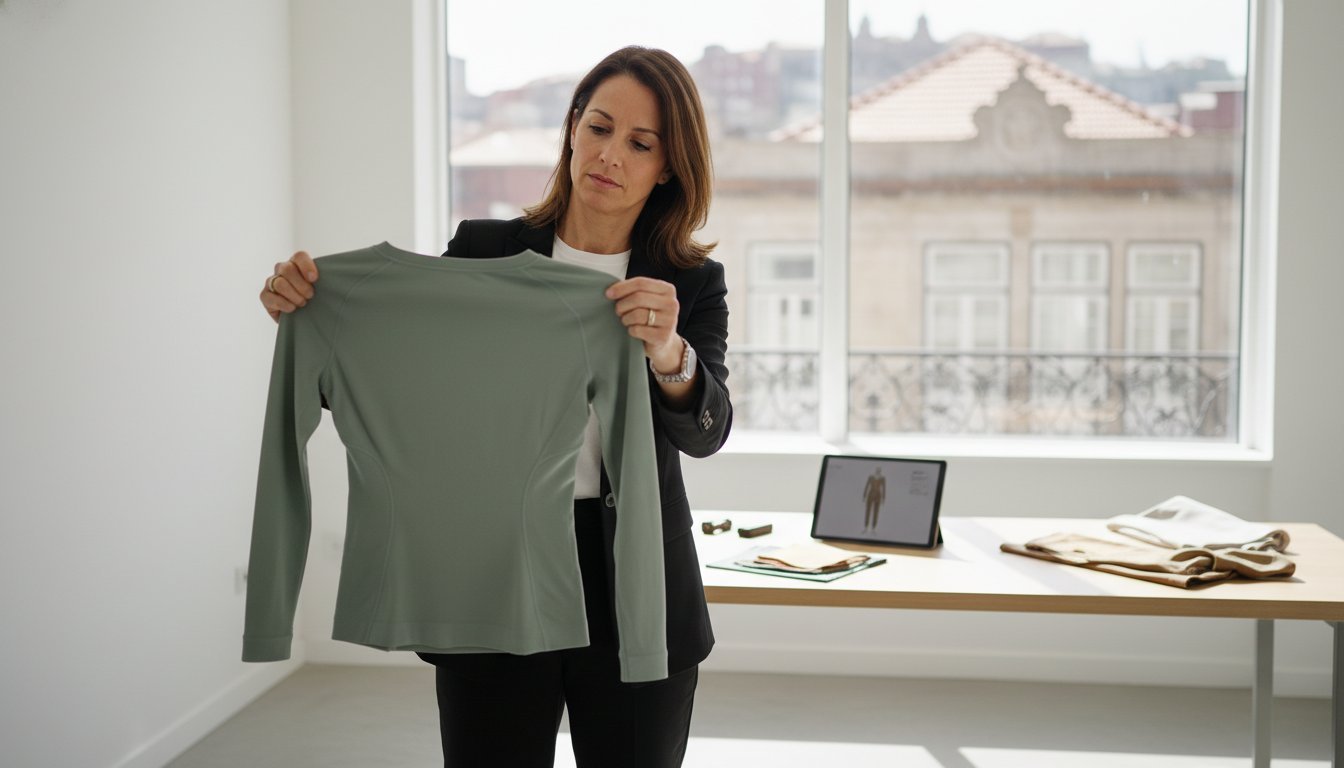
Private Label Athleisure Portugal: The 2026 Founder’s Guide
What if the secret to scaling your fitness brand isn't finding the cheapest factory, but the most agile one? Many founders realize that chasing high-volume production in Asia often leads to dead stock, inconsistent quality, and communication breakdowns that stall growth. If you've felt the frustration of 1,000-piece minimums or opaque supply chains, you're not alone. Transitioning to private label athleisure portugal allows you to bypass these hurdles by leveraging a manufacturing hub that prioritizes premium craftsmanship and operational transparency.
We understand that entering the luxury market requires more than just a logo; it demands a partner who understands the rigorous EU standards of 2026. This guide provides the strategic roadmap you need to master the "Portuguese Formula" and launch a scalable athleisure collection. You'll learn how to navigate new 2026 requirements like Digital Product Passports and updated OEKO-TEX standards while maintaining the low MOQs necessary for a lean startup. We'll explore how to find a long-term partner to ensure your brand stands for both high-end quality and ethical integrity in a year where sustainability is no longer optional.
Key Takeaways
- Understand why the "Made in Portugal" seal is a critical asset for 2026 brands and how private label athleisure portugal manufacturing ensures compliance with new EU sustainability regulations.
- Identify the technical differences between standard fabrics and premium Portuguese long-staple cotton to ensure your products meet luxury market standards.
- Evaluate whether white label luxury blanks or custom CMT production is the most efficient path for your brand's specific growth stage and design complexity.
- Learn the logistical requirements for successful production, from developing professional tech packs to sourcing sustainable trims from specialized local mills.
- Discover strategies to mitigate financial risk by utilizing lower minimum order quantities without compromising on premium craftsmanship or ethical certifications.
Why Portugal is the Global Hub for Private Label Athleisure
Portugal has secured its position as the premier destination for high-end activewear production. This isn't by accident. The region's infrastructure is built on vertical integration, where sourcing, sample creation, and full CMT production often happen within a small geographic radius. This proximity reduces lead times and ensures that private label athleisure portugal partners can maintain strict oversight over every stitch. As the global Athleisure trend evolves toward "quiet luxury" and performance-driven basics, Portugal's ability to produce heavy-duty cotton and advanced synthetic blends has become a competitive necessity for founders.
The manufacturing landscape has shifted from the old model of mass production to a more agile, high-quality boutique approach. In 2026, successful brands aren't the ones with the largest warehouses; they're the ones that can react to market shifts without being weighed down by thousands of units of unsold stock. Portuguese factories specialize in this operational agility. They offer the technical sophistication of a large-scale operation with the flexibility that emerging brands need to test new silhouettes and premium fits.
The Heritage of Portuguese Textiles
The Northern region of Portugal, particularly the area surrounding Porto, houses a textile cluster with centuries of expertise in knitting and weaving. This local knowledge is why many of the world's leading streetwear and gym wear brands choose made in portugal clothing for their core collections. The workforce isn't just skilled; they're experts in high-density fabrics that don't lose shape after repeated washing. Because the country operates under strict EU labor laws, brands can confidently market their products as 100% ethical. This transparency is a powerful tool for entrepreneurs who need to prove their supply chain integrity to a discerning audience.
Sustainability as a Standard, Not an Option
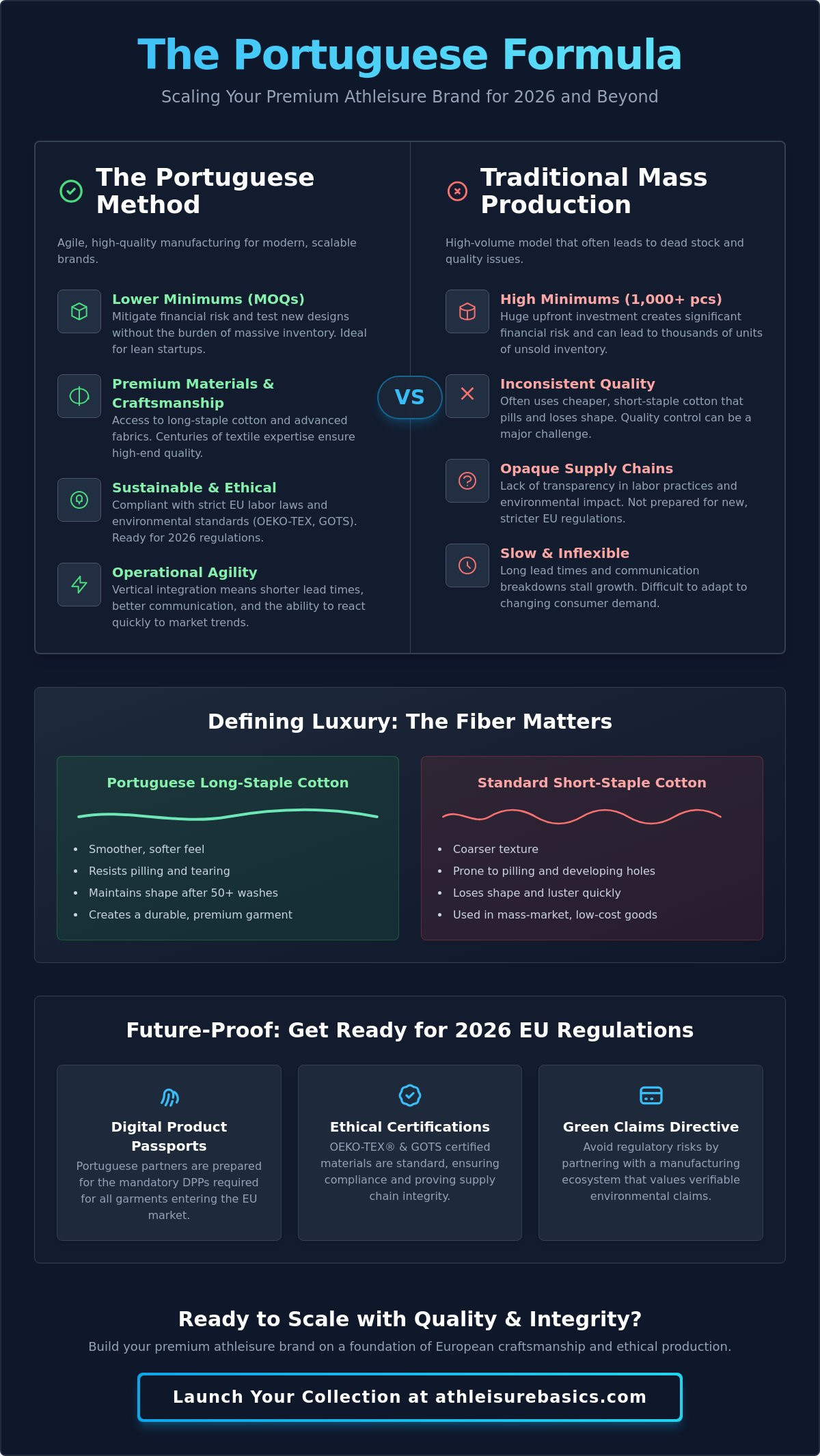
In 2026, sustainability is a regulatory requirement, not just a marketing buzzword. Portuguese factories have stayed ahead of the curve by integrating OEKO-TEX® and GOTS certified materials into their standard offerings. This commitment to principled manufacturing helps brands avoid the risks associated with the EU's Green Claims Directive. By choosing private label athleisure portugal, you're aligning your brand with a manufacturing ecosystem that values long-term environmental health.
- Waste reduction: Advanced CAD-assisted cutting minimizes fabric scraps during the CMT process.
- Low-carbon sourcing: Proximity to high-end textile mills reduces the environmental footprint of raw material transport.
- Regulatory readiness: Local partners are already prepared for the mandatory Digital Product Passports required for all garments entering the EU market.
This focus on ethical production and material integrity ensures your collection meets the high standards of conscious consumers who prioritize European craftsmanship over low-cost, offshore alternatives.
Defining Quality: The Technical Side of Athleisure Manufacturing
Quality in the 2026 premium market is defined by technical specifications that consumers can feel. When you choose private label athleisure portugal, you're accessing a manufacturing culture that prioritizes fiber length and fabric density over cost-cutting. The foundation of any luxury collection starts with the raw material. Portuguese long-staple cotton fibers are significantly smoother and stronger than the short-staple alternatives used in mass production. These longer fibers result in a fabric that resists pilling, maintains its luster, and feels substantial against the skin.
Modern consumers expect garments that survive the "50-wash test" without losing their shape. Achieving this requires advanced finishing techniques that many offshore factories overlook. Many Portuguese manufacturers are currently leading the green transition of the T&C industry by implementing closed-loop finishing processes. Techniques like enzyme washes remove surface fuzz for a cleaner look, while silicone softeners provide a buttery tactile experience. For those seeking a vintage or unique aesthetic, garment dyeing allows you to dye the finished piece rather than the fabric roll, creating soft color variations at the seams.
Athleisure Fabric Weights and Weaves
Understanding GSM (Grams per Square Metre) is essential for positioning your brand. Standard retail t-shirts usually sit between 140 and 160 GSM, which often feels thin and disposable. Premium streetwear and athleisure brands now demand heavyweight jerseys ranging from 250 to 300 GSM for tees. For hoodies and sweatshirts, 400+ GSM French Terry is the gold standard. This heavy, looped-back knit provides the structural "weight" that customers associate with luxury. If you want to evaluate these weights firsthand, exploring luxury blanks is an effective way to compare different GSM levels before starting a custom run.
Fit and Silhouette: Mastering the Oversized Look
Creating a successful "boxy" or oversized fit is a technical challenge that requires precise pattern making. A poorly constructed oversized tee will sag at the neck or drape awkwardly at the waist. In private label athleisure portugal production, pattern makers focus on drop-shoulder construction and reinforced double-stitching to ensure the garment holds its intended silhouette. You should also consider the following technical details to elevate your designs:
- Custom Ribbing: High-density 1x1 or 2x2 ribbing on cuffs and collars prevents stretching over time.
- Reinforced Necklines: Herringbone tape at the neck adds a bespoke feel and structural integrity.
- Side Seam Construction: Traditional side seams provide better shape retention than tubular knits used in budget apparel.
By focusing on these technical nuances, you move beyond simple clothing and begin building a brand based on tangible product excellence.
Custom vs. White Label: Which Path Fits Your Brand?
Choosing the right production model is the most critical strategic decision a founder makes. It dictates your initial capital requirements, your speed to market, and your long-term scalability. For those entering the private label athleisure portugal market, the choice usually rests on whether you need a proprietary fit or if you prefer to leverage existing luxury-grade patterns that have already been market-tested. Both paths offer the same high-end Portuguese craftsmanship, but they serve different business stages and goals.
A hybrid approach is often the most efficient way to scale. Many founders launch with a core collection of white label essentials to generate immediate cash flow. They then reinvest those profits into custom CMT projects for their "hero" pieces. This strategy allows you to build a comprehensive private label portugal brand without the massive upfront risk of developing ten unique silhouettes simultaneously.
The White Label Advantage for Startups
White label production is designed for rapid 2026 market entry. By using pre-vetted, luxury-grade silhouettes, you bypass the time-consuming sample and pattern-making phases. This model offers lower MOQs, often starting at just 70 pieces per style. It's an ideal solution for testing new colors or seasonal "drops" without committing to heavy inventory. You still receive the benefit of premium fabrics and ethical production, but with a significantly faster turnaround time than custom manufacturing.
Custom Manufacturing for Brand Differentiation
When your brand identity relies on a unique "moat"-such as a proprietary fabric blend or a specific oversized drape-custom CMT (Cut, Make, Trim) is the necessary path. This requires a 250-piece MOQ threshold but provides total design control. You can specify everything from unique hardware and custom woven labels to reinforced double-stitching patterns. Custom manufacturing allows you to create a product that cannot be easily replicated by competitors, ensuring your brand stands out in the crowded private label athleisure portugal landscape.
- Design Control: Create proprietary fits and unique silhouettes from the ground up.
- Branding: Integrate custom hardware, zippers, and bespoke internal taping.
- Exclusivity: Ensure your designs remain exclusive to your brand.
Whether you choose the speed of white label or the creative freedom of custom CMT, the key is to align your production choice with your current budget and growth projections. Starting lean doesn't mean sacrificing quality; it means being pragmatic about how you deploy your resources in the early stages of your brand's lifecycle.
Navigating the Production Process in Portugal
The transition from a design concept to a shelf-ready product requires a disciplined, multi-step workflow. Portugal's manufacturing ecosystem is built on a foundation of logical progression and transparency, which helps mitigate the risks often associated with offshore production. This structured approach is why private label athleisure portugal remains the gold standard for founders who prioritize precision. The process is generally divided into five distinct phases: technical development, material sourcing, sampling, bulk production with quality control, and final logistics.
Communication is the most critical element during these stages. Because Portuguese factories operate within the EU, they adhere to high standards of operational reporting. You aren't just sending an email and hoping for the best; you're engaging in a collaborative partnership where each checkpoint requires formal approval. This ensures that the final bulk run aligns perfectly with your brand's quality expectations and 2026 sustainability requirements.
The Role of the Tech Pack
A professional tech pack serves as the non-negotiable blueprint for your collection. Without this document, the factory is forced to make assumptions about your designs, which leads to costly delays. For athleisure, where the "boxy" fit or the tension of a waistband is vital, your tech pack must include an exhaustive measurement chart and a detailed Bill of Materials (BOM). You should specify everything from the exact thread type to the placement of reinforced double-stitching. Providing these technical details upfront prevents sampling errors and ensures your factory understands the specific tactile goals of your brand.
Sampling: The Bridge to Bulk Production
You should never skip the "Golden Sample" phase. This is the final prototype that represents exactly what the customer will receive. During sampling, you evaluate how your chosen 400+ GSM French Terry drapes in a real-world setting. It's the time to test color accuracy and the durability of prints or embroidery after industrial washing. If the silhouette needs adjustment, this is your window to provide technical feedback. For example, you might request a 1cm increase in the drop-shoulder width to achieve a more structured look. Once this sample is signed off, it becomes the physical contract for the bulk production run.
- Bulk Production: Once the sample is approved, the factory begins the CMT process, utilizing rigorous QC checkpoints at the cutting, sewing, and finishing stages.
- Logistics: Portugal's position as a central European hub allows for efficient global distribution, reducing lead times for brands targeting the EU or North American markets.
If you're ready to move from concept to creation, our team offers expert tech pack development and sample creation to ensure your production journey is seamless and professional.
Scaling Your Brand with Athleisurebasics
Building a successful fitness or streetwear brand in 2026 requires more than just a manufacturer; it requires a strategic ally that understands the evolving regulatory landscape. Athleisurebasics positions itself as that dedicated partner, bridging the gap between startup-friendly accessibility and the uncompromising standards of the luxury industry. By choosing private label athleisure portugal services through our facility, you aren't just buying clothing. You're investing in a transparent production model that prioritizes material integrity and ethical labor standards.
Our commitment to excellence is reflected in our adherence to the latest industry regulations. As of June 1, 2026, updated OEKO-TEX® standards have introduced stricter requirements for biodegradability and chemical management. We ensure that every garment in your collection meets these rigorous benchmarks, protecting your brand from the potential fines associated with the EU's Green Claims Directive. Our location in the heart of Portugal’s textile region also provides a logistical advantage, offering efficient shipping routes to global markets from a central European hub.
Our Full-Service Production Model
We provide an end-to-end solution that adapts to your brand's growth lifecycle. Whether you're a startup looking for luxury blanks or an established label requiring full CMT production, our infrastructure supports your journey. We offer expert consulting to help you navigate the complex landscape of clothing manufacturers in Portugal, ensuring you find the right technical fit for your designs. Our service model includes:
- Custom Materials Sourcing: Direct support in finding sustainable, high-performance fabrics from local mills.
- Flexible Production Volumes: White label services starting from 60-70 pieces and custom manufacturing from 200-300 pieces.
- Professional Tech Pack Development: Ensuring your design blueprints are factory-ready to prevent costly sampling errors.
- Dedicated Account Management: Proactive and transparent communication throughout the entire production cycle.
Launch Your Next Drop Today
The path to a premium collection starts with a single, well-executed step. You can access our catalog of luxury blanks for immediate private label branding or initiate a custom project to develop your proprietary silhouettes. Our team is ready to provide a tailored quote based on your specific fabric requirements, GSM targets, and quantity needs. By removing the traditional barriers to entry, we empower you to focus on marketing and community building while we handle the technical complexities of manufacturing.
Partner with Athleisurebasics for your streetwear production and secure your brand's place in the 2026 luxury market. We're ready to help you transition from a lean startup to a lasting commercial presence with the quality and speed your customers demand.
Secure Your Brand's Future in the Luxury Market
Launching a successful brand in 2026 requires more than just a creative vision; it demands a manufacturing partner that can translate that vision into a high-quality reality. We've explored how mastering technical fabric weights and selecting the right production model are essential steps in building a defensible market position. By focusing on private label athleisure portugal, you ensure your brand benefits from ethical production standards and the agility needed to scale without the burden of excessive inventory.
Success in this industry is built on the foundation of expert Portuguese heritage craftsmanship and a commitment to principled manufacturing. Whether you're starting with small-batch white label drops or developing a fully custom CMT collection, the path to a luxury presence is now more accessible than ever. With low MOQ options starting from 70 pieces and access to OEKO-TEX® certified premium fabrics, you can launch with confidence knowing your supply chain is secure and sustainable.
Take the first step toward building a lasting commercial presence today. Start your premium athleisure production in Portugal with Athleisurebasics. We're here to help you navigate every technical choice and turn your design concepts into a finished, shelf-ready collection. Your journey from a lean startup to a globally recognized label begins with the right partnership.
Frequently Asked Questions
What is the typical MOQ for private label athleisure in Portugal?
Minimum order quantities for white label services typically start at 60 to 70 pieces per style. If you require full custom manufacturing (CMT), the threshold is generally between 200 and 300 pieces. These lower requirements allow emerging brands to test the market without committing to the thousands of units often required by offshore factories. It's a strategic entry point for founders prioritizing lean inventory management.
How long does the production process take from initial design to final delivery?
The timeline generally spans 12 to 20 weeks depending on the complexity of your requirements. Sampling and tech pack finalization usually take 4 to 8 weeks, while bulk production and quality control require an additional 8 to 12 weeks. Nearshoring in Portugal significantly reduces the transit time compared to Asian hubs. This allows you to react faster to seasonal trends and restock best-sellers with greater efficiency.
Can I use my own designs or do I have to use your pre-existing templates?
You have the flexibility to choose between full custom CMT production or white label luxury blanks. If you have proprietary fits and unique silhouettes, our custom manufacturing path allows you to create your garments from the ground up. Alternatively, you can use our pre-vetted luxury blanks to launch your brand quickly. This hybrid capability ensures that your private label athleisure portugal brand can scale from basic essentials to complex, bespoke designs.
Are Portuguese clothing manufacturers more expensive than those in Asia?
Unit costs in Portugal are higher than in many Asian hubs, but the total cost of ownership is often lower for premium brands. You save on international shipping, import duties within the EU, and the hidden costs of poor quality control. The "Made in Portugal" label also allows for higher retail price points. Most founders find that the reduced risk and superior craftsmanship justify the initial manufacturing investment.
What kind of fabrics are best for high-end, luxury streetwear?
High-density French Terry and heavyweight jersey are the gold standards for modern luxury streetwear. For hoodies and sweatshirts, a 400+ GSM French Terry provides the structural weight that consumers associate with premium quality. T-shirts should ideally use long-staple cotton in the 250 to 300 GSM range. These materials ensure that your collection maintains its shape and tactile feel after repeated industrial washes.
Do I need a professional tech pack to start production in Portugal?
A professional tech pack is essential for custom CMT production to ensure accuracy and prevent delays. This document acts as a blueprint that includes your measurement charts, bill of materials, and specific stitching instructions. While you don't need a tech pack for white label luxury blanks, having one for custom designs protects your investment. It ensures the factory delivers exactly what you envisioned without costly misunderstandings.
How does shipping and customs work when manufacturing within the EU?
Manufacturing in Portugal offers a seamless logistical experience for brands based within the European Union. There are no customs duties or complex import paperwork for intra-EU shipments, which simplifies your supply chain significantly. For global distribution, Portugal serves as a central European hub with efficient maritime and air freight connections. This proximity reduces your carbon footprint and shortens the lead time between the factory and your final customer.
Is sustainable manufacturing standard in Portuguese athleisure factories?
Ethical and sustainable production is a core pillar of the private label athleisure portugal industry. Most facilities already operate under strict EU labor and environmental laws, making them naturally more compliant than many global competitors. You'll find a wide availability of OEKO-TEX® and GOTS certified materials as standard offerings. This commitment helps your brand meet the 2026 Digital Product Passport requirements and appeals to the growing demographic of conscious consumers.



Leave a comment
This site is protected by hCaptcha and the hCaptcha Privacy Policy and Terms of Service apply.