
Streetwear Manufacturer Portugal: 2026 Premium Brand Guide
The obvious choice for low-cost streetwear production has always pointed east. But for brands serious about quality, ethics, and a heavyweight feel that actually holds up, that assumption is costing them more than they think. Finding the right streetwear manufacturer in Portugal is increasingly where ambitious labels are turning, and the reasons go well beyond geography.
You already know the frustration. Minimum order quantities that lock you into thousands of units before your first drop. Fabric weights that feel promising in a sample but inconsistent in bulk. Factories where communication breaks down at the worst possible moment. These aren't small inconveniences; they're the barriers that stall brands before they ever find their footing.
Portugal has quietly built one of Europe's most capable textile industries, combining heritage craftsmanship with the kind of ethical, OEKO-TEX® certified production that premium streetwear consumers now expect. This guide breaks down exactly what makes Portuguese manufacturing a serious strategic choice for emerging brands in 2026, how to evaluate potential partners, and what to look for in a manufacturer that can support both your first small-batch drop and your growth beyond it.
Key Takeaways
- Choosing the right streetwear manufacturer in Portugal means accessing OEKO-TEX® certified fabrics, ethical production standards, and a "Made in Portugal" mark that premium consumers increasingly demand.
- Understanding technical specifications like GSM and fabric hand feel is essential for ensuring your bulk production matches the quality of your sample — and protects your brand's reputation from the first drop.
- White label and custom cut & sew are two distinct strategic paths, each with different MOQs, lead times, and brand-building implications — knowing which fits your current stage can save significant time and capital.
- Preparing a professional tech pack and planning around Portugal's production calendar are two practical steps that directly impact your lead times and manufacturer relationships in 2026.
- Low MOQ entry points — starting at 70 pieces for white label — mean emerging brands no longer have to overcommit inventory to access premium European manufacturing.
Why Portugal is the Global Hub for Premium Streetwear in 2026
Something significant has shifted in how serious streetwear brands think about sourcing. The conversation has moved away from simply finding the cheapest production option and toward finding the most defensible one. "Made in Portugal" has become that answer for a growing number of labels that understand their customers are paying attention to where, and how, their garments are made.
Portugal's textile industry isn't a recent discovery. The country's manufacturing infrastructure, concentrated in regions like the Ave Valley and Braga, has been producing high-specification knitwear and jersey fabrics for decades. What's changed is how strategically valuable that heritage now is for streetwear brands specifically. The core fabrics of the category, heavyweight fleece, French terry, and premium cotton jersey, are precisely where Portuguese mills have built their deepest expertise.
Proximity to the EU market is a practical advantage that compounds over time. Shipping from Portugal to major European markets typically takes days rather than weeks, which means tighter inventory management, faster restocking, and a meaningfully lower carbon footprint compared to transoceanic supply chains. For brands building a sustainability narrative, that difference isn't just logistical; it's a marketing asset.
The Rise of 'Luxury Streetwear' Sourcing
The groundwork was laid by brands like Fear of God and Off-White, which demonstrated that streetwear consumers would pay a premium for garments with genuine construction quality and traceable origins. That shift created a new sourcing imperative: find manufacturers capable of delivering heavyweight, durable garments with consistent quality across bulk runs. Working with a credible streetwear manufacturer in Portugal directly addresses that need. Portuguese cotton, processed through mills with decades of experience in high-GSM knit construction, has become the gold standard for brands that want their hoodies and fleece pieces to feel as premium as their price point demands.
Sustainability and Ethical Transparency
EU labor law compliance isn't optional for Portuguese manufacturers; it's the baseline. That means fair wages, regulated working hours, and documented production conditions. For brands, this translates into something tangible: the ability to answer a customer's question about where their garment was made with a confident, verifiable answer.
OEKO-TEX® certification takes that transparency further. It confirms that the fabrics used in production have been tested and verified free from harmful substances, which matters both to conscious consumers and to retailers with strict sourcing requirements. Made in Portugal clothing built on certified materials gives brands a clean, auditable supply chain from the very first production run, something that's increasingly difficult to replicate at comparable cost from outside Europe.
Technical Standards: Fabrics and Fits That Define Modern Streetwear
Quality in streetwear isn't subjective. It's measurable. The difference between a hoodie that commands £120 and one that ends up on a clearance rack often comes down to decisions made at the fabric specification stage, before a single stitch is placed. Understanding those decisions is what separates brands that build lasting reputations from those that don't survive their second drop.
Streetwear Fabric Essentials
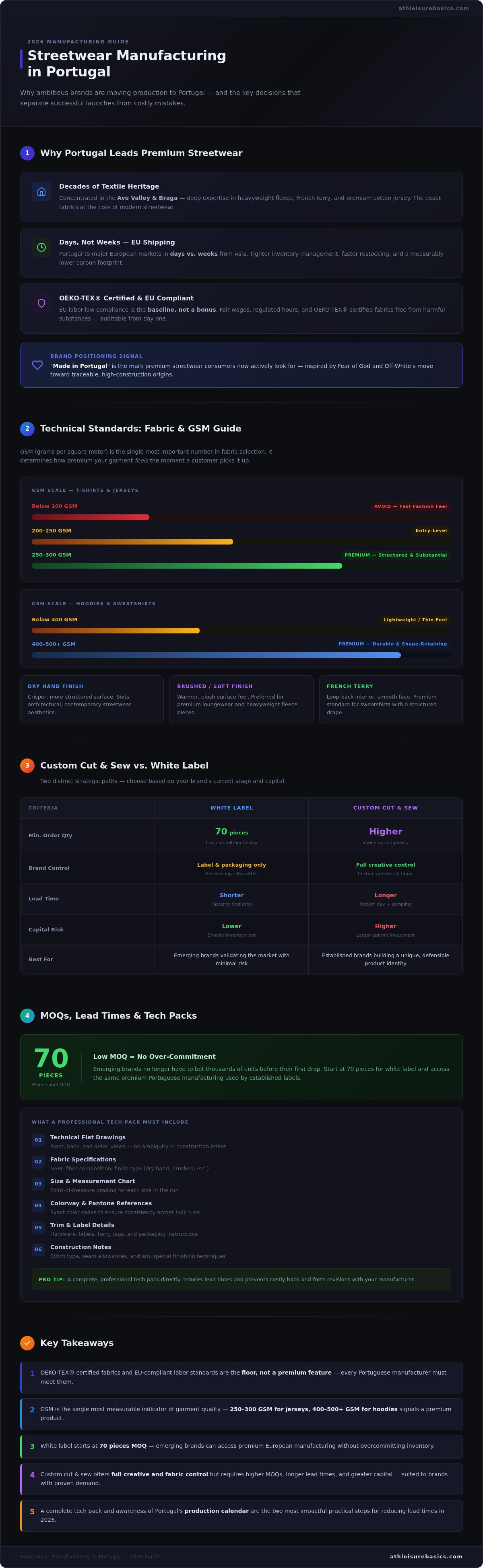
GSM, grams per square meter, is the most important number you'll work with in fabric selection. For premium t-shirts, heavyweight jersey in the 250 to 300 GSM range delivers the substantial, structured feel that signals quality the moment a customer holds the garment. Anything below 200 GSM reads as fast fashion, regardless of how it's branded. For hoodies and sweatshirts, French terry and brushed fleece in the 400 to 500+ GSM range are the standard for structured, durable pieces that hold their shape after repeated washing.
Beyond weight, finish matters enormously. A dry hand finish produces a crisper, more structured surface with a subtle texture, which suits the architectural aesthetic of contemporary streetwear. A soft hand finish delivers a pillowy, supple feel that works better for relaxed, comfort-led pieces. Neither is objectively superior; the choice should be deliberate and consistent across your range, because customers notice when it isn't.
Sustainable fabric options have matured significantly. Organic cotton and recycled cotton blends now perform at the same GSM benchmarks as conventional equivalents, without the hand-feel compromise that once made them a difficult sell to quality-conscious buyers. For brands building an ethical narrative, specifying OEKO-TEX® certified organic fleece at 480 GSM isn't a trade-off. It's a positioning statement.
Precision in Patterns and Grading
Fit is where technical knowledge translates directly into brand identity. The oversized, boxy, and drop-shoulder silhouettes that define modern streetwear don't behave like standard apparel patterns. A drop shoulder requires precise sleeve cap adjustments to avoid pulling across the back. An oversized fit needs carefully controlled proportions so it reads as intentional rather than simply large. Understanding the full garment production process is essential here, because these silhouettes demand pattern decisions that cascade through every subsequent production stage.
Standard size grading, designed for fitted garments, doesn't translate to streetwear silhouettes. Grading an oversized piece using conventional increments often produces a size XL that looks proportionally different from the size S, breaking the visual consistency that makes a range feel cohesive. Experienced manufacturers working in this category grade proportionally, preserving the intended silhouette across the full size run.
Construction quality reinforces everything. Double-needle stitching on hems, bartacking at stress points like pocket corners and drawstring channels, and reinforced seams at the shoulder and side panels are the details that distinguish a garment built to last from one built to look good in a flat lay. Working with a credible streetwear manufacturer in Portugal means these specifications are understood from the outset, not negotiated after a disappointing first sample.
- 250–300 GSM jersey: the minimum threshold for premium t-shirts
- 400–500+ GSM fleece: required for structured hoodies with body and drape
- Dry hand vs. soft hand: specify this in your tech pack, not as an afterthought
- Drop-shoulder grading: requires custom pattern logic, not standard increments
- Bartacking and double-needle stitching: non-negotiable for durability at a premium price point
If you're at the stage of translating these specifications into a production-ready brief, clothing production consulting can help you build a tech pack that communicates these details precisely to your manufacturer from day one.
Custom Cut & Sew vs. White Label: Which Path Fits Your Brand?
The decision between white label and custom cut & sew isn't just operational. It's a strategic choice about where your brand is right now and where you're building toward. Getting this wrong costs time and capital. Getting it right means your first drop can actually fund your second.
Launching Fast with White Label
White label is the fastest route from concept to customer. Starting at an MOQ of 70 pieces, it lets emerging brands access premium Portuguese blanks built on OEKO-TEX® certified fabrics, then layer their identity on top through embroidery, screen printing, custom woven labels, and neck relabeling. The result can look and feel entirely proprietary without the development overhead of a bespoke pattern.
The strategic value here is risk mitigation. Committing to 70 units to test a colorway or silhouette is a fundamentally different financial decision than locking into 250 or more before you've validated demand. For a brand in its first or second drop, that difference is often the difference between staying solvent and not. High-end finishing choices, a custom woven label, a precisely placed embroidered graphic, a garment-dyed colorway exclusive to your run, do significant work in elevating a blank into something that reads as considered and brand-specific. Customers rarely distinguish between a customized blank and a fully bespoke piece when the finishing is executed well. Understanding the full range of options available through private label Portugal manufacturing is the starting point for making those choices deliberately.
Building Authority with Custom Manufacturing
Custom cut & sew is where brand DNA gets built into the garment itself. At an MOQ of 250 pieces, you're working from original patterns, which means unique pocket placements, proprietary silhouettes, custom hardware, and construction details that no other brand can replicate because no other brand owns the pattern.
In a streetwear market where blanks are widely accessible, differentiation through construction is one of the few genuinely defensible positions. A signature oversized silhouette with a custom-engineered shoulder drop isn't something a competitor can copy by sourcing the same blank. That's long-term brand equity built at the production stage.
Managing a 250-piece MOQ strategically means planning at the collection level rather than the individual style level. Distributing that minimum across two or three colorways of a hero piece, for example, makes the commitment more manageable while still generating the variety a launch needs.
The most practical approach for many brands working with a credible streetwear manufacturer Portugal is a hybrid model: launch with white label to validate the market and build an audience, then transition core hero pieces to custom cut & sew as volume and confidence grow. That progression isn't a compromise. It's a capital-efficient way to build something that lasts.
- White label MOQ: 70 pieces, fastest route to market, ideal for testing
- Custom cut & sew MOQ: 250 pieces, full pattern ownership, maximum differentiation
- Hybrid path: start with blanks, migrate hero styles to custom as you scale
- White label finishing: embroidery, screen printing, and relabeling create a brand-specific look without bespoke development costs
- Custom advantage: proprietary patterns can't be replicated by competitors sourcing the same blanks
Sourcing Your Streetwear: MOQs, Lead Times, and Tech Packs
Knowing what you want to make is only half the equation. Getting a factory to produce it accurately, on time, and without costly back-and-forth requires preparation that most first-time brands underestimate. The brands that move fastest through sampling and into production aren't the ones with the biggest budgets. They're the ones who arrive ready.
The Anatomy of a Streetwear Tech Pack
A tech pack is the document that bridges your creative vision and a factory's production floor. Without one, you're asking a manufacturer to interpret your intentions rather than follow your instructions. That gap is where sampling rounds multiply and costs escalate.
A production-ready tech pack for streetwear should include:
- Bill of Materials (BOM): every component specified by name, weight, and supplier where possible, including main fabric, lining, trims, hardware, labels, and threads
- Graded spec sheets: measurements for every size in your run, not just the sample size, with tolerances clearly marked
- Construction callouts: annotated technical flats showing stitch types, seam allowances, bartack placements, and finishing details
- Colorways and colorway codes: Pantone references or physical swatches, never verbal descriptions like "washed grey"
- Treatment specifications: if you're requesting distressing, acid washing, enzyme washing, or garment dyeing, these need their own dedicated pages with reference imagery and process notes
Streetwear-specific treatments are where vague briefs cause the most damage. "Distressed" means something different to every factory. A tech pack that includes reference photography, a description of the desired intensity, and the specific areas where distressing should appear gives a manufacturer something actionable. That precision is the difference between a first sample that's close and one that misses entirely. A professional tech pack development service can help you build this documentation correctly before you approach any factory.
Navigating Production Timelines
Portugal's production calendar has one consistent variable every brand needs to plan around: August. Portuguese factories, like most of southern Europe's textile industry, operate at significantly reduced capacity throughout August. Brands that submit orders in July expecting delivery in September routinely face delays. The practical fix is straightforward: place orders for autumn or early Q4 drops no later than June, and plan spring releases with fabric sourcing beginning in October.
Outside of that window, standard timelines from fabric sourcing through final quality control typically run eight to fourteen weeks for custom cut and sew, with white label production moving faster given that base fabrics are already in stock. Shipping from Portugal to the UK runs two to four days by road freight. US shipments via air freight typically land within five to seven business days, with sea freight adding three to four weeks but reducing cost significantly for larger bulk orders.
Experienced clothing manufacturers Portugal build seasonal demand into their scheduling, which means brands that communicate timelines clearly and early are consistently prioritised over those that arrive with urgent, underprepared briefs.
One rule applies regardless of your timeline or order size: never skip the prototype phase. A pre-production sample is the single most cost-effective quality checkpoint in the entire process. Catching a fit issue or a fabric discrepancy at sample stage costs a fraction of what it costs to address it in bulk. Every round of sampling you invest in before production protects the margin and reputation you're building your brand on.
If you're preparing to approach a streetwear manufacturer Portugal for the first time and want your tech pack to be factory-ready from day one, clothing production consulting is the practical starting point.
Partnering with Athleisurebasics for Your Streetwear Production
Everything covered in this guide, from GSM thresholds to tech pack precision to production calendar planning, only delivers results when you're working with a manufacturer that actually understands streetwear. Athleisurebasics was built specifically for brands at the stage where those details matter most: early enough that every decision carries risk, ambitious enough that cutting corners isn't an option.
Why We Specialize in Startups and Emerging Brands
Most factories are optimized for volume. Their processes, their pricing, their communication workflows are all calibrated for brands that already know what they're doing and can commit accordingly. That leaves a significant gap for founders who have a clear creative vision and a serious commitment to quality, but aren't yet in a position to place five-figure orders to prove it.
Athleisurebasics closes that gap. Our 70-piece MOQ for white label production isn't a concession; it's a deliberate choice to make premium Portuguese manufacturing accessible at the stage where it's most strategically valuable. A founder testing their first colorway deserves access to the same OEKO-TEX® certified fabrics and Portuguese craftsmanship as an established label, and that's exactly what we provide.
Our materials sourcing support extends that advantage further. We don't work from a fixed catalog and tell you to choose. We help you identify textiles that match your specific weight, finish, and sustainability requirements, including fabric options that aren't broadly available to brands sourcing independently. That access is a genuine competitive advantage for emerging labels building a premium positioning from day one.
- White label entry: 70-piece MOQ with access to luxury blanks and OEKO-TEX® certified fabrics
- Custom cut and sew: 250-piece MOQ for full pattern ownership and proprietary silhouettes
- Materials sourcing support: specialist textile sourcing beyond standard catalog options
- Tech pack development: factory-ready documentation built to minimize sampling rounds
- Production consulting: end-to-end guidance from concept through final quality control
Working with a credible streetwear manufacturer Portugal-side means more than access to good fabric. It means having a production partner who understands the category, communicates clearly, and treats your brand's growth as a shared objective rather than a transaction to be processed.
Take the Next Step in Your Brand Journey
Getting started is straightforward. To request a quote, you'll need your basic product brief, an indication of your target fabric weight and finish, your preferred colorways, and an approximate quantity. The more detail you can provide upfront, the faster we can give you an accurate, actionable response. If your tech pack isn't ready yet, our Clothing Production Consulting Services are the right starting point; we'll help you build the documentation that gets your project moving without costly revisions later.
First-time founders consistently find that investing in production consulting before approaching any factory compresses the entire development timeline. It's the difference between arriving prepared and arriving with good intentions. The brands manufacturing in Portugal today and building lasting commercial presence started by making that choice deliberately.
Your product deserves to be built on the same standard. Start the conversation with Athleisurebasics and take the first concrete step toward premium streetwear production that your brand, and your customers, can stand behind.
Your Next Step Toward Premium Streetwear Production Starts Here
The case for working with a streetwear manufacturer Portugal comes down to three things that genuinely move the needle for emerging brands: access to OEKO-TEX® certified fabrics that support a credible sustainability story, low MOQs starting at 70 units that let you validate demand before overcommitting capital, and expert production consulting that compresses your development timeline from the very first conversation.
Portugal's manufacturing infrastructure isn't a shortcut. It's a strategic foundation. Brands that build on it early don't have to retrofit quality into their identity later, because quality is already baked into every production decision they make.
Whether you're preparing your first white label drop or ready to develop a proprietary cut and sew silhouette, the path forward is clearer than it might feel right now. The right production partner makes that difference tangible.
Start your premium streetwear journey with Athleisurebasics today and build a brand your customers can trust from the very first garment.
Frequently Asked Questions About Streetwear Manufacturing in Portugal
What is the typical MOQ for streetwear manufacturing in Portugal?
MOQs vary depending on the production path you choose. White label manufacturing starts at 70 pieces per style, making it the most accessible entry point for emerging brands testing a new colorway or silhouette. Custom cut and sew production, where you own the pattern and all construction details, starts at 250 pieces. Both thresholds are designed to let brands move forward without overcommitting capital before demand is validated.
How long does it take to produce a streetwear collection in Portugal?
Custom cut and sew production typically runs eight to fourteen weeks from fabric sourcing through final quality control. White label moves faster because base fabrics are already available. One variable every brand needs to plan around is August, when Portuguese factories operate at reduced capacity. Submit orders for autumn drops no later than June, and begin fabric sourcing for spring releases in October to avoid delays.
Do I need a tech pack to start working with a Portuguese manufacturer?
A complete tech pack isn't always required to start a conversation, but it's essential before sampling begins. Factories produce what's documented, not what's described verbally. Arriving without a tech pack typically means more sampling rounds, longer timelines, and higher development costs. If yours isn't ready, investing in tech pack development before approaching any factory is the most efficient use of your pre-production budget.
Can I use sustainable or organic fabrics for my streetwear brand?
Yes, and Portuguese manufacturers are well-positioned to support this. Organic cotton and recycled cotton blends are available at the same GSM benchmarks as conventional equivalents, meaning you don't sacrifice hand feel or weight for sustainability credentials. OEKO-TEX® certified fabrics confirm that materials are tested and free from harmful substances, giving your brand a verifiable sustainability claim that holds up to retailer and consumer scrutiny.
What is the difference between CMT and Full Package production?
CMT, which stands for Cut, Make, and Trim, means you supply the fabric and trims while the factory handles construction. Full Package production means the manufacturer sources materials on your behalf, manages the supply chain, and delivers a finished garment. Full Package is generally more practical for emerging brands that don't yet have established fabric supplier relationships, as it reduces the coordination burden and consolidates responsibility with one partner.
How much does it cost to ship samples and bulk orders from Portugal?
We don't publish specific shipping costs here, as rates vary based on order weight, destination, and carrier. What's useful to know is that road freight from Portugal to the UK typically takes two to four days, while air freight to the US lands within five to seven business days. Sea freight to the US adds three to four weeks but reduces cost significantly for larger bulk orders. Your manufacturer can provide accurate freight quotes once your order volume is confirmed.
What certifications should I look for in a Portuguese clothing factory?
OEKO-TEX® certification is the most important for fabric-level transparency, confirming that materials are tested against harmful substances. Beyond that, look for factories operating under EU labor law compliance, which sets baseline standards for wages, working conditions, and documented production processes. These aren't optional extras; they're the foundation of a supply chain you can communicate to customers and retailers with confidence.
Can a streetwear manufacturer in Portugal help with fabric sourcing?
The right streetwear manufacturer Portugal-side will offer materials sourcing support as part of their service, rather than handing you a fixed catalog and asking you to choose. Specialist sourcing access means you can identify textiles matched to your specific GSM, finish, and sustainability requirements, including options that aren't broadly available to brands sourcing independently. This is a genuine competitive advantage for labels building a premium positioning from their first production run.



Leave a comment
This site is protected by hCaptcha and the hCaptcha Privacy Policy and Terms of Service apply.