
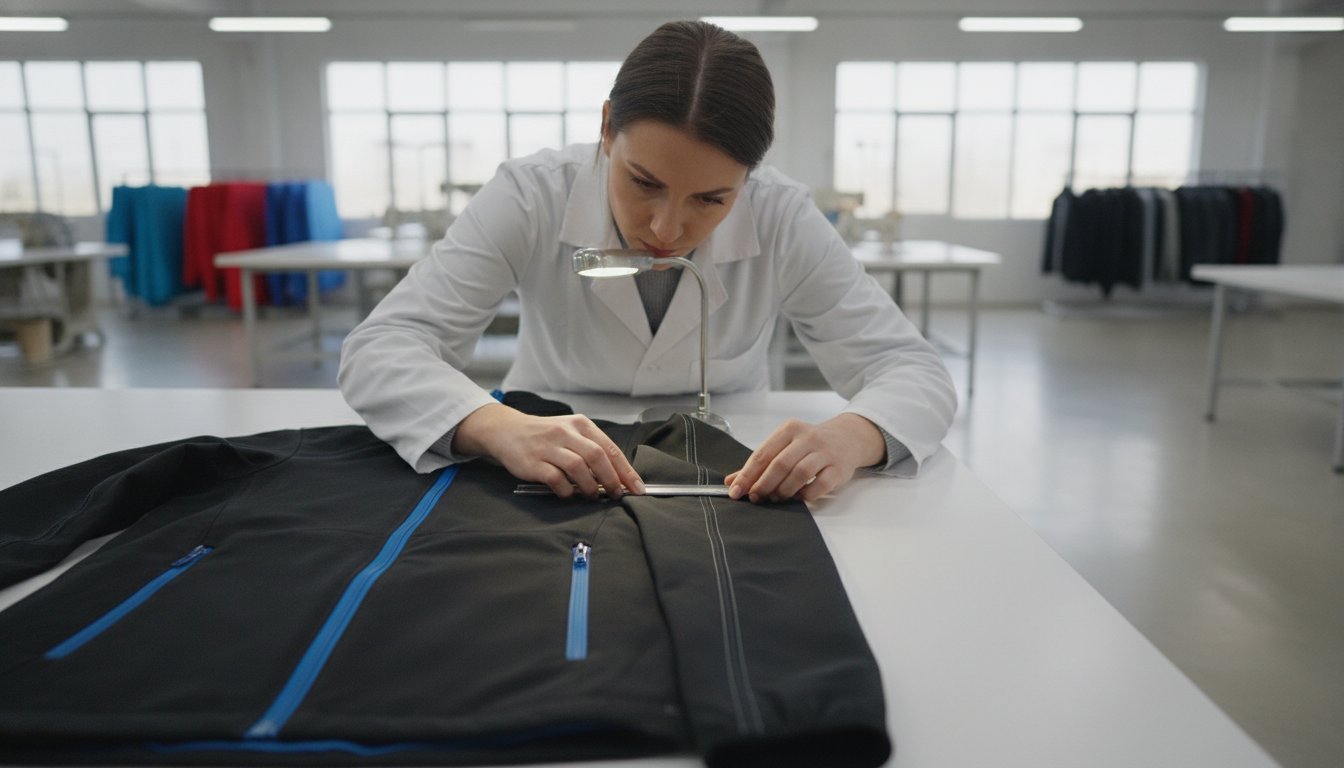
The Ultimate Garment Inspection Checklist: A 2026 Guide for Apparel Brands
Did you know that a single labeling error can result in FTC penalties of up to $51,744 per violation? For many emerging brands, the transition from a design concept to a physical product is often filled with anxiety. You've likely felt the fear of receiving a large batch of inventory only to find crooked stitching or fabric defects that make the pieces unsellable. Communicating these technical expectations to a factory can feel like learning a second language, especially when your brand's reputation is on the line.
We understand that consistent quality is the foundation of a premium brand. This guide provides a comprehensive garment inspection checklist to help you master the quality control process and ensure every piece meets professional standards. By following this repeatable framework, you can reduce return rates and create high-end products that justify your pricing. We'll preview the essential steps for verifying fabric integrity, construction accuracy, and regulatory compliance to keep your operations agile and your customers satisfied.
Key Takeaways
- Implement a systematic framework to identify technical defects early and prevent the arrival of unsellable inventory.
- Master the 5-point core inspection process to verify fabric weight, color consistency, and the structural integrity of seams.
- Adopt performance-specific checks for activewear, focusing on stretch recovery and the durability of flatlock stitching.
- Learn how to use a professional garment inspection checklist alongside AQL standards to classify defects as critical, major, or minor.
- Discover how partnering with ethical manufacturers in Portugal can naturally lower defect rates through superior craftsmanship and premium materials.
Why a Garment Inspection Checklist is Your Brand’s Best Defense
A garment inspection checklist is a systematic technical document used to verify that finished apparel meets pre-defined technical and aesthetic standards. It serves as a contract of quality between a brand and a manufacturer. In 2026, where consumer protection laws like the EU's General Product Safety Regulation (GPSR) are strictly enforced, this checklist is your primary defense against legal and financial liability. It ensures that "high quality" is not a subjective term but a measurable metric that both parties understand and respect.
Implementing a rigorous inspection process is essential for risk mitigation. In the current market, consumer patience for defects is at an all-time low. A single batch of unsellable inventory can stall your growth and drain your capital. By using a professional checklist, you protect your brand reputation and drastically reduce your Cost of Poor Quality (COPQ). This includes the visible costs of returns and the hidden costs of lost customer lifetime value. Catching an error at the factory level is always more cost-effective than managing a recall after the product has reached the customer's doorstep.
The Consequences of Skipping Quality Control
Skipping quality control leads to more than just a few unhappy customers. In the age of viral social proof, a shipment of leggings with transparent fabric or failing seams can lead to a wave of negative reviews that are nearly impossible to erase. The logistical burden of handling defective stock from international shipments can be devastating for emerging brands. You also face significant legal risks. With the US CPSC eFiling mandate now in effect as of July 2026, importers must provide certificates of conformity for every shipment. Safety failures, such as high lead content in trims or flammability issues, can lead to immediate product recalls and heavy federal penalties.
Quality Control vs. Quality Assurance
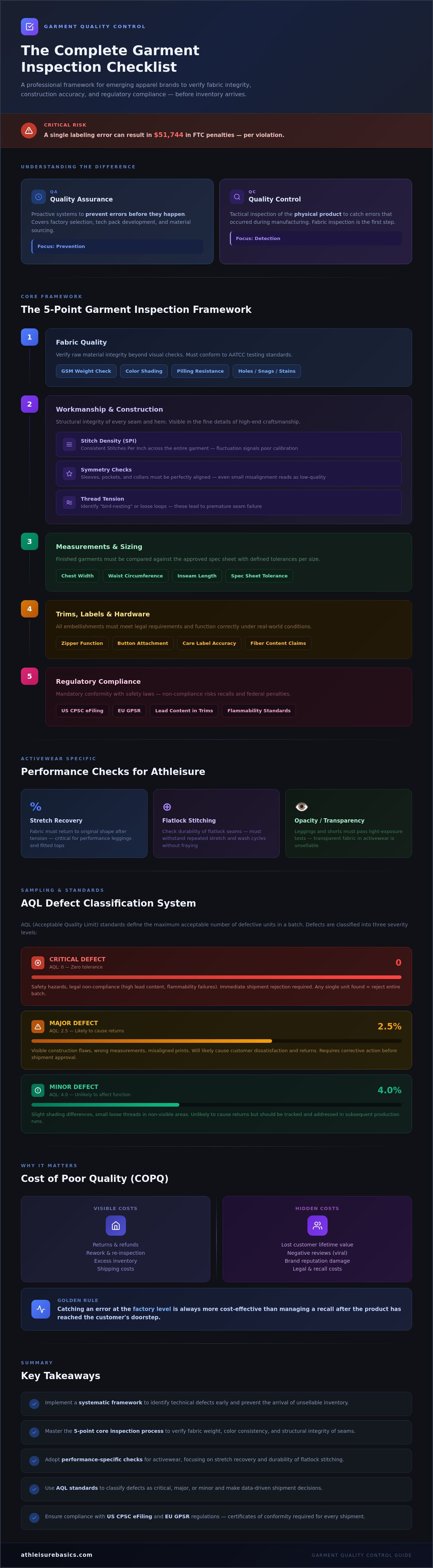
It's helpful to distinguish between Quality Assurance (QA) and Quality Control (QC). QA focuses on the systems you put in place to prevent errors before they happen, such as choosing the right factory or perfecting your tech pack. A comprehensive garment production process integrates QA at every stage, from material sourcing to sample approval. QC is the tactical act of inspecting the physical product to catch errors that occurred during manufacturing. Fabric inspection is often the first step in this tactical process, ensuring the raw materials are sound before the cutting phase begins.
Quality control serves as the final gatekeeper of your brand standards. By consistently applying a garment inspection checklist, you ensure that your premium vision is exactly what the customer receives.
The 5-Point Core Garment Inspection Framework
A professional garment inspection checklist focuses on five critical pillars that define the physical integrity of a product. These pillars transform a subjective "look and feel" into a set of technical requirements that can be measured and audited. By standardizing these checks, you ensure that your production remains consistent whether you are producing 70 pieces or 7,000.
Fabric Quality: The inspection begins with the raw material. Beyond checking for visible holes, snags, or stains, inspectors must verify the GSM (Grams per Square Meter) to ensure the fabric weight matches your specifications. Adhering to AATCC testing standards allows brands to objectively evaluate color shading and pilling resistance. This ensures the fabric performs as intended over its lifecycle and maintains the premium feel your customers expect.
Workmanship and Construction: This stage evaluates how the garment is put together. High-end craftsmanship is visible in the details, and a thorough garment inspection checklist should prioritize the structural integrity of every seam and hem.
Detailed Workmanship Checkpoints
- Stitch Density: Verify that the Stitches Per Inch (SPI) remain consistent across the entire garment. Fluctuating SPI often indicates poor machine calibration or rushed production.
- Symmetry Checks: Ensure sleeves, pockets, and collars are perfectly aligned. Even a small misalignment can make a premium garment appear low-quality.
- Thread Tension: Identify "bird-nesting" or loose loops. These technical flaws compromise the durability of the piece and lead to premature seam failure.
Measurements and Sizing: Finished garments must be compared against the approved tech pack. If you are refining your quality standards, our clothing production consulting services can help you build a robust measurement framework from day one.
Verification of Measurements
Understanding the "Tolerance" rule is vital. Brands typically allow a small deviation, such as 0.5cm, for non-critical points. However, critical points like the chest width or waist circumference require higher precision. To ensure accuracy, always use flat-lay techniques on a hard surface rather than measuring garments while they are hanging.
Trims and Accessories: Every zipper, button, and drawstring must be tested for functionality. Heat-press logos should be checked for adhesion and cracking, especially in performance wear where fabric stretch is high. Any failure here can lead to a high return rate.
Packaging and Presentation: The final pillar covers the customer's unboxing experience. Verify that polybags are correctly sealed, hangtags are attached to the right SKU, and all labels are accurate. This final check prevents logistical errors that could lead to negative social proof or shipping delays.
Performance-Specific Checks for Athleisure and Activewear
Generic checklists often overlook the unique physical demands of performance apparel. If you're building a brand in the activewear space, your garment inspection checklist must evolve to include technical tests that go beyond basic aesthetics. Performance pieces like leggings and sports bras rely on elasticity and durability. This means a minor defect in a standard t-shirt could be a critical failure in a pair of high-compression tights.
Inspectors must perform rigorous stretch tests to ensure garments return to their original dimensions after tension. If the fabric "bags out" or loses its shape, it fails the premium standard. Brands like Lunia prioritize these performance standards to ensure their garments offer both invisibility and freedom of movement. Similarly, flatlock seam integrity is a non-negotiable checkpoint. These seams must be perfectly smooth and chafe-free to prevent skin irritation during high-intensity movement. Any loose threads or skipped stitches in a flatlock seam compromise the structural integrity of the entire piece and can lead to painful friction for the end user.
High-contrast performance panels are a staple of modern athleisure, but they carry the risk of color bleeding. Verification of color fastness ensures that dark dyes don't transfer to lighter panels during perspiration or washing. Additionally, the "squat test" remains the industry standard for verifying the opacity of a textile. This ensures the fabric density is sufficient to remain opaque even at maximum stretch, protecting your customers and your brand's reputation for quality.
Inspecting Technical Fabrics
Verifying the functional claims of your fabric is essential for maintaining brand trust. On-site water drop tests can quickly confirm moisture-wicking capabilities before the batch leaves the factory. You should also evaluate pilling resistance by subjecting samples to friction, ensuring the fabric won't degrade after minimal use. To better understand how premium textiles respond to professional cleaning processes, you can discover Lśniąca Biel and their approach to high-standard garment care. Finally, confirm that all materials are OEKO-TEX® compliant. This certification guarantees that no harmful chemicals are present in the dyes or finishes, which is a hallmark of ethical European production and a core standard for our manufacturing partners.
Activewear Trim Functionality
Trims in activewear must be as durable as the fabric itself. Reflective strips should be checked for adhesion and cracking after the garment is stretched to its limit. Elastic waistband tension requires a careful balance; it must provide enough support to stay in place without causing discomfort. To ensure a statistically valid assessment of these features, professional inspectors utilize the Acceptable Quality Limit (AQL) sampling method to determine if the batch meets your pre-defined performance thresholds. Reinforced stitching at high-stress points, such as crotch gussets and underarms, should also be a priority on your garment inspection checklist to ensure long-term product durability.
Executing the Inspection: Sampling, AQL, and Defect Classification
Executing the inspection requires a balance of statistical rigor and practical common sense. While your garment inspection checklist identifies exactly what to look for, the sampling method determines how many pieces you actually need to evaluate. This ensures that your quality control is both thorough and efficient, allowing you to scale your operations without needing to inspect every single unit by hand.
Understanding AQL for Startups
Startups often feel they must check every garment to ensure perfection. However, as your production volume grows, this becomes logistically impossible. The Acceptable Quality Limit (AQL) is a statistical tool that allows you to inspect a representative sample of your lot to determine the overall quality. For premium private label Portugal production, brands typically use AQL Level II. AQL 2.5 is the industry standard for major defects. This means that if the number of major defects in your sample exceeds a specific threshold, the entire batch fails and must be re-inspected or repaired by the factory.
Defect Classification Examples
To make an informed Pass/Fail decision, you must categorize every issue found during the inspection. A professional garment inspection checklist uses three distinct categories:
- Critical: These are safety or legal violations. Examples include a broken needle left in a seam, a choking hazard on children's wear, or incorrect fiber content on a label. One critical defect usually results in an automatic failure of the entire batch.
- Major: These affect the garment's function or salability. Examples include an open seam, a visible hole in the fabric, or measurements that fall outside of the allowed tolerance.
- Minor: These are small aesthetic issues that don't impact the overall wearability or value. Examples include a loose thread that can be easily trimmed or a slight shading variation that is only visible under specific lighting.
On-site Testing and Documentation
Beyond visual checks, your team should perform functional tests during the inspection process. The "Pull Test" verifies the strength of seams and attachments like buttons or zippers. The "Dry/Wet Rub Test" ensures that dyes won't transfer to other surfaces or skin. Every finding must be documented in a formal Inspection Report. This report serves as your technical proof of quality and should include high-resolution photographic evidence of any defects found. If you need help establishing these technical protocols, you can explore our clothing production consulting services to ensure your brand standards are met every time.
Ultimately, the decision to accept or reject a shipment rests on your brand's specific quality threshold. A documented report gives you the leverage needed to negotiate repairs or replacements with the factory before the goods are shipped. This proactive approach prevents the arrival of unsellable inventory and protects your bottom line.
Building Quality into Production: The Portugal Advantage
While a professional garment inspection checklist is an essential tool for identifying errors, the most successful brands aim to prevent those errors from occurring in the first place. Choosing the right manufacturing partner is the single most effective way to reduce your defect rates and protect your capital. Made in Portugal clothing has earned a global reputation for excellence because the region combines centuries of textile heritage with modern, ethical production standards. When you produce in Portugal, you aren't just buying a product; you're investing in a culture of craftsmanship that prioritizes quality over mass-market speed.
At Athleisurebasics, we simplify this transition for emerging businesses. We provide access to premium Portuguese manufacturing with low MOQs ranging from 70 to 250 pieces. This flexibility allows startups to maintain lean inventory while ensuring every garment meets OEKO-TEX® certified standards. By starting with a high baseline of craftsmanship, your final garment inspection checklist becomes a tool for verification rather than a desperate attempt to catch systemic failures.
Transparency in the Supply Chain
Direct communication with the factory is the key to preventing "lost in translation" errors that often plague global production. EU manufacturing standards provide a predictable regulatory environment, ensuring that safety and labeling requirements are met by default. We support our partners through technical development and materials sourcing, removing the technical barriers that often lead to production errors. This transparency builds a sense of security, allowing you to focus on scaling your operations while we handle the technical complexities of the factory floor.
Next Steps for Your Brand
To protect your brand reputation, start by creating a customized version of the inspection checklist for your next production run. Focus on the critical performance points we've discussed, such as stretch recovery and seam integrity. If you need expert guidance to refine your production strategy or develop your technical specifications, our consulting services provide the industry insight needed to ensure professional-grade results. It's time to transition from a design concept to a finished product that justifies premium pricing.
Launch your premium collection with Athleisurebasics and experience the reliability of Portuguese manufacturing tailored for the modern entrepreneur.
Elevate Your Brand with Rigorous Quality Standards
Mastering the quality control process is what separates emerging startups from established premium brands. By adopting a systematic garment inspection checklist, you eliminate the guesswork and technical uncertainty that often leads to unsellable inventory. You now have a technical framework to verify fabric weight, construction integrity, and performance-specific traits like stretch recovery. These steps ensure that every piece delivered to your customer reflects the high standards of your brand vision.
Building a successful apparel line requires more than just a great design; it requires a reliable manufacturing partner. Portugal remains the global seal of quality for high-end activewear, offering specialized athleisure craftsmanship and OEKO-TEX® certified materials. We're here to help you navigate the complexities of production while maintaining ethical EU production standards. It's time to transition from a concept to a market-ready collection that justifies its premium positioning.
Start Your Premium Production in Portugal with Athleisurebasics today and build a brand that stands for excellence. Your journey toward professional-grade production starts with a single, quality-focused step.
Frequently Asked Questions
What is the most common defect in garment manufacturing?
Open seams and loose threads are the most frequent issues found during quality control. In the performance sector, skipped stitches in flatlock seams are a common technical defect. These issues usually stem from poor machine calibration or improper thread tension during the sewing phase, which can compromise the garment's durability.
How many garments should I inspect in a production run?
You should determine your sample size based on the AQL (Acceptable Quality Limit) standard. For most apparel batches, Level II sampling is the industry norm. This statistical approach ensures you check enough units to represent the entire lot accurately without the excessive time and cost required for a 100% inspection.
What is the difference between a major and a minor defect?
A major defect affects the garment's function, safety, or salability, such as a significant hole or incorrect sizing. A minor defect is a small aesthetic issue, like a loose thread or slight shading variation, that doesn't impact wearability. Your garment inspection checklist should clearly define these categories to ensure consistent Pass/Fail decisions.
Do I need a third-party inspector for small MOQs?
It isn't always necessary for low MOQs (70-250 pieces) if you work with a trusted partner who provides internal QC reports. However, for your first production run, hiring an independent expert can provide peace of mind. This helps you establish your brand's technical standards and ensures the factory understands your quality expectations from the start.
How do I use a tech pack during the inspection process?
The tech pack serves as the master reference for all measurements, materials, and technical specifications. Inspectors compare the physical garment directly against the spec sheet to verify that all tolerances are met. It's the only way to objectively confirm that the factory followed your design exactly, from stitch density to the placement of heat-press logos.
What should I do if my production run fails inspection?
You must request a formal corrective action plan from the factory immediately. The manufacturer should repair or replace the defective units at their expense before the goods are shipped. A failed report is a signal to pause the shipment until the batch meets the professional standards outlined in your garment inspection checklist.
Why is the squat test important for athleisure brands?
The squat test verifies fabric opacity and textile density under maximum tension. For brands selling leggings or shorts, it's the primary way to ensure the material remains non-transparent during movement. This test protects your brand from the high return rates and negative social proof associated with "see-through" performance fabrics.
How does manufacturing in Portugal improve garment quality?
Portugal offers a high concentration of skilled craftsmanship and strict adherence to EU labor and environmental standards. The region's expertise in technical textiles and OEKO-TEX® certified materials naturally leads to lower defect rates. This cultural commitment to excellence reduces the operational risks often found in global manufacturing hubs that prioritize volume over precision.



Leave a comment
This site is protected by hCaptcha and the hCaptcha Privacy Policy and Terms of Service apply.