

Clothing Pre-Production Process Guide: A Roadmap for Emerging Brands in 2026
Did you know that 65% of emerging fashion brands fail within their first three years, often because they underestimate hidden manufacturing fees by as much as 25%? It's a daunting statistic, especially when you're grappling with the fear of wasting capital on unusable samples or feeling lost in a sea of technical terms like pattern grading and tech packs. You likely want to build something premium, but the path from a design concept to a finished garment can feel like a high-stakes gamble. This clothing pre-production process guide is designed to change that, reframing this phase not as a delay, but as the essential stage where you protect your profit and engineer your quality.
We'll show you exactly how to master the critical steps that happen before the sewing machines start. By following this roadmap, you'll gain the confidence to communicate with high-end factories and ensure your production stays on budget without sacrificing craftsmanship. We'll preview a clear checklist of pre-production steps for 2026, covering everything from professional documentation to sourcing high-quality materials that meet the latest EU standards. You'll finish this guide with the tools needed to maintain premium standards and scale your brand with operational agility.
Key Takeaways
- Understand why treating pre-production as an "insurance policy" prevents costly errors and ensures your garment quality meets industrial standards.
- Learn to create a comprehensive tech pack that functions as the technical "bible" for your designs, effectively minimizing sampling rounds and production delays.
- Follow this clothing pre-production process guide to navigate the sampling cycle, from initial proto samples to the final gold standard approval.
- Identify strategies for sourcing high-performance fabrics and trims while ensuring compliance with 2026 EU regulations and sustainability requirements.
- Discover how the vertical integration and ethical standards of Portuguese manufacturing can streamline your timeline and protect your brand’s reputation.
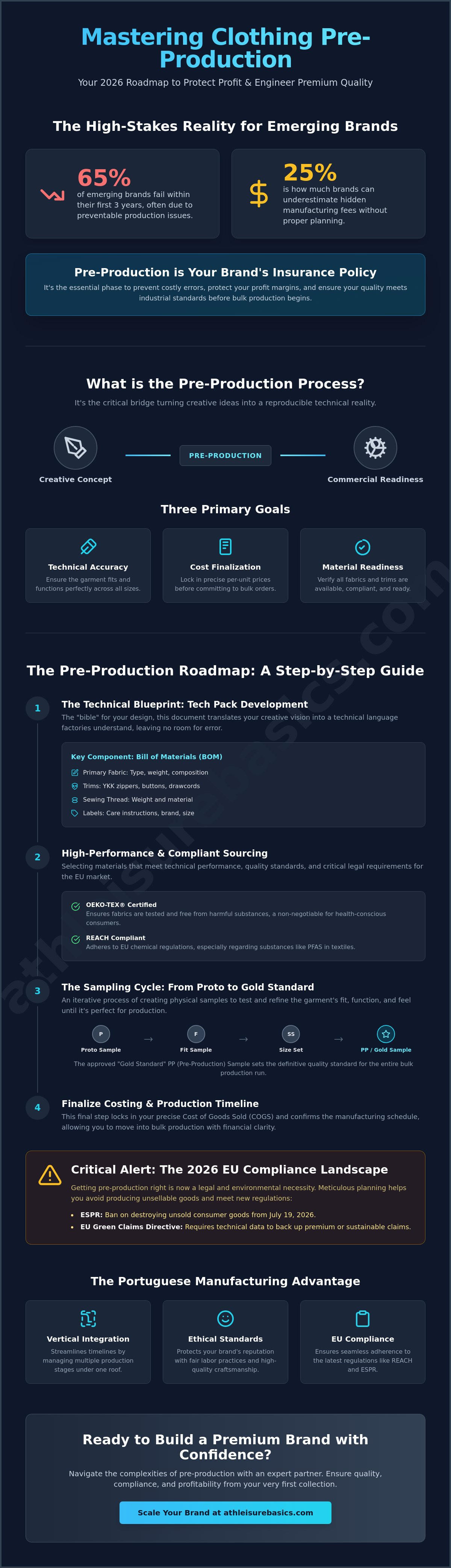
What is the Clothing Pre-Production Process? (And Why It Matters)
The pre-production phase acts as the essential bridge between your creative sketches and the industrial realities of the factory floor. It's the period where abstract ideas transform into a reproducible technical reality. For any brand utilizing a clothing pre-production process guide, the primary objective is to eliminate ambiguity. By the time the bulk machines start, every seam, button, and stitch must be documented, tested, and verified. This phase ensures that your vision doesn't get lost in translation when it reaches the hands of a manufacturing team.
Think of this phase as your brand's insurance policy. Identifying a fit error or a fabric flaw in a single sample costs cents in adjustments. Discovering that same error after 500 units have been sewn costs thousands of dollars in wasted materials and labor. In 2026, the stakes are even higher for emerging labels. With the EU Ecodesign for Sustainable Products Regulation (ESPR) banning the destruction of unsold consumer goods as of July 19, 2026, getting the product right the first time is a legal and environmental necessity. To succeed, brands must focus on three primary goals:
- Technical Accuracy: Ensuring the garment fits and functions exactly as intended across all sizes.
- Cost Finalization: Locking in precise per-unit prices before making bulk financial commitments.
- Material Readiness: Verifying that all fabrics and trims are available, compliant with REACH regulations, and ready for the cutting table.
The Financial Impact of Skipping Pre-Production
Rushing to press without a finalized tech pack is a classic startup trap. It's often fueled by a desire to reach the market quickly, yet it frequently leads to a 25% underestimation of total manufacturing fees. Thorough pre-production allows for a precise cost of goods sold clothing brand calculation, which is vital for maintaining healthy margins. Without these steps, you risk producing inventory that fails to meet quality standards, contributing to the 65% failure rate seen among new labels that ignore the technical details of their supply chain.
Pre-Production vs. Production: Drawing the Line
The pre-production stage officially ends when you approve the "Gold Seal" or Pre-Production (PP) sample. This is the definitive version that sets the standard for the entire bulk run. While you provide the creative vision, the manufacturer manages the complex textile manufacturing process to ensure the chosen fabric performs under industrial conditions. This transition is a pivotal moment in the overall garment production process, moving your brand from the world of conceptual design to the reality of commercial readiness.
The Technical Blueprint: Tech Pack Development and Sourcing
Success in the apparel industry starts with a definitive technical blueprint. If the pre-production phase is your insurance policy, the Tech Pack is the "bible" that dictates every term of that policy. This document translates your creative vision into a language factories understand. It leaves no room for interpretation. A professional clothing pre-production process guide must emphasize the Bill of Materials (BOM). This is a comprehensive list of every physical component required to build your garment. It includes everything from the primary fabric and YKK zippers to the specific weight of the sewing thread and the composition of the care labels. In 2026, documenting these details is critical for compliance with the EU Green Claims Directive. You can't claim your product is premium without the technical data to back it up.
Modern athleisure brands must look beyond aesthetic appeal. Technical performance is now the standard. Sourcing OEKO-TEX® certified materials ensures that your fabrics are free from harmful substances. This requirement is becoming non-negotiable for health-conscious consumers and aligns with the latest REACH regulations regarding PFAS in textiles. When you prioritize these certifications during sourcing, you're building a foundation of trust and quality that protects your brand's long-term reputation. To discover premium fabric options that meet these high industrial standards, you can learn more about Shiveshwar Textiles and their commitment to quality manufacturing.
Essential Components of a Professional Tech Pack
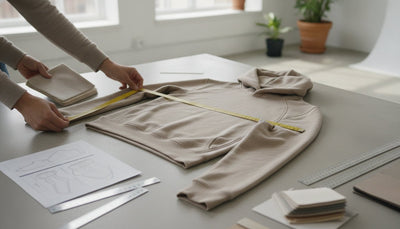
To eliminate factory guesswork, you need more than just a sketch. A factory-ready document includes detailed technical drawings, construction call-outs, and Point of Measurement (POM) charts. Learning how to create a tech pack for clothing is the most effective way to reduce sampling rounds from an average of 4.5 to fewer than two. This efficiency saves months of development time and thousands in sampling costs. For example, always specify your stitching types clearly. For athleisure, requesting flatlock seams ensures the garment is durable and comfortable against the skin, marking the difference between a basic item and a luxury product.
Strategic Material Sourcing in Portugal
Sourcing materials near your manufacturer significantly reduces lead times and your overall carbon footprint. The Portuguese textile hub offers a unique advantage through vertical integration. This proximity allows for rapid testing of fabric shrinkage and color fastness before bulk production begins. If you aren't sure where to start, professional fabric sourcing support can help you navigate these technical choices. Partnering with experts at Athleisurebasics ensures your materials meet the highest industrial standards from day one, allowing you to focus on scaling your business with confidence.
The Sampling Cycle: From Proto to the Gold Standard
The sampling cycle transforms your technical blueprint into a tangible product. This stage is highly iterative. It's not a sign of failure if the first version isn't perfect; it's a necessary part of refining your vision for the industrial environment. Within a comprehensive clothing pre-production process guide, this cycle typically begins with the Proto Sample. In Portugal, developing a proto sample generally costs between €80 and €200 per unit. At this stage, the factory uses available fabrics to test the construction and silhouette. It's about seeing if the 2D sketch functions correctly in a 3D space.
Once the silhouette is confirmed, you move to Fit Samples. This is the critical stage where you adjust measurements on a live model or dress form. It's vital to be precise with feedback during this phase. Instead of vague descriptions, use your tech pack's Point of Measurement charts to request specific adjustments. The cycle concludes with the Pre-Production Sample (PPS). This version must use the actual bulk fabrics and trims you've sourced. It's the final dress rehearsal before bulk production. Sampling is a significant investment, with the total process for a 10-piece collection often ranging from $3,000 to $7,000, but it's the only way to ensure your final product meets premium standards.
Mastering the Fit and Grading Process
Grading is the technical process of scaling your approved fit across your entire size range. This is the most complex part of pre-production. A perfect fit in a size Medium doesn't automatically translate to a balanced XL without professional grading. This process typically adds $150 to $400 per style to your development budget. Curve proportions don't scale linearly, so investing in accurate grading is essential for reducing customer returns. Detailed size charts built during this phase are your best tool for ensuring customer satisfaction from day one.
The "Gold Seal" Sample: Your Quality Benchmark
The approved PPS becomes the "Gold Seal" or "Sealed Sample." One copy stays with you, and another remains at the factory to serve as the definitive benchmark for Quality Control (QC). You should never authorize the start of bulk production without a physically approved PPS in hand. If adjustments are still needed, provide clear, technical comments on the sample. This disciplined approval workflow protects your brand from the 25% cost overruns often caused by mismanaged production expectations. The sampling timeline usually takes 2 to 6 weeks, providing a necessary window to perfect every detail before the machines start.
Finalizing Costing and the Production Timeline
The transition from sampling to bulk manufacturing is a pivotal moment where your financial and temporal roadmaps are solidified. While earlier stages focus on aesthetic and technical refinement, this part of the clothing pre-production process guide focuses on the commercial viability of your collection. You cannot set an accurate retail price or plan a marketing launch without knowing every cost and every deadline. Finalizing these details ensures your brand maintains healthy margins and delivers products to customers on time.
Costing is not a static figure. It evolves from an initial estimate to a final production price based on the technical realities of your approved samples. For instance, fabrics and trims typically account for 40% to 60% of the total cost of clothing production. Any adjustment made during the sampling cycle, such as changing a zipper type or adding a pocket, will shift this balance. By the end of pre-production, you must have a locked-in price that accounts for every physical component and labor hour required.
Calculating Your Final Per-Unit Cost
Your final per-unit cost is the sum of several variables that only become clear once the technical blueprint is finalized. Unlike estimated costing, which relies on assumptions, final costing is based on verified data. Consider these essential factors:
- Fabric Consumption: The exact meterage needed per garment, calculated during pattern making.
- CMT Labor: The "Cut, Make, Trim" fee, which covers the factory's labor for assembly.
- Labels and Hardware: The cost of branded buttons, YKK zippers, and compliance-ready care labels.
- Packaging and Logistics: Shipping fees, customs duties, and the cost of primary packaging like compostable polybags.
Understanding clothing manufacturing moq is essential during this calculation. Lower order volumes in Portugal, which can start as low as 50 to 150 units for small workshops, often carry a higher per-unit cost but offer the agility needed to test the market without the risk of deadstock.
Building a Realistic Launch Calendar
Planning a successful launch requires a transparent view of the manufacturing calendar. While the actual sewing process might only take 6 to 10 weeks, the total timeline from first contact to delivery in Portugal typically spans 16 to 28 weeks. This buffer accounts for essential pre-production tasks like fabric lab dips, which can take 2 to 3 weeks, and sample revisions, which usually require 2 to 6 weeks. Identifying potential bottlenecks, such as fabric mill delays or international holidays, prevents last-minute shipping crises.
The final step in this timeline is the Pre-Production Meeting (PPM). This is a dedicated session where you and the manufacturer review the "Gold Seal" sample and the production file one last time. It's the final gatekeeper that ensures everyone is aligned on quality standards before the first fabric is cut. If you're ready to secure a transparent production roadmap, contact Athleisurebasics to begin your journey with an expert partner.
Partnering with a Portuguese Manufacturer for Seamless Pre-Production
Portugal is a global leader in high end apparel for a reason. The country's textile industry is built on vertical integration. This means fabric sourcing, dyeing, and sewing often happen within the same regional hub. This proximity slashes the time spent waiting for fabric lab dips or trim shipments, directly accelerating your development timeline. In 2025, Portuguese textile and apparel exports reached €5.499 billion, proving its status as a reliable and sophisticated partner for international brands. By following this clothing pre-production process guide, you leverage the "Made in Portugal" prestige to justify premium retail prices while ensuring your supply chain aligns with 2026 EU environmental standards.
Manufacturing in Portugal offers more than just logistical speed. It provides a quality seal that resonates with conscious consumers. With 15% to 20% of European textile production expected to reshore to Southern Europe by 2030, Portugal stands as the primary destination for brands seeking ethical labor standards and reduced carbon footprints. This regional advantage allows you to maintain close oversight of the sampling cycle, ensuring that the "Gold Seal" approved in pre-production is exactly what arrives at your warehouse.
The Athleisurebasics Approach to Pre-Production
We specialize in lowering the barriers to entry for emerging businesses. If you're new to the industry, our clothing production consulting provides the technical oversight needed to avoid common pitfalls. We understand that scaling a brand requires flexibility. That's why we offer accessible minimum order quantities, including 70 pieces for White Label collections and 250 pieces for Custom designs. Partnering with a team that understands the premium garment manufacturing market ensures your brand is built on a foundation of high end craftsmanship and operational agility.
Next Steps: From Blueprint to Bulk
The journey from a small idea to a lasting commercial presence is a structured process. It begins with a detailed tech pack and moves through strategic sourcing and rigorous sampling. This preparation is what distinguishes successful brands from the 65% of startups that fail within their first three years. Once you've secured your approved pre-production sample, you can confidently transition to your first clothing production run. Your entrepreneurial journey deserves a partner that values material integrity and ethical standards as much as you do. Get a custom apparel manufacturing quote today to start your pre-production phase with an expert team.
Build Your Commercial Presence with Confidence
Mastering the initial stages of development is the most effective way to protect your brand's capital and long term reputation. By prioritizing a detailed technical blueprint and a rigorous sampling cycle, you eliminate the ambiguity that often leads to costly manufacturing errors. This clothing pre-production process guide provides the roadmap needed to transition from creative concepts to premium, market ready garments that stand out in a competitive landscape, much like the curated sports-themed collections found at is my life.
Success in the 2026 fashion industry requires a commitment to both high end craftsmanship and ethical standards. Partnering with a collaborator who understands these requirements ensures your collections meet the highest industrial expectations from the very first run. We empower emerging labels through premium Portuguese craftsmanship, offering accessible low 70-piece MOQs and a commitment to using OEKO-TEX® certified materials.
Your vision deserves a foundation of technical excellence and a partner invested in your growth. Launch your brand with a partner who masters the details. Contact Athleisurebasics today. We're ready to help you navigate the journey from a small idea to a lasting commercial presence.
Frequently Asked Questions
How long does the clothing pre-production process usually take?
The total timeline from first contact to final delivery in Portugal typically spans 16 to 28 weeks. This duration includes a sampling cycle of 2 to 6 weeks, alongside essential stages for fabric lab dips and material procurement. Planning with these specific windows ensures your launch calendar remains realistic and avoids the stress of last minute shipping delays.
Can I start pre-production without a professional tech pack?
It's highly discouraged to begin development without a professional tech pack as it serves as the definitive technical blueprint for your garment. Starting without this "bible" forces factories to guess on construction details, which leads to excessive sampling rounds and higher costs. A well prepared tech pack is the foundation of any successful clothing pre-production process guide.
How many samples should I expect to pay for before bulk production?
You should typically budget for two to three rounds of samples for each style in your collection. These rounds generally include a proto sample, a fit sample, and a final pre-production sample. Utilizing a detailed tech pack can reduce these iterations from an industry average of 4.5 to fewer than two, saving your brand significant time and capital.
What is the difference between a Proto sample and a Pre-Production sample?
A proto sample is the first physical version of your design, often made with available fabrics to test the basic silhouette and construction. In contrast, a pre-production sample (PPS) is the final version made with the exact bulk fabrics, trims, and labels intended for the final run. The PPS serves as the "Gold Seal" benchmark for industrial quality control.
Why is fabric sourcing considered part of pre-production?
Fabric sourcing is critical to the clothing pre-production process guide because it determines the final per-unit cost and ensures compliance with 2026 EU regulations. Testing for shrinkage, color fastness, and REACH compliance must happen before bulk cutting begins. This stage verifies that your chosen materials are technically suitable for the industrial manufacturing environment.
Do I need to be in Portugal to manage the pre-production process with the factory?
You don't need to be physically present in Portugal to manage the process effectively. Modern communication tools and detailed technical documentation allow for seamless remote collaboration with Portuguese manufacturers. However, the regional proximity within the EU still offers significant advantages in terms of reduced lead times for shipping samples and raw materials.
What happens if I find an error in the Pre-Production Sample (PPS)?
If you identify an error in the PPS, you must provide clear technical comments and request a revised sample before authorizing bulk production. Never allow the factory to start the first cut until you have a physically approved "Gold Seal" in your possession. This disciplined approach prevents the 25% cost overruns often associated with uncorrected production errors.
How does pre-production affect my Minimum Order Quantity (MOQ)?
Pre-production costs are generally independent of your production volume, but they impact your overall budget when working with low MOQs. While smaller runs of 50 to 150 units in Portugal carry a higher per-unit development cost, they significantly reduce the financial risk of overproduction. This balance allows emerging brands to scale with greater operational agility and less deadstock.


Leave a comment
This site is protected by hCaptcha and the hCaptcha Privacy Policy and Terms of Service apply.