

How to Finalize Clothing Patterns for Manufacturing: A 2026 Guide
Would you gamble your entire production budget on a single digital file? Many emerging brands do exactly that by sending unrefined sketches to a factory, only to receive a shipment of garments that simply don't fit. It's a common frustration. You've spent months perfecting a design, but the bridge between a creative vision and a factory floor is often built on technical confusion. Learning how to finalize clothing patterns for manufacturing is the critical step that transforms a creative concept into a mathematical blueprint for success.
We understand the pressure to get every detail right before production begins. This guide provides the technical roadmap you need to scale your brand with precision and quality. We'll address the common friction points that lead to costly errors, such as choosing between .DXF and .AI file formats or navigating the latest updates in software like Gerber AccuMark V2026.1 and Optitex O/26. You'll learn how to master size grading to ensure a consistent fit across your entire range. By following these steps, you'll create a production-ready technical file that ensures seamless communication with your Portuguese manufacturer and high-end results for your customers.
Key Takeaways
- Understand the critical distinction between a design pattern and a production-ready blueprint, ensuring all technical details like seam allowances and drill holes are included.
- Master the 2026 industry standards for digital CAD files, specifically .DXF and .AI formats, to enable precise automated cutting and nesting.
- Learn how to finalize clothing patterns for manufacturing through a rigorous revision cycle that ensures fit consistency across your entire size range.
- Execute a professional pattern audit to verify that every component, including linings and facings, matches your tech pack exactly before bulk production.
- Leverage the technical expertise of Portuguese manufacturing partners to refine your patterns and meet high-end ethical and quality standards.
The Bridge to Production: What It Means to Finalize Clothing Patterns
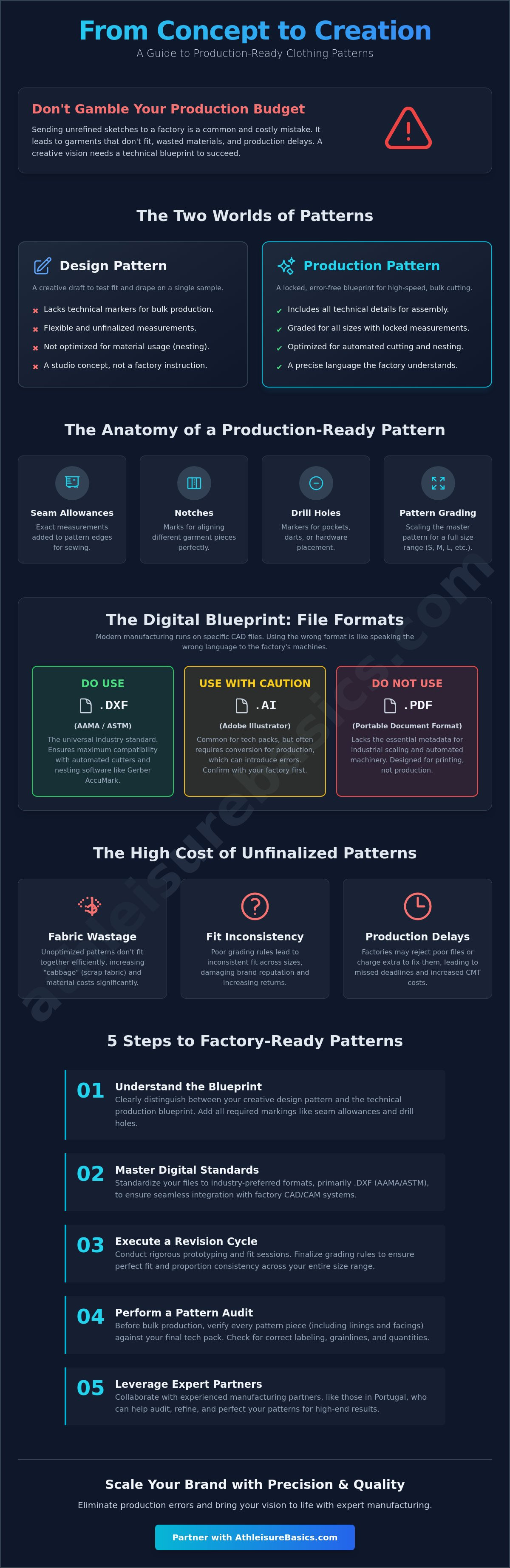
Finalizing a pattern is the pivot point where creative design meets industrial reality. A production-ready pattern is an error-free blueprint designed specifically for high-speed, bulk cutting. It's a technical document that speaks the language of a factory, not just a studio. While a design pattern might look perfect on a dress form, it lacks the technical markers required for a commercial sewing line. Learning how to finalize clothing patterns for manufacturing involves translating your aesthetic vision into a set of precise instructions that any professional CMT (Cut, Make, Trim) team can follow without hesitation. This stage is a vital part of the garment production process because it eliminates the guesswork that leads to manufacturing delays.
In 2026, manufacturing standards are more rigid than ever due to the rise of automated cutting technology. A manufacturing pattern must include specific technical details that a standard design draft often ignores. This includes exact seam allowances, notches for alignment, and drill holes to mark pocket or hardware placements. Without these, a factory cannot guarantee that the garment will be assembled correctly across hundreds of units. Adhering to these industrial standards is the most effective way to mitigate risk and ensure your brand maintains a reputation for high-end quality.
Design Patterns vs. Production Patterns
The transition from a creative draft to a technical template is a structured journey. During the sampling phase, you work with "working patterns." These are flexible drafts used to test the fit and drape of a single sample. However, "finalizing" means locking in every measurement for your entire size run. This is where Pattern grading becomes essential. It's the process of scaling your master pattern into different sizes while maintaining the intended fit and proportions. A production pattern is the final, "locked" version of these files, ensuring that a size Small and a size Large both reflect your brand's specific fit standards.
The Consequences of Unfinalized Patterns
Sending unfinalized patterns to a manufacturer often leads to significant financial loss. The most immediate impact is fabric wastage. Professional patterns are designed to fit together like a puzzle to minimize "cabbage," which is the industry term for scrap fabric. If your patterns aren't optimized, you're paying for expensive material that ends up on the cutting room floor. Beyond the waste, poor patterns cause fit inconsistency across different production batches. If a factory receives a file that doesn't meet technical standards, they may reject the order entirely or increase your CMT costs to cover the time they spend fixing your technical errors. Investing time in how to finalize clothing patterns for manufacturing protects your margins and your brand's integrity.
Technical Standards: Digital Formats and Grading Rules
Modern factories don't work with paper rolls or static images. To understand how to finalize clothing patterns for manufacturing, you must embrace the digital standards that drive 2026 production lines. These standards ensure that your design is interpreted correctly by automated nesting software and laser cutters. This digital precision reduces human error and optimizes fabric usage, which is a cornerstone of a robust quality assurance framework. Without technical accuracy at this stage, even the most beautiful design will fail during bulk production.
Digital File Types for Modern Factories
Premium factories require specific CAD formats for cross-platform compatibility. The industry standard is the .DXF file, specifically using AAMA or ASTM extensions. These files allow factory plotters and cutting machines to read data accurately regardless of the software used to create them. While .AI (Adobe Illustrator) files are common for visual tech packs, they often require conversion for actual production. Avoid sending PDF patterns. These are designed for home printers and lack the metadata required for industrial scaling. Your digital files must have clearly labeled layers. Every piece needs distinct lines for cutting, stitching, and grain direction to ensure the factory's automated systems function correctly. If you're currently preparing your technical files, partnering with an expert consultant can help you avoid common formatting errors.
Establishing Professional Grading Rules
Pattern grading is the process of scaling your base size into a full range from XS to XXL. It's not just about making the pieces bigger or smaller. It involves establishing specific "grade points" that dictate how the garment grows at the chest, waist, and hips. These rules differ significantly depending on the product type. For example, made in Portugal clothing often utilizes high-stretch, performance fabrics that require unique grading rules compared to rigid formal wear. A professional size chart must match your pattern grading exactly to maintain fit consistency across the entire collection.
When working with OEKO-TEX® certified materials, you must also account for fabric shrinkage during the pattern finalization stage. Different knits and weaves react differently to heat and moisture. A professional pattern maker will adjust the master pattern based on wash test results to ensure the final garment matches the size chart after the first laundry cycle. This level of detail is what separates a startup from a premium brand. Mastering how to finalize clothing patterns for manufacturing means accounting for these physical variables before the first yard of fabric is cut.
Prototyping vs. Production: Why Your First Pattern Isn’t Ready
Many emerging designers believe that once a single sample fits, the job is finished. This is the most common misconception in apparel production. A pattern used for a one-off prototype is a working draft, while a manufacturing pattern is a refined technical blueprint. Understanding how to finalize clothing patterns for manufacturing requires accepting that your first iteration is rarely the last. Premium brands typically plan for a cycle of two to three revisions to perfect the drape, balance, and industrial efficiency of the garment before bulk cutting begins.
Standardization is the key to scaling your brand without quality dips. For instance, seam allowances must be consistent across all pieces to ensure the sewing line maintains a steady rhythm. Most professional factories in Europe prefer a standard 1cm or 1.2cm allowance. If your patterns vary between 0.5cm and 1.5cm without a technical reason, you invite assembly errors. Utilizing private label Portugal services can help bridge this gap. These experts review your initial drafts and provide the technical consulting necessary to ensure they meet the rigorous demands of a commercial floor.
The Fit Sample Hurdle
Testing a pattern in its final bulk fabric is non-negotiable. A pattern that works in a cotton muslin will behave differently in a recycled polyester or a high-stretch nylon. For athleisure brands, wearer trials are essential. You need to see how the pattern performs during movement to finalize the tension and recovery points. There is also a distinct difference between a Fit Sample and a Pre-Production (PP) Sample. The Fit Sample confirms the silhouette and proportions. The PP Sample is the final check, sewn using the finalized production pattern and the actual bulk materials to ensure everything is perfect before the machines start for the full order.
Standardizing for the Factory Floor
A factory-ready pattern must be stripped of any design fluff that doesn't serve the construction process. Every piece needs clear, universal annotations that any machinist can understand. This includes:
- Grain lines: These ensure the fabric hangs and stretches correctly across the body.
- Alignment notches: Small cut-outs that show exactly where two pieces of fabric must meet.
- Internal markings: Precise indicators for pocket placements, zippers, or hardware using drill holes or standard symbols.
If your pattern relies on vague instructions, it slows down the industrial sewing machines. This inefficiency leads to higher CMT costs and potential quality issues. Professional finalization ensures that any technician can look at the pattern and understand exactly how the pieces fit together without needing a translation.
The 2026 Finalization Checklist: 5 Steps to Factory-Ready
Moving from a sample to bulk production requires a disciplined hand-off. You've already refined the fit and established your digital standards. Now, you must execute a final technical review. Learning how to finalize clothing patterns for manufacturing culminates in this five-step checklist. This process ensures that when your files reach the cutting room, there's zero ambiguity for the production team.
- Step 1: Conduct a Pattern Audit. Physically or digitally lay out every single piece. Don't forget the "hidden" components like facings, linings, interlinings, and pocket bags. A missing facing piece can stall an entire production line for days.
- Step 2: Verify the Tech Pack matches the pattern exactly. Cross-reference every pattern piece against your Bill of Materials. If the pattern says "Front Panel A," the technical documentation must use the identical identifier.
- Step 3: Digitize and Grade. Convert any physical cards to CAD files. Apply your established size rules to generate the full size run from XS to XXL.
- Step 4: Create a Marker. This is the digital layout guide for cutting. It arranges all graded pieces to maximize fabric yield and minimize waste.
- Step 5: The Final Seal. Once the pre-production sample is approved, sign off on the pattern. This "sealed" version becomes the official master that the factory uses for the entire bulk order.
Syncing Patterns with Your Tech Pack
The tech pack and the pattern are two halves of the same technical language. Every pattern piece must have a corresponding ID in the Tech Pack Bill of Materials (BOM). This ensures that the factory knows exactly which fabric or trim applies to which specific piece. You must also annotate "Points of Measure" (POM) on your technical drawings. These POMs allow the factory's quality control team to verify the finished garment's fit against the pattern's intended dimensions during the assembly process. The relationship between a tech pack and its pattern is the contract of quality between a brand and its factory.
Maximizing Efficiency with Marker Making
Finalizing your patterns allows for professional nesting. This process involves arranging pieces as tightly as possible on the fabric width to reduce waste. Efficient marker making is directly linked to achieving your target Cost of Goods (COGS). If your marker efficiency is low, you're paying for premium fabric that ends up as floor scrap. High-efficiency markers are particularly valued by Portuguese factories committed to sustainable production standards. They prefer working with brands that provide precise, finalized files that respect material integrity. Knowing how to finalize clothing patterns for manufacturing with this level of detail protects your margins and streamlines the cutting process.
If you're ready to move from a final pattern to high-quality production, Athleisurebasics provides the technical expertise and manufacturing support to bring your collection to life with precision.
Scaling Your Brand with Athleisurebasics: From Final Pattern to Premium Production
Mastering how to finalize clothing patterns for manufacturing is a significant milestone for any brand founder. Once your technical blueprints are locked and your grading is verified, the focus shifts to execution. This is where your choice of manufacturing partner becomes the most critical factor in your brand's growth. Athleisurebasics serves as a dedicated technical ally, transforming your production-ready files into luxury-grade apparel that meets the highest industrial standards. We don't just manufacture clothing; we provide the operational agility required for emerging businesses to compete in a global market.
Choosing to manufacture in Portugal provides your brand with a powerful competitive advantage. Our regional origin serves as a shorthand for ethical production, material integrity, and high-end craftsmanship. Beyond the quality seal, proximity to the European market allows for faster turnaround times and reduced logistics complexity. We've structured our services to remove traditional barriers to entry. For brands developing unique silhouettes, our custom clothing manufacturing starts at 250 pieces per style. If you're looking for a faster market entry, our white-label luxury blanks offer a lower threshold of just 70 pieces. This flexibility ensures you can scale your inventory without overextending your capital.
Our Production Consulting Services
Technical errors at the factory level are almost always rooted in pattern inconsistencies. Our experts conduct a thorough review of your finalized patterns to prevent production bottlenecks before they occur. We look for alignment issues, seam allowance conflicts, and grading errors that might have been overlooked. This proactive approach is a core part of our production consulting services. We also provide comprehensive materials sourcing support. We help you identify premium, OEKO-TEX® certified fabrics that react perfectly to your specific pattern measurements, accounting for the shrinkage and stretch variables we discussed earlier. This level of partnership ensures that the "Made in Portugal" label on your garments truly reflects a standard of technical excellence.
This dedication to quality is essential for brands targeting competitive sports markets, where athletes expect the same level of performance from their apparel as they do from professional gear like that found at Chef Padel.
Ready to Start Your Production Run?
The transition from your digital CAD files to our factory floor is designed to be seamless. Once you've followed the steps on how to finalize clothing patterns for manufacturing, you're ready to initiate the quoting process. You simply submit your technical files and tech pack through our structured onboarding system. Our team reviews the data to ensure every notch, grain line, and grade point is ready for high-speed industrial sewing. We act as the guardian of your brand's fit, ensuring that the consistency you've worked hard to achieve in your prototypes is maintained across every single unit in your bulk run. Your journey from a creative concept to a lasting commercial presence starts with this technical hand-off.
Partner with Athleisurebasics for your custom clothing manufacturing.
Transition Your Vision into Scalable Production
Moving from a creative concept to a market-ready collection requires technical discipline and a deep understanding of industrial standards. By mastering how to finalize clothing patterns for manufacturing, you ensure that your brand scales with fit consistency and minimal fabric waste. Your digital CAD files and grading rules are the mathematical blueprints that dictate your brand’s reputation for quality. These technical foundations are what separate an amateur project from a professional apparel business.
Executing a thorough pattern audit and syncing your files with a comprehensive tech pack protects your production budget from avoidable errors. This level of precision allows you to leverage the benefits of high-end manufacturing without the fear of factory rejection. Athleisurebasics is ready to support your journey with expert technical consulting and premium Portuguese craftsmanship. We specialize in accessible production volumes, offering MOQs of 70 pieces for white-label and 250 for custom designs, alongside OEKO-TEX® certified fabric sourcing.
Launch your premium clothing line with Athleisurebasics today. Your path from a small idea to a lasting commercial presence is built on technical excellence. We're excited to help you take this next step with confidence and precision.
Frequently Asked Questions
What is the best digital file format for clothing patterns in 2026?
.DXF (AAMA/ASTM) is the premier digital file format for clothing patterns in 2026. This format ensures that your technical data is compatible with industrial CAD software like Gerber AccuMark V2026.1. While .AI files are useful for visual design, factories require the mathematical precision of .DXF for automated nesting and laser cutting. Using these industry-standard files prevents data corruption and ensures that your fit remains consistent during the transition from studio to factory floor.
Can I send a physical paper pattern to a clothing manufacturer?
You can send physical patterns, but modern factories will typically digitize them before production begins. This extra step often incurs additional service fees and can delay your production timeline. In 2026, most premium manufacturers prefer receiving digital files like .DXF to streamline the cutting process. If you only have paper patterns, it's more efficient to have them professionally digitized and graded into a CAD format before submitting them for a manufacturing quote.
How much seam allowance should I include for manufacturing?
Most premium manufacturers in Europe prefer a standard seam allowance of 1cm or 1.2cm for most seams. However, specific construction methods like flatlock stitching or heavy outerwear might require different specifications. It's essential that your pattern and tech pack match perfectly. If you're learning how to finalize clothing patterns for manufacturing, always confirm the factory's preferred allowance during the sampling phase to ensure the sewing line maintains high-speed efficiency without assembly errors.
What is pattern grading and why is it necessary for my brand?
Do I need a different pattern for every size I want to produce?
You don't need a separate manual draft for every size. Instead, you create one master pattern in your "base size," which is usually a Small or Medium. You then apply a set of grading rules within your CAD software to generate the other sizes in your range. This digital approach ensures that every size maintains the exact design proportions of your original prototype while adjusting for the physical dimensions of different body types.
What happens if my pattern has an error after production starts?
An error discovered after bulk cutting has started is a significant financial risk. It often results in a total production halt, wasted fabric, and the need for expensive manual corrections. This is exactly why learning how to finalize clothing patterns for manufacturing through rigorous pattern audits and pre-production samples is so vital. If an error occurs, you must communicate with your factory immediately to determine if the pieces can be recut or adjusted before further assembly.
How does a Tech Pack work with my finalized pattern?
The Tech Pack acts as the instruction manual, while the pattern serves as the physical blueprint. They must work in perfect sync. Every piece in your pattern should have a corresponding ID in the Tech Pack Bill of Materials. The Tech Pack also lists the "Points of Measure" that the quality control team uses to verify that the finished garment matches the pattern's intended dimensions after it leaves the sewing line to ensure total quality.
Why is Portugal considered a top location for pattern-perfect manufacturing?
Portugal is a global leader in apparel production due to its combination of ethical labor standards and advanced technical expertise. Portuguese factories specialize in high-end craftsmanship and are early adopters of the latest CAD and automated cutting technologies. Brands choose Portugal because the manufacturers there act as collaborative partners, offering the technical precision required to handle complex patterns and premium materials like OEKO-TEX® certified fabrics with extreme accuracy.



Leave a comment
This site is protected by hCaptcha and the hCaptcha Privacy Policy and Terms of Service apply.