

Clothing Quality Control: The Ultimate Guide for Apparel Brands
You’ve poured your vision, time, and capital into your new clothing line. The designs are perfect, the branding is set, and your launch is on the horizon. But a single thought can undermine it all: what if the final production run doesn’t meet your high standards? This fear of receiving a bad batch, losing your investment, and damaging your brand’s hard-won reputation is a major hurdle for many founders, but it’s one you can confidently overcome.
The key to protecting your brand and ensuring customer satisfaction lies in a systematic and robust clothing quality control process. It’s the single most important step in transforming your designs from a great concept into a premium, market-ready product line. This guide is designed to be your trusted partner, demystifying the technical jargon and empowering you to take full control of your production quality, from the first sample to the final shipment.
Here, you will learn exactly how to create a detailed QC checklist, confidently identify and classify defects, and understand industry standards like AQL. We’ll provide the expert framework you need to launch a product line known for its superior craftsmanship and consistency, building a legacy of quality from day one.
What Is Clothing Quality Control (And Why It's Non-Negotiable for Your Brand)
For any new clothing brand, the distance between a great design and a profitable product is measured in quality. But what does that truly mean? In simple terms, clothing quality control is the systematic process you and your manufacturing partner use to ensure every garment meets a specific, pre-defined set of standards. It’s not just about catching a loose thread; it’s a comprehensive framework designed to guarantee consistency, performance, and craftsmanship across your entire production run.
A robust Quality Control system moves beyond just protecting your reputation. It's a core business strategy that directly fuels growth. When customers receive a product that meets or exceeds their expectations every single time, you build the trust necessary to justify premium pricing. This consistency is the foundation of customer loyalty, turning first-time buyers into repeat purchasers and brand advocates. Think of it not as an expense, but as an investment in your brand's legacy.
The True Cost of Poor Quality
Overlooking quality control isn't just a minor oversight-it's a direct threat to your brand's profitability and survival. The consequences are tangible and can be devastating for a startup.
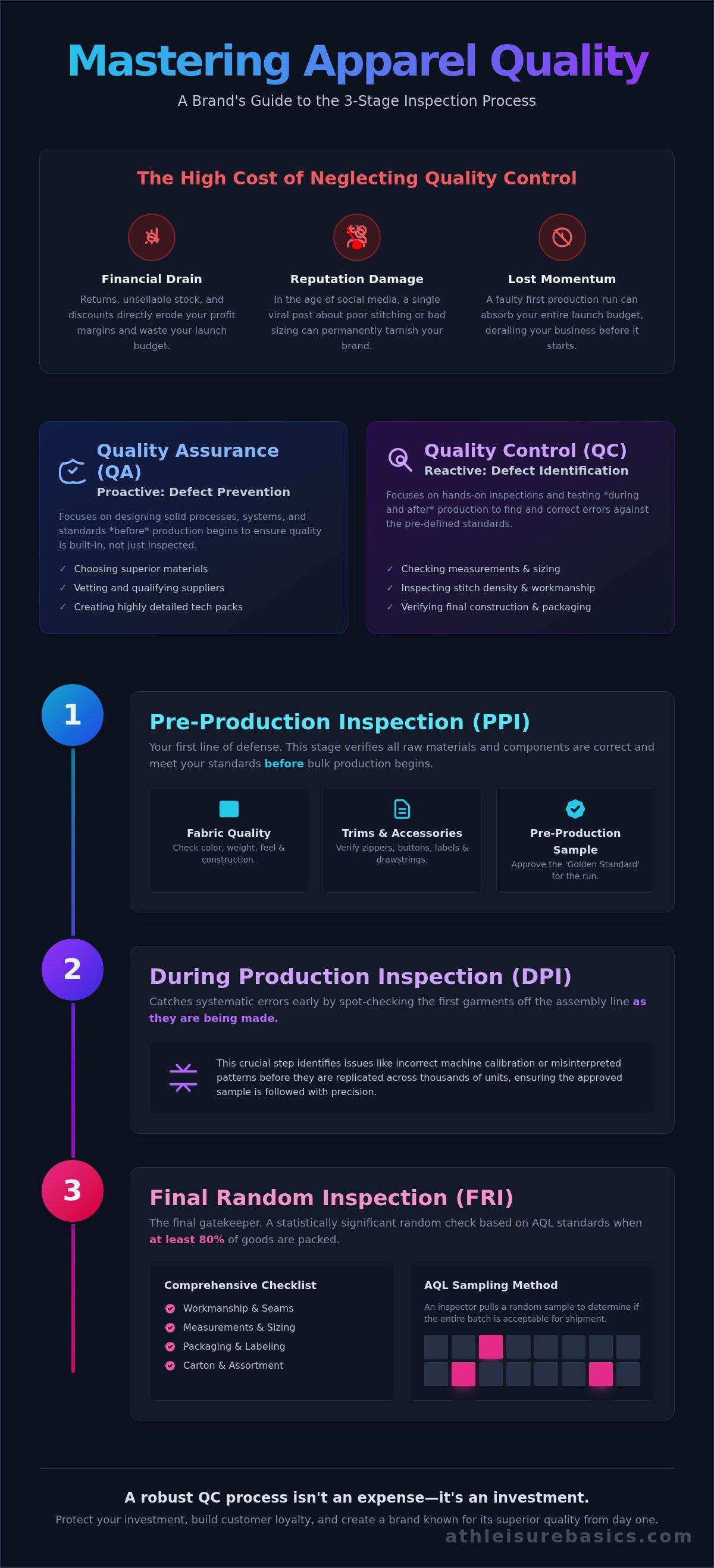
- Financial Drain: Every customer return, unsellable garment, and discounted sale due to defects directly erodes your profit margins.
- Reputation Damage: In the age of social media, a single negative review showing poor stitching or incorrect sizing can go viral, permanently tarnishing your brand's image.
- Lost Momentum: A faulty first production run can absorb your entire launch budget, leaving you with wasted inventory and derailing your business before it even begins.
Quality Control (QC) vs. Quality Assurance (QA)
While often used interchangeably, QA and QC are two distinct functions. Understanding the difference is key to building a comprehensive quality strategy.
- Quality Assurance (QA) is proactive. It focuses on preventing defects by creating solid processes. This includes choosing superior materials, vetting suppliers, and creating highly detailed tech packs.
- Quality Control (QC) is reactive. It focuses on identifying defects through hands-on inspections during and after production. This includes checking measurements, stitch density, and overall construction against your standards.
Your Role vs. Your Manufacturer's Role in QC
Achieving superior quality is a partnership built on clear communication and defined responsibilities. Success depends on both you and your production partner excelling in your respective roles.
- Your Responsibility (The Brand): You must clearly define what "quality" means for your product. This is accomplished through a meticulous tech pack that leaves no room for interpretation on materials, measurements, stitching, and finishing.
- Your Manufacturer's Responsibility: A trusted partner will implement internal QC processes to meet your standards. They are responsible for inspecting the output, flagging issues, and ensuring the final product perfectly matches your vision.
The 3 Critical Stages of an Apparel Quality Inspection
Effective clothing quality control is not a single event, but a continuous process integrated throughout the production timeline. Waiting until an entire order is complete to check for issues is a costly mistake. A proactive, multi-stage inspection process is the most efficient way to protect your investment, ensure consistency, and build a brand known for superior quality. This is the standard that any reliable manufacturing partner should follow to prevent small errors from becoming production-wide disasters.
By breaking the process down, you can catch and correct issues early, saving both time and money. Here are the three critical stages that form the foundation of a robust quality assurance strategy.
Stage 1: Pre-Production Inspection (PPI)
This is your first line of defense. Before a single stitch is sewn on your bulk order, a PPI verifies that all the raw materials and components are correct and meet your standards. This is your best and most cost-effective opportunity to make final corrections. During this stage, your manufacturing partner will check:
- Fabric Quality: Confirming the color, weight, feel, and construction match your specifications. Verifying that materials meet performance criteria, often guided by industry benchmarks like AATCC testing standards, is crucial.
- Trims and Accessories: Ensuring zippers, buttons, labels, and drawstrings are the correct color, size, and quality.
- Pre-Production Sample (PPS): Reviewing and approving this final sample, which serves as the "golden standard" for the entire production run.
Stage 2: During Production Inspection (DPI or DUPRO)
Once production begins, a DPI involves spot-checking the first few garments as they come off the assembly line. The primary goal is to identify any systematic errors early before they are replicated across hundreds or thousands of units. For example, if a sewing machine is calibrated incorrectly or a pattern was misinterpreted, a DPI catches it immediately. This stage highlights the value of a transparent factory that allows for hands-on oversight, ensuring the approved PPS is being followed with precision.
Stage 3: Final Random Inspection (FRI)
This is the final gatekeeper. When production is complete and at least 80% of the goods are packed, an inspector conducts a random check based on the internationally recognized AQL (Acceptable Quality Limit) statistical sampling method. This determines if the overall quality of the batch is acceptable for shipment. The FRI is a comprehensive review of the finished product, covering:
- Workmanship (stitching, seams, defects)
- Measurements and sizing consistency
- Packaging, folding, and labeling
- Carton markings and assortment accuracy
An FRI is the ultimate safeguard that protects your brand from receiving a defective shipment, ensuring the products your customers receive perfectly represent your vision and quality promise.
How to Build Your Essential Quality Control Checklist
Your Quality Control (QC) Checklist is the single most important document for communicating your standards to your manufacturing partner. It translates your approved tech pack into a series of actionable, pass/fail checkpoints, leaving no room for interpretation. The more specific and visual you are-using diagrams, photos, and precise measurements-the more effectively you can ensure your final product matches your vision.
A robust checklist is the foundation of an effective clothing quality control strategy. Structure your checklist around these four critical areas to cover every detail from the first stitch to the final package.
Garment Workmanship & Construction
This section focuses on the structural integrity and overall craftsmanship of the garment. Your inspector should have clear, objective criteria for what constitutes superior quality work. Pay close attention to details that signal top-notch construction.
- Stitching: Verify stitches are straight, consistent, and match the specified Stitches Per Inch (SPI). Check for skipped stitches or loose tension.
- Seams: Inspect seams for strength, puckering, and proper finishing. Ensure they are flat and neat, especially on key stress points.
- Assembly: Confirm all components like sleeves, collars, and pockets are attached correctly and symmetrically.
- Common Defects: Systematically check for and flag loose threads, raw edges, and missing or poorly executed bar tacks.
Fabric, Materials, and Trims
The quality of your raw materials directly impacts the final product's look, feel, and durability. Your checklist must include checks for both aesthetic and functional material quality. Beyond visual inspection, ensure your fabrics meet performance criteria, such as those defined by ASTM International standards for durability and colorfastness. Using OEKO-TEX® certified fabrics provides a built-in quality check, guaranteeing they are free from harmful substances.
Sizing, Measurements, and Fit
Consistency in sizing is non-negotiable for customer satisfaction. Your checklist must reference the specific Points of Measure (POM) from your tech pack, such as chest width, body length, and sleeve length. It's crucial to define an acceptable "tolerance"-a minor variation (e.g., +/- 1cm) that is normal in production. Remember to inspect garments across the entire size range, not just a single sample, to catch any grading errors.
Labeling, Finishing, and Packaging
The final stage of clothing quality control ensures your product is retail-ready and represents your brand professionally. This is your last chance to catch errors before products ship to your customers.
- Labels: Confirm brand, size, and care instruction labels are present, correctly placed, and legible.
- Finishing: Check that each garment is properly pressed, free of wrinkles, and folded according to your specifications.
- Packaging: Verify that hang tags, polybags, barcodes, and carton markings all match your requirements exactly.
Defining these standards can feel overwhelming, but it is the key to building a brand known for its quality. Need help defining your standards? Our experts can guide you.
Common Garment Defects: What to Accept vs. What to Reject
One of the most common questions for new brand founders during an inspection is, "Is this flaw a big deal?" Without an objective framework, it's easy to either accept poor-quality stock or reject a perfectly sellable batch. The goal is not absolute perfection, which is unattainable in mass production, but a commercially acceptable product that upholds your brand's reputation. A robust clothing quality control process uses an industry-standard system to classify defects, empowering you to make informed, objective decisions.
Critical Defects: The 100% Rejection Category
A critical defect is a flaw that poses a safety hazard to the consumer or violates legal regulations. These are non-negotiable failures. Discovering even a single critical defect is grounds for rejecting the entire production order, as it represents a failure in the factory's fundamental safety and compliance procedures.
- Examples: A broken sewing needle or sharp pin left in a garment, incorrect flammability labels on sleepwear, or the presence of banned chemicals.
Major Defects: Flaws That Impact Salability
Major defects are issues that would be immediately noticeable to a customer, likely leading to a return and a negative review. These flaws impact the garment's appearance, fit, or function and fail to meet the premium standards your customers expect. Effective clothing quality control focuses heavily on identifying and rectifying these issues before shipment.
- Examples: A large, visible stain, an open or poorly stitched seam, a hole in the fabric, mismatched colors on different panels, or incorrect sizing that doesn't match the label.
Minor Defects: Small, Acceptable Imperfections
A minor defect is a small imperfection that a customer is highly unlikely to notice or care about. These are typically located in non-prominent areas and do not affect the garment's wearability or overall look. While you want to minimize them, a small number of minor defects are commercially acceptable according to established AQL (Acceptable Quality Limit) standards.
- Examples: A single untrimmed thread on an inside seam, a minor stitch inconsistency hidden in the armpit, or a tiny fabric slub on the back of a leg.
Understanding this classification system is key to protecting your investment and ensuring every product you launch reflects the highest quality. As your manufacturing partner, we help you define these standards from day one. Explore our quality promise to see how we build excellence into every garment.
How a Premium Partner Elevates Your Quality Control
A detailed checklist is essential, but the single most impactful decision you can make for your brand's quality is choosing the right manufacturing partner. A premium partner doesn't just follow your checklist; they have their own rigorous systems already in place. This shifts your role from a remote inspector to a collaborative brand builder, simplifying the entire process of clothing quality control and ensuring superior results from the very beginning.
The 'Made in Portugal' Advantage: A Culture of Craftsmanship
Choosing a European manufacturer, particularly one based in Portugal, offers an immediate quality advantage. We operate within a culture of high standards, where skilled labor and ethical practices are the norm, not the exception. This environment inherently results in fewer defects and greater attention to detail. It's a proactive approach to quality, contrasting sharply with the challenges of managing inspections and communication across distant time zones and different regulatory landscapes.
Integrated QC: Building Quality Into Every Step
At Athleisurebasics, quality control isn't an optional add-on; it's integrated into our DNA. We see ourselves as your trusted partner, and our internal processes are designed to protect your brand's reputation. This comprehensive system includes:
- Material Vetting: We begin by sourcing premium, OEKO-TEX® certified fabrics that meet the highest industry standards for safety and durability.
- Pre-Production Review: Our experts collaborate with you to refine your tech packs, identifying potential issues to prevent costly errors before production even starts.
- In-Line & Final Inspections: Garments are meticulously checked at multiple stages of the production line and undergo a comprehensive final audit to ensure every piece matches your approved sample.
Low MOQ, High Standards: Quality for Brands of All Sizes
Many startups fear that their smaller orders will receive less attention, leading to quality compromises. We eliminate that concern. Our robust quality systems are applied with the same diligence to every client, whether you're launching with our low MOQ of 60 pieces or scaling to thousands. We are invested in your success because we are your partner, not just a producer. This commitment ensures that premium quality is accessible to every brand with a vision.
Let's build your brand with quality from day one. Submit Your Project Today.
Elevate Your Brand with Superior Quality Control
Mastering your apparel's quality is not just a final step; it's the foundational process for building a reputable brand that customers trust. As this guide has shown, a proactive approach-from establishing a detailed inspection checklist to understanding the critical stages of inspection-is non-negotiable for consistently delivering excellence.
You don't have to navigate this complex landscape alone. Partnering with an expert manufacturer is the most effective way to implement rigorous clothing quality control from day one. At Athleisure Basics, we integrate quality into our very fabric. With expert 'Made in Portugal' craftsmanship, premium OEKO-TEX® certified materials, and the flexibility of low MOQ production, we serve as your trusted partner, ensuring every garment meets the highest standards. We empower you to turn your vision into a brand celebrated for its unwavering quality.
Ready to manufacture premium apparel? Get a quote from your trusted partner in Portugal.
Frequently Asked Questions About Clothing Quality Control
What is AQL (Acceptable Quality Limit) in simple terms?
AQL is a statistical method used to determine the maximum number of defective units acceptable in a production batch. For example, an AQL of 2.5% means you are willing to accept a shipment if 2.5% or fewer items in the sample are defective. It's a crucial industry standard that balances the cost of inspection with the need for superior quality, ensuring your products meet your brand's high standards without checking every single garment.
Do I need to hire my own third-party inspector for clothing production?
While some brands hire third-party inspectors for added peace of mind, it is not always necessary when you work with a trusted manufacturing partner. A reliable manufacturer, especially one adhering to strict EU standards, will have its own robust internal inspection processes. As your partner, we conduct rigorous checks at every stage, from fabric sourcing to final packing. This integrated approach often provides the comprehensive oversight needed to guarantee premium quality for your brand.
How does a detailed tech pack prevent quality control issues?
A detailed tech pack is your production blueprint and the foundation of effective clothing quality control. It eliminates ambiguity by providing precise specifications for materials, measurements, stitching, colors, and label placement. When your manufacturer has this clear, comprehensive guide, the risk of misinterpretation and production errors drops significantly. This ensures the final product aligns perfectly with your vision, preventing costly mistakes and upholding your brand's commitment to top-notch craftsmanship.
What happens if my manufacturer finds defects during a production run?
A professional manufacturer will have a clear protocol for handling defects. When issues are found during in-line inspections, production is typically paused to identify the root cause. Minor defects may be corrected on the spot, while garments with major flaws are separated and remade. This proactive approach ensures issues are resolved efficiently, preventing widespread problems. As your partner, we communicate transparently and take full responsibility for delivering a final order that meets the highest quality standards.
How much should I budget for quality control?
Budgeting for quality control is an investment in your brand's reputation and long-term success. If you choose to hire a third-party inspection service, a general guideline is to allocate 1% to 5% of your total production cost. The exact amount can vary based on garment complexity and the inspection level required. However, partnering with a manufacturer that includes rigorous in-house inspections as part of their service can make this a more cost-effective and integrated part of your production.
Can I provide my own QC checklist to my clothing manufacturer?
Absolutely. Providing your own quality control checklist is not only possible but highly encouraged. It ensures that your manufacturer understands your brand’s specific standards and priorities, from stitch density to the feel of the fabric. This document serves as a clear, mutual agreement on what defines an acceptable, premium product. We welcome detailed checklists from our clients as it helps us align our process perfectly with your vision and deliver the superior quality your customers expect.


Leave a comment
This site is protected by hCaptcha and the hCaptcha Privacy Policy and Terms of Service apply.