
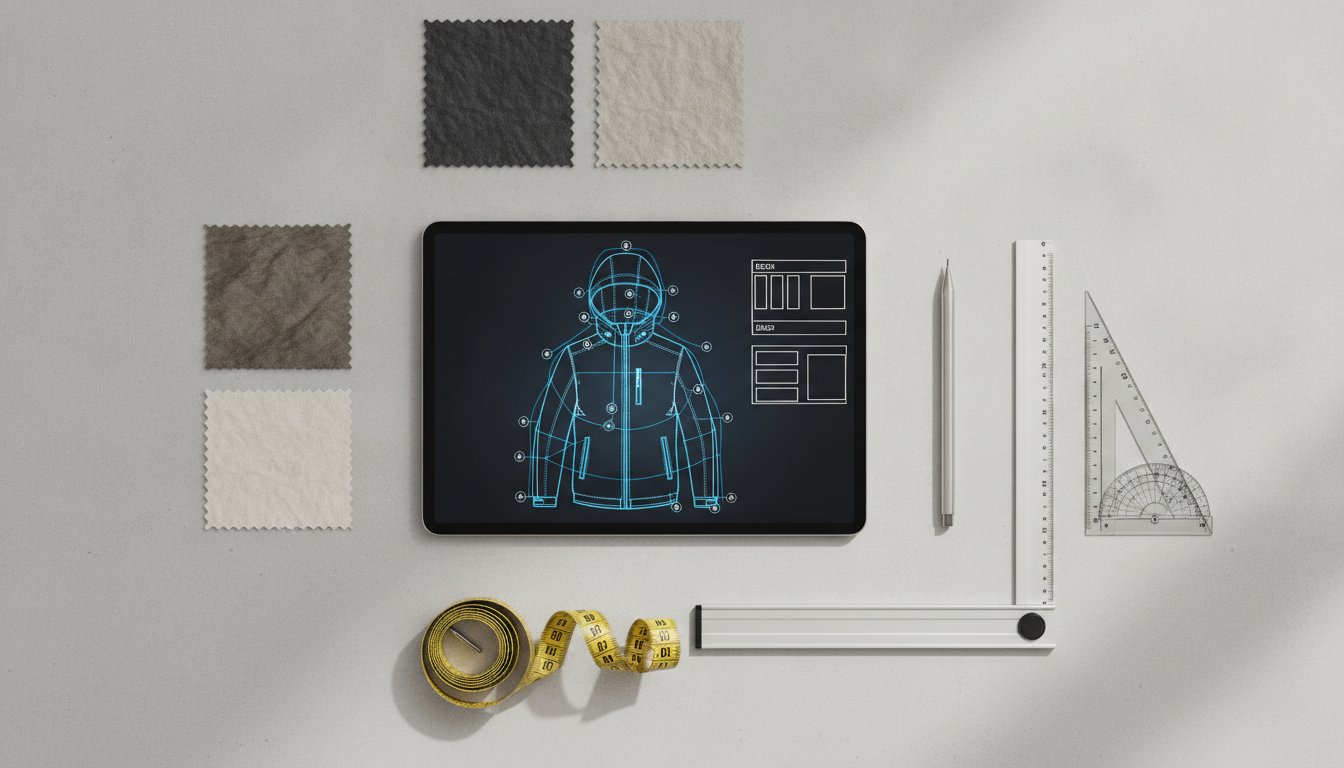
Clothing Tech Pack Template: The 2026 Guide to Production-Ready Design
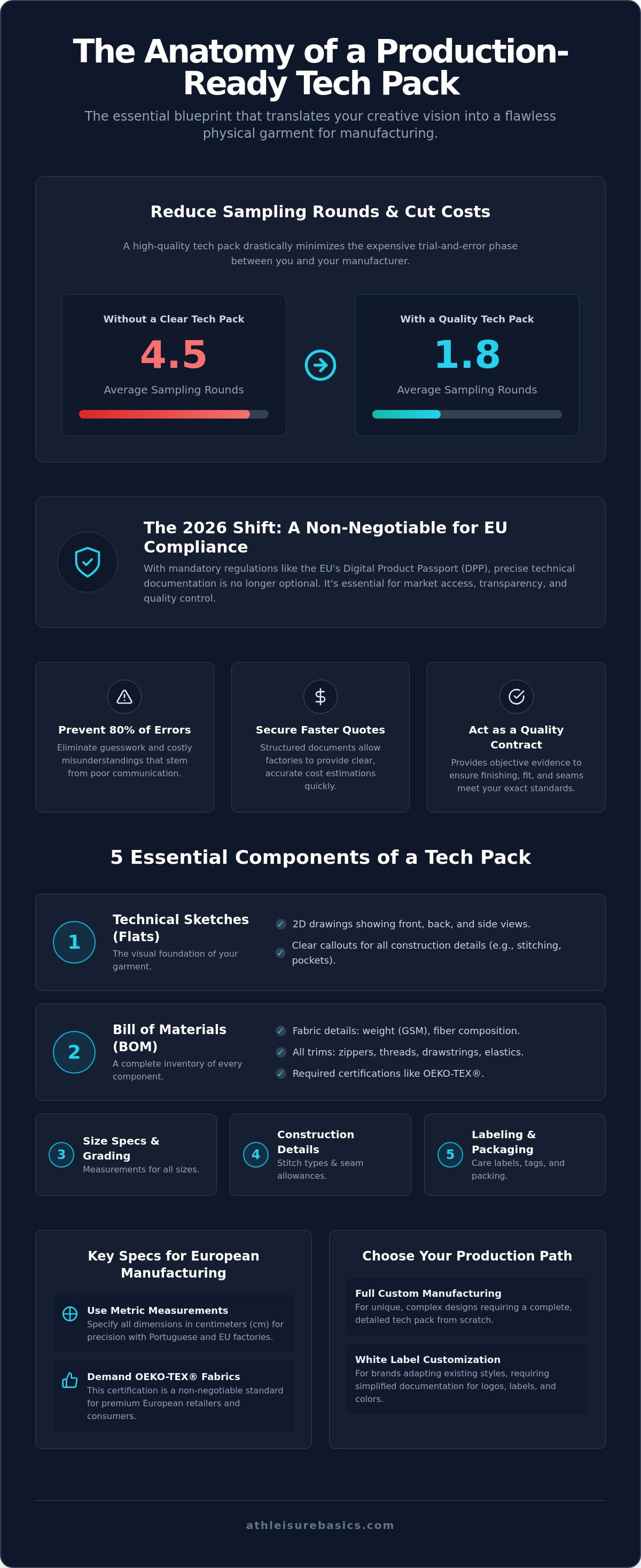
Did you know that a high-quality tech pack can reduce your sampling rounds from an average of 4.5 down to just 1.8? For many emerging designers, the transition from a creative concept to a physical garment is where the most expensive mistakes happen. You might feel overwhelmed by technical terms like Bill of Materials (BOM) or grading tolerances, fearing that a single communication breakdown will lead to a wasted production run. It's a common hurdle, but it's one that a structured clothing tech pack template is designed to solve.
In this guide, we'll help you master the anatomy of a professional tech pack that bridges the gap between your vision and premium Portuguese manufacturing. As the 2026 EU regulations like the Digital Product Passport (DPP) become mandatory, your technical documentation is no longer just a set of instructions; it's a vital tool for compliance and quality control. We'll show you how to use templates to secure clear cost estimations, reduce lead times, and ensure your brand stands out for its craftsmanship and reliability. By the end of this article, you'll have a clear roadmap to creating production-ready designs that factories actually want to build.
Key Takeaways
- Understand why a visual sketch is insufficient and how a professional clothing tech pack template serves as the essential blueprint for consistent manufacturing.
- Identify the five non-negotiable components of a technical document, from detailed flats to a complete Bill of Materials (BOM).
- Learn how to adapt your designs for European standards by using metric measurements and specifying high-performance, OEKO-TEX certified fabrics.
- Evaluate whether your brand requires full custom manufacturing or simplified white label documentation based on your production volume and design complexity.
- Discover how production consulting in Portugal can help you refine your technical specifications to reduce sample lead times and prevent costly errors.
Why Your Brand Needs a Professional Clothing Tech Pack Template in 2026
A tech pack is the DNA of your garment. It translates a creative vision into a technical language that a factory can execute without guesswork. In 2026, the fashion industry has no room for ambiguity. The European Union's mandates on textile transparency and the mandatory Digital Product Passport (DPP) require every stitch and fiber to be documented. A professional clothing tech pack template is your primary tool for achieving this level of precision. Relying on artistic sketches often leads to expensive misunderstandings. While a drawing shows what you want the piece to look like, the tech pack defines exactly how to build it. This document acts as a master blueprint that covers everything from seam allowances to the specific Technical Design requirements needed for premium apparel.
Precision saves capital. Research indicates that a high-quality tech pack can reduce the number of sampling rounds from over four down to fewer than two. In an era where inventory levels are high and market speed is critical, reducing these cycles is a major competitive advantage. By using a standardized template, you avoid the trial and error phase that often drains a startup's budget. It ensures that your first sample is as close to the final product as possible, preventing the 80% of production errors that typically stem from poor communication.
The Tech Pack as a Quality Contract
Portuguese manufacturers are world-renowned for their craftsmanship, but they require technical accuracy to deliver premium results. Your tech pack serves as a contract of quality. It establishes clear expectations for fit, seams, and finishing. If a sample deviates from the specified tolerances, the document provides the objective evidence needed to address the issue. This clarity is vital when working with technical fabrics that require specialized construction methods. Portuguese factories prioritize this technical accuracy because it allows them to maintain the high standards your brand promises to its customers.
Reducing Lead Times with Standardization
Efficiency begins the moment you request a quote. Factories provide faster and more accurate cost estimations when they receive a structured document instead of fragmented emails. A standardized template eliminates the exhausting back-and-forth communication that often stalls a project for weeks. Using a consistent clothing tech pack template across your entire collection ensures brand uniformity and speeds up the factory's internal planning. It creates a seamless transition through the garment production process, moving your brand from concept to final delivery with operational agility. By standardizing your documentation, you position your brand as a professional partner ready for the rigors of international manufacturing.
5 Essential Components Every Apparel Tech Pack Template Must Include
Building a successful collection requires more than a creative eye. It demands a rigorous technical foundation. A comprehensive clothing tech pack template ensures that every detail of your garment is documented with industrial precision. This prevents the interpretation errors that often occur when a factory tries to guess your intent. To move from a prototype to a retail-ready product, your template must house five critical pillars of technical information.
First, your technical sketches, or flats, are non-negotiable. Unlike fashion illustrations, flats are two-dimensional line drawings that show the garment as it would lay flat on a table. You must include front, back, and side views. Clear callouts should highlight specific construction details like reinforced stitching, hidden pockets, or specialized seam types. This visual clarity is the first step in aligning your design with the factory's capabilities.
Mastering the Bill of Materials (BOM)
Measurement Grading for Athleisure
Achieving the perfect fit in high-performance wear is notoriously difficult because stretch percentages dictate the final measurement table. If your fabric has a 20% 4-way stretch, your measurements must reflect that elasticity. Using Points of Measure (POM) is essential for consistency. These are standardized locations on the garment where measurements are taken, such as the chest width or inseam. Common grading mistakes, like scaling up a sports bra without adjusting the strap tension, can ruin the fit for larger sizes. Your clothing tech pack template should include a detailed grading rule table to ensure your design remains proportional from XS to XL. If you find these technical requirements daunting, our team provides production consulting to help you refine your specifications before manufacturing begins.
Finally, do not overlook labeling and packaging. Your tech pack must detail care label placement, brand tags, and any specific folding or bagging requirements. With new EU regulations regarding the Digital Product Passport, including a QR code area for recyclability data is now a standard practice for forward-thinking brands. These details ensure your product is ready for the retail floor the moment it leaves the factory.
Choosing Between Custom Design Tech Packs and White Label Customization
Selecting a production model is a strategic decision that dictates the complexity of your technical documentation. While every professional brand needs a robust clothing tech pack template, the level of detail required depends on whether you're developing a unique silhouette or adapting a proven design. Understanding the nuances of private label Portugal options helps you align your design ambitions with your operational budget and market strategy.
Your choice ultimately hinges on your brand's current lifecycle and available capital. Custom production offers total creative freedom but requires a longer development phase and higher initial investment. White label allows for a faster market entry while maintaining the high standards associated with Portuguese textiles. Both paths lead to premium results when supported by clear, technical documentation that leaves no room for factory interpretation.
The Custom Manufacturing Path
Innovation requires a blank canvas. When you opt for custom manufacturing, you create a unique tech pack for every style in your collection. This path allows for complete control over the fit, specialized performance features, and proprietary fabric blends. Because this process involves significant factory setup, including pattern making and grading from scratch, the minimum order quantity (MOQ) typically starts at 250 pieces per style. Technical designers play a vital role in this phase. They refine your initial clothing tech pack template to ensure that complex seams or innovative paneling are production-ready. This model is ideal for brands looking to differentiate themselves with signature pieces that cannot be found elsewhere in the market.
The White Label Advantage for Startups
For emerging brands or those testing new market segments, white label services offer a pragmatic and efficient entry point. Instead of designing a garment from the ground up, you utilize the factory’s existing, pre-vetted technical specifications. You customize these styles by selecting specific colorways and defining branding placements. This significantly simplifies your documentation needs because the core measurements and construction methods are already finalized and tested by the manufacturer. The primary advantage here is accessibility. With MOQs as low as 70 pieces per style, you can launch a premium collection with significantly reduced financial risk. You focus on brand positioning and aesthetic choices rather than the intricacies of technical pattern engineering.
How to Fill Out Your Tech Pack for European Manufacturing Standards
Working with premium manufacturers in Portugal requires a shift in how you document technical details. European factories operate with high levels of industrial precision. They expect your documentation to reflect those same standards. To ensure a seamless transition from your clothing tech pack template to the factory floor, you must follow a structured, data-driven approach that accounts for regional regulations and industrial preferences.
- Step 1: Use the Metric System. Always record measurements in centimeters (cm). Using inches is a common source of conversion errors that can ruin an entire production run.
- Step 2: Specify Performance Tech. Clearly define moisture-wicking properties and 4-way stretch percentages.
- Step 3: Detail Construction. Choose between Flatlock and Overlock stitching based on the garment's purpose.
- Step 4: High-Resolution Artwork. Provide vector files for all branding to ensure crisp execution.
- Step 5: Verify BOM Data. Double-check supplier certifications to meet 2026 EU transparency mandates.
Specifying Performance Fabrics
In the athleisure sector, grams per square meter (GSM) is the most critical metric. It determines the fabric's opacity, weight, and hand feel. Your clothing tech pack template must list exact fiber compositions to comply with strict EU customs and labeling laws. Since the enforcement of the Green Claims Directive in 2026, vague descriptions like "sustainable" are insufficient. You must provide verifiable data, such as OEKO-TEX® certification numbers. Many brands prefer sourcing from specific Portuguese mills known for high-performance recycled synthetics. If you have a preference, name the supplier directly in your Bill of Materials to ensure material integrity, much like how the quality of Fairtex Muay Thai gloves is maintained through strict component sourcing.
Construction Details That Matter
Durability in activewear is defined by stitches per inch (SPI). A higher SPI generally indicates a stronger, more premium garment, but it must be balanced against the fabric's weight to prevent structural damage. Specify thread types that offer high elasticity, such as textured polyester, to prevent seams from popping during intense movement. Use clear call-outs on your technical flats to show exactly where Flatlock seams should be used for comfort against the skin. These granular details distinguish a professional brand from an amateur one. If you need expert guidance to finalize these technicalities, you can partner with our production consultants to ensure your designs are fully optimized for Portuguese manufacturing standards.
From Template to Finished Garment: Partnering with Athleisurebasics in Portugal
A completed clothing tech pack template is only as effective as the hands that receive it. While your documentation provides the instructions, the expertise of clothing manufacturers Portugal is what transforms those digital files into a commercial reality. At Athleisurebasics, we don't just view your tech pack as a static document. We treat it as a dynamic communication tool that guides our specialized machinery and skilled artisans. Our role is to interpret your specifications through the lens of industrial feasibility; this ensures that your vision is translated into a high-performance product that meets the rigorous standards of the 2026 market.
Submitting a professional tech pack allows us to provide a transparent and accurate production quote. This clarity eliminates the hidden costs often associated with vague designs and reduces the financial risks for your brand. By providing detailed data on materials, construction, and grading, you enable us to plan our production cycles with operational agility. This precision helps your brand scale with confidence and maintain consistent quality across every batch.
Our Tech Pack Development Services
Many emerging entrepreneurs have a distinct design vision but lack the technical skills to build a production-ready file from scratch. We solve this barrier through our dedicated production consulting services. If your clothing tech pack template is incomplete or feels overwhelming, our technical designers work as your ally to refine the specifications. We audit your designs to ensure they are compatible with our advanced stitching machines and specific fabric types. This collaborative process leads to the creation of the Golden Sample. This is the definitive physical garment that proves your tech pack is accurate and ready for a full production run; this applies whether you're meeting our 70-piece white label minimum or our 250-piece custom manufacturing threshold.
The Advantage of Portuguese Manufacturing
Portugal remains the premier destination for brands that value material integrity and ethical standards. By manufacturing within the European Union, you benefit from proximity to major markets; this significantly reduces your brand's carbon footprint compared to global competitors. Our commitment to high-end craftsmanship is backed by the strict labor laws of Portugal, where the national minimum wage reached €920 per month as of January 1, 2026. This ensures your garments are produced under fair conditions by skilled professionals. Access to premium, OEKO-TEX® certified materials allows your brand to position itself as a quality-conscious leader in the athleisure industry. Partnering with us means moving beyond a simple transaction; it builds a long-term relationship focused on sustainable growth and industry-leading standards.
Secure Your Production Success in 2026
Transitioning from a creative concept to a retail-ready garment requires more than just inspiration; it demands technical discipline. By mastering your clothing tech pack template, you eliminate the communication gaps that lead to costly production errors and wasted samples. A professional document is your best defense against inconsistent quality and the key to meeting the European Union's latest transparency mandates. You now have the roadmap to translate your vision into the technical language that premium factories require.
We're ready to help you bridge the gap between design and delivery. Whether you're utilizing our expert production consulting to refine your templates or sourcing our OEKO-TEX® certified premium fabrics, we provide the industrial foundation your brand needs to thrive. With low MOQs starting at just 70 pieces for white label collections, the path to high-end Portuguese manufacturing is more accessible than ever. It's time to move beyond sketches and start building a scalable, ethical business model.
Launch your premium athleisure brand with Athleisurebasics today. Your journey from a small-batch idea to a lasting commercial presence begins with a single, precise blueprint. We look forward to helping you create something exceptional.
Frequently Asked Questions
Do I need a different tech pack for every size in my collection?
You don't need a separate document for every size. Instead, your clothing tech pack template includes a grading sheet that specifies how the base size scales up or down. You list the Points of Measure and define the specific increments for each size in your range. This allows the factory to maintain correct proportions from XS to XL without the need for redundant files.
Can I create a professional tech pack in Excel or Google Sheets?
You can certainly use Excel or Google Sheets to build a professional document. These tools are excellent for organizing the Bill of Materials and measurement tables. You must ensure your technical sketches are high-resolution and clearly integrated into the layout. While specialized software exists, a well-structured spreadsheet remains an industry standard for many emerging brands due to its accessibility and ease of sharing.
What is the difference between a tech pack and a spec sheet?
A spec sheet is a single component within a comprehensive tech pack. The spec sheet focuses specifically on measurements and technical drawings of the garment. In contrast, the tech pack is the complete master folder. It includes the Bill of Materials, construction details, labeling instructions, and packaging requirements. Think of the spec sheet as the dimensions and the tech pack as the full instruction manual.
How much does it cost to have a professional tech pack developed?
Industry costs for tech pack development vary based on the complexity of the garment. Entry-level basics like t-shirts typically range from $80 to $150. More technical items like high-performance leggings or complex outerwear can cost between $300 and $800. These costs reflect the technical design expertise required to ensure your garment is production-ready. Investing in professional development early prevents much higher costs during the sampling phase.
What is a BOM in a tech pack and why is it crucial?
The Bill of Materials (BOM) is an exhaustive list of every physical item needed to create your garment. This includes the primary fabric, threads, zippers, buttons, and brand labels. It is crucial because it ensures the factory doesn't substitute your specified materials with lower-quality alternatives. A precise BOM in your clothing tech pack template is essential for accurate cost estimations and maintaining premium brand standards.
Do Portuguese manufacturers require tech packs in English or Portuguese?
Most premium Portuguese manufacturers prefer tech packs in English. English is the universal language of the global fashion industry and is used by technical designers and production managers across Europe. While the factory staff speaks Portuguese, their technical systems and documentation processes are optimized for English. Providing your documentation in English ensures clarity and prevents translation errors during the critical pattern-making and sampling stages.
How do I measure stretch percentage for my athleisure tech pack?
You measure stretch percentage by performing a physical test on a fabric sample. Take a 10cm piece of fabric and stretch it over a ruler until it resists. If it stretches to 15cm, you have a 50% stretch. You must measure this for both the horizontal and vertical directions to determine the 4-way stretch capability. Recording this data accurately is vital because it dictates the measurement tolerances in your technical specifications.
What happens if I send a factory a design without a tech pack?
Sending a design without a tech pack often leads to factory rejection or significant production errors. Without technical instructions, the manufacturer is forced to guess your requirements for fit, seams, and materials. This usually results in multiple expensive sampling rounds and inconsistent final quality. Most high-end Portuguese manufacturers require a professional tech pack before providing a formal quote to protect your brand and their production standards.


Leave a comment
This site is protected by hCaptcha and the hCaptcha Privacy Policy and Terms of Service apply.