

How to Build Brand Trust with Quality Manufacturing: A 2026 Strategy for Apparel Brands
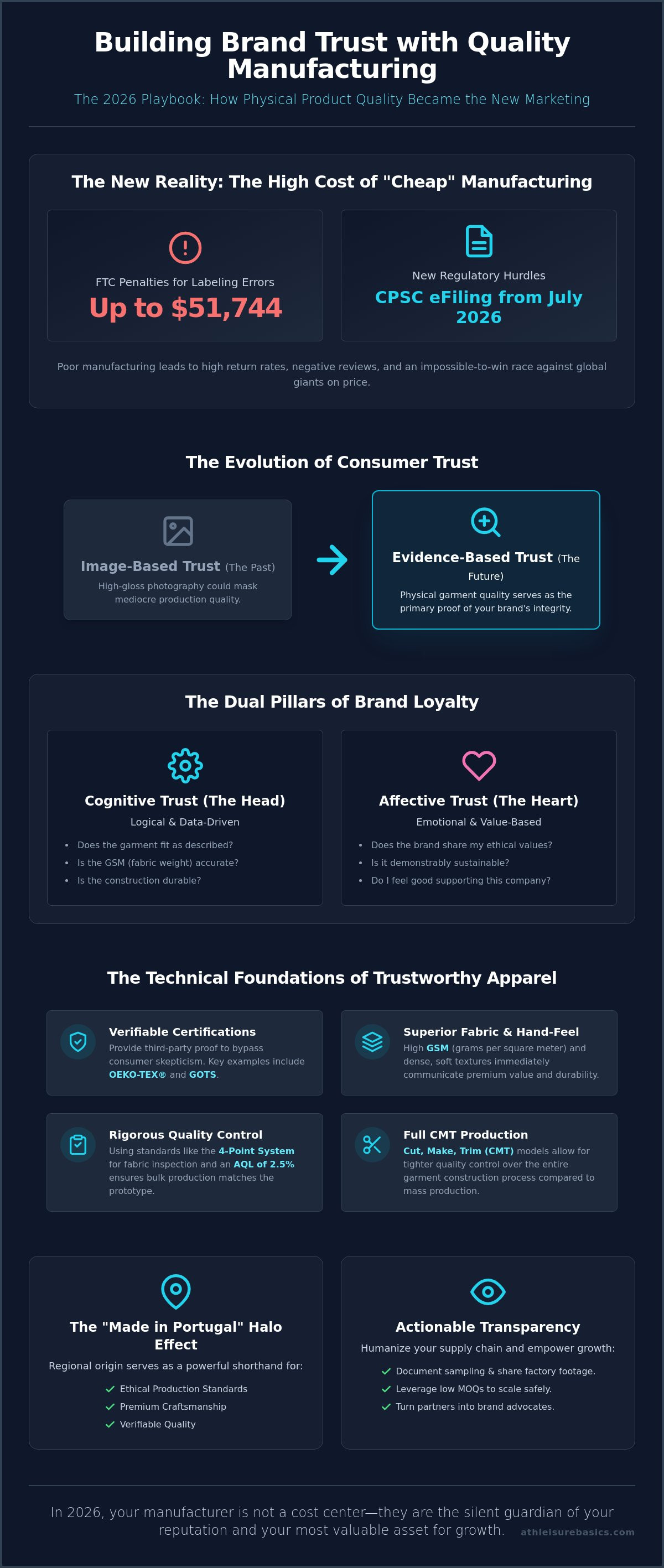
In 2026, brand trust is no longer a marketing layer. It is the physical byproduct of your tech pack and factory choice. With the FTC enforcing penalties of up to $51,744 for labeling errors and new CPSC eFiling requirements starting in July 2026, the cost of "cheap" manufacturing has never been higher. You've likely felt the frustration of high return rates or the sting of negative reviews that claim your materials don't match your price point. This creates an exhausting cycle that makes it impossible to compete with global giants on price alone.
This guide reveals how to build brand trust with quality manufacturing by moving your production from a hidden back-end cost to your most valuable asset. We'll show you how to implement a strategy that lowers return rates and builds a verifiable "Made in Europe" brand story. You'll learn how to navigate the new regulatory landscape, use the 4-Point System for fabric inspection, and leverage ethical certifications to turn skeptical consumers into loyal, long-term partners in your brand's growth.
Key Takeaways
- Learn why the 2026 apparel market has shifted from image-based marketing to evidence-based trust, where physical product quality must validate every brand promise.
- Discover how to build brand trust with quality manufacturing by prioritizing OEKO-TEX® certified materials and superior fabric hand-feel to create immediate perceived value.
- Understand the "halo effect" of Portuguese manufacturing and how regional origin serves as a powerful shorthand for ethical production and premium craftsmanship.
- Master actionable transparency by documenting your sampling process and using factory footage to humanize your supply chain for skeptical consumers.
- Explore how flexible production models and low minimum order quantities allow emerging brands to scale safely while maintaining world-class quality standards.
The Psychology of Brand Trust in the 2026 Apparel Market
Trust in the fashion industry is the narrow bridge between an Instagram ad and the unboxing experience. For a new brand, this moment of truth defines your future. If the garment feels thin or the stitching looks frayed, that digital promise collapses instantly. In 2026, we've moved away from "Image-Based Trust," where high-gloss photography could mask mediocre production. Today's consumers demand "Evidence-Based Trust," where the physical garment serves as the primary proof of your brand's integrity. Understanding the psychology of brand trust is essential because it dictates whether a first-time buyer becomes a lifelong advocate.
Your manufacturer is the silent guardian of your reputation. While you focus on marketing and community building, they are responsible for the tactile reality of your vision. For startups, a single production run with quality defects can be fatal. It doesn't just result in lost revenue; it permanently breaks the emotional connection with your early adopters. Brands like Beme Collections demonstrate how focusing on high-quality craftsmanship from the start builds long-term customer loyalty. Learning how to build brand trust with quality manufacturing means choosing a partner who understands that every seam is a statement of your values. It requires a shift in perspective from seeing production as a back-end cost to seeing it as your most powerful growth lever.
Cognitive vs. Affective Trust in Clothing
Trust operates on two distinct levels in the mind of a consumer. Cognitive trust is logical and data-driven. It asks: Does the hoodie fit as described? Is the GSM accurate? Affective trust is emotional and value-based. It asks: Does the brand share my values regarding ethical labor and sustainability? Quality manufacturing satisfies both the "head" and the "heart." When a garment feels premium and arrives with verifiable certifications like OEKO-TEX®, you validate the customer's logic while securing their emotional loyalty. This dual satisfaction is the foundation of a resilient brand identity.
The Cost of Broken Trust: Returns and Reputation
Manufacturing defects do more than trigger expensive returns; they attach the "Fast Fashion" stigma to your name. High return rates are often a direct symptom of poor material sourcing or inconsistent CMT production processes. The long-term ROI of investing in premium production is found in the absence of these failures. By choosing high-end craftsmanship over low-cost alternatives, you avoid the hidden costs of customer churn and negative reviews. Understanding how to build brand trust with quality manufacturing ensures that your brand isn't just seen, but felt and respected.
Quality-Led Trust is the primary driver of customer retention because it ensures the product experience always exceeds the digital expectation.
Technical Pillars of Quality Manufacturing That Build Trust
Technical quality isn't just an engineering goal; it's the physical language of your brand's integrity. When you're deciding how to build brand trust with quality manufacturing, you must look beyond aesthetic design and focus on the technical pillars that consumers can feel, see, and verify. In 2026, material integrity has become a non-negotiable trust signal. Fabrics with OEKO-TEX® STANDARD 100 or GOTS certifications prove that your garments are free from harmful substances and ethically produced. This level of Actionable Transparency bypasses consumer skepticism by providing third-party validation of your claims.
The "hand-feel" test remains the most immediate psychological driver of value. A hoodie with a high GSM (grams per square meter) and a dense, soft texture communicates durability before a customer even checks the price tag. Conversely, flimsy, mass-market fabrics trigger "fast fashion" associations that are nearly impossible to erase. Beyond the fabric, the construction matters. Full CMT (Cut, Make, Trim) production allows for tighter quality control compared to generic mass-production models. Understanding how to build brand trust with quality manufacturing ensures that your bulk production never deviates from the quality your customers expect. To maintain this, leading brands use the 4-Point System for fabric inspection and an Acceptable Quality Limit (AQL) of 2.5% to ensure the 100th garment matches the prototype exactly.
Certifications as Verifiable Proof
Consumers in 2026 are more educated than ever. They look for verifiable proof rather than vague marketing slogans. Accessing expert materials sourcing support is critical for identifying suppliers who meet these high standards. For startups needing a faster market entry, using Luxury Blanks provides a shortcut to established quality without the R&D lead times of custom development. These certified foundations allow you to market your products with confidence and reduce the risk of lead content or flammability violations that trigger costly recalls.
The Role of the Tech Pack in Quality Control
A detailed tech pack acts as both a blueprint and a contract between your brand and the factory. It reduces variance by specifying every stitch count, seam type, and measurement tolerance. By mastering these technical details, you demonstrate a level of professionalism that builds confidence with partners and customers alike. If you're ready to elevate your production standards, partnering with a specialist can help you translate your vision into a technically sound product that stands the test of time.
Regional Origin: Why "Made in Portugal" is a Trust Shorthand
Geographic origin is one of the most powerful triggers for "affective trust." While a consumer might not understand the technical nuances of a flatlock stitch, they immediately recognize the value of a "Made in Europe" label. In the premium athleisure market, Portugal has emerged as the definitive hub for quality. This regional reputation creates a halo effect for your brand, allowing you to bypass the skepticism often directed at mass-produced goods from global manufacturing hubs. Understanding how to build brand trust with quality manufacturing involves aligning your brand with regions that have already earned the consumer's respect.
The contrast between "Ethical Europe" and "Mass-Produced Asia" is a significant factor in 2026 consumer behavior. Manufacturing in Portugal automatically satisfies many of the social responsibility requirements that modern shoppers demand. Because Portugal adheres to strict EU labor standards, you don't have to constantly defend your ethical claims. The supply chain is transparent; auditing a factory in the EU is far more accessible than managing a remote offshore facility. Partnering for Trust with a European factory means you're investing in a system built on fair wages and safe working conditions. This becomes a core part of your brand story that builds immediate credibility.
The Heritage of Portuguese Textiles
The reputation of Made in Portugal clothing isn't just about labels. It's about a unique heritage of artisan skill combined with modern technology. This blend of tradition and innovation makes Portuguese production synonymous with premium quality. For global brands, the psychological value of small-batch production is immense. It allows you to highlight specific craftsmanship markers that resonate with customers:
- Artisan Expertise: Decades of textile knowledge refined through specialized family-run factories.
- Technological Innovation: Early adoption of sustainable dyeing and high-performance seamless knitting.
- Social Compliance: Guaranteed adherence to European Union labor laws and environmental regulations.
Sustainability and Reduced Carbon Footprint
Logistical trust is a growing concern for the eco-conscious consumer. Choosing clothing manufacturers in Portugal significantly reduces the carbon footprint associated with long-distance shipping to EU and US markets. This proximity allows you to make verifiable "Eco-Friendly" claims that stand up to scrutiny during factory audits. By shortening your supply chain, you minimize environmental guilt and demonstrate a principled approach to production. It's an efficient way to prove that your brand values material integrity over simple cost-cutting.
Actionable Transparency: Showing the "How" Behind the "What"
Transparency is no longer an optional marketing tactic. It's the standard by which 2026 consumers judge a brand's integrity. To truly master how to build brand trust with quality manufacturing, you must invite your audience into the production cycle. This doesn't mean revealing trade secrets. It means documenting the journey from a raw concept to a finished garment. Start by showcasing the sampling process. When you share the "evolution of quality" through multiple iterations of a prototype, you prove that you don't settle for "good enough."
Humanizing your supply chain is the next critical step. Use "Behind the Scenes" footage of the factory floor to show the skilled artisans handling your textiles. This visual evidence of craftsmanship creates a powerful emotional connection. Additionally, you should publish a "Quality Manifesto." This document should detail your factory's specific certifications, such as OEKO-TEX® or GOTS, and explain your internal standards for stitch density and seam strength. Educating your audience on technicalities, like why you chose a 400 GSM French Terry for its weight and structure, gives them the vocabulary to appreciate your brand's premium positioning.
From Factory Floor to Social Feed
Every milestone in the garment production process is a potential marketing hook. Showing the people who made your clothes is the ultimate trust builder because it removes the anonymity of mass production. Using low MOQ production allows you to launch "transparent" limited editions where you can trace the journey of every single piece. This level of detail makes how to build brand trust with quality manufacturing a tangible part of your customer experience rather than just a slogan.
Handling Mistakes with Manufacturing Transparency
Even the best brands face production hurdles. The "Trust Recovery" paradox suggests that being honest about a manufacturing error can actually increase brand loyalty. If a batch doesn't meet your GSM standards, tell your customers. Explain the problem and how you're fixing it. This honesty demonstrates that your commitment to quality is real. Proactive clothing production consulting can help you navigate these challenges and prevent PR disasters before they happen. If you're looking for a partner who values transparency as much as you do, explore our production services to see how we can support your growth.
Partnering for Trust: Why Athleisurebasics is the Strategic Choice
Choosing a production partner is a pivotal decision. It's the moment you transition from a conceptual design to a physical product that must survive the scrutiny of a skeptical market. At Athleisurebasics, we position ourselves as more than a vendor; we're a dedicated ally in your entrepreneurial journey. We understand how to build brand trust with quality manufacturing by removing the technical and financial barriers that often stall new ventures. Our accessible low Minimum Order Quantities (MOQs) allow you to test premium garments without the perceived risk of massive inventory overhead. This pragmatic approach empowers you to scale based on real customer feedback rather than guesswork.
Our commitment to material integrity is the foundation of our partnership model. By using OEKO-TEX® certified fabrics and prioritizing ethical Portuguese production, we provide the physical evidence needed to support your brand's claims. We serve as the vital bridge between the operational speed of Private Label Portugal and the high-end craftsmanship of custom manufacturing. This balance ensures your brand remains agile enough to respond to trends while maintaining a "Made in Europe" quality seal that inspires immediate consumer confidence. We move beyond simple transactions to create a relational framing that supports your brand's long-term commercial presence.
Custom vs. White Label: Choosing Your Trust Path
We apply the same industry-leading standards to our White Label service as we do to our full CMT production runs. If you're looking to launch a high-trust brand in weeks rather than months, our Luxury Blanks provide a strategic shortcut. These aren't generic products; they're premium essentials designed with superior hand-feel and durability. For brands with unique visions, our custom manufacturing services allow for total creative control. Regardless of the path you choose, we offer expert clothing production consulting to ensure your tech packs and material choices align with the high standards of the 2026 apparel market.
Your Next Steps to a High-Trust Brand
Building a brand that lasts requires a partner who values quality as much as you do. The first step in proving your brand's value is to see and feel the production quality for yourself. Requesting a sample allows you to verify our stitch density, fabric weight, and overall construction before committing to a larger run. We also encourage a consultation to align your specific brand values with our technical capabilities. This collaborative start is how to build brand trust with quality manufacturing that converts first-time buyers into lifelong advocates.
Partner with Athleisurebasics to build a brand that lasts.
Secure Your Brand's Future through Production Excellence
The apparel market in 2026 demands more than just aesthetic appeal. It requires a physical commitment to integrity that consumers can verify at every touchpoint. By mastering how to build brand trust with quality manufacturing, you transform your supply chain from a logistical necessity into a powerful marketing asset. You've seen how regional origin, technical precision, and radical transparency work together to eliminate consumer skepticism and foster long-term loyalty. This strategy ensures your brand isn't just another voice in the crowd; it's a trusted partner in your customer's life.
Transitioning from a small concept to a lasting commercial presence is easier when you have the right support. We provide the expertise and infrastructure needed to navigate complex industrial processes with confidence. With our OEKO-TEX® Certified Materials, Premium Portuguese Craftsmanship, and low 70-piece MOQs for startups, we help you mitigate risk while maintaining world-class standards.
Start your journey toward a high-trust brand with a custom quote. Your vision deserves a foundation built on quality and principled production.
Frequently Asked Questions
How does quality manufacturing directly impact brand trust?
Quality manufacturing directly impacts brand trust by ensuring the physical product matches the digital expectation. When a garment arrives without defects and feels premium, it validates the consumer's purchase decision. This reliability reduces return rates and prevents negative reviews that can permanently damage a startup's reputation. Learning how to build brand trust with quality manufacturing is the most effective way to secure customer loyalty in a competitive market.
What are the most important certifications to look for in a clothing manufacturer?
The most critical certifications for 2026 are OEKO-TEX® STANDARD 100 and GOTS. These labels prove that fabrics are free from harmful chemicals and meet strict environmental standards. For social responsibility, look for BSCI or SA8000 audits. These third-party validations provide the verifiable proof that modern consumers demand, allowing you to bypass skepticism and market your brand's ethical integrity with complete confidence.
Is 'Made in Portugal' actually better than 'Made in China' for brand trust?
'Made in Portugal' is often superior for brand trust because it serves as a shorthand for ethical production and artisan skill. While other regions offer lower costs, Portugal adheres to strict EU labor laws and environmental regulations. This regional origin creates a "halo effect" that justifies a premium price point. It helps consumers feel secure that their clothing was made under fair conditions without requiring exhaustive proof.
How can a startup with a small budget afford high-quality manufacturing?
Startups can afford high-quality manufacturing by choosing partners with flexible production models and low Minimum Order Quantities (MOQs). By producing batches as small as 70 pieces, you can invest in premium materials without the risk of massive inventory overhead. This allows you to focus your budget on quality rather than quantity, ensuring that every garment you sell reinforces your brand's reputation for excellence from day one.
What technical details should I include in my marketing to prove quality?
You should include technical specifications like fabric weight (GSM), stitch density, and specific material blends in your marketing. Providing these details moves your brand from "image-based trust" to "evidence-based trust." For example, explaining the durability of a 400 GSM French Terry hoodie justifies its value. This transparency educates your audience and provides the physical proof points they need to trust your brand's quality claims.
How do low MOQs help in building a trustworthy brand?
Low MOQs help build a trustworthy brand by allowing for tighter quality control and faster iteration. When you produce in smaller batches, it's easier to ensure that every garment matches your tech pack exactly. This prevents the quality drift often found in mass production. It also allows you to refine your products based on real customer feedback, showing that you are responsive and dedicated to maintaining high standards.
What is the difference between white label and custom manufacturing for trust?
White label manufacturing offers a pre-vetted shortcut to trust, while custom production allows you to build unique brand integrity from scratch. Our white label "Luxury Blanks" use the same premium Portuguese standards as our custom runs, ensuring high quality regardless of the path you choose. Understanding how to build brand trust with quality manufacturing involves selecting the model that best fits your technical expertise and current growth stage.
How can I verify the ethical claims of my clothing manufacturer?
You can verify ethical claims by requesting current certification numbers and checking them against official databases like the OEKO-TEX® or GOTS websites. Transparent manufacturers will also provide recent social audit reports upon request. Choosing a factory in a highly regulated region like Portugal adds an extra layer of security, as these facilities must comply with strict EU labor and environmental laws, making their claims much easier to verify.



Leave a comment
This site is protected by hCaptcha and the hCaptcha Privacy Policy and Terms of Service apply.