

Building a Transparent Supply Chain: A Guide for Emerging Apparel Brands
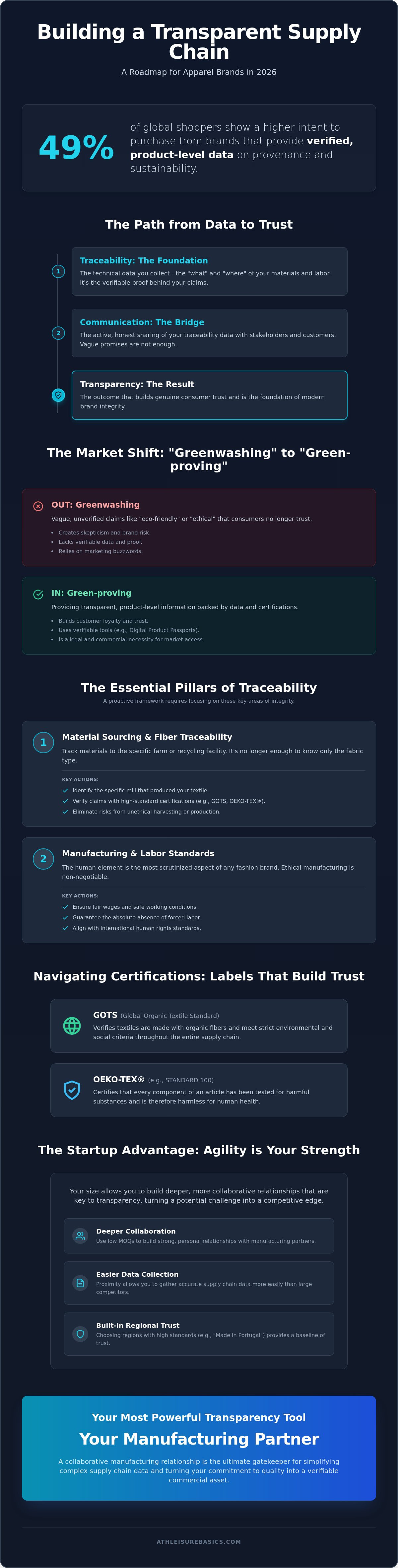
Did you know that 49% of global shoppers now show a higher intent to purchase from brands that provide verified, product-level data on provenance and sustainability? As an emerging entrepreneur, you likely feel the weight of this shift. You want to do things the right way, but the fear of greenwashing accusations or the difficulty of tracking every fiber across the globe can feel overwhelming. It's frustrating when you have the vision for an ethical brand but lack visibility beyond your primary factory floor.
Building a transparent supply chain doesn't have to require a massive enterprise budget or complex technical systems. You can achieve full traceability and earn genuine consumer trust by focusing on strategic partnership choices. This guide provides a clear roadmap for end-to-end traceability; it helps you understand which certifications actually matter in 2026 and how to find a manufacturing partner that simplifies your data. We'll show you how to move from a concept to a lasting commercial presence by prioritizing material integrity and operational agility.
Key Takeaways
- Define transparency as a mandatory legal and commercial standard that tracks your product from raw fiber to the final customer.
- Identify the four essential pillars for building a transparent supply chain to ensure your brand remains proactive rather than reactive.
- Master a five-step roadmap to audit your production journey and gain deeper visibility through your Tier 1 manufacturing partners.
- Navigate the "alphabet soup" of industry certifications to determine which labels actually provide verifiable proof of your ethical claims.
- Learn why a collaborative manufacturing relationship is the ultimate gatekeeper for simplifying complex supply chain data.
What does building a transparent supply chain mean in 2026?
In 2026, building a transparent supply chain is no longer a luxury for high-end labels; it's a fundamental requirement for any brand that intends to survive. Transparency is the ability to track every single stage of production, starting from the raw fiber harvested in a field to the final delivery at a customer's doorstep. While many founders focus only on their primary factory, true transparency requires visibility into every tier of the manufacturing process. This shift from a voluntary "nice-to-have" feature to a commercial necessity is driven by both new legislation and a fundamental change in consumer behavior.
It's vital to distinguish between traceability and transparency. Traceability refers to the technical data you collect, the "what" and "where" of your materials and labor. Transparency is the active, honest communication of that data to your stakeholders and customers. Today's conscious consumers aren't satisfied with vague promises. They demand proof. They want to see the certifications, the factory conditions, and the environmental impact of their purchases. If you can't provide this proof, you risk losing their trust and their business.
The shift from "Greenwashing" to "Green-proving"
Vague sustainability claims don't work in the 2026 market. Consumers have grown skeptical of buzzwords like "eco-friendly" or "ethical" when they aren't backed by data. The European fashion industry is leading this change with Digital Product Passports (DPP). These regulations require brands to provide product-level information via QR codes, covering everything from fiber composition to carbon footprints. Brands that can't provide this data will find themselves locked out of major markets. Supply chain transparency is the foundation of modern brand integrity.
Transparency as a competitive advantage for startups
Small brands often feel overwhelmed by these requirements, but your size is actually a strategic strength. You can use low minimum order quantities (MOQs) to build deeper, more collaborative relationships with your partners. This proximity allows you to collect accurate data more easily than a massive corporation managing thousands of distant factories. Choosing made in portugal clothing offers built-in trust because of the region's strict labor laws and high environmental standards. By investing in sustainable and transparent supply chains, you reduce your brand risk and build a level of customer loyalty that larger, less agile competitors can't match. It's about turning your commitment to quality into a verifiable commercial asset.
The 4 essential pillars of apparel supply chain traceability
Building a transparent supply chain requires a proactive framework rather than a reactive one. Instead of waiting for a customer inquiry or a regulatory audit to scramble for data, successful brands design their operations with traceability as a core feature. This is particularly critical in the athleisure and technical apparel sectors, where high-performance synthetic fibers and complex chemical treatments are the norm. To identify potential blind spots before they become liabilities, founders must start by understanding the garment production process in its entirety. By mapping out every touchpoint, you can ensure that your brand stands on the following four pillars of integrity.
Pillar 1: Material Sourcing and Fiber Traceability
Transparency begins with the raw material. It is no longer enough to know your fabric is "recycled polyester" or "organic cotton." You must be able to track the origin back to the specific farm or recycling facility. This involves knowing which mills produced your textile and verifying that their claims are legitimate. High-standard certifications like GOTS for organics and OEKO-TEX® for chemical safety provide the necessary "currency" for trust. When you can name the mill and verify the fiber source, you eliminate the risk of being associated with unethical harvesting practices.
Pillar 2: Manufacturing and Labor Standards
The human element is the most scrutinized aspect of any fashion brand. Ethical manufacturing means ensuring fair wages, safe working conditions, and the absolute absence of forced labor. Many brands are now aligning with the Apparel and Footwear Supply Chain Transparency Pledge to demonstrate their commitment to worker rights. Manufacturing within the EU provides a higher baseline of labor transparency due to strict regional regulations. We recommend working with partners who maintain "Open Factory" policies, allowing you to visit production lines and see the working environment firsthand.
Pillar 3: Environmental Impact and Waste Management
Modern consumers demand data on water usage, chemical management, and carbon footprints. Adhering to REACH compliance ensures that no harmful substances are used during dyeing or finishing processes. Efficient clothing manufacturers in Portugal often lead the industry by utilizing renewable energy and sophisticated waste reduction systems. A transparent system also accounts for deadstock management, ensuring that leftover fabric is repurposed rather than sent to a landfill. If you are looking to simplify these complex requirements, our production consulting services can help you vet partners who prioritize these environmental standards.
Pillar 4: Data Integrity and Digital Documentation
The final pillar is the digital record of the previous three. In 2026, building a transparent supply chain relies on maintaining a "single source of truth" for all production data. This includes digital certificates of origin, shipping manifests, and lab test results. By digitizing your sourcing and production records, you prepare your brand for the upcoming Digital Product Passport requirements while providing your marketing team with the verifiable proof they need to communicate your brand's values to your audience.
5 Steps to map your production journey
Mapping your production journey is a pragmatic exercise in data collection. You don't need expensive blockchain software to begin. Start by selecting a single product line, perhaps a core luxury blank or a signature athleisure piece, and trace its history. This focused approach allows you to establish a repeatable process for the rest of your collection. Building a transparent supply chain is an iterative process that relies on verifiable documentation rather than simple verbal agreements.
Step 1: Identify your Tier 1 and Tier 2 suppliers
Start by asking your Tier 1 partners for a comprehensive list of all subcontractors. You need to know exactly where every component is made, from the main fabric to the smallest label. Your Tier 1 partner is the facility performing the cut and sew operations. Tier 2 includes the mills providing the textiles and the suppliers providing trims. Requesting these details ensures no "hidden" production occurs without your knowledge. Tier 1 visibility is the minimum entry requirement for ethical brands in 2026. Use the Fair Labor Association's transparency standards to benchmark these factory disclosures.
Step 2: Collect and verify certifications
You must move beyond accepting "we use eco-fabrics" as a sufficient answer. Demand physical, batch-specific certificates for every order to ensure the materials meet your standards. Utilizing OEKO-TEX® labels provides your customers with immediate, recognizable proof of safety and chemical compliance. Third-party audits serve as an essential check, confirming that the facility's operational reality matches its documented claims. This verification process ensures that your marketing claims are always backed by industrial proof.
Step 3: Implement a "Chain of Custody" for materials
A "Chain of Custody" ensures the integrity of your materials is maintained from the source to the sewing machine. Use Transaction Certificates (TCs) to prove that the organic cotton or recycled polyester you paid for is exactly what ended up in the final garment. Athleisurebasics supports emerging brands with materials sourcing and verification to simplify this logistical hurdle. Maintaining a rigorous paper trail from fiber to finished garment protects your brand from liability and builds genuine trust with your audience.
Step 4: Audit and evaluate your findings
Once you've gathered your data, look for potential gaps or risks in the journey. Are there subcontractors you weren't aware of? Do any of your supplier certificates need renewal in the coming months? Building a transparent supply chain requires ongoing vigilance; regular evaluations ensure that your standards remain high as your brand scales. This step allows you to address supply chain vulnerabilities before they become public issues.
Step 5: Communicate the journey to your customers
Navigating certifications: Which labels actually build trust?
Navigating the complex landscape of industry labels is a critical step in building a transparent supply chain. In 2026, these certifications serve as the primary currency of trust between a brand and its customers. They provide the verifiable, product-level data required by the new EU Digital Product Passport (DPP) regulations. Since nearly half of global consumers now prioritize verified data on provenance, having the right labels on your hangtags is a major commercial advantage. However, you don't need every certification available; you need the ones that matter to your niche.
The Gold Standards: OEKO-TEX®, GOTS, and GRS
For brands focused on athleisure and activewear, OEKO-TEX® Standard 100 is a non-negotiable requirement. Because these garments have prolonged skin contact during intense activity, verifying they are free from over 1,000 harmful substances is a baseline safety standard. If your brand identity is built on organic materials, the Global Organic Textile Standard (GOTS) remains the most respected benchmark. For technical apparel using synthetic fibers, the Global Recycled Standard (GRS) provides the "Chain of Custody" proof mentioned earlier. It ensures that your recycled polyester actually originates from post-consumer waste, protecting you from greenwashing accusations.
REACH Compliance and the EU Advantage
Choosing to manufacture within the European Union provides an immediate advantage in building a transparent supply chain. Portugal, specifically, operates under the strict REACH (Registration, Evaluation, Authorisation and Restriction of Chemicals) framework. This regulation acts as a built-in pre-filter for your brand. It ensures that all production meets high chemical safety and environmental standards without you needing to micromanage every chemical input at the mill level. By working with private label Portugal partners, you inherit a system that is already pre-vetted for ethical and environmental compliance. This regional origin serves as a shorthand for quality and material integrity.
Prioritizing these certifications allows you to communicate complex supply chain data simply and effectively. Instead of asking customers to trust your word, you provide them with third-party proof that is recognized globally. This strategic approach to documentation reduces your brand risk and streamlines your path to market. If you are ready to source verified materials that meet these rigorous global standards, explore our materials sourcing support to find the right certified textiles for your next collection.
Why your choice of manufacturer is your best transparency tool
The manufacturer acts as the ultimate gatekeeper of your brand's integrity. While software and certifications provide the data, your production partner controls the actual flow of that information from the factory floor to your office. A purely transactional relationship often leads to information gaps and hidden subcontractors, whereas a collaborative partnership ensures that transparency is baked into the production process from day one. By choosing a partner who values material integrity as much as you do, you simplify the complex task of building a transparent supply chain.
The "Portugal Factor": Proximity and Regulation
Proximity sourcing is a strategic advantage for any brand founder. When your production hub is geographically and culturally accessible, conducting factory visits and audits becomes a straightforward task rather than a global expedition. Portuguese manufacturing is defined by a deep-seated commitment to craftsmanship and high-end quality. This regional pride serves as a natural alignment for brands building a premium, transparent identity. Because Portugal adheres to stringent EU environmental and labor regulations, you start with a foundation of compliance that many other global hubs simply can't match. This "pre-vetted" environment reduces your operational risk and provides built-in trust for your customers.
Athleisurebasics: Your partner in ethical production
We understand that for emerging brands, the barriers to entry in ethical manufacturing can seem high. Our services are specifically designed to remove those obstacles while maintaining industry-leading standards. We prioritize OEKO-TEX® certified fabrics and guarantee ethical labor practices across all our production lines, ensuring your brand is ready for the 2026 market. Our commitment to accessibility is a central part of our identity; we offer white label options starting at just 70 pieces per style. This flexibility allows startups to test transparent business models and scale operations without the risk of massive inventory overhead.
Taking control of your supply chain is a decisive step toward long-term brand growth. It's about moving from a small idea to a lasting commercial presence with the confidence that every garment you sell is ethically made and fully traceable. Don't let the perceived complexity of industrial processes hold your vision back. We invite you to contact us for a custom manufacturing quote and take the first step in your journey toward a fully transparent and successful apparel brand.
Future-Proof Your Brand with Radical Transparency
In the 2026 apparel market, your brand's integrity is defined by the proof you provide. Building a transparent supply chain is no longer an optional marketing strategy; it's a legal and commercial necessity. By prioritizing ethical manufacturing in Portugal and verifying your materials through OEKO-TEX® certified fabrics, you create a foundation of trust that resonates with the modern conscious consumer. You've learned that mapping your production journey starts with the right questions and ends with a verifiable paper trail that protects your reputation.
Your choice of manufacturer is the most significant decision in this journey. At Athleisurebasics, we simplify the path for emerging entrepreneurs with low MOQs starting at 70 pieces for white label collections. This accessibility allows you to scale with confidence while maintaining the high standards your audience demands. Launch your transparent brand with Athleisurebasics today and transform your vision into a principled, premium commercial presence. The transition from a small concept to a market leader begins with a single, transparent choice.
Frequently Asked Questions
How do I start building a transparent supply chain on a small budget?
Start by mapping a single core product rather than your entire collection at once. You can begin building a transparent supply chain on a budget by partnering with manufacturers that offer low minimum order quantities (MOQs). This allows you to verify data for 70 to 100 pieces at a time. Focusing your limited resources on one high-quality, traceable item builds a foundation of trust without requiring the massive capital of an enterprise-level brand.
What is the difference between Tier 1, Tier 2, and Tier 3 suppliers?
Tier 1 suppliers are the factories that perform the final assembly, such as cutting and sewing your garments. Tier 2 suppliers provide the finished materials, including the textile mills and trim manufacturers. Tier 3 suppliers are the source of the raw fibers, such as the cotton farms or polyester recycling facilities. Complete transparency requires you to identify and verify the standards of partners across all three levels of the production journey.
Are there specific laws regarding supply chain transparency for clothing brands?
Yes, several new regulations are making transparency a legal requirement. The EU Digital Product Passport (DPP) will be phased in starting with large brands in 2027, but it eventually applies to all textile products sold in the EU. Additionally, the Corporate Sustainability Due Diligence Directive (CSDDD) requires large companies to identify environmental and human rights risks in their value chains. These laws indirectly impact smaller brands as larger partners demand verified data.
How can I prove to my customers that my supply chain is actually transparent?
You can provide verifiable proof through digital tools like QR codes on hangtags that link to a product's history. Sharing third-party audit results and batch-specific transaction certificates for organic or recycled materials offers concrete evidence of your claims. Transparency is about the active communication of data. Publishing your factory locations and their certifications on your website helps build a narrative of honesty that customers can verify themselves.
Why is manufacturing in Portugal considered more transparent than other regions?
Portugal is considered a transparency leader because it operates under some of the world's strictest labor and environmental laws. Manufacturing within the EU ensures that every facility must comply with REACH chemical safety standards and fair wage requirements by default. This regional origin acts as a built-in pre-filter for ethical production. Proximity sourcing also makes it easier for brand founders to visit factories and verify conditions in person.
Can I achieve transparency with white-label or private-label products?
You can absolutely achieve transparency with white-label products by choosing a manufacturer that maintains high standards for its luxury blanks. At Athleisurebasics, we provide the necessary data for our white-label styles, ensuring they meet the same ethical and environmental criteria as custom production. Building a transparent supply chain is possible as long as your partner provides clear documentation for the materials and labor used in their pre-made styles.
What certifications should I look for in an ethical clothing manufacturer?
Look for a manufacturer that holds globally recognized labels like OEKO-TEX® Standard 100 for chemical safety and GOTS for organic fibers. If you are using recycled materials, the Global Recycled Standard (GRS) is essential for tracking content integrity. These certifications act as the currency of trust in the apparel industry. A reliable partner should be able to provide physical copies of these certificates to back every production run they complete for your brand.
Does a transparent supply chain make my products more expensive?
Transparent production often carries a higher initial price point than mass-market fast fashion due to fair wages and premium material sourcing. However, it significantly reduces your long-term business risks, such as legal fines or reputational damage. By building a transparent supply chain, you create a premium brand identity that justifies a higher retail price. Many consumers are willing to pay more for products with verified ethical and environmental credentials.



Leave a comment
This site is protected by hCaptcha and the hCaptcha Privacy Policy and Terms of Service apply.