

What is OEKO-TEX Standard 100? A Guide for Emerging Clothing Brands
A premium price tag means very little if your brand can't prove its products are safe for the people wearing them. You likely recognize that modern shoppers are increasingly wary of hidden toxins, yet the technical jargon surrounding chemical safety often feels like a barrier to growth. If you're asking what is OEKO-TEX standard 100, you're looking for more than a definition; you're seeking a way to bridge the trust gap between industrial manufacturing and the high-end experience your customers expect.
It's natural to feel uncertain about whether certified fabrics justify the cost or how to stay compliant with shifting EU and US regulations. This guide simplifies those complexities, offering a clear path to ensuring garment safety and building a reputable brand. We'll break down the 2026 updates, such as the tightened limit values for Bisphenols and the mandatory certification for all wet processes in the supply chain. You'll discover how to verify supplier certificates and leverage this global standard to market your apparel as both safe and premium.
Key Takeaways
- Learn how this certification goes beyond the fabric to test every component, including threads and buttons, ensuring your final product is entirely safe for the consumer.
- Identify which of the four product classes aligns with your brand's needs, from the rigorous requirements of baby apparel to general clothing standards.
- Understand what is OEKO-TEX standard 100 and how it simplifies your path to compliance with international regulations like EU REACH and US CPSIA.
- Discover the strategic advantages of sourcing in Portugal, where high-end manufacturing expertise naturally complements strict European safety and labor laws.
- Gain insights into scaling your business through low-MOQ production models that offer the same premium, certified quality as global luxury brands.
Understanding OEKO-TEX Standard 100: The Safety Benchmark
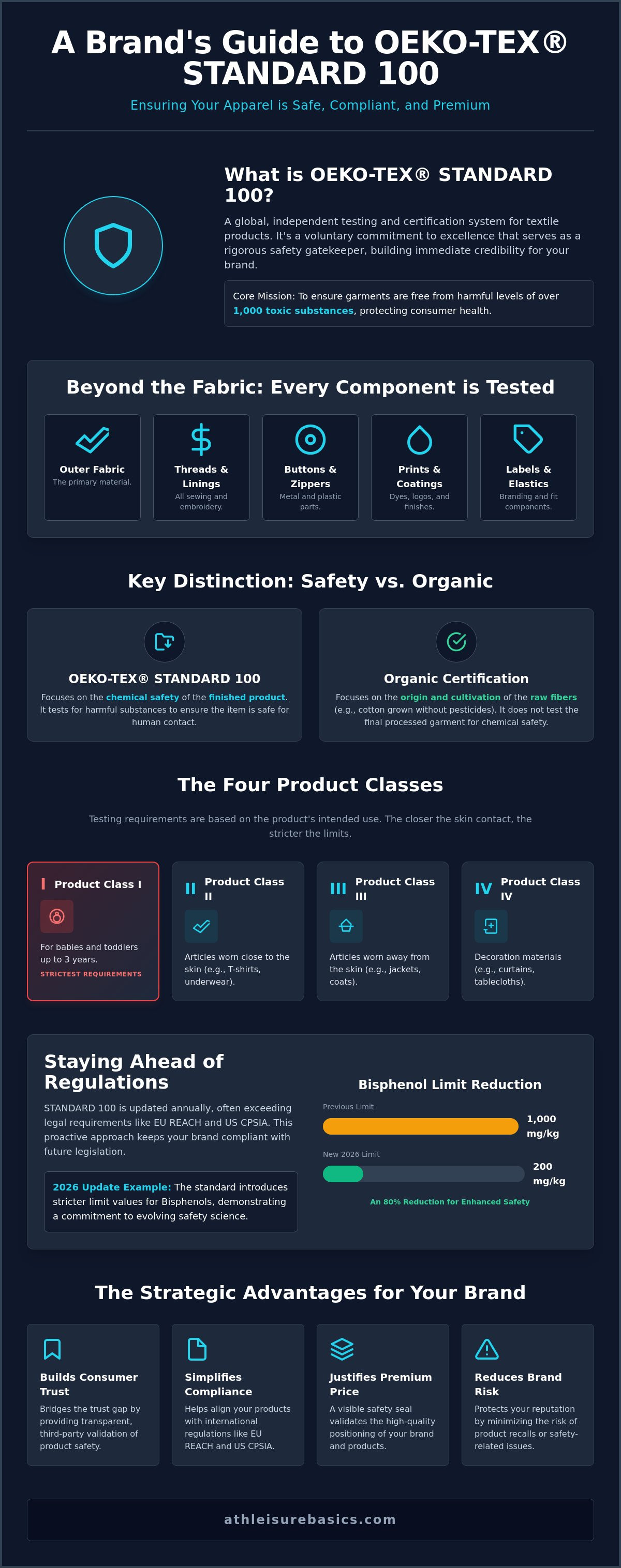
When entrepreneurs ask what is OEKO-TEX standard 100, they're often looking for a way to validate the quality of their products in a crowded market. At its core, this is a global, independent testing and certification system for textile products. It serves as a rigorous safety gatekeeper, ensuring that the garments your customers wear are free from harmful levels of toxic substances. Unlike mandatory government regulations that sets a minimum bar, this standard is a voluntary commitment to excellence that builds immediate credibility for your brand.
The integrity of the label is maintained by independent testing institutes within the International Oeko-Tex Association. You can find more about the organization's history and its global impact through the Oeko-Tex Wikipedia page. These institutes test products against a list of over 1,000 harmful substances, updating their criteria annually to reflect the latest scientific findings and legal changes.
One of the most significant advantages for a clothing brand is the standard’s comprehensive nature. It doesn't just test the outer fabric; it examines every single component of the garment. This includes:
- Sewing threads and linings.
- Buttons, zippers, and rivets.
- Prints, coatings, and appliqués.
- Elastic bands and labels.
It's vital to distinguish this safety label from an "organic" certification. While organic standards focus on the origin and cultivation of the fibers, OEKO-TEX Standard 100 focuses on the safety of the finished product. As of April 1, 2025, the association moved organic claims to a separate standard, meaning Standard 100 is now purely dedicated to chemical safety rather than fiber origin.
The Scope of Testing
The testing process is exhaustive, covering regulated substances like azo dyes, formaldehyde, and phthalates, as well as non-regulated chemicals that are harmful to health but not yet restricted by law. In 2026, the standard introduced even stricter limit values for Bisphenols, reducing the threshold from 1,000 mg/kg to 200 mg/kg. OEKO-TEX Standard 100 is a voluntary safety seal that exceeds REACH compliance by testing for a wider range of substances at stricter limit values. This proactive approach ensures your brand stays ahead of future legislation.
Why Safety Matters in 2026
Modern consumers are more educated about skin health and chemical sensitivities than ever before. They don't just want a beautiful design; they want the peace of mind that their clothing won't cause adverse reactions. Clean fashion has shifted from a niche trend to a standard expectation for premium labels. Understanding what is a textile in the context of safety allows you to make informed sourcing decisions that protect both your customers and your brand's reputation. By prioritizing certified materials, you position your startup as a principled, quality-conscious leader in the industry.
The Four Product Classes: Which One Does Your Brand Need?
Determining which level of testing your brand requires is a critical step in the manufacturing process. The OEKO-TEX system categorizes textile products into four distinct classes based on their intended use and the intensity of skin contact. The logic is straightforward: the more sensitive the skin and the more prolonged the contact, the stricter the human-ecological requirements become. This tiered approach ensures that a baby’s romper undergoes more rigorous screening than a decorative curtain or a leather belt.
These classifications are part of a broader effort to promote responsible consumption and safer supply chains, as seen in the collaboration between OEKO-TEX and the UN Sustainable Development Goals. By aligning your brand with these classes, you're participating in a global movement toward material transparency.
The four classes are defined as:
- Product Class I: Articles for babies and toddlers up to 3 years old. This is the strictest level, accounting for infants’ sensitive skin and their tendency to place textiles in their mouths.
- Product Class II: Articles worn close to the skin. This includes items like underwear, t-shirts, and bed linen.
- Product Class III: Articles worn away from the skin. This covers outerwear like jackets and coats, as well as accessories like belts.
- Product Class IV: Furnishing materials. This class applies to tablecloths, curtains, and upholstery fabrics.
Focus on Product Class II: Essential for Athleisure
For most emerging brands, Product Class II is the standard you'll target. Since leggings, sports bras, and performance tops are designed for high-intensity use, they must maintain a skin-friendly pH value and demonstrate exceptional sweat-fastness. If a fabric bleeds dye when a customer sweats, it's a sign of poor quality and a potential health risk. Meeting Class II standards protects your brand from customer complaints and costly returns caused by skin irritation. If you need help navigating these requirements, consulting with a production expert can clarify your sourcing strategy.
Verifying Your Components
When you evaluate what is OEKO-TEX standard 100 certification for your collection, remember the modular system logic. A finished garment is only as safe as its least-certified component. This means you must verify that not only the primary fabric but also the zippers, elastics, sewing threads, and linings meet the required product class. If every individual part is already certified, the process of certifying the final garment becomes significantly faster and more cost-effective. This end-to-end transparency is what separates premium labels from fast-fashion competitors.
The Business Value: Why Startups Should Prioritize Certification
For a new brand, the initial investment in certified materials can seem daunting. However, understanding what is OEKO-TEX standard 100 from a business perspective reveals that it's a strategic insurance policy rather than just an added cost. Certification significantly mitigates the risk of expensive product recalls and legal liabilities. By ensuring your products are tested for harmful substances, you protect your business from the catastrophic financial and reputational damage that follows a safety failure.
Beyond risk management, the standard simplifies global market entry. Regulations like EU REACH and the US CPSIA are complex and strictly enforced. Because the OEKO-TEX® STANDARD 100 criteria often exceed these national requirements, having the label provides an immediate pathway to compliance. This allows you to scale into international markets with confidence, knowing your inventory won't be seized or flagged for chemical non-compliance at customs.
- Risk Mitigation: Protects against legal claims related to skin irritation or toxic exposure.
- Market Agility: Eases the transition into European and North American retail spaces.
- Supplier Vetting: Provides a clear, verifiable benchmark when selecting international manufacturing partners.
- Operational Efficiency: Reduces the need for your brand to conduct redundant, independent lab tests on every batch.
Building a Premium Brand Identity
In a market saturated with fast fashion, certification justifies a higher price point. Modern shoppers look for the "green label" as a shorthand for quality and safety. By positioning your brand as health-conscious and responsible from day one, you build a loyal customer base that values transparency. This psychological trust-building is a powerful marketing tool that transforms a simple garment into a premium, principled product. When consumers ask what is OEKO-TEX standard 100, your brand can confidently answer with a promise of safety and high-end craftsmanship.
Simplifying the Manufacturing Process
Choosing certified suppliers streamlines the entire garment production process. When you work with factories that already hold valid certificates, you eliminate the guesswork and technical friction involved in material sourcing. This proactive approach offers a far better long-term ROI than chasing the cheapest uncertified materials. Starting in June 2026, updated regulations require that all wet processes in the supply chain be certified for renewals, making it even more important to partner with transparent, high-standard manufacturers today.
Sourcing OEKO-TEX Certified Apparel in Portugal
Portugal has established itself as a global leader in high-end textile manufacturing, specifically for brands that prioritize chemical safety. When you investigate what is OEKO-TEX standard 100 in the context of European production, you find that many Portuguese factories already operate at this level by default. The country’s long-standing tradition of craftsmanship combined with modern, high-tech facilities makes it a reliable hub for emerging labels that refuse to compromise on quality.
One practical step for any brand owner is verifying a supplier’s claims. You should always ask for a certificate number and enter it into the OEKO-TEX Label Check portal. This ensures the certificate is valid and covers the specific product class your brand requires. Reliable manufacturers in this region are transparent about their certifications because they understand that your brand's reputation depends on their compliance. For renewals starting in June 2026, remember that the association will require certificates to be issued by your direct supplier, adding another layer of necessary transparency to your partnership.
The "Made in Portugal" Advantage
Choosing clothing manufacturers in Portugal provides a significant competitive edge for premium startups. Because Portugal is part of the EU, its factories must already adhere to strict environmental and labor laws that naturally align with OEKO-TEX requirements. This synergy simplifies the audit process and provides a sense of security for UK and US brands. You aren't just buying a safe fabric; you're investing in an ethical supply chain that values both human health and environmental integrity. Logistically, sourcing within Europe also offers faster lead times and easier communication compared to distant global manufacturing hubs.
White Label vs. Custom Certified Production
For startups looking for a faster market entry, private label Portugal solutions offer an efficient path. These solutions typically use pre-certified luxury blanks, allowing you to launch a collection without the lead times of custom fabric development. If your brand requires unique athleisure designs, you can source custom OEKO-TEX fabrics tailored to your specific performance needs. In this case, ensure your tech pack explicitly specifies the required product class, such as Class II for direct-to-skin contact. Understanding what is OEKO-TEX standard 100 helps you navigate these technical conversations with your factory to ensure every component meets your standards.
Working with a partner that understands these technical nuances is essential for scaling a new business. If you're ready to build your brand with certified quality, get in touch for materials sourcing support to find the right manufacturing path for your collection.
Partner with Athleisurebasics for Certified Quality
Understanding what is OEKO-TEX standard 100 is a vital first step, but successfully implementing these standards requires a manufacturing partner that shares your commitment to excellence. At Athleisurebasics, we don't just view certification as a checkbox. It's a foundational element of our production philosophy. We use premium, certified fabrics in all our production runs to ensure that every garment leaving our facility meets the highest global safety benchmarks.
For emerging brands, the barrier to entry for high-end manufacturing often involves high minimum order quantities. We've removed this obstacle by offering low MOQs, starting at just 70 pieces for our white label clothing. This allows you to launch a professional, certified collection without the financial strain of massive inventory overhead. Whether you're utilizing our custom clothing manufacturing or our luxury blanks, you receive the same level of material integrity found in established global brands.
Our Production Standards
Our facility in Portugal operates under the strictest European standards for safety and ethical labor. We maintain total transparency in our sourcing, tracking materials from the initial yarn stage to the finished garment. Because we specialize in athleisure, we focus heavily on the intersection of performance and safety. Fabrics must not only withstand intense activity but also remain safe for prolonged skin contact. Athleisurebasics is a partner that bridges the gap between premium design and industrial safety.
We also provide specialized clothing production consulting services to guide you through the complexities of the industry. If you're unsure about specific certification requirements or need materials sourcing support, our team offers the technical expertise to simplify your decision making. We help you select the right fabrics and ensure your tech pack development aligns with the necessary product classes for your specific niche.
Launch Your Brand with Confidence
Transitioning from a concept to a market ready product is a significant milestone for any entrepreneur. By choosing a partner that prioritizes what is OEKO-TEX standard 100 compliance, you're investing in the long-term viability of your business. Our white label solutions and luxury blanks are ideal for brands that need immediate, certified inventory to meet market demand quickly. For those with a more specific vision, our full CMT production services allow for complete creative control without sacrificing safety standards.
We invite you to take the next step in your brand’s lifecycle by requesting a custom manufacturing quote. Our team is ready to help you navigate the production landscape with clarity and confidence. Contact Athleisurebasics today to start your certified production journey and see how our Portuguese craftsmanship can elevate your brand.
Build Your Brand on a Foundation of Safety
Ready to elevate your collection? Start Your Premium Production with OEKO-TEX Certified Fabrics through our specialized Portuguese facility. We are specialists in certified athleisure. We support emerging labels with low MOQs starting at just 70 pieces. This accessibility ensures that high-end manufacturing remains within reach as you scale. It's the most efficient way to transition from a concept to a finished, market-ready product without the typical barriers to entry.
Your journey from a small idea to a recognized commercial presence depends on these principled choices. We are here to act as your dedicated ally. We provide the security and capability you need to succeed in the global market. Let's build something exceptional together.
Frequently Asked Questions
Is OEKO-TEX Standard 100 the same as organic?
No, these certifications focus on different aspects of production. Organic standards, such as GOTS, regulate the origin and cultivation of fibers without synthetic pesticides. In contrast, what is OEKO-TEX standard 100 focuses purely on the chemical safety of the finished product. As of April 1, 2025, organic claims are no longer part of this specific standard and are handled under the separate OEKO-TEX ORGANIC COTTON label.
Does a brand need its own OEKO-TEX certificate if the factory has one?
You don't strictly need your own certificate to market your products as safe, but you do need one to use your brand name on the official label. If you rely on your factory’s certificate, you must use their name or license number. For startups, referencing a supplier's valid certificate is a common way to build trust while scaling toward your own independent brand certification.
How much does OEKO-TEX certification cost for a small brand?
The total investment depends on the complexity of your garments and the number of components requiring laboratory testing. Generally, the cost includes an annual basic fee, an audit fee for the manufacturing facility, and individual testing costs for every button, thread, and fabric type. Working with pre-certified materials from a reputable partner can significantly reduce these technical expenses for emerging businesses.
What is the difference between OEKO-TEX Standard 100 and Made in Green?
Standard 100 is a product-specific safety seal that ensures a garment is free from harmful levels of toxic substances. Made in Green is a more comprehensive traceable label. It requires the product to meet Standard 100 safety levels while also ensuring the manufacturing facilities follow STeP standards for environmentally friendly production and socially responsible working conditions. It essentially combines chemical safety with ethical manufacturing proof.
Can I use the OEKO-TEX logo on my clothing tags?
Yes, you can use the logo if you hold a valid certificate or have explicit permission from your certified supplier. To remain compliant, the label must include the specific certificate number and the name of the testing institute. This transparency allows consumers to verify the claim. Using the logo without a valid, verifiable certificate number can lead to legal complications and damage your brand's reputation.
Is OEKO-TEX Standard 100 mandatory for selling clothes in the EU?
Certification is a voluntary choice, not a legal requirement for market entry. However, it serves as a powerful tool for demonstrating compliance with mandatory EU regulations like REACH. Many retailers and distributors prioritize certified brands because it simplifies their own risk management. Understanding what is OEKO-TEX standard 100 helps you decide if this voluntary seal aligns with your brand's premium positioning and target audience expectations.
How long is an OEKO-TEX certificate valid?
A certificate is valid for exactly 12 months. You must renew it annually to ensure your products continue to meet the association’s updated chemical limit values and testing criteria. This annual cycle maintains the standard's integrity. For renewals after June 2026, keep in mind that all wet processes in your supply chain must be certified, and certificates must be issued by your direct supplier.
What happens if a supplier provides a fake OEKO-TEX certificate?
Using a fake certificate exposes your brand to significant legal liability, potential product recalls, and a total loss of consumer trust. If customs or regulatory bodies discover non-compliant chemicals in your inventory, you are responsible for the consequences. Always verify every certificate number on the official OEKO-TEX Label Check portal. Partnering with transparent manufacturers in high-standard regions like Portugal helps mitigate this risk through verifiable documentation.



Leave a comment
This site is protected by hCaptcha and the hCaptcha Privacy Policy and Terms of Service apply.