
How to Create a Clothing Tech Pack: The 2026 Guide for Emerging Brands
A tech pack is not just a drawing; it is a legally binding contract of quality that protects your brand and empowers your manufacturer. You've likely felt the anxiety of sending a creative sketch to a factory, only to worry that the final sample won't match your vision. It's common to feel overwhelmed by industry terminology like BOM or grade rules, especially when communication barriers with overseas partners put your investment at risk. Learning how to create a clothing tech pack is the most effective way to replace that uncertainty with professional confidence.
This 2026 guide will help you master the art of garment blueprints. You'll ensure your designs are manufactured with precision, quality, and zero costly misunderstandings. We'll walk through the essential steps to build a factory-ready document, including updated standards like the EU Digital Product Passport data becoming mandatory for textiles. By the end, you will have the tools to secure accurate production quotes and establish a reliable, long-term relationship with your manufacturing partners.
Key Takeaways
- Define the role of a tech pack as your primary instructional document to ensure every design detail is executed with industrial precision.
- Master the professional process of how to create a clothing tech pack by building essential components like technical sketches and a comprehensive Bill of Materials.
- Gain insights into performance-specific requirements for athleisure, such as managing four-way stretch properties and skin-contact comfort through specialized stitching.
- Learn how professional documentation facilitates successful partnerships with ethical manufacturers in Portugal and helps you access flexible production volumes.
- Prepare your brand for 2026 industry standards by understanding the documentation necessary for accurate production quotes and regulatory compliance.
Understanding the Clothing Tech Pack: Your Garment Blueprint
A clothing tech pack is the primary instructional document that translates your creative vision into a tangible product. It functions as a master blueprint, providing every specification a manufacturer needs to produce your garment correctly. In the garment production process, this document serves as the bridge between your initial concept and the final shipment. Learning how to create a clothing tech pack is the most critical step you can take to protect your investment. It acts as an insurance policy, clearly defining your expectations so that factories have no room for interpretation. When your instructions are precise, you eliminate the costly misunderstandings that lead to discarded samples and wasted fabric.
Beyond risk mitigation, a professional tech pack significantly accelerates the quoting and sampling phases. Manufacturers can provide accurate pricing only when they understand the complexity of the construction, the specific materials required, and the finishing details. Without this document, factories often pad their quotes to account for unknown variables. A clear, technical layout demonstrates that your brand is prepared for a professional partnership. This is particularly important when approaching high-end facilities in regions like Portugal, where manufacturers prioritize efficiency and high craftsmanship standards.
The Difference Between a Sketch and a Tech Pack
Many new designers confuse an artistic fashion illustration with a technical document. While a sketch conveys mood and silhouette, it lacks the data required for manufacturing. Pretty drawings often lead to production nightmares because they don't specify seam types, stitch counts, or exact component placements. Transitioning from artistic vision to technical execution requires a shift in mindset. You must move from what the garment looks like to how it is built. This level of detail is a core component of technical design, a field explored in Wikipedia on Advanced Fashion Technology, which emphasizes the necessity of precise specifications in modern apparel manufacturing. Technical clarity builds immediate trust with premium factories, showing them you value their time and expertise.
Why Emerging Brands Cannot Skip This Step
For a startup, every dollar counts. Reducing the number of sample iterations is the fastest way to save your budget. Each time a factory has to redo a sample because of a missing detail, you lose weeks of time and hundreds of dollars in shipping and labor. Consistency is another major benefit. A well-structured pack ensures that your production runs remain uniform across different sizes and future reorders. When you understand how to create a clothing tech pack, you establish a professional standard that commands respect from manufacturers. It signals that your brand is ready to scale from a small idea to a lasting commercial presence. By providing a factory-ready document, you remove the barriers to entry that often hinder small-scale ventures.
The Anatomy of a Professional Tech Pack: 6 Essential Components
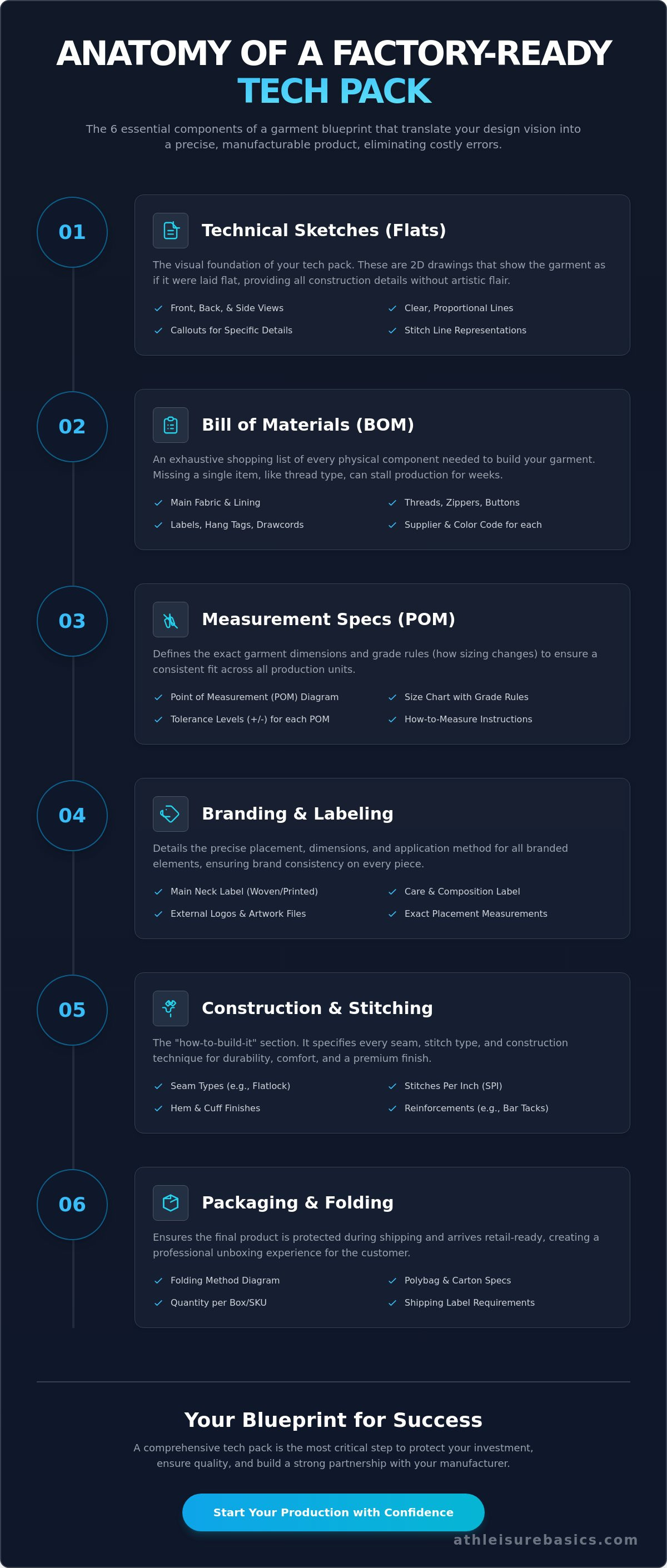
A complete tech pack is a modular document where each section serves a distinct purpose for the factory floor. While the complexity of your garment dictates the total number of pages, every professional document must include several core components to be considered factory-ready. These elements include technical sketches (flats) showing front, back, and side views; a comprehensive Bill of Materials (BOM); and measurement specification sheets with Point of Measurement (POM) codes. You must also detail branding and labeling requirements, including precise placement and dimensions, alongside stitching and construction details like seam types and stitch density. Finally, include packaging instructions to ensure your product arrives retail-ready. Learning how to create a clothing tech pack involves organizing these modules so that a pattern maker or seamstress can follow them without asking for clarification.
Mastering the Bill of Materials (BOM)
The BOM is the exhaustive list of every physical component required to build your garment. When you learn how to create a clothing tech pack, you realize that leaving out a single thread type can stall production for weeks. High-end manufacturers, particularly those in Portugal, expect you to specify OEKO-TEX® certified textiles to meet European safety and environmental standards. You must also include every trim, zipper, and specialized thread for durability. Always specify your colorways using industry-standard Pantone codes. This ensures the factory matches your vision exactly, regardless of their local lighting conditions or screen settings. For brands looking to scale, our team provides expert tech pack development as part of our comprehensive consulting services.
Technical Sketches and Callouts
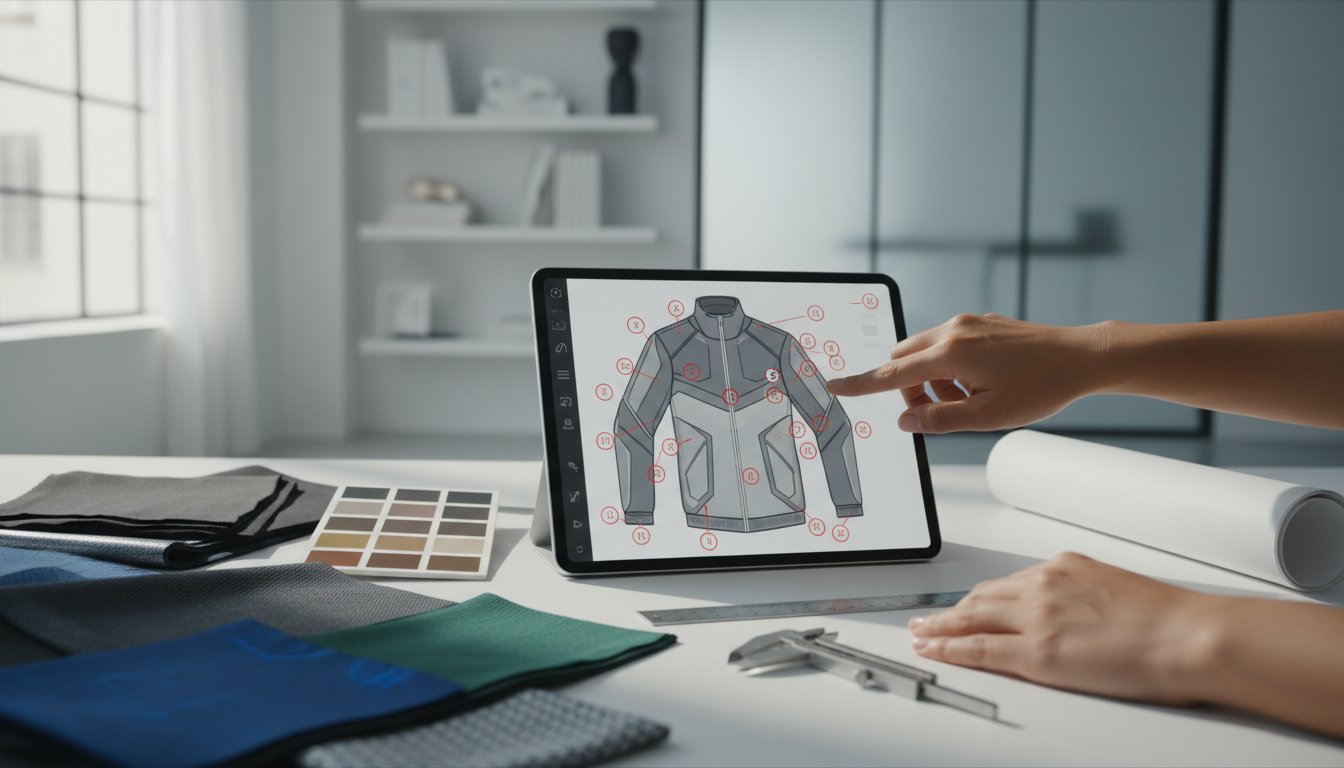
Unlike fashion illustrations, technical sketches are two-dimensional representations that focus entirely on construction. These drawings must be clear and proportional, showing the garment as it would lie flat on a table. According to SCAD on the Value of Tech Packs, high-quality technical documentation is the most effective way to minimize errors during the sampling phase. Use callouts to highlight hidden features like internal pockets, reinforced seams, or specific zipper placements. For complex items, include an "inside-out" view so the manufacturer understands the internal finishing requirements. This level of detail is a hallmark of premium brands and builds immediate respect with your production partners.
Measurements and Grade Rules
The measurement sheet is the most technical part of the pack. You start by defining a "Sample Size," which acts as the anchor for all other measurements. From there, you establish grade rules to explain how the garment grows or shrinks across your size range. It is also vital to set "Tolerance" levels. Tolerance defines the acceptable margin of error, usually between 0.5cm and 1cm, for each measurement. This protects your brand from receiving a batch of inconsistent garments while giving the factory a realistic operational framework. Clear tolerances ensure that your quality control team has a objective standard to follow during final inspections.
Step-by-Step: How to Create a Clothing Tech Pack from Scratch
Developing a commercial garment begins long before you open a design program. The process is divided into logical phases to ensure no technical detail is overlooked. First, conduct market research and competitive benchmarking. This involves analyzing the fit and construction of similar products to establish your brand's unique standards. Once your direction is clear, move into phase two: developing the initial design and technical flat sketches. These drawings must be accurate, black-and-white vector files that show every seam and stitch line. For a deeper dive into the technical hierarchy of these documents, refer to this comprehensive tech pack guide from WFX.
The third phase involves building the Bill of Materials (BOM) with specific fabric and hardware details. This list is your inventory for production; it tells the factory exactly what to source or use. In phase four, you'll create the measurement spec sheet for your base size, defining the primary dimensions the factory must hit. Finally, perform a comprehensive review of the entire document before factory submission. Understanding how to create a clothing tech pack in this structured way prevents the "back-and-forth" emails that often delay production starts by weeks.
Tools of the Trade: Software vs. Templates
Adobe Illustrator remains the industry standard for creating vector flats because of its precision and ability to handle complex callouts. However, many startup brands begin with Excel-based templates to manage their data and measurement sheets. While templates are accessible, they lack the dynamic scaling of professional software. If you're a founder with a strong vision but limited technical skills, hiring a professional technical designer is a wise investment. They ensure your document speaks the factory's language from day one. For those who want to maintain control while learning how to create a clothing tech pack, starting with a high-quality template and migrating to vector software as you scale is a pragmatic path.
Sourcing Support and Material Selection
Accurate material descriptions are vital for receiving a correct quote. You must specify fabric weight in grams per square meter (GSM) and provide a clear fiber composition, such as 95% Organic Cotton and 5% Elastane. Leveraging factory materials sourcing support can help you find textiles that align with your brand's sustainability goals while meeting technical requirements. In Portugal, factories often provide access to premium, ethical fabrics that already meet EU environmental certifications. This collaborative approach ensures your chosen materials are not only beautiful but also suitable for the specific construction methods detailed in your tech pack.
Athleisure-Specific Tech Packs: Handling Stretch and Performance
Athleisure garments demand a higher level of technical specification than standard streetwear. Because these pieces are designed for high-intensity movement, your documentation must account for fabric elasticity and physical recovery. When learning how to create a clothing tech pack for performance wear, you must specify four-way stretch properties. This ensures the fabric expands in all directions without losing its original shape. You should also define specific compression levels for items like leggings and sports bras. With trends like V-front pants seeing a 44% increase in market adoption in 2026, your tech pack must detail how these unique waistlines maintain their structure during exercise.
Performance callouts are another essential layer of a professional athleisure blueprint. You must clearly identify requirements for moisture-wicking and anti-bacterial finishes. These treatments are vital for managing perspiration and odor in high-performance environments. The global athleisure market is projected to reach a value of $1018.1 billion in 2026, and meeting these technical standards is what separates professional brands from hobbyists. Including these specifications at the start of your journey ensures your production quotes are accurate and your final product meets the premium standards expected by modern consumers.
Seam Construction for High-Movement Apparel
Standard seams often fail under the stress of athletic activity. To prevent tearing, your tech pack should specify reinforced stitching and flatlock seams. Flatlock stitching is particularly important for skin-contact comfort as it lies flat against the body to prevent chafing. You must also include callouts for ergonomic paneling and gussets. A gusset is a small triangular or diamond-shaped piece of fabric inserted into a seam to improve range of motion and reduce stress on the garment. Ensure you specify that the thread elasticity matches the main fabric stretch. If the thread is too rigid, the seams will snap when the garment is pulled during a workout.
Performance Hardware and Branding
Branding in activewear requires a functional approach. Most premium brands now use heat-transfer labels instead of woven tags to provide a "tagless" experience and eliminate skin irritation. If your designs are intended for outdoor use, specify reflective elements to enhance safety for runners and cyclists. Your hardware choices also matter. You must choose zippers and drawcords specifically designed to withstand high-intensity use and frequent washing. If you're ready to transition from a concept to a finished product, explore our clothing manufacturers in Portugal guide to see how we bring technical designs to life through ethical production.
From Tech Pack to Production: Partnering with a Portuguese Manufacturer
Portuguese manufacturers are world-renowned for their craftsmanship and ethical standards. When you approach clothing manufacturers in Portugal, presenting a professional document is the quickest way to establish credibility. These facilities value detailed tech packs because they eliminate the need for guesswork, allowing their teams to focus on high-quality execution. For an emerging brand, a clear document is often the deciding factor in qualifying for low minimum order quantities (MOQs). Factories are more likely to accept smaller runs, sometimes as low as 50 units, when they know the technical specifications are already finalized and production-ready.
The relationship between your tech pack and the first prototype is foundational. Your document serves as the objective standard for the initial sample. If the prototype deviates from your vision, the tech pack helps you identify whether the error occurred in your instructions or the factory's interpretation. Once production begins, the tech pack transitions into a Quality Control (QC) tool. Inspectors use your measurement tables and construction callouts to verify that the final production run matches the approved sample exactly. Mastering how to create a clothing tech pack ensures that your quality standards remain consistent from the first piece to the last.
Custom Manufacturing vs. White Labeling
The level of detail required in your documentation depends on your production path. For custom manufacturing, you must provide a full tech pack that covers every unique seam and measurement. However, if you choose private label production, the factory already owns the base technical specifications. In this scenario, you adapt a tech pack to focus on custom branding, specific colorways, and hardware selections. Choosing the right path depends on your budget and timeline. Custom manufacturing offers total creative control, while white labeling allows for a faster market entry with lower development costs.
Communicating with Your Production Partner
Professional manufacturing is a collaborative process. Experienced factories in Portugal will often suggest technical improvements to your tech pack to enhance durability or reduce waste. Transparency in your Bill of Materials (BOM) is particularly important for obtaining competitive pricing. When you specify every component clearly, the factory doesn't need to add a "risk margin" to their quote. Building a long-term partnership requires clear, technical communication that respects the factory's expertise. When you understand how to create a clothing tech pack that speaks the language of the factory floor, you move from being just a customer to becoming a valued production partner.
Building Your Brand on a Foundation of Technical Excellence
A professional tech pack is the ultimate tool for mitigating risk and ensuring your creative vision is executed with industrial precision. By mastering the anatomy of these documents, you move beyond simple sketches and provide your manufacturing partners with a clear, actionable roadmap. Understanding how to create a clothing tech pack is the definitive first step in scaling from a creative concept to a commercial reality. This process ensures your brand is prepared for the technical demands of high-performance apparel and the regulatory standards of the 2026 market.
Much like how a chef relies on precision instruments to achieve consistent results, you can learn more about Sole Cookware and see how functional tools empower creators in other fields to work with similar professional confidence.
Transitioning from design to production is a significant milestone for any emerging business. We specialize in helping startups navigate this journey through expert production consulting and high-end manufacturing in Portugal. Our services include materials sourcing support for OEKO-TEX® certified premium fabrics and flexible production with low MOQs starting at 70 pieces. Ready to turn your tech pack into reality? Contact Athleisurebasics for premium Portuguese manufacturing.
Frequently Asked Questions
Do I need a tech pack for every single item in my clothing line?
Yes, every unique style requires its own dedicated document to ensure production accuracy. Even a slight variation in construction, fabric weight, or hardware changes the technical requirements for the factory. Individual packs act as a master record for each garment, preventing confusion and ensuring that your quality standards are maintained across your entire collection.
Can I create a clothing tech pack without being a fashion designer?
Yes, you can certainly learn how to create a clothing tech pack using structured templates and specialized software. While professional technical designers offer deep industry expertise, many founders successfully build their first factory-ready documents by following detailed guides. The key is to focus on technical clarity and precise data rather than artistic illustration.
What is the most common mistake made in a first tech pack?
Vague descriptions are the most frequent error found in initial documentation. New brands often fail to specify the exact thread type, stitch density, or Pantone codes, which leaves too much room for factory interpretation. This lack of detail is the primary cause of incorrect samples and wasted development budgets during the early stages of production.
How much does it cost to have a professional create a tech pack for me?
Professional development costs vary significantly based on the complexity of the garment and the designer's experience level. Simple items like basic t-shirts generally require less time than complex outerwear or performance athleisure with ergonomic paneling. You should research current market rates for freelance technical designers to establish a realistic development budget for your specific product line.
Is a physical sample better than a tech pack for a manufacturer?
A tech pack is more important because it provides the mathematical data behind the garment. While a physical sample shows the finished result, the tech pack explains the specific construction methods, tolerances, and grade rules required to replicate it. Manufacturers need these written specifications to ensure consistency across every size and future production run.
What file format should I send my tech pack in to the factory?
A high-resolution PDF is the global industry standard for sharing these documents with manufacturers. This format ensures that your technical sketches, measurement tables, and callouts remain fixed and legible on any device. It is also beneficial to keep your original vector files in a format like Adobe Illustrator for internal revisions and future updates.
How do I handle revisions to my tech pack after the first sample?
Revisions must be documented in a version history log within the original file to maintain a clear audit trail. When you receive a sample that requires adjustments, update the specific measurements or callouts and save the document with a new version number. This organized approach prevents the factory from accidentally using outdated specifications during the final production phase.
What is a POM in a tech pack and why does it matter?
POM stands for Point of Measurement. It defines the exact location on a garment where a measurement is taken, such as the "high point shoulder" or "across chest." Establishing clear POM codes is vital for fit consistency. It ensures the factory's quality control team measures the garment exactly the same way you do, eliminating discrepancies between your expectations and the finished product.



Leave a comment
This site is protected by hCaptcha and the hCaptcha Privacy Policy and Terms of Service apply.