

How to Scale a Small Clothing Business: The 2026 Growth Blueprint
What if the biggest barrier to your brand's growth isn't your marketing budget, but the hidden inefficiencies in your current production line? You've likely hit that frustrating plateau where high per-unit costs eat your margins and inconsistent supplier quality threatens your reputation. It's a common hurdle for founders who are ready to move past small batches but feel stuck in the "craft project" phase. Learning how to scale a small clothing business in 2026 requires more than just better ads; it demands a professionalized supply chain that can handle global demand while managing rising costs.
This blueprint provides the exact operational and financial shifts you need to transition from a startup project to a globally recognized brand. We'll explore how to lower production costs and ensure predictable supply chains, even as new regulations like the California Responsible Textile Recovery Act and PFAS bans change the industry landscape. You'll gain a clear understanding of the manufacturing transitions and tech pack developments required to secure your place in the $783 billion global apparel market. Let's look at how to build a production system that supports your long-term vision.
Key Takeaways
- Identify the "Marginal Trap" by analyzing sell-through rates to determine exactly when demand outpaces your current production capacity.
- Transition from basic print-on-demand models to professional custom manufacturing by leveraging low minimum order quantities that protect your initial capital.
- Increase profit margins by shifting toward premium product categories and consolidating fabric choices to maximize your bulk purchasing power.
- Discover how to scale a small clothing business by moving beyond organic social media toward a data-driven strategy centered on paid media and conversion optimization.
- Learn why selecting a factory partner that offers production consulting and ethical regional craftsmanship provides a significant competitive advantage for 2026 growth.
Identifying the "Scaling Point" in Your Clothing Brand
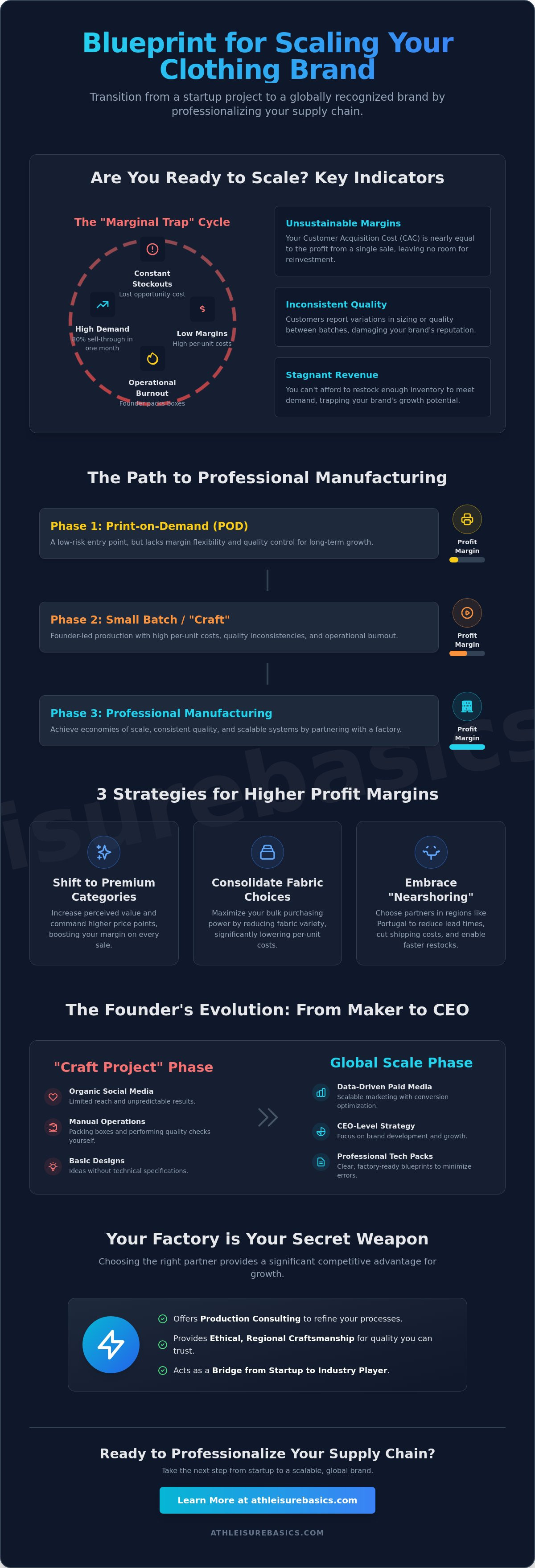
Many founders struggle to identify the exact moment when a passion project needs to become a professional enterprise. If your bestsellers are constantly out of stock or your profit margins disappear after paying for basic social media ads, you've reached the scaling point. Understanding how to scale a small clothing business starts with a cold, hard look at your sell-through rates. If you're selling 80% of your inventory within the first month but can't afford to restock twice as much, you're caught in a cycle that limits your potential. Stagnation isn't just about lack of sales; it's often about the inability to meet the demand you've already created.
This phase is frequently defined by the "Marginal Trap." Small batch production usually carries high per-unit costs that leave little room for reinvestment in the brand. A deep understanding economies of scale is essential here. As you increase your production volume, your costs should drop significantly, freeing up the capital you need for marketing and team expansion. Without this shift, you're simply trading your time for stagnant revenue. You must also evaluate customer feedback. If buyers report inconsistent sizing or quality across different small batches, your current suppliers aren't ready for your growth.
Revenue vs. Demand: The Data of Scaling
Data provides the most objective signal for scaling. Calculate your "Lost Opportunity Cost" by looking at how much revenue you miss during frequent stockouts. If your Customer Acquisition Cost (CAC) is nearly equal to the profit from a single sale, your current margins are unsustainable. Many startups begin with Print-on-Demand (POD) because it's low risk, but this model rarely supports the 2026 growth targets required for a global brand. Transitioning to an inventory-based model with professional manufacturing is the only way to secure the margins necessary for a healthy Lifetime Value (LTV) ratio.
Operational Bottlenecks: From Founder to CEO
Your time is your most valuable asset. If you spend most of your day packing boxes or performing manual quality checks, you aren't acting as a CEO. Operational burnout is a clear indicator that your current systems are failing. Scaling requires a shift toward a professional garment production process. This means moving away from the "making clothes" mindset and toward managing a structured supply chain. By outsourcing production to a reliable partner, you reclaim the time needed to focus on high-level strategy and long-term brand development.
Transitioning from Small Batch to Professional Manufacturing
Transitioning from small batch production to professional manufacturing is often the most daunting phase for emerging brands. While Print-on-Demand (POD) serves as a useful entry point, it lacks the margin flexibility and quality control necessary for long-term growth. To truly understand how to scale a small clothing business, you must move toward White Label and Custom Manufacturing models. This shift allows you to own your inventory and improve your brand's perceived value. Utilizing strategic scaling tactics ensures that you don't just grow fast, but grow sustainably by managing these new operational complexities.
Success in 2026 is largely driven by "nearshoring." By choosing manufacturing partners closer to your primary markets, such as Portugal for the European and US markets, you reduce lead-time risks and shipping costs. This proximity allows for faster restocks, which is critical for maintaining momentum. Before you approach a factory, professionalize your designs through Tech Pack development. These technical blueprints ensure that your factory-ready specifications are clear, minimizing costly errors during the sampling phase. If you're ready to professionalize your supply chain, exploring custom clothing manufacturing can provide the bridge you need from startup to industry player.
Many brands fail because they hit a "Manufacturing Bottleneck." They generate demand through marketing but lack the physical infrastructure to produce enough quality stock. Professional manufacturing solves this by providing a scalable production system. Instead of searching for the lowest possible price on global marketplaces, focus on the quality-to-cost ratio. A slightly higher investment in a reliable partner prevents the catastrophic costs of defective batches or missed delivery windows during peak seasons.
The MOQ Strategy: Scaling Without the Risk
Scaling doesn't require ordering thousands of units upfront. You can validate new colors or silhouettes using 70-piece White Label runs. Once a style is proven, you can graduate to 250-piece Custom Manufacturing for unique designs that define your brand's identity. This balanced approach maximizes cash flow while ensuring you have enough inventory depth to satisfy demand without overextending your capital.
Quality Control at Scale
Maintaining quality is harder as volumes increase. Moving to a professional factory ensures consistent made in portugal clothing standards that low-cost hubs often fail to meet. Implement a rigorous sampling phase, including proto-samples and size sets, before committing to bulk production. Additionally, prioritizing ethical compliance through certifications like OEKO-TEX® builds the trust that modern 2026 consumers demand.
Optimizing Your Product Line for Higher Margins
Scaling isn't just about moving more units; it's about ensuring each sale generates a sustainable profit. Many founders get trapped in a high-volume, low-margin cycle by selling commodity items like basic cotton tees. To truly master how to scale a small clothing business, you must pivot toward premium categories, such as technical athleisure, where consumers expect and justify higher price points. This shift allows you to absorb the rising costs of ethical production and global shipping while maintaining a healthy bottom line. High-end craftsmanship and superior materials are the foundation of a brand that survives the transition from startup to industry staple.
Efficiency at scale also requires you to simplify your operations. Consolidating your fabric choices across multiple styles allows you to leverage bulk purchasing power, even if you're still working with relatively low MOQs for individual designs. Audit your textile choices to ensure they meet the durability standards of a growing brand. Reducing SKU complexity by focusing on high-performing "Core Collections" prevents the capital-draining trap of constant new drops that leave you with unsold deadstock. Focus on what sells and refine it until it's perfect.
Custom Designs vs. Luxury Blanks
Determining when to invest in entirely unique patterns versus customizing pre-existing styles is a critical financial decision. Luxury blanks provide an efficient way to launch "Limited Edition" lines or test new market segments with minimal development time. These high-quality blanks allow you to maintain premium standards without the long lead times of custom pattern development. While custom hardware like branded zippers and labels adds to your per-unit cost, the return on investment in brand recognition and perceived luxury often justifies the expense for your top-tier collections.
Strategic Fabric Sourcing
Utilizing factory-led sourcing support is a powerful way to access technical fabrics that differentiate your brand from competitors. The specific weight and composition of your materials directly impact customer satisfaction and return rates. In 2026, prioritizing sustainable and eco-conscious materials is a commercial necessity. Consumers increasingly demand transparency regarding material origins. Using certified sustainable fabrics helps you meet these expectations while building the principled brand identity required for long-term loyalty in a crowded market.
Building a Scaling-First Marketing and Sales Strategy
Scaling your brand requires a shift from reactive posting to a predictive sales engine. While organic social media builds a loyal foundation, it doesn't provide the consistent traffic required to sustain professional production volumes. In 2026, most small to mid-size brands spend between $1,500 and $5,000 monthly on social media marketing to maintain visibility. To understand how to scale a small clothing business, you must diversify your reach through a combination of paid media, strategic influencer partnerships, and a high-converting e-commerce platform. Your website must be optimized for conversion (CRO) to ensure that increased traffic results in revenue rather than wasted ad spend.
Implementing a pre-order model is a pragmatic way to fund larger production runs and gauge market interest before committing capital to inventory. This strategy reduces the risk of overstocking and aligns your cash flow with your manufacturing cycle. Additionally, transitioning from a pure Direct-to-Consumer (DTC) model to include boutique partnerships and wholesale opportunities provides a secondary revenue stream. These B2B channels stabilize your brand during seasonal fluctuations and increase your market presence without increasing your individual customer acquisition costs.
To prepare your digital storefront for increased volume, focus on these essential CRO elements:
- Streamline the checkout process to minimize cart abandonment.
- Use high-resolution zoom and 360-degree product views to reduce return rates.
- Incorporate social proof and verified customer reviews to build trust with new visitors.
Beyond Organic Social Media
A structured influencer seeding program is essential for building long-term brand equity. This involves sending your garments to creators whose audience aligns with your target demographic, creating a steady stream of authentic content. High-quality editorial photography is no longer optional; your visuals must reflect the premium craftsmanship of your manufacturing partners. Once you've acquired a customer, use email marketing and SMS to drive retention. These channels often provide a higher return on investment than acquisition, especially with Meta CPMs averaging $11.20 in 2026. Consistent, value-driven communication keeps your brand top-of-mind for repeat purchases.
Expanding Sales Channels
Setting up dedicated wholesale portals allows small boutiques to order your line efficiently, providing you with larger, more predictable orders. You should also evaluate third-party marketplaces like Wolf & Badger or Faire to reach global audiences without the overhead of individual customer acquisition. As you grow, ensure your logistics and fulfillment systems are prepared for the complexities of international shipping and regional tax compliance. If you need help structuring your production for these new channels, our clothing production consulting services can help you design a supply chain that supports a multi-channel sales strategy.
Partnering for Growth: Why Your Factory is Your Secret Weapon
Your choice of manufacturer determines the ceiling of your brand's potential. While many competitors treat factories as faceless vendors, a strategic partnership is what separates a hobbyist from a market leader. When you're determining how to scale a small clothing business, you need a collaborator that provides detailed production consulting rather than just simple sewing services. This proactive approach identifies technical issues in your tech packs or material choices before they become expensive mistakes on the factory floor. Transparent communication and direct access to production managers ensure your vision remains intact as your volumes grow from small batches to thousands of units.
A reliable factory partner acts as an extension of your team, offering the stability required to navigate a volatile global market. By 2026, the ability to pivot quickly based on real-time sell-through data is a massive competitive advantage. A partner invested in your success will help you optimize your supply chain, suggesting ways to consolidate materials or refine construction methods to improve your margins. This collaborative relationship mitigates the perceived risks of scaling and allows you to focus on high-level brand strategy while the technical complexities are handled by industry experts.
The "Made in Portugal" Advantage
Leveraging the "Made in Portugal" label serves as a powerful differentiator in a crowded apparel market. EU manufacturing offers significant logistical advantages, including reduced shipping costs and a smaller carbon footprint compared to long-haul global hubs. Portuguese factories are world-renowned for their high-end athleisure technical expertise and superior craftsmanship. Positioning your brand as "Ethically Made" allows you to command premium prices, as consumers increasingly prioritize labor standards and material integrity over fast-fashion alternatives. This regional origin acts as a quality seal, providing the transparency and security that modern buyers demand.
Scaling with Athleisurebasics
Athleisurebasics is designed to grow alongside your business. We specialize in helping brands transition from their first 70 pieces to massive commercial success. By utilizing our low MOQs, you can scale your product range without the risk of inventory bloat or wasted capital. We also provide comprehensive materials sourcing support to help you find the latest 2026 textile innovations, ensuring your garments remain at the forefront of the industry. Our end-to-end service model removes the barriers to entry for emerging brands, providing a clear path to becoming a globally recognized label. Ready to move from startup to scale-up? Consult with our production experts today.
Your Blueprint for Global Brand Expansion
Scaling is a deliberate shift from managing individual tasks to overseeing a professionalized production system. By identifying your scaling signals early and optimizing your product line for premium margins, you create the financial headroom necessary for sustained growth. Transitioning from small batches to a reliable, inventory-based model is the most significant step in learning how to scale a small clothing business in 2026. Success depends on choosing a partner that treats your brand as a priority rather than just another order number.
Athleisurebasics offers the infrastructure you need to transition from a startup project to a globally recognized label. With low MOQs starting at 70 pieces and expert production consulting for emerging brands, we simplify the path to high-end manufacturing. Our commitment to quality is backed by the use of OEKO-TEX® certified fabrics, ensuring your collections meet the highest industry standards for safety and ethics. It's time to move beyond the limitations of small-batch production and build a brand that lasts.
Launch your next collection with a premium Portuguese manufacturer today and take the next step in your entrepreneurial journey. Your vision deserves a production partner that is as invested in your growth as you are.
Frequently Asked Questions
How much capital do I need to scale my clothing business in 2026?
Capital requirements depend on your inventory model and marketing goals. You'll need enough to cover professional tech pack development, initial inventory runs, and a diversified marketing strategy. Since social media marketing often requires $1,500 to $5,000 monthly for visibility, ensure your cash flow can support both production and customer acquisition simultaneously without compromising your operational reserves.
What is a realistic MOQ for a scaling clothing brand?
A realistic Minimum Order Quantity (MOQ) for a scaling brand typically ranges from 70 to 250 pieces per style. This volume allows you to test market demand without overextending your capital. Low MOQs provide the agility to pivot your collection based on real-time feedback while maintaining the high quality standards that define a professional apparel brand.
How do I find a reliable clothing manufacturer in Portugal?
Focus on finding partners that offer end-to-end production consulting rather than just sewing services. Look for manufacturers with transparent communication channels and direct access to production managers to ensure your specifications are met. Choosing a partner with OEKO-TEX® certifications ensures your brand meets the rigorous ethical and environmental standards required for the 2026 market.
Should I focus on more designs or higher quality when scaling?
Prioritizing higher quality is essential for learning how to scale a small clothing business successfully. In a crowded market, premium craftsmanship and durable textiles justify higher price points and significantly reduce return rates. Focusing on a "Core Collection" of high-quality pieces is more sustainable than launching numerous low-quality designs that lead to unsold deadstock.
What are the main risks of scaling an apparel brand too quickly?
The primary risks include cash flow shortages, inventory bloat, and a decline in product consistency. Scaling too fast often strains your logistics and fulfillment systems, leading to delayed shipping and poor customer experiences. Professional manufacturing partners help mitigate these risks by providing structured growth plans and manageable production volumes that align with your actual sales data.
How does manufacturing in the EU impact my profit margins?
Manufacturing in the EU, specifically Portugal, can improve long-term margins by reducing shipping costs and carbon footprints for Western markets. While per-unit costs may be higher than low-cost global hubs, the "Made in Portugal" label allows for premium pricing. Faster lead times also mean fewer stockouts and more predictable revenue cycles, which stabilizes your overall profitability.
What is the difference between custom manufacturing and white label for scaling?
White label involves customizing pre-existing styles for speed to market, while custom manufacturing involves creating unique patterns from scratch. White label is ideal for validating new colors or silhouettes with minimal risk and lower development costs. Custom manufacturing is necessary for brands that want to establish a unique identity with proprietary designs as they grow into a global brand.



Leave a comment
This site is protected by hCaptcha and the hCaptcha Privacy Policy and Terms of Service apply.