
How to Start a Clothing Brand in Portugal: The 2026 Entrepreneur’s Guide
What if you could launch your first premium collection without the risk of 500-unit minimums or the stress of midnight calls to overseas factories? You likely already know that the apparel industry is shifting toward smaller, more agile production runs, yet 60% of new founders still struggle to find European partners who actually welcome startups. It's a common frustration to feel stuck between high entry costs and the confusing maze of EU textile regulations. This guide is designed to remove those barriers by showing you exactly how to start a clothing brand in portugal using a proven roadmap for 2026.
We'll provide a comprehensive checklist for your legal business setup and explain why the "Made in Portugal" label is your strongest asset for scaling a luxury brand. You'll learn how to navigate tech pack requirements and secure a reliable manufacturing partner with MOQs as low as 60 pieces per style. By the end of this article, you'll have the technical knowledge and the confidence to move from an initial vision to a profitable, ethical fashion label.
Key Takeaways
- Discover why Northern Portugal’s "Golden Triangle" is the premier hub for ethical, high-quality manufacturing and how nearshoring provides a strategic advantage for 2026.
- Navigate the essential legal requirements for foreign founders, including obtaining your NIF and selecting the most efficient business structure for a fast setup.
- Follow a comprehensive roadmap on how to start a clothing brand in portugal, from developing technical blueprints to sourcing premium fabrics from local mills.
- Evaluate the best production path for your vision by weighing the creative freedom of custom designs against the speed and accessibility of premium white label options.
- Learn how to scale your brand with low-MOQ manufacturing partners that offer end-to-end support, helping you transition from initial concept to a lasting legacy.
Why Start a Clothing Brand in Portugal in 2026?
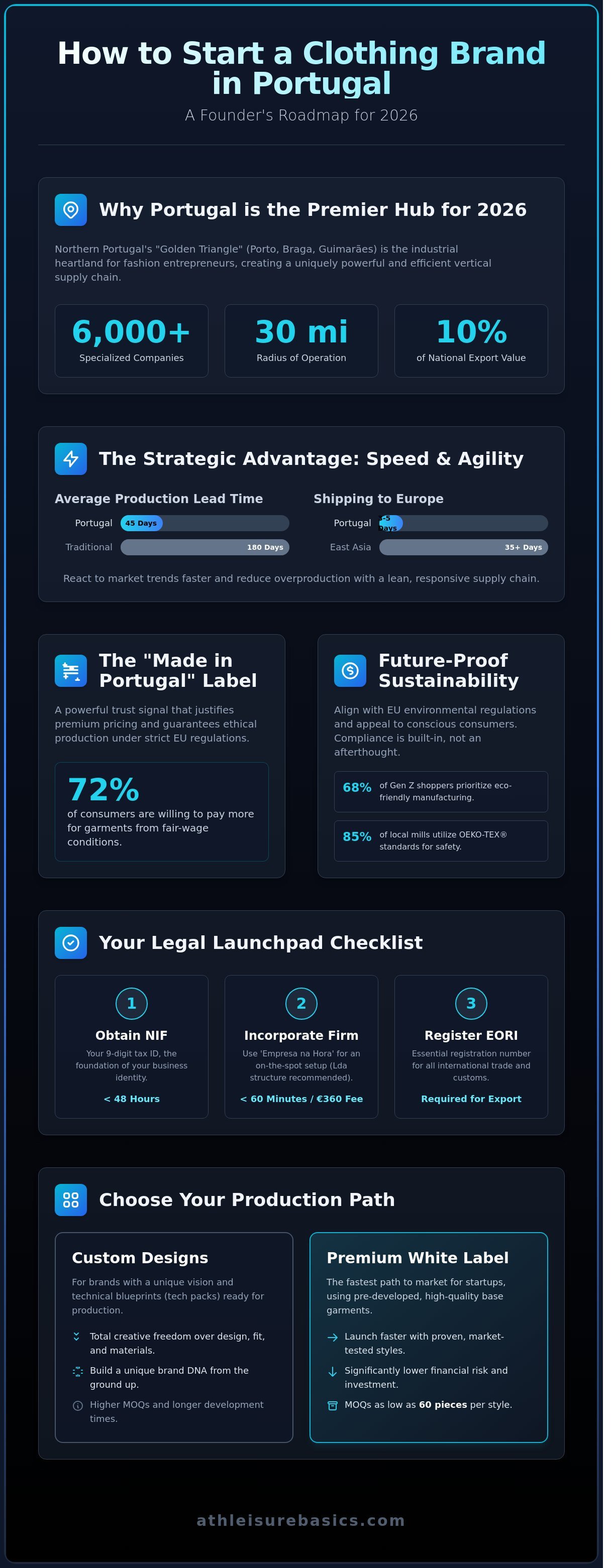
Portugal's "Golden Triangle," the industrial heartland spanning Porto, Braga, and Guimarães, has become the premier destination for fashion entrepreneurs in 2026. This region accounts for nearly 10% of the national export value, and its concentrated infrastructure is a major reason why founders are looking at how to start a clothing brand in portugal. Unlike fragmented manufacturing hubs, this cluster hosts over 6,000 specialized companies within a 30-mile radius. This proximity allows for a "vertical" supply chain where fabric sourcing, dyeing, and garment construction happen almost side-by-side.
The Economy of Portugal has pivoted toward high-value, sustainable textile production to stay competitive. For your brand, this means nearshoring advantages that Asia cannot match. In 2026, shipping a container from East Asia often takes 35 days and faces volatile freight costs, whereas Portuguese goods reach major European cities in 3 to 5 days by road. This speed reduces your lead times from the traditional 180-day cycle to a lean 45-day window, allowing you to react to trends without overproducing.
The "Made in Portugal" label serves as a powerful trust signal for premium brands. By 2026, the EU's Digital Product Passport requires brands to prove ethical production. Since Portuguese factories already operate under strict EU labor laws and environmental regulations, your compliance is built-in. This label justifies premium pricing, as 72% of modern consumers report a willingness to pay more for garments produced under fair-wage conditions.
Sustainability isn't an optional "green" marketing tactic; it's a legal and operational standard in 2026. Portugal leads this transition, with the textile sector investing over €100 million in circular economy technologies between 2023 and 2025. When you choose a Portuguese partner, you're tapping into a system where water recycling and solar-powered factories are the norm. This alignment with EU environmental regulations protects your brand from future penalties and appeals to the 68% of Gen Z shoppers who prioritize eco-friendly manufacturing.
The 2026 Fashion Landscape
The market has shifted from volume-heavy fast fashion to quality-driven, small-batch apparel. Portugal's factories have adapted by offering digital-first infrastructure that supports direct-to-consumer (D2C) agility. Portuguese manufacturing is the top choice for startups in 2026 because it combines heritage craftsmanship with the rapid-response logistics necessary for a profitable, low-inventory business model.
Key Benefits for Small Labels
Small labels gain a competitive edge through Low MOQs, with many partners offering white-label runs starting at 60 pieces. You get access to premium materials like GOTS-certified organic cotton and high-GSM heavy fleece. By 2026, 85% of local mills utilize OEKO-TEX® standards, ensuring your products meet the highest safety and sustainability benchmarks while significantly reducing your brand's carbon footprint. These factors make the region the logical starting point for anyone learning how to start a clothing brand in portugal with a focus on longevity.
The Legal and Business Essentials for Launching in Portugal
Establishing a legal presence is your first milestone when learning how to start a clothing brand in Portugal. You can't sign a production contract or open a business bank account without a Número de Identificação Fiscal (NIF). This nine-digit tax identification number is the foundation of your professional identity. For founders living outside the EU, you'll need a local fiscal representative to facilitate this process with the Portuguese Tax Authority. It's a straightforward step that typically takes less than 48 hours to complete through a lawyer or specialized service.
Speed is a major advantage in the Portuguese ecosystem. The 'Empresa na Hora' (On the Spot Firm) initiative allows you to incorporate your business in under 60 minutes at a government office for a flat fee of €360. If you prefer a digital approach, you can create a company online in Portugal using the official ePortugal portal. Most startups choose a 'Sociedade por Quotas' (Lda), which limits your personal liability to the capital you invest. This structure provides the professional credibility needed to secure partnerships with premium textile manufacturers.
International trade requires specific identifiers beyond your tax ID. You must register for an EORI number (Economic Operators Registration and Identification) via the AT portal if you plan to ship goods outside the European Union. Portugal's standard VAT (IVA) rate is 23%, and you'll need to account for this in your pricing strategy. Registering your trademark is equally vital. A filing with the European Union Intellectual Property Office (EUIPO) starts at approximately €850 and protects your brand across all 27 member states, ensuring your "logo to legacy" journey remains legally secure.
Setting Up Your Administrative Foundation
To work with high-end factories, you'll need a robust documentation pack. This includes your permanent business certificate, a dedicated Portuguese bank account, and a contract with a Certified Accountant (TOC). In Portugal, hiring an accountant is a legal requirement for companies with organized accounts. A TOC familiar with the textile industry helps you recover VAT on raw materials and manages complex payroll requirements. Having these pieces in place shows producers you're a serious partner in the manufacturing process.
Navigating EU Regulations
Compliance is non-negotiable for success in the European market. Your garments must adhere to Textile Regulation 1007/2011, which dictates that labels must be permanent, legible, and list fiber composition in descending order by weight. You also need to ensure your supply chain meets REACH standards (Regulation 1907/2006) regarding chemical safety in dyes and finishes. Legally using the 'Made in Portugal' mark requires that the final, substantial transformation of the product happened locally. This label acts as a premium seal of quality, often allowing for higher retail margins compared to goods produced elsewhere.
Understanding these requirements early prevents costly delays during your first production run. By handling the NIF, EORI, and trademark registrations properly, you build a stable platform for your brand. When you're figuring out how to start a clothing brand in Portugal, these legal steps are just as important as your design sketches. They turn your creative vision into a legitimate, scalable business entity that's ready to compete on the global stage.
From Concept to Collection: The Manufacturing Roadmap
Moving from a creative vision to a retail-ready collection requires a disciplined manufacturing strategy. When you're learning how to start a clothing brand in Portugal, you'll find that the "Made in Portugal" label carries a 20% to 30% premium in perceived market value compared to non-EU production. This value is built on a structured five-phase roadmap that ensures every garment meets luxury standards while minimizing financial risk.
Your journey begins with the tech pack. Think of this as the architectural blueprint for your garment. It includes every measurement, stitch type, and fabric weight. Once the blueprint is ready, you'll source materials. Portugal is home to over 6,000 textile companies, many of which provide GOTS or OEKO-TEX certified organic cotton. Sourcing locally reduces your carbon footprint and lead times, often cutting shipping windows from six weeks via sea from Asia to just 3 to 5 days by road within Europe.
Mastering the Tech Pack
A professional tech pack must include a detailed Bill of Materials (BOM), graded size specs, and Point of Measure (POM) diagrams. This document acts as a legal contract between you and the factory. Industry data shows that incomplete documentation leads to a 40% higher chance of sample rejection. By providing clear construction details, you reduce the need for multiple expensive revisions and keep your project on schedule. Link to 'What is a Tech Pack?' guide
The Importance of Sampling
Never skip the sampling phase to save time. You'll start with a prototype to test the basic fit and drape using available fabric. Once you approve this, the factory produces a Pre-Production Sample (PPS) using the actual bulk fabric and trims. This is your last chance to catch errors. A single adjustment to a sleeve length or pocket placement can save you €1,500 in wasted materials across a production run of 200 units. Give feedback that's specific; use centimeters rather than vague terms like "a bit shorter."
Understanding Minimum Order Quantities (MOQs) is vital for your cash flow management. While many traditional factories require 500 pieces per style, modern partners like Athleisurebasics offer flexibility with MOQs as low as 60 pieces. This allows you to launch with a wider variety of designs without tying up all your capital in inventory. Pricing usually follows a CMT (Cut, Make, and Trim) model, where you pay for the labor and the factory handles the technical execution.
The final phase is quality control (QC) and the production run. Professional manufacturers in Portugal typically follow these steps to ensure excellence:
- In-line inspection: Checking garments during the sewing process to catch errors early.
- AQL 2.5 Standards: Using the "Acceptable Quality Level" 2.5 statistical tool to ensure the batch meets international retail requirements.
- Sealing the Gold Sample: Keeping one perfect, approved garment as the benchmark for the entire production run.
- Final Pressing and Packaging: Ensuring items are retail-ready with your custom labels and eco-friendly bags.
By following this roadmap, you transform a simple idea into a high-quality product that justifies a premium price point. It's the most effective way to ensure your brand's longevity in a competitive market.
Choosing the Right Production Path: Custom vs. White Label
Deciding how your garments are made is the most critical financial decision you'll make when learning how to start a clothing brand in portugal. Your choice dictates your initial capital outlay, your speed to market, and your brand's unique value proposition. Most founders choose between Custom (Cut & Sew) manufacturing and White Label production. Each path offers distinct advantages depending on your stage of growth and your design complexity.
Custom manufacturing represents the pinnacle of creative freedom. You control every stitch, fabric blend, and measurement. However, this level of detail requires a higher investment. For a standard Custom project in 2026, expect a development timeline of 18 to 24 weeks from the initial tech pack to final production. In contrast, White Labeling allows you to launch using premium, pre-made blanks that are already engineered for a luxury fit. This model reduces your time-to-market to just 6 to 8 weeks; it's the fastest way to get your vision into customers' hands.
When researching how to start a clothing brand in portugal, understanding these risk profiles is non-negotiable. A smart scaling strategy often involves a hybrid approach. Many of our successful partners start with White Label collections to validate their brand identity and build a customer base without the heavy research and development costs of custom development. Once they hit a consistent sales volume, they transition into Custom manufacturing for their hero products. This path minimizes risk while ensuring your brand maintains the high quality standards expected from Portuguese manufacturing.
When to Choose Custom Manufacturing
Custom production is the right choice for brands focusing on a specific technical niche. If you're building a performance athleisure line that requires specialized compression fabrics or unique pocket placements, Custom is essential. Keep in mind that Portuguese factories typically require a 250 piece Minimum Order Quantity (MOQ) per style and color for custom designs. This ensures the production line efficiency meets the EU quality standards your customers expect. By 2026, the demand for sustainable, custom-developed textiles will likely extend development cycles, so planning at least two seasons ahead is vital for success.
The Strategic Advantage of White Labeling
White Labeling is a powerhouse for startups. It allows you to leverage luxury-grade blanks that are already OEKO-TEX® certified and retail-ready. You aren't just buying a basic t-shirt; you're buying a proven fit that has undergone rigorous testing. You can customize these blanks through high-end embroidery, screen printing, or private relabeling to make them truly yours. This model is ideal for testing new markets with a lower financial barrier. For a deeper dive into these options, you can read our guide on the Private Label vs. White Label manufacturing models. Our white label service starts at just 60 pieces per style, providing the ultimate flexibility for new entrepreneurs.
Ready to bring your designs to life with a trusted Portuguese partner? Explore our premium manufacturing options and start your collection today.
Launching with Athleisurebasics: Your Partner in Portugal
Building a successful fashion label requires more than just a creative eye; it demands a supply chain that can keep pace with your growth. At Athleisurebasics, we specialize in helping entrepreneurs master how to start a clothing brand in portugal by removing the traditional barriers to entry. Our infrastructure is designed to support you from the initial sketch to the final shipment, ensuring your products meet the highest European quality standards.
Risk management is the most critical factor for any new business. High minimum order quantities (MOQs) often kill promising brands before they launch. We solve this by offering two distinct paths. Our White Label service starts at just 70 pieces per style and color, allowing you to test the market with premium, pre-developed silhouettes. For those seeking a unique identity, our Custom Manufacturing service begins at 250 pieces. These low thresholds mean you can invest your capital into marketing and brand building rather than sitting on thousands of units of unsold inventory.
We provide comprehensive end-to-end support that covers every technical detail. Our team assists with tech pack development, which acts as the precise blueprint for your garments. This prevents costly errors during the sampling phase. We also manage the complex task of materials sourcing. Since 2018, we've maintained a network of local Portuguese suppliers that provide everything from heavy-weight French Terry to high-performance recycled nylon.
Quality is our baseline, not an upgrade. Every fabric we use is OEKO-TEX® certified, meaning it has been tested for harmful substances and is safe for both the consumer and the environment. This certification gives your brand an immediate competitive advantage. In a market where 65% of consumers now prioritize sustainability, having the "Made in Portugal" seal combined with certified non-toxic materials allows you to position your brand in the premium segment from day one.
Our Specialized Athleisure Expertise
We focus on what we do best: premium hoodies, leggings, and lifestyle essentials. Our "Partner, not just Producer" philosophy means we actively advise you on fit, fabric weight, and finishing techniques to ensure your vision translates into a sellable product. A typical success journey with Athleisurebasics involves a founder launching a 70-unit capsule collection to validate their niche, then scaling to a 500-unit custom line within their first 18 months of operation.
How to Start Your Project Today
Taking the first step is simple and structured. When you use our "Submit Your Project" portal, we ask for your designs, desired quantities, and target launch dates. This data allows our team to provide an accurate feasibility assessment within 48 hours. For founders who need deeper strategic guidance, we offer production consulting sessions to refine your tech packs and sourcing strategy before manufacturing begins. This proactive approach ensures your brand is built on a foundation of professional industry standards.
Ready to turn your vision into a reality? Get a custom apparel manufacturing quote today and take the first step toward building your legacy in the fashion industry.
Build Your Fashion Legacy in Northern Portugal
Launching a fashion label requires a balance of creative vision and strategic logistics. By choosing to manufacture in the heart of Northern Portugal's textile hub, you secure access to OEKO-TEX® certified fabrics and ethical production standards. You don't need to navigate the complexities of how to start a clothing brand in portugal without expert guidance. Success in 2026 depends on selecting a manufacturing partner that prioritizes flexibility through low MOQs starting at 70 pieces. This strategy effectively minimizes your initial capital risk while ensuring your products meet premium European quality requirements.
Athleisurebasics provides the end-to-end support needed to transition from a concept to a professional collection. We manage the technical production details so you can focus on scaling your business and building a loyal community. Whether you're developing custom silhouettes or utilizing white-label designs, our infrastructure is ready to support your growth. Take the first step toward your 2026 launch today.
Start your clothing brand journey with a custom quote
Your vision deserves a foundation of quality and integrity. We're ready to help you turn those brand goals into a tangible reality.
Frequently Asked Questions
How much does it cost to start a clothing brand in Portugal?
Starting a professional clothing brand in Portugal typically requires an initial investment between €5,000 and €15,000 for a debut collection. This budget covers the creation of tech packs at roughly €350 each; sampling at €150 per garment; and a small production run of 100 pieces. You should also set aside a 20% reserve for shipping costs and digital marketing. It's a cost-effective entry point for accessing premium European craftsmanship without the massive overhead of larger global hubs.
Can I start a clothing brand in Portugal if I live in the UK or USA?
You can successfully launch and manage your brand from the UK or USA by partnering with a full-service Portuguese manufacturer. Digital communication tools and DHL express shipping mean samples reach New York in 48 hours or London in 24 hours. Many founders never visit the factory in person during their first year. When learning how to start a clothing brand in Portugal from abroad, focus on finding a partner that provides end to end logistics and quality control services.
What is the typical lead time for production in Portuguese factories?
Production lead times in Portuguese factories usually range from 6 to 10 weeks after you approve your final samples. The sampling phase itself takes about 3 to 4 weeks depending on how complex your designs are. During peak seasons like September or January, these timelines often extend by 15% due to high demand. Planning your production calendar 6 months in advance ensures you hit your launch dates without paying for rushed shipping or overtime fees.
Do I need to speak Portuguese to work with local manufacturers?
You don't need to speak Portuguese because 85% of export-oriented factory managers and account leads are fluent in English. Technical terms in the garment industry are standardized globally; which makes communication straightforward. Most daily updates happen via email or WhatsApp in English to ensure every specification is documented. While having a partner who speaks the local language helps when negotiating with small fabric mills, it's not a requirement for the brand owner.
What are the minimum order quantities (MOQ) for startups in Portugal?
Minimum order quantities for startups in Portugal are some of the most flexible in Europe, often starting at just 50 to 100 units per style. Specialized white label services even allow for 60 pieces per color in certain categories. These low MOQs reduce your initial financial risk and prevent the accumulation of dead stock. It's the ideal setup for testing the market with 3 or 4 different designs before scaling up to larger volumes of 500 units.
Is it better to source my own fabrics or let the factory handle it?
Letting the factory handle fabric sourcing is usually more efficient because they have established accounts with local mills like Somelos or Riopele. Factories typically secure 10% to 20% better pricing than independent designers due to their high purchase volumes. If you source your own materials, you're responsible for delivery delays and quality defects. When the factory manages the supply chain, they're fully accountable for the final product's integrity from fiber to finished garment.
How do I ensure my clothing brand is ethically manufactured in Portugal?
Ensure ethical production by choosing factories that hold OEKO-TEX® or GOTS certifications and strictly follow EU labor laws. Portugal's textile industry is heavily regulated; meaning workers earn at least the national minimum wage of €820 per month and work in safe environments. You can request a "Certificate of Origin" for every shipment you receive. This transparency is a primary reason why founders choose this region when researching how to start a clothing brand in Portugal.
What is a Tech Pack and do I really need one to start?
A Tech Pack is a detailed blueprint of your garment that includes precise measurements, materials, and construction details. You absolutely need one because it serves as the legal contract between you and your manufacturer. Without a professional Tech Pack, your error rate can increase by 40% during the sampling phase. It ensures that the factory produces exactly what you envisioned; saving you thousands of euros in wasted materials and rejected samples.



Leave a comment
This site is protected by hCaptcha and the hCaptcha Privacy Policy and Terms of Service apply.