
How to Vet a Clothing Manufacturer: The 2026 Founder's Guide to Quality & Reliability
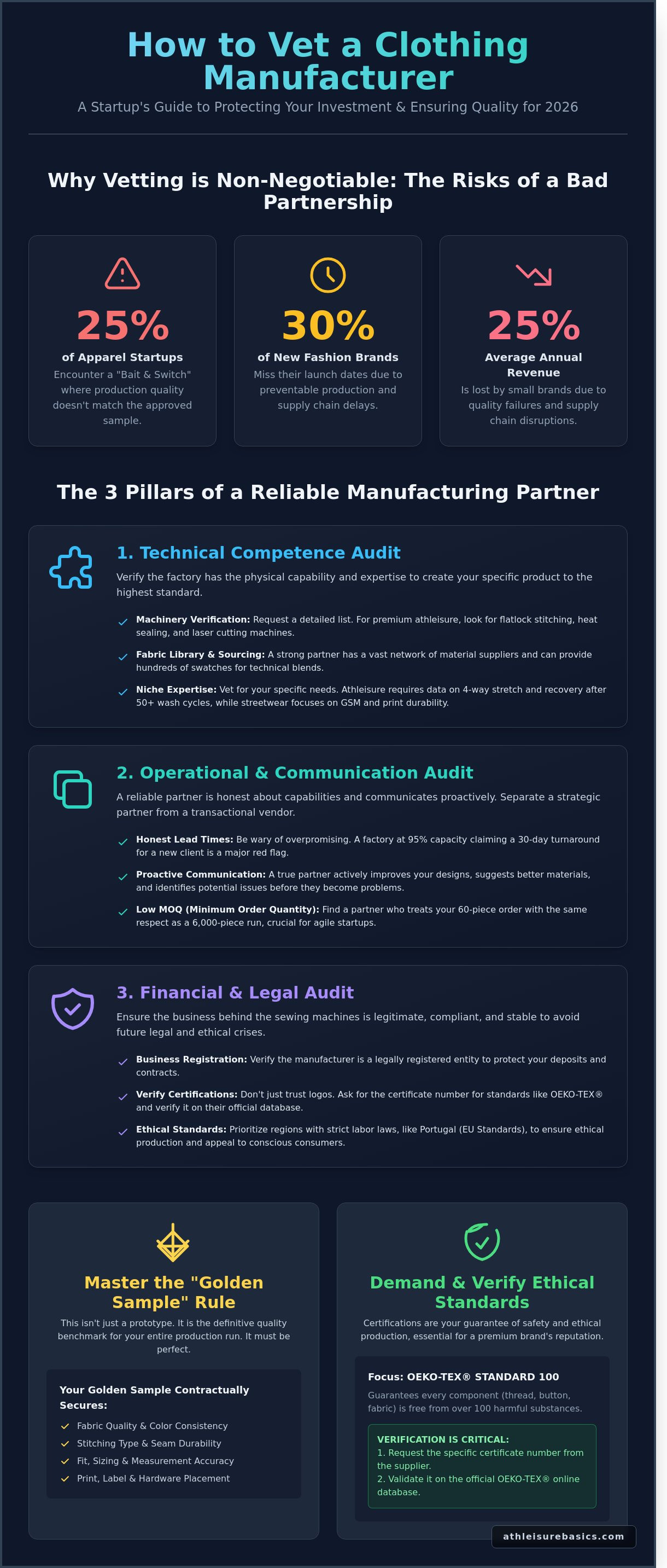
What if the factory that sent you a flawless prototype isn't actually the one sewing your bulk order? Industry data suggests that nearly 25% of apparel startups encounter a "bait and switch" scenario where production quality fails to match the initial sample. You've likely felt the anxiety of sending a significant deposit across the globe, only to be met with communication barriers or confusing technical jargon about certifications. It's a valid fear, especially when your brand's reputation and capital are on the line.
You can vet a manufacturer remotely by requesting live video tours and ordering physical prototypes to inspect craftsmanship. For those manufacturing abroad, utilizing End-to-End Sourcing & Procurement services provides vital on-the-ground oversight, while independent inspection agencies can conduct on-site audits. These partners provide detailed reports on working conditions and machinery, giving you peace of mind that the facility meets your high standards for premium production without needing a flight.
We believe that finding a reliable production partner shouldn't feel like a gamble. This guide explains exactly how to vet a clothing manufacturer to protect your investment and ensure your 2026 collection meets the highest industry standards. You'll master the essential vetting process to find a partner who offers superior quality and transparent communication, rather than just a low price point. Finding a partner who values top-notch craftsmanship is the first step in scaling your vision.
We'll provide a clear checklist for verifying factory legitimacy, a deep dive into ethical standards like OEKO-TEX® certification, and a strategy to avoid the production delays that cause 30% of new fashion brands to miss their launch dates. By the end of this article, you'll have the tools to turn your creative vision into a premium, profitable legacy.
Key Takeaways
- Learn how to vet a clothing manufacturer by moving beyond price comparisons to conduct total value audits that protect your capital and brand reputation.
- Understand why verifying OEKO-TEX® certifications and EU labor standards is essential for ensuring your garments meet premium ethical and safety requirements.
- Master the "Golden Sample" rule to establish a definitive quality benchmark that secures consistency across your entire production run.
- Identify the critical communication markers that separate a transactional vendor from a strategic partner who actively improves your designs.
- Discover how leveraging Portuguese manufacturing and low MOQs can help you scale your brand quickly while maintaining superior quality standards.
Why Vetting Your Clothing Manufacturer is the Difference Between Brand Success and Failure
Launching a clothing brand involves significant financial risk. For a founder in 2026, the stakes are higher than ever. Poor vetting often leads to lost deposits and unsellable inventory. Industry reports indicate that supply chain disruptions and quality failures cost small apparel brands an average of 25% of their annual revenue. Learning how to vet a clothing manufacturer is no longer just a checkbox. It's the foundation of your brand's legacy. Vetting is the systematic reduction of production risk through evidence-based verification.
Startups are particularly vulnerable to manufacturing pitfalls. Without the leverage of massive orders, new founders often face deprioritized production schedules or hidden costs. Protecting your vision means finding a partner who offers low MOQ options and treats your 60-piece order with the same respect as a 6,000-piece run. Modern consumers now demand 100% transparency. They want to know their leggings were made ethically in regions like Portugal, where EU quality and ethical standards are strictly enforced. Moving beyond simple price comparisons to total value audits ensures you don't sacrifice your brand's reputation for a lower unit cost.
The Three Pillars of a Reliable Manufacturing Partner
- Technical Competence: You must verify they possess the machinery and skill for your specific designs. A deep understanding the textile manufacturing process helps you ask the right questions about yarn count and fabric construction.
- Operational Transparency: Honesty about lead times is non-negotiable. If a factory claims a 30-day turnaround but operates at 95% capacity, they're likely overpromising.
- Financial and Legal Stability: Verifying the business behind the sewing machines is essential. Ensure the manufacturer is legally registered and holds necessary certifications like OEKO-TEX® to avoid future compliance issues.
Vetting for Your Specific Niche
Athleisure requires a different audit than basic streetwear. When you analyze how to vet a clothing manufacturer for performance wear, you must prioritize technical testing. You need to verify capabilities for 4-way stretch, recovery, and moisture-wicking. If a manufacturer cannot provide data on fabric recovery percentages after 50 wash cycles, they aren't the right partner for premium activewear. Streetwear might focus on heavy GSM cotton and print durability; however, athleisure demands specialized machinery for flatlock stitching and heat-sealed seams. Choosing a partner with niche expertise ensures your high-quality products perform exactly as your customers expect. For brands looking to source professional corporate wear, The Staff Uniform Company provides a benchmark for the specialized tailoring and formal fabric standards required in that sector.
The Technical Audit: Verifying Certifications and Ethical Standards
A manufacturer's website might look professional, but the technical reality happens on the factory floor. When you learn how to vet a clothing manufacturer, you must look beyond the marketing copy. You need to verify their physical capabilities and legal compliance to protect your brand's reputation. Start by requesting a detailed list of their machinery. High-performance athleisure requires specific equipment like flatlock stitching machines for chafe-free seams, heat sealing for waterproof finishes, and laser cutting for precision edges. If a factory relies solely on basic overlock machines, they won't be able to produce the technical quality required for a premium 2026 startup.
You should also assess the depth of their fabric library. A reliable manufacturer maintains a vast network of raw material suppliers and can provide hundreds of swatches ranging from recycled nylons to heavy-weight organic cottons. If a factory struggles to source specific technical blends, it indicates a weak supply chain that could lead to production delays later.
Decoding Textile Certifications
Certifications like OEKO-TEX® Standard 100 are essential for luxury positioning. This certification guarantees that every component, from the thread to the zipper, is free from over 100 harmful substances. To verify this, ask the supplier for their specific certificate number. You should then enter this code into the Oeko-Tex Label Check portal to ensure it's active and covers the correct product class. In 2026, roughly 82% of premium buyers expect this level of transparency. Verified materials build immediate consumer trust, turning a simple purchase into a long-term brand relationship.
Sustainability as a Vetting Metric
Ethics and sustainability are no longer optional extras. Choosing Made in Portugal clothing serves as a strategic vetting shortcut because these factories operate under strict EU labor laws and environmental regulations. Unlike manufacturers in regions with opaque standards, Portuguese partners undergo regular third-party audits such as SEDEX or BSCI. These reports provide objective data on working hours, fair wages, and safety protocols.
Watch out for greenwashing during your initial inquiry. If a manufacturer claims to be "eco-friendly" but cannot provide specific data on their waste management or energy sources, it's a red flag. A reliable partner will have a transparent waste-reduction strategy and a deep fabric library featuring GRS (Global Recycled Standard) documentation. If you want to scale without the headache of ethical scandals, it's best to work with a partner committed to EU quality standards from the very first sample.
- Verify SEDEX/BSCI: Ask for the most recent audit date and any corrective action plans.
- Energy Use: Inquire if the factory uses renewable energy or has ISO 14001 certification.
- Waste Management: Confirm how they handle fabric offcuts and chemical disposal.
The Sampling Protocol: Testing Quality Before the Bulk Run
The sample stage is the ultimate stress test for your partnership. It provides a tangible look at the factory's technical capabilities and their attention to detail. If a manufacturer cannot execute a single prototype to your exact specifications, they will likely struggle with a 500-unit production run. Treat this phase as your primary method for how to vet a clothing manufacturer before signing a high-value contract. A sample isn't just a piece of clothing; it's a physical proof of concept that validates the factory's claims of premium quality.
The Tech Pack as a Legal and Quality Contract
A professional tech pack acts as your insurance policy. You shouldn't vet a factory without one because it removes ambiguity from the production equation. To see where this document sits within the wider timeline, review the garment production process. Common vetting failures often stem from missing measurements or vague material descriptions in the tech pack rather than actual poor sewing. Ensure your document includes a Bill of Materials (BOM) and a graded spec sheet to avoid these "false" negatives during the evaluation phase.
Analyzing the Prototype Construction
When the sample arrives, perform a rigorous audit. Check the seam strength by applying pressure to high-stress areas like the crotch or armpits. Verify that label placement matches your brand guidelines within a 2mm tolerance. Color fastness is equally critical; a premium garment shouldn't lose its vibrancy after the first wear. A sample is a test of the factory's communication as much as their sewing.
Conduct a "Wash Test" audit by putting the sample through a 20-cycle home laundry simulation. Measure the garment before and after to check for shrinkage exceeding 3%. This data proves whether the manufacturer pre-shrunk the fabric or used inferior blends that won't hold up for your customers. This level of scrutiny is essential when learning how to vet a clothing manufacturer for long-term reliability.
Once a prototype meets every requirement, it becomes the "Golden Sample." This physical item serves as the final benchmark for production quality. You should keep one copy at your office and send a signed copy back to the factory. This ensures both parties have an identical reference point for the final quality control check, leaving no room for disputes regarding the finished goods. Using this protocol protects your investment and ensures your vision translates into a legacy-building product.
Auditing Communication and Business Culture
Technical literacy is the bedrock of a successful production run. When you learn how to vet a clothing manufacturer, you must look beyond the price list to evaluate how they interpret your vision. A factory's ability to analyze a tech pack accurately is a primary indicator of their expertise. If a manufacturer responds within 24 hours with specific, granular questions about your seam allowances or fabric GSM (grams per square meter), they're demonstrating the high technical literacy required for premium apparel.
You need a partner, not just a vendor. A vendor simply follows instructions, even if those instructions lead to a flawed product. A true partner suggests improvements. They might point out that a specific recycled polyester blend won't hold the structure of your pleated design, or they may recommend a different stitch type to improve durability. This proactive feedback saves you from 100% loss on a faulty production batch. It's about finding a team invested in your brand's longevity.
Scalability is equally vital for your 2026 growth strategy. A factory that excels at producing 70 pieces for a capsule launch must also possess the infrastructure to handle 7,000 pieces as you scale. Ask for their maximum monthly output and how lead times shift when order volumes increase by 10x. Ensure their communication remains consistent during these transitions; your vision shouldn't get lost in translation as the production line grows.
Red Flags vs. Green Flags in Factory Communication
- Red Flag: Vague answers about lead times or claims of "guaranteed" perfection. In manufacturing, variables like fabric mill delays or shipping logistics are common; a transparent partner will discuss these risks openly.
- Green Flag: The production manager asks for clarification on your tech pack or suggests a more efficient way to handle your embroidery.
- Red Flag: Requests for payment via non-traceable methods or personal accounts. Professional manufacturers always use secure, business-verified banking channels.
The Importance of On-Site or Virtual Tours
Transparency is non-negotiable. If you cannot visit the facility in person, use video calls to verify the physical existence of the production line. Look for a clean, organized workspace where safety protocols are visible. Observe the morale of the staff; happy, well-treated workers produce higher quality garments. You can find more specific regional insights in our Clothing Manufacturers Portugal guide to understand how EU ethical standards impact factory culture.
Verifying these elements during the process of how to vet a clothing manufacturer ensures your brand's reputation remains intact. A factory walkthrough, even a virtual one, confirms that the equipment is modern and the production capacity matches their claims.
Partnering with Athleisurebasics: Your Vetted Choice in Portugal
Vetting a production partner shouldn't feel like a high-stakes gamble. Athleisurebasics removes the typical anxiety of how to vet a clothing manufacturer by prioritizing radical transparency and accessible entry points. We operate our facility in Portugal, a region synonymous with premium craftsmanship and strict EU ethical standards. By choosing a Portuguese partner, you're opting for a supply chain that respects labor rights and environmental regulations by default.
Our commitment to quality is backed by concrete certifications. We exclusively use OEKO-TEX® certified materials, ensuring every garment is free from harmful substances. This level of oversight allows founders to focus on growth rather than micro-managing factory floors. Through our 'From Logo to Legacy' framework, we provide a structured path for startups. You don't need to commit to thousands of units to get started. We support emerging brands beginning with their first 70 pieces, providing a low-risk environment to prove your concept.
The strategic advantage of our Portuguese facility lies in its efficiency. We bridge the gap between artisanal quality and industrial scale. This makes us the preferred choice for European brands that demand fast lead times without sacrificing the luxury feel of their activewear. We don't just act as a factory; we act as your boots on the ground in Europe.
Custom Manufacturing with Built-in Quality Control
Our custom manufacturing service features a 250-piece MOQ per style and color. This requirement ensures your brand maintains a sense of exclusivity while remaining accessible for scaling. To simplify how to vet a clothing manufacturer, we integrate production consulting into every project. Our experts audit your designs and tech packs before production begins. This acts as a secondary vetting layer, catching potential construction issues that could lead to costly defects. For founders looking for even faster market entry, you can learn about private label Portugal options that bypass long development cycles.
Start Your Brand with Confidence
If you're looking for the fastest way to launch, our white-label service is the ideal solution. It allows for rapid vetting of our quality because you can order as few as 60 to 70 pieces per style. You'll get to experience our fabric hand-feel and stitching precision firsthand with minimal capital at risk. Once you're satisfied with the results, scaling into full custom production is a seamless transition. We're ready to help you turn your vision into a professional collection. Take the first step toward a reliable partnership and Get a Custom Apparel Manufacturing Quote to start your first vetted production run today.
Secure Your Brand's Future with a Proven Production Partner
Choosing a production partner is the most critical decision you'll make for your business this year. You've learned that rigorous technical audits and a disciplined sampling protocol are non-negotiable for long-term reliability. By verifying OEKO-TEX® certifications and testing build quality before committing to bulk, you protect your brand's reputation from the start. Mastering how to vet a clothing manufacturer transforms a risky gamble into a strategic advantage that scales with your ambition.
Athleisurebasics removes the guesswork by providing premium Portuguese craftsmanship with accessible entry points. We offer low MOQs starting at just 70 pieces, allowing you to launch collections without the burden of excessive inventory or ethical compromises. Our team focuses on transparent communication and high industry standards to ensure your vision reaches the market exactly as intended.
Launch your brand with a trusted Portuguese partner, Get a quote today
Your vision deserves a foundation of quality and ethical integrity. It's time to stop worrying about manufacturing hurdles and start building your legacy with a partner who cares about your success as much as you do.
Frequently Asked Questions
How do I know if a clothing manufacturer is legitimate?
You can verify a manufacturer's legitimacy by checking their business registration number and physical address on official government databases. Validating their presence on platforms like LinkedIn or reviewing their VAT number ensures they're a registered entity. A legitimate partner will provide references from 3 to 5 current clients and share clear, professional communication through official company channels.
What questions should I ask a clothing manufacturer before hiring them?
Ask about their lead times, production capacity, and specific quality control protocols before signing any contracts. You should also inquire about their experience with your specific fabric types, such as organic cotton or recycled polyester. Knowing how to vet a clothing manufacturer involves asking for a detailed breakdown of their 4 point inspection system to ensure every garment meets your luxury standards.
Is it better to manufacture clothing in Europe or Asia for a startup?
Manufacturing in Europe, specifically Portugal, is often better for startups because of lower minimums and faster shipping times. While Asian factories might offer lower unit costs for orders exceeding 5,000 pieces, European hubs provide the flexibility and EU ethical standards needed to scale a premium brand. Portugal's textile industry grew by 4 percent in 2023, reflecting its status as a reliable hub for high-quality production.
What is a 'low MOQ' and why does it matter for vetting?
A low MOQ, or Minimum Order Quantity, refers to the smallest number of units a factory will produce per style, often starting at 60 pieces. This matters for vetting because it allows you to test the market without committing 10,000 dollars in capital upfront. It's a sign of a supportive partner who understands the needs of first-time founders and values long-term growth over quick, massive orders.
Can I vet a manufacturer without visiting the factory in person?
You can vet a manufacturer remotely by requesting live video tours and ordering physical prototypes to inspect craftsmanship. Use third-party inspection services like QIMA or SGS to conduct on-site audits if you can't travel. These agencies provide 20-page reports on working conditions and machinery, giving you peace of mind that the facility meets your high standards for premium production without needing a flight.
What certifications should a high-quality clothing manufacturer have?
Look for OEKO-TEX Standard 100 and GOTS certifications to ensure the factory uses safe, non-toxic materials and ethical processes. These 2 certifications prove the manufacturer adheres to strict environmental and social criteria. High-quality partners also often hold ISO 9001 certification, which demonstrates a commitment to consistent quality management systems across their entire production line.
How much does it cost to get a sample made for vetting purposes?
Sampling costs typically range from 2 to 3 times the estimated bulk production price per unit. For a premium hoodie, this might mean paying 100 to 150 dollars for a single prototype. This fee covers the pattern making, fabric sourcing, and machine setup required for a one-off piece. Most professional manufacturers will credit this sampling fee back to your account once you place a bulk order.
What should I do if a manufacturer fails the vetting process?
If a manufacturer fails your vetting process, stop the negotiation immediately and move to your secondary list of vetted suppliers. Don't try to fix a factory that lacks transparency or fails to meet your quality standards during the sampling phase. Understanding how to vet a clothing manufacturer means recognizing red flags early to protect your brand's reputation and your financial investment.

Leave a comment
This site is protected by hCaptcha and the hCaptcha Privacy Policy and Terms of Service apply.