
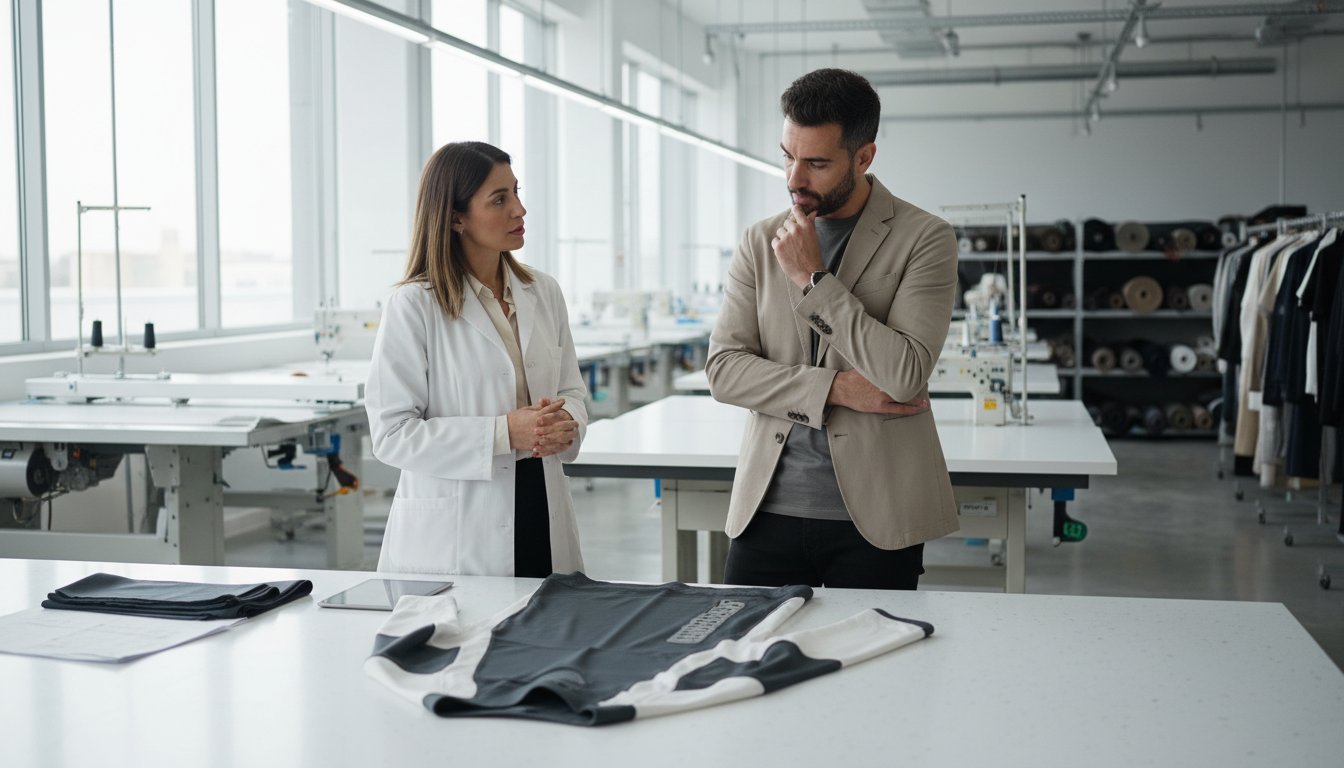
25 Essential Questions to Ask a Potential Clothing Factory in 2026
What if the most expensive mistake you make in 2026 isn't your marketing spend, but the factory you choose to bring your vision to life? You've likely felt that familiar anxiety when scrolling through supplier directories, fearing that a single bad bulk order could drain your startup capital. It's difficult to identify the right questions to ask a potential clothing factory while trying to decode technical jargon like CMT versus FPP. We understand that you need more than just a vendor; you need a reliable manufacturing partner that ensures your samples match your vision every single time.
You can protect your investment by using a structured vetting framework. This article outlines 25 essential inquiries designed to help you separate reliable partners from those who cut corners. We'll cover everything from managing low MOQs to verifying OEKO-TEX certifications and transparent pricing structures. By the end of this guide, you'll have the confidence to scale your brand with a partner that delivers top-notch craftsmanship and supports your journey from logo to legacy.
Key Takeaways
- Learn to identify the subtle communication cues that distinguish a strategic manufacturing partner from a simple transactional vendor.
- Master the specific questions to ask a potential clothing factory to verify their technical mastery and ensure they can scale with your brand’s growth.
- Protect your startup's cash flow by understanding how to negotiate tiered pricing and navigate the reality of minimum order quantities in 2026.
- Safeguard your brand reputation by learning how to audit ethical standards and premium certifications like OEKO-TEX® and GOTS.
- Discover the "Made in Portugal" advantage and how it provides a superior quality and ethical foundation for your technical apparel marketing.
The Strategy of Vetting: Why Your Questions Define Your Brand's Future
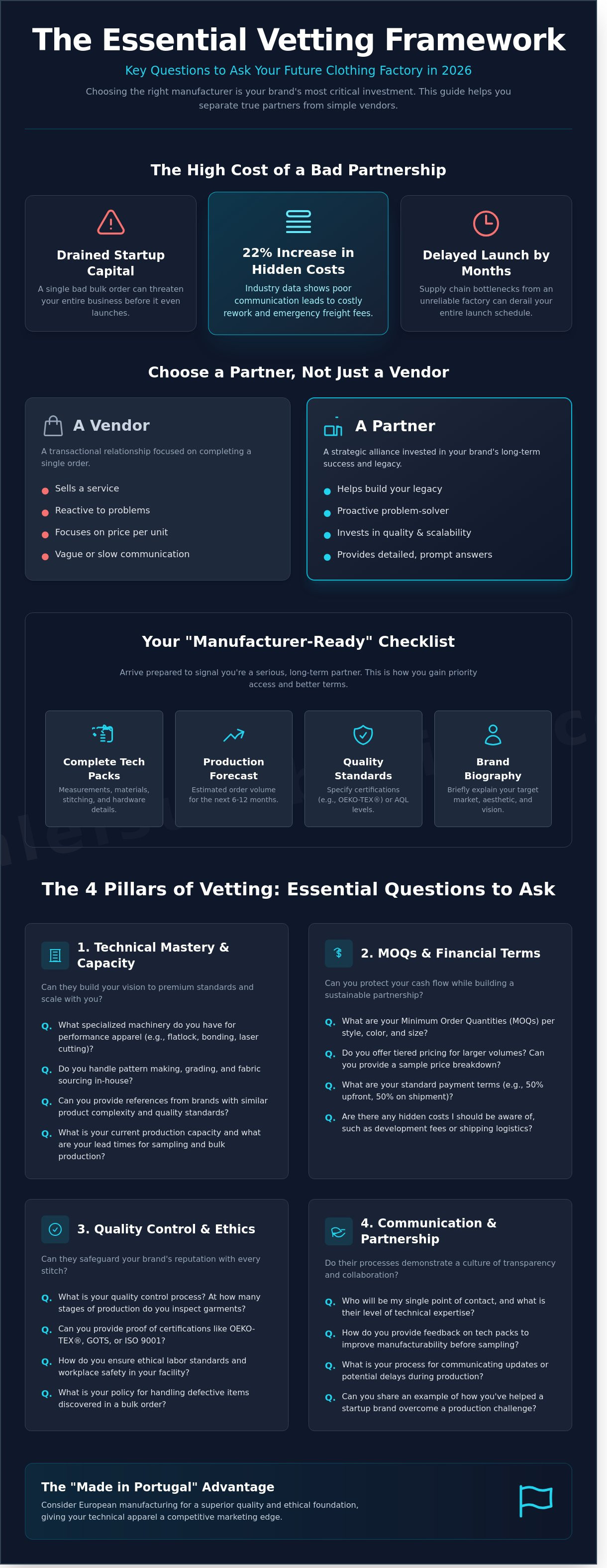
The questions to ask a potential clothing factory have changed. In 2026, the global clothing industry demands more than just a price quote; it requires a strategic alliance. Your vetting process is the first line of defense for your brand's reputation. A factory's initial response serves as a blueprint for future production quality. Prompt, detailed answers suggest a culture of precision. Vague or delayed replies often signal upcoming production defects or missed deadlines. These aren't just minor inconveniences. Industry data shows that poor communication at the start of a project can lead to a 22% increase in hidden costs due to rework and emergency air-freight fees.
Choosing a manufacturer based on price alone is a gamble that rarely pays off. High-end factories prioritize clients who ask the right questions because it shows professional maturity. If you don't screen for technical capability and ethical standards early, you risk your entire capital on a partner that can't scale with you. Your goal is to find a facility that mirrors your commitment to excellence, especially if you're aiming for the superior quality standards associated with European manufacturing.
The Difference Between a Vendor and a Partner
A vendor sells you a service, but a partner helps you build a legacy. For startups, this distinction is vital. You'll likely need technical support during the garment production process to ensure your designs are actually manufacturable. Partners provide feedback on fabric performance and construction methods before the first sample is cut. This proactive transparency prevents supply chain bottlenecks that could delay your launch by months. It's the difference between a product that looks good on screen and one that meets premium retail standards.
Preparing Your Brand for the Inquiry
High-end factories in regions like Portugal look for serious clients who understand the business of fashion. You must demonstrate that you aren't just testing the waters. Being "Manufacturer-Ready" means arriving with a complete tech pack and a clear growth plan. This professional approach signals to a factory that you're worth their time and resources. Frame your inquiry around long-term goals rather than a one-off order. When you present a vision for a profitable, ethical brand, premium manufacturers are more likely to offer flexibility on MOQs or prioritize your production slots.
The Manufacturer-Ready Checklist:
- Complete Tech Packs: Include measurements, materials, and hardware details.
- Production Forecast: Share your estimated volume for the next 12 months.
- Quality Standards: Specify requirements like OEKO-TEX® certification or specific stitching types.
- Brand Bio: A brief summary of your target market and aesthetic.
By entering the conversation prepared, you shift the dynamic from a simple transaction to a professional collaboration. This sets the stage for a relationship built on mutual respect and high-quality output.
Technical Mastery & Production Capacity: Can They Build Your Vision?
A factory's machinery defines your product's limit. You can't produce high-performance leggings on standard lockstitch machines. When vetting partners, the specific questions to ask a potential clothing factory must focus on their technical infrastructure. High-performance athleisure requires specialized equipment like flatlock machines for chafe-free seams and heat-press stations for bonded hems. If a factory claims they can do it all but lacks these specific tools, your quality will suffer during the scaling phase. These technical details are non-negotiable for brands aiming for the premium market in 2026.
Understanding the workflow from Sourcing Products and Manufacturers to final delivery is a core part of your due diligence. Ask if they handle pattern making and fabric sourcing in-house or if they rely on third-party vendors. Vague answers about their equipment or textile origins are immediate red flags. A transparent partner will provide a detailed list of their machinery and even offer a virtual tour of their production floor to prove their capabilities. Clear communication about technical limits now prevents costly production delays later.
Equipment and Specialty Skills
Athleisure isn't standard apparel. It requires 4-way stretch handling and precise tension control to prevent seam popping. Ask if they have experience with premium materials like Portuguese cotton, which is known for its durability and soft hand-feel. You should also confirm if embellishments like 3D embroidery or screen printing are done on-site. Outsourced embellishments often lead to longer lead times and inconsistent quality control across the batch. Direct oversight of these processes ensures your brand's aesthetic remains consistent from the first piece to the last.
The Sampling and Prototyping Phase
The transition from a tech pack to a physical garment is the most critical stage. A professional factory usually provides a first prototype within 10 to 15 business days. Ask how many revision rounds are included in your sampling fee; most high-quality manufacturers include at least two rounds to perfect the fit. Your goal is to establish a "gold sample" that serves as the legal and quality benchmark for the entire bulk run. This ensures that the 500th unit matches the first approved version exactly. If you want to see how this precision works in practice, you can explore our high-quality manufacturing options to see our commitment to craftsmanship. Establishing these questions to ask a potential clothing factory early on secures your production pipeline and protects your investment.
Navigating MOQs and Financial Terms: Protecting Your Cash Flow
In 2026, cash flow management remains the primary reason why 20% of new apparel brands fail within their first two years. When you're identifying the right partner, the most critical questions to ask a potential clothing factory involve their Minimum Order Quantities (MOQs) and how those numbers impact your bottom line. High MOQs can trap up to 85% of a startup's capital in unsold inventory, creating a "stock rich, cash poor" scenario that halts growth. You need to understand how costs fluctuate as you scale. Ask for a tiered pricing breakdown: for example, what's the unit cost for 70 pieces versus 500 pieces? Usually, reaching the 500-unit mark can reduce your per-garment cost by 15% to 30%, but you must balance this against your storage capacity and sales velocity.
Beyond the base manufacturing price, you must uncover hidden expenses that often appear after the first invoice. Be direct and ask about these specific costs:
- Import duties and customs clearance fees for EU versus non-EU shipments.
- Logistics costs from the factory floor to your specific fulfillment center.
- Individual packaging, polybagging, and sustainable mailer options.
- Labeling, hangtag application, and specialized brand embroidery fees.
Decoding MOQ Flexibility
Many premium manufacturers in 2026 now offer "surcharge" options to support emerging designers. This allows you to produce orders below the standard factory MOQ by paying a 20% premium on the unit price. It's a strategic way to test a new market segment without overcommitting your budget. Exploring private label Portugal options can lower your initial barrier to entry, as Portuguese factories often specialize in high-quality, low-volume production with MOQs as low as 60 pieces per style. You should also clarify the difference between fabric minimums and garment minimums. A factory might require 300 meters of custom-dyed fabric but allow you to split that material across three different styles to meet your needs.
Financial Transparency and Terms
Payment structures vary significantly by region. While many Asian factories still demand a 30% deposit and 70% balance payment before the goods leave the port, European partners often provide more balanced terms. Standard EU manufacturing terms typically involve a 50% deposit to initiate production and the remaining 50% upon final quality control approval. These are essential questions to ask a potential clothing factory to ensure your brand's liquidity stays healthy. Always negotiate a 'Force Majeure' clause and specific production delay penalties. If a shipment is delayed by more than 14 days due to factory error, you should have a pre-agreed 5% to 10% discount to compensate for lost retail time. These protections ensure your manufacturer is as invested in your delivery timelines as you are.
Quality Control and Ethical Standards: Safeguarding Your Reputation
In 2026, transparency is your most valuable asset. Consumers demand to know who made their clothes and how the process affected the planet. This is why the "Made in Portugal" label serves as a powerful marketing tool. Choosing clothing manufacturers in Portugal ensures your production aligns with strict EU labor laws and environmental protections. These regulations provide a safety net for your brand identity that many overseas options simply cannot match. When you partner with an ethical facility, you aren't just buying products; you're buying peace of mind.
The Quality Control (QC) Framework
Consistency defines a successful brand. You need to know exactly what percentage of garments undergo inspection during production. Most high-end factories use an Acceptable Quality Level (AQL) of 2.5 or 4.0 to maintain standards. Ask if they perform 100% inspections on finished goods or only random samples. You should also inquire about their policy for "seconds" or defective items found after delivery. If 5% of your order arrives with crooked seams, how will they compensate you? Always demand a written quality guarantee or a specific contract clause to protect your investment. A professional partner won't hesitate to put their standards in writing.
Ethical and Sustainable Production
Greenwashing won't work in 2026. You must verify certifications like OEKO-TEX® Standard 100, which ensures textiles are free from harmful chemicals, or GOTS for organic fibers. These aren't just badges; they're proof of a clean supply chain. One of the critical questions to ask a potential clothing factory involves their waste management. Do they recycle fabric offcuts? How do they handle chemical runoff? Portugal's infrastructure includes advanced water treatment facilities that reduce environmental impact significantly compared to less regulated regions.
Your final list of questions to ask a potential clothing factory must also include a deep dive into their raw material sourcing and energy usage. Confirming where the raw yarn comes from is vital for true traceability. Ask if the factory uses solar arrays or carbon footprint reduction initiatives to power their machines. If you or a third party visit the floor, look at the lighting and ventilation. Observe how they handle raw materials. Is the fabric stored in a clean, climate-controlled area? These details reflect the factory's overall discipline and respect for your brand's quality.
Ready to build a brand backed by EU quality standards? Partner with Athleisure Basics to ensure your production meets the highest ethical benchmarks.
Partnering with Athleisurebasics: The Right Answers for Your Brand
Finding the right manufacturing partner is often the biggest hurdle for new founders. When you're evaluating the questions to ask a potential clothing factory, the answers regarding minimums and ethics usually determine your brand's survival. Athleisurebasics eliminates the "Startup Struggle" by providing access to premium Portuguese manufacturing without the standard requirement of thousands of units. We've built our model to support entrepreneurs who refuse to compromise on quality just because they're starting small.
We use OEKO-TEX® certified fabrics exclusively. This ensures every thread, zipper, and button meets strict safety and environmental standards. Our facility in Portugal operates under rigorous EU labor laws, meaning your products are made ethically by skilled artisans receiving fair wages. We maintain 100% transparency from the initial tech pack review to the final shipment delivery. You'll never have to guess about the status of your production or the origin of your materials.
Our Custom and White Label Solutions
We offer two distinct paths for growth to suit different business stages. Our custom manufacturing service requires 250 pieces per style. This is the ideal choice for designers with unique visions and proprietary fits that require specialized patterns. If you need a faster, lower-risk market entry, our white label solution starts at just 70 pieces per style. In 2024, we helped a boutique activewear brand scale from a 70-unit test run to a full 500-unit custom collection in less than six months. This flexibility allows you to test market demand without overextending your capital on unsold inventory.
Your Journey Starts Here
Our "Vision to Legacy" roadmap guides you through every technical stage of the manufacturing process. It's an end-to-end support system that begins with your inquiry and moves through fabric sourcing, sampling, and bulk production. We don't just sew garments; we build the foundational quality that carries your brand's reputation. We treat every project as a long-term partnership rather than a one-off transaction.
To get a tailored quote for your athleisure project, you can submit your inquiry through our website. When you reach out, expect a detailed response from our team within 48 business hours. We'll review your tech packs or design ideas and provide clear timelines for sampling and production. Whether you're launching your first legging or expanding a global fitness empire, we provide the professional infrastructure you need to succeed in the competitive 2026 market.
Build Your Brand Legacy with the Right Partnership
Choosing a production partner is the most critical decision your brand will make this year. By focusing on technical mastery and financial transparency, you protect your business from common scaling pitfalls. Knowing the right questions to ask a potential clothing factory allows you to verify ethical standards and production capacity before committing your capital. You need a partner that values your vision as much as you do.
Athleisurebasics simplifies this journey by offering premium "Made in Portugal" craftsmanship and OEKO-TEX® certified fabrics. We prioritize your growth with low MOQs starting at 70 pieces, ensuring you can test the market without excessive risk. Our team acts as a dedicated partner, providing the high industry standards required to turn your creative ideas into a profitable legacy. It's time to move from concept to reality with a team you can trust.
Ready to launch? Get a custom manufacturing quote from Athleisurebasics today.
Your brand's future starts with a single, informed step. Take that step today and build something extraordinary.
Frequently Asked Questions
What is the most important question to ask a clothing manufacturer?
The most important question to ask a potential clothing factory is whether their production capacity and lead times align with your specific growth stage. You need to ensure they can handle a 50 piece order today and a 5,000 piece order next year. Ask for a specific production schedule that includes fabric sourcing, sampling, and final assembly. This transparency helps you avoid delays that affect 100% of your retail delivery dates.
How do I know if a clothing factory is ethical?
You can verify if a factory is ethical by requesting copies of their OEKO-TEX® Standard 100 or GOTS certifications. Look for facilities located in regions with strict labor laws, such as Portugal, where 100% of workers are protected by EU employment standards. Request a signed code of conduct or a recent social audit report from the last 12 months. These documents provide objective proof of fair wages and safe working conditions.
What should I include in my first email to a clothing factory?
Your first email should include a detailed tech pack, your estimated order quantity per style, and your target launch date. Clear communication is essential when researching questions to ask a potential clothing factory to ensure they take your brand seriously. Mention if you require specific services like pattern making or embroidery. Providing these 3 key details allows the manufacturer to give you an accurate initial assessment and a realistic timeline.
Can I visit the factory before placing a bulk order?
You should definitely visit the factory before committing to a large production run. Most professional manufacturers in Portugal welcome scheduled tours to showcase their craftsmanship and machinery. Seeing the production line in person allows you to verify the quality of their work firsthand. If a physical visit isn't possible, request a live video tour of the sewing floor and fabric storage areas to confirm their operational capacity.
What happens if the bulk order doesn't match my samples?
If the bulk order deviates from your approved samples, you must refer to the quality standards outlined in your manufacturing agreement. This is one of the critical questions to ask a potential clothing factory before signing any contract. Professional partners typically offer a 1% to 3% tolerance for minor variations. If the errors exceed these limits, the factory should provide a plan for repairs, replacements, or credits based on your pre-signed terms.
How do I negotiate lower MOQs with a new factory?
You can negotiate lower MOQs by offering to pay a higher price per unit or by using the factory’s in-stock fabrics. Many Portuguese manufacturers offer white label services with minimums as low as 60 pieces per style. Another strategy is to commit to a larger total order across multiple designs to reduce the risk for the producer. This flexibility allows you to test the market with 3 or 4 different styles without excessive inventory.
What is the difference between CMT and FPP manufacturing?
CMT stands for Cut, Make, Trim, which means you provide the fabric and patterns while the factory only handles the sewing. FPP stands for Full Package Production, an end-to-end service where the factory sources all materials and develops your patterns. About 80% of startups prefer FPP because it simplifies the supply chain. Choosing the right model depends on whether you have your own textile suppliers or need the factory's expertise.
How long does it typically take from first inquiry to final delivery?
The journey from your first inquiry to final delivery usually takes between 16 and 24 weeks. This period includes 4 weeks for fabric sourcing, 6 weeks for sampling and revisions, and 8 weeks for bulk production and shipping. Factors like seasonal demand or custom embroidery can add 14 days to the schedule. Planning your collection 6 months in advance ensures you have a 100% buffer for any unforeseen logistics delays.

Leave a comment
This site is protected by hCaptcha and the hCaptcha Privacy Policy and Terms of Service apply.