

Is Made in Portugal Clothing Good Quality? The 2026 Definitive Guide
A single loose thread or a pilling fabric can destroy a startup's reputation before the first collection even sells out. If you've spent months perfecting a design, the last thing you want is a shipment of low-quality samples from an anonymous factory located thousands of miles away. You're likely asking yourself: is made in portugal clothing good quality, and can it really justify the higher investment for your brand? Many founders feel the same pressure to balance production costs while meeting the high expectations of a modern, quality-conscious audience.
In this 2026 guide, you'll discover the technical, ethical, and material reasons why Portugal remains the undisputed global benchmark for premium apparel. We'll move past the marketing buzzwords to look at the 100 year history of the Norte region's textile clusters and the rigorous OEKO-TEX® standards that define EU manufacturing. With Portugal’s textile exports reaching over 6 billion euros in recent annual reports, the infrastructure for excellence is proven. This article provides the technical criteria you need to judge garment quality with confidence, giving you the tools to choose a Portuguese partner that turns your vision into a lasting legacy.
Key Takeaways
- Discover why the Northern Portugal Textile Cluster is recognized as the 2026 global gold standard for luxury-tier apparel manufacturing and ethical compliance.
- Analyze the technical construction secrets, such as high-density knits and long-staple fibers, that explain why is made in portugal clothing good quality.
- Understand the competitive advantage of EU labor laws in ensuring your brand meets the growing consumer demand for radical transparency and fair wages.
- Evaluate the "Total Cost of Quality" to see how Portuguese production provides superior long-term value and brand prestige compared to lower-cost regions.
- Learn how to bridge the gap between premium craftsmanship and your startup by leveraging ethical, OEKO-TEX® certified production partnerships.
The "Made in Portugal" Benchmark: Why It Is the Gold Standard in 2026
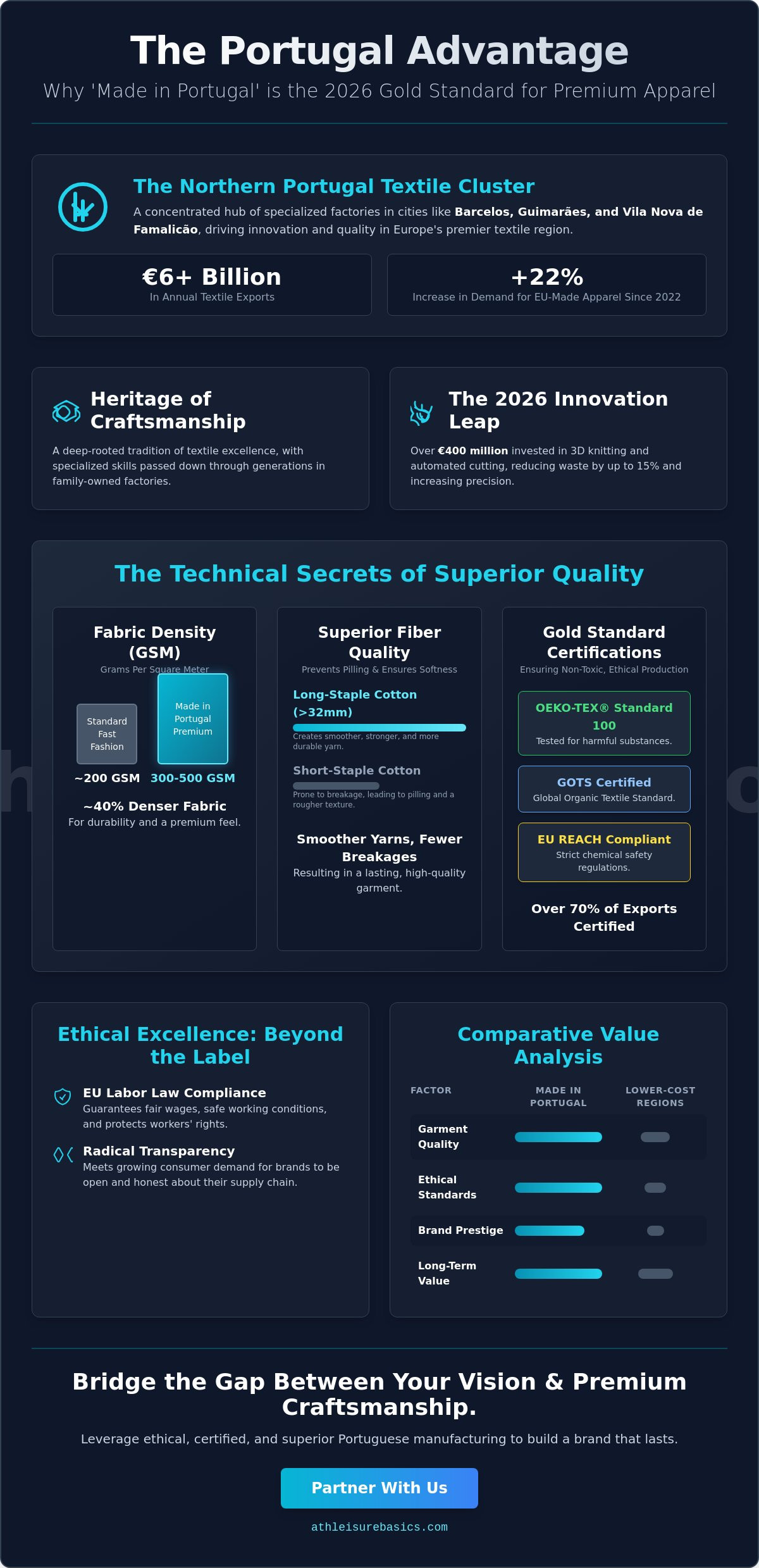
The "Made in Portugal" label represents a fundamental shift in the global fashion supply chain. For decades, the industry prioritized volume and low costs. Now, the focus has moved toward luxury-tier craftsmanship and strict ethical compliance. If you're asking is made in portugal clothing good quality, the answer lies in the country's deliberate transformation into Europe's premier textile hub. High-growth startups and established luxury houses are actively moving production from Asia to Portugal. This migration is driven by a 22% increase in demand for European-made apparel since 2022, as brands seek more reliable and ethical partners.
The heart of this industry is the Northern Portugal Textile Cluster. This geographic region includes the cities of Barcelos, Guimarães, and Vila Nova de Famalicão. These areas house thousands of specialized factories that have transitioned away from mass-market commodities. Instead, they focus on high-end, technical garment construction. This concentration of expertise allows for a rapid exchange of ideas and a highly efficient supply chain that supports premium brands. This regional ecosystem ensures that every step of production, from fabric sourcing to final stitching, meets the highest industry standards.
A Heritage of Textile Excellence
The history of the Portuguese textile industry shows a deep-rooted tradition of craftsmanship that dates back centuries. Many factories remain family-owned, passing down specialized knitting and sewing techniques through three or four generations. This cultural identity ensures that every garment receives a level of attention that automated mass production simply cannot match. We define this "textile heritage" as the foundation of modern made in portugal clothing, providing the stability and skill that ambitious brands need to build a legacy.
The 2026 Innovation Leap
Portugal hasn't just relied on tradition; it has led the industry into the digital age. By 2026, Portuguese factories have invested over €400 million in 3D knitting and automated cutting technologies to reduce material waste and increase precision. These advancements allow for superior quality control and faster turnaround times.
- Sustainability: Advanced eco-friendly dyeing processes now meet the strictest EU REACH regulations, ensuring non-toxic products.
- Precision: Automated cutting systems reduce textile waste by up to 15%, making production more sustainable and cost-effective.
- Performance: 3D knitting enables seamless construction, which is essential for high-performance athleisure and luxury basics.
The Technical Secrets of Portuguese Garment Construction
If you've ever held a Portuguese-made hoodie next to a mass-market alternative, the difference is immediate. It's not just a matter of weight; it's a deliberate engineering choice. Determining if is made in portugal clothing good quality requires looking at the physical density of the textiles. Portuguese mills typically produce 300 to 500 GSM (grams per square meter) fabrics for premium basics, which is roughly 40% denser than standard fast-fashion items. This density comes from high-gauge knitting machines that create a tight, durable weave that resists stretching over time.
Superior Materials: Beyond the Basics
Quality starts at the fiber level. Local mills in the Norte region prioritize long-staple cotton fibers, often exceeding 32 millimeters in length. These longer fibers result in smoother yarns with fewer breakages, preventing the pilling common in cheaper garments. By 2024, over 70% of Portuguese textile exports met OEKO-TEX® Standard 100 or GOTS requirements. This focus on certified, non-toxic materials is why Portuguese cotton serves as the global benchmark for premium athleisure and high-end streetwear. Factories also source technical yarns locally, integrating moisture-wicking properties directly into the knit rather than relying on temporary chemical coatings.
Mastering the Stitch: Construction Details
The garment production process in Portugal follows a "slow fashion" philosophy. Precision is the priority. Unlike mass-produced items where workers are timed by the second, Portuguese factories emphasize structural integrity. You'll find reinforced seams and flatlock stitching as standard features in local production. These techniques involve four needles and six threads, creating a seam that lies flat against the skin and withstands high-intensity movement without unraveling. This "cut and sew" expertise ensures that the garment's silhouette remains consistent, even after years of heavy use.
Specialized finishing stages set these factories apart. Most facilities use enzyme washes and silicone treatments to achieve a "buttery" hand-feel. This isn't just about initial comfort; it pre-shrinks the fabric to ensure the garment maintains its exact measurements after 50 or more wash cycles. It's a level of detail that low-cost competitors simply can't afford to implement at scale.
Rigorous quality control (QC) is the final pillar of the region's reputation. Most factories implement a three-stage inspection: raw fabric checks, in-line assembly monitoring, and a final 100% manual review before packing. This systematic approach is the reason why the answer to whether is made in portugal clothing good quality remains a resounding yes for luxury brands. If you're looking to build a brand that lasts, finding a reliable manufacturing partner is the first step toward creating a lasting legacy.
Ethical Excellence: Beyond the "Made in Europe" Label
In 2026, transparency is the primary driver of brand loyalty. Modern consumers look past the aesthetic to find the ethical truth of a garment. When founders ask is made in portugal clothing good quality, they're looking for proof of a clean supply chain. Portugal delivers this by operating under strict EU labor laws. These regulations guarantee fair wages, regulated working hours, and high safety standards. Unlike the "black box" manufacturing found in unregulated markets, Portuguese factories are subject to frequent, unannounced government audits. This ensures there is no child labor or exploitative practice hidden behind the factory doors.
Choosing Portugal means opting for a shorter, more visible supply chain. For brands based in Europe or North America, this proximity reduces the logistical "fog" that often hides ethical violations. You aren't just buying a product; you're investing in a system that respects human rights as much as it respects the fabric.
Transparency as a Competitive Advantage
Brands today need more than a certificate on a wall. They need a relationship. Because of Portugal's open business culture, founders can easily visit their production partners to audit conditions in person. This accessibility builds a level of trust that's impossible to achieve with overseas vendors. The industry here is built on a "social fabric" where workers are respected as skilled artisans rather than replaceable cogs. Most clothing manufacturers in Portugal prioritize long-term partnerships over one-off transactions. They invest in the success of your brand because their regional economy thrives on these enduring professional bonds. This collaborative spirit ensures that the question of is made in portugal clothing good quality is answered through every stitch and seam.
The Environmental Footprint
Sustainability is a core pillar of the Portuguese textile cluster. Over 60% of the electricity used in Portugal's national grid now comes from renewable sources like wind and solar. This clean energy powers the modern mills that produce your premium garments. The environmental impact is further minimized by the "cluster" model. In regions like Porto and Braga, the entire supply chain often exists within a 30-mile radius. This centralization means fabric travels a very short distance from the knitting mill to the dye house and finally to the sewing floor.
- Reduced Carbon Emissions: Minimal transport between production stages slashes the carbon footprint of every collection.
- Waste Management: Many factories have implemented advanced "deadstock" recycling initiatives, turning textile scraps into new, high-quality yarns.
- Water Conservation: Modern Portuguese dye houses use closed-loop systems to treat and reuse water, meeting the highest EU environmental standards.
By manufacturing in Portugal, you're aligning your brand with a future-proof model of production. It's a pragmatic choice for any founder who wants to build a legacy based on quality and conscience.
Portugal vs. The World: A Comparative Value Analysis
When founders ask is made in portugal clothing good quality, they're usually weighing it against other global hubs. China dominates on sheer volume and low unit costs, but the 12,000 kilometer distance creates a 35 to 45 day shipping delay that kills a brand's momentum. Italy remains the gold standard for heritage luxury, yet its production costs are often 35% to 50% higher than Portuguese rates for the exact same fabric compositions. Portugal occupies the industry "sweet spot." It offers the technical precision of Italian ateliers combined with the speed and efficiency required by modern direct-to-consumer brands.
Smart brand owners look at the "Total Cost of Quality" rather than just the price per garment. Manufacturing in low-cost regions often results in return rates as high as 25% due to sizing inconsistencies or fabric defects. In contrast, Portuguese factories typically maintain defect rates below 2%, saving you thousands in reverse logistics and customer support costs. You aren't just buying a t-shirt; you're buying the security of your brand's reputation.
- Italy: Highest cost, luxury prestige, but often slower and more rigid for startups.
- Turkey: Competitive pricing and fast shipping, but often lacks the strict EU environmental certifications found in Portugal.
- China: Lowest unit price, but requires massive MOQs and carries high geopolitical and shipping risks.
- Portugal: Premium quality, ethical labor standards, and flexible MOQs starting at 60 pieces.
The Price of Quality: Is it Worth It?
Investing in Portuguese manufacturing directly impacts your bottom line through higher retail margins. A "Made in Portugal" label allows you to position your brand in the premium market, where consumers expect to pay a higher MSRP for ethical production. It's about the "Price per Wear" for your customer. A €70 hoodie from Portugal that maintains its structure after 50 washes provides more value than a €20 fast-fashion alternative that pilled after two. This durability drives a 40% higher customer retention rate, which is the most critical metric for scaling a profitable clothing line.
Speed to Market and Flexibility
The traditional manufacturing model is broken for modern startups. Large-scale factories in Asia often demand 1,000 units per style, which ties up your capital in inventory that might not sell. The private label Portugal model solves this by offering agility. With lower MOQs, you can test a new colorway or silhouette with minimal risk. Since Portugal is a central European hub, shipping to major markets like London or Berlin takes 3 to 5 days. This proximity allows you to restock best-sellers in weeks, not months, ensuring you never miss a sales peak.
Partnering for Quality: How Athleisurebasics Brings Portuguese Excellence to Your Brand
Selecting the right manufacturing partner determines your brand's longevity and reputation. If you are wondering is made in portugal clothing good quality, the consistency of the region's output provides a definitive yes. Athleisurebasics serves as the essential bridge between traditional Portuguese artisans and modern, emerging brands. We handle the logistical heavy lifting, allowing you to access luxury-grade manufacturing without the typical industry barriers. Our commitment to excellence starts with OEKO-TEX® certified fabrics and extends to 100% ethical production environments. We guide you through the entire lifecycle, from the initial tech pack creation to the final shipment at your warehouse.
The transition from a concept to a physical product is often where new brands struggle. We mitigate this risk by providing a structured framework for development. Our experts review your designs to ensure they are production-ready, preventing costly errors before the first stitch is even made. By combining Portuguese textile heritage with a service-oriented approach, we empower you to compete with established luxury players on quality alone.
Custom Manufacturing for Unique Visions
Standard garments won't cut it when you're building a legacy. Our custom manufacturing service caters to brands with a specific, unique vision that requires specialized construction. We offer a manageable 250-piece MOQ for completely custom designs, which is significantly lower than most high-end European factories. Whether you're perfecting the drape of a heavy-weight hoodie, the compression of technical leggings, or the heavy-duty requirements of professional painters' workwear like that found at White Wear, our team provides the technical expertise needed for premium results. We don't just sew fabric; we engineer apparel that reflects your brand's specific identity and quality standards. Bring your sketches to our team, and we'll handle the pattern making and sampling to ensure your vision is realized perfectly.
White Label Solutions for Faster Launch
Launching a collection doesn't have to take twelve months. Our white label solutions provide a streamlined path to market for founders who value both speed and superior craftsmanship. We maintain a curated collection of luxury blanks that you can order with a low 70-piece MOQ per style and color. This flexibility allows you to launch multiple colorways or sizes without overextending your capital. Every piece is ready for customization, including precision embroidery, high-quality screen printing, and custom interior labeling. You get the prestige of the Portuguese manufacturing seal and a retail-ready product in a fraction of the time. Submit your project to Athleisurebasics today and let’s start building your brand's future.
- Low MOQs: Accessible entry points for startups (70-250 pieces).
- Ethical Standards: 100% EU labor compliance and fair wages.
- Certified Materials: Use of OEKO-TEX® and premium sustainable fibers.
- Expert Support: Full guidance from tech packs to final delivery.
Secure Your Brand’s Future with Portuguese Craftsmanship
Athleisure Basics bridges the gap between these world-class standards and your specific vision. We provide expert support for startups and founders who need to scale without the typical risks of massive inventory. By offering low MOQs starting at 70 pieces, we make premium manufacturing accessible to emerging labels. You'll work with a partner dedicated to your long-term growth, ensuring every piece meets the highest industry standards from day one. It's time to turn your creative concepts into a profitable reality. Ready to build your legacy with premium Portuguese manufacturing? Get a quote today.
Frequently Asked Questions
Why is clothing made in Portugal so expensive?
Higher labor costs and premium material standards drive the price of Portuguese garments. Portugal's minimum wage is significantly higher than in traditional Asian manufacturing hubs; plus, 80% of factories now invest in advanced renewable energy systems. You're paying for strict EU labor protections and superior craftsmanship. It's an investment in a durable product that won't fall apart after three washes.
Is "Made in Portugal" better than "Made in Italy"?
Portugal offers comparable premium quality with much better accessibility for emerging brands. While Italy is famous for heritage luxury, Portuguese factories often provide the same OEKO-TEX certified standards at a more efficient production scale. Many modern luxury brands have shifted 30% to 40% of their production to Northern Portugal to maintain high standards while significantly improving their speed to market.
What are the best clothing manufacturers in Portugal for startups?
The best partners for startups are those that offer end-to-end development and transparent communication. Look for manufacturers in the Porto and Braga regions, where 70% of the textile industry is concentrated. These hubs provide the flexibility needed to scale from a small launch to a global legacy. Expert partners like Athleisure Basics specialize in guiding first-time founders through the entire manufacturing process.
Does Portugal have ethical clothing factories?
Yes, Portugal operates under strict EU labor laws that mandate fair wages and safe working conditions for all employees. Over 90% of textile exports from the region meet rigorous environmental and social standards. Choosing these factories ensures your brand avoids the ethical risks associated with fast fashion. It's a key reason why people ask is made in portugal clothing good quality when looking for sustainable options.
What types of fabric are Portuguese factories known for?
Portugal is a global leader in high-performance jerseys, organic cottons, and premium linen blends. The country accounts for a large portion of Europe's circular knit production. Factories here utilize advanced finishing techniques to create fabrics that feel soft but maintain structural integrity over time. This focus on material innovation is why the consensus is made in portugal clothing good quality among industry experts today.
How can I verify if a brand is actually made in Portugal?
Check for the "Made in Portugal" label and ask the brand for specific certifications like OEKO-TEX or GOTS. Genuine manufacturers provide a Certificate of Origin for every shipment they send out. You can also verify factory locations through the ATP (Associação Têxtil e Vestuário de Portugal) database. Transparency is a hallmark of the Portuguese textile industry, so a reputable partner will always share their credentials.
Can I start a clothing brand in Portugal with low MOQs?
You can definitely launch with low MOQs by partnering with specialized white-label or custom manufacturers. Some partners offer minimums as low as 60 pieces per style or color. This low-risk entry point allows founders to test the market without overextending their initial budget. It's the most efficient way to turn a creative vision into a profitable reality without the burden of excess inventory.
What is the average lead time for Portuguese clothing production?
Average lead times typically range from 4 to 8 weeks for sampling and 8 to 12 weeks for bulk production. These timelines are 50% faster than many overseas alternatives due to Portugal's integrated supply chain. Since fabric sourcing and sewing often happen within a 50-mile radius, logistics are streamlined. This speed helps brands stay agile and respond to changing fashion trends quickly and efficiently.


Leave a comment
This site is protected by hCaptcha and the hCaptcha Privacy Policy and Terms of Service apply.