

How to Negotiate with Clothing Manufacturers: A 2026 Guide for Scaling Brands
What if the biggest barrier to your brand’s growth isn't your marketing budget, but the fact that you're paying 22% more for production than your competitors? Many founders feel like outsiders when they enter a factory meeting, fearing that a lack of technical knowledge will lead to inflated quotes or rigid minimums that tie up essential capital. It’s a valid concern because learning how to negotiate with clothing manufacturers isn't just about saving pennies; it’s about building a profitable and sustainable supply chain. You deserve to walk into these meetings with the confidence of an industry veteran.
We understand that securing a fair deal feels daunting when you are trying to protect your cash flow. This guide teaches you exactly how to negotiate with clothing manufacturers by using professional frameworks that position your brand as a high value partner. You will learn how to leverage your brand's growth potential to secure lower unit costs and more flexible MOQ terms. We are going to break down the four specific tactical levers you need to move from a simple transaction to a premium partnership that supports your long term legacy. By the end of this article, you will have a clear roadmap to reduce your manufacturing risks while maintaining superior quality standards for your 2026 collections.
Key Takeaways
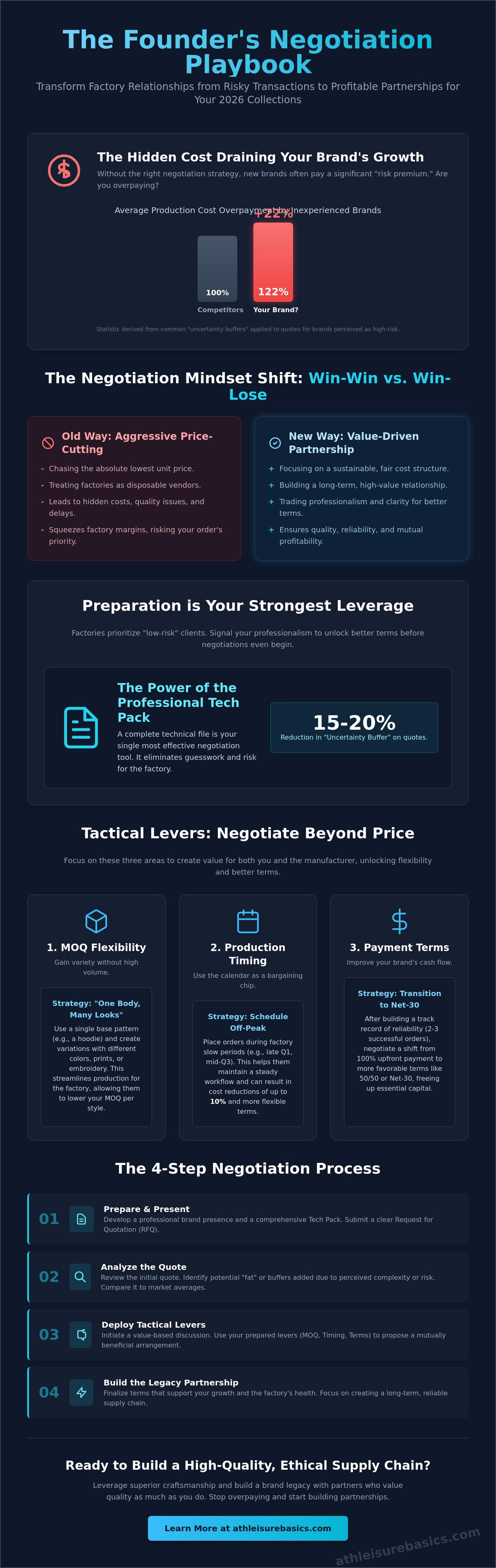
- Shift your mindset from aggressive price-cutting to a value-driven partnership that respects factory labor and material efficiency.
- Master how to negotiate with clothing manufacturers by using professional Tech Packs to signal low risk and secure more competitive terms.
- Discover the "One Body, Many Looks" strategy to gain MOQ flexibility and launch multiple styles without increasing production costs.
- Learn the step-by-step process for identifying "fat" in initial quotes and transitioning from upfront payments to favorable Net-30 terms.
- Leverage the superior ethical standards and craftsmanship of Portuguese manufacturing to build a high-quality legacy for your brand.
What Does Negotiation Mean in Clothing Manufacturing?
Negotiation in the apparel industry is often misunderstood as a simple battle over cents per unit. It's actually a strategic value exchange designed to build a sustainable partnership. When you master how to negotiate with clothing manufacturers, you're seeking a balance between your brand's growth and the factory's operational health. This process isn't about winning a fight; it's about finding a "Win-Win" framework where you trade clarity and reliability for better terms.
From the factory's perspective, profit is tied to three variables: machine downtime, labor costs, and material waste. A 2024 industry report by McKinsey highlighted that fashion supply chains are shifting toward agile production to mitigate risks. By 2026, market trends favor brands that prioritize ethical and transparent partnerships. A manufacturer is more likely to offer favorable terms to a brand that provides professional tech packs and predictable order volumes. This transparency reduces their overhead and allows them to commit their best labor to your projects.
Effective Negotiation involves understanding that a factory is your most important business partner. If you squeeze their margins too tight, they'll eventually cut corners on your quality or deprioritize your orders during peak seasons. True negotiation ensures both parties remain profitable and motivated.
The Myth of the 'Lowest Price'
Chasing the cheapest quote is a trap for scaling brands. A price that's 15% to 20% lower than the market average often results in hidden costs, such as quality control failures or 30-day shipping delays. Manufacturing complexity directly dictates unit cost. A premium hoodie with high-density embroidery requires more "minutes on the floor" than a basic tee. You should transition from cost-plus to value-based negotiation. Instead of asking how cheap a garment can be, ask how you can optimize the design to reduce waste while maintaining premium quality standards. This approach protects your margins without sacrificing the top-notch craftsmanship your customers expect.
Understanding Factory Capacity and Timing
Your production calendar is a powerful bargaining tool. Most factories face extreme pressure during peak seasons before major holidays. Scheduling your production during "off-peak" months, such as late Q1 or mid-Q3, can lead to a 10% reduction in costs. Manufacturers want to fill gaps in their schedule to keep their skilled workforce employed year-round. Knowing how to negotiate with clothing manufacturers involves using these timing windows as leverage. If you can provide a deposit and finalized designs during a slow period, a factory is much more likely to flex on their Minimum Order Quantity (MOQ) or offer priority lead times when the rush starts.
Preparation as Leverage: The Professionalism Playbook
Professionalism acts as a silent currency in the manufacturing world. When you approach a production partner, they are vetting your brand's stability just as much as you are vetting their quality. High-end factories in 2026 prioritize "low-risk" clients who minimize operational friction. By presenting a polished, data-driven front, you position yourself as a serious partner rather than a hobbyist. This perceived professionalism is the foundation of how to negotiate with clothing manufacturers for better credit terms, prioritized production slots, and reduced sampling fees.
The Power of the Tech Pack
The most effective way to Negotiate The Best Price is to provide a complete technical file. Creating a tech pack for clothing significantly reduces factory overhead because it eliminates the need for the production manager to guess your requirements. When specifications are vague, manufacturers often add a 15% to 20% "uncertainty buffer" to their quotes to protect their margins from unexpected revisions.
A Tech Pack is the blueprint that eliminates costly guesswork for the factory.
Detailed specs, including POM (Point of Measure) charts, bill of materials, and grading rules, ensure that your first sample is 90% accurate. This efficiency saves the factory time and saves you money. It removes the "padding" from the quote, allowing you to negotiate based on actual labor and material costs rather than a safety margin.
Forecasting and Transparency
Honesty about your current scale builds more trust than inflated promises that never materialize. If you're a startup, own that reality. Transparency is a core pillar when choosing a clothing manufacturer that aligns with your long-term vision. Instead of promising huge orders today, share a realistic 12-month sales forecast. This allows the factory to plan their machine capacity and raw material sourcing months in advance.
Providing a roadmap for future volume allows you to secure "growth-based" discounts. You might pay a standard rate for the first 100 pieces, with a contractual agreement that the unit price drops by 10% once you hit a cumulative 500 pieces. This collaborative approach turns the manufacturer into a stakeholder in your success. If you're ready to start this professional journey, you can submit your project details to see how a structured approach changes the conversation.
Tactical Levers: Negotiating Beyond the Unit Price
Price is often the first thing founders look at, but it's rarely the most important factor for a scaling brand. If you focus only on the unit cost, you might miss opportunities to protect your cash flow or reduce your operational risk. Learning how to negotiate with clothing manufacturers requires a holistic view of the entire production cycle. You can often secure better long-term value by shifting your focus toward payment flexibility, sampling credits, and bundled services.
Many factories initially demand 100% payment upfront from new brands. As you build a relationship, you should negotiate a move to a 50/50 structure, where you pay half to start production and the balance before shipping. For brands with a 12-month history of reliable payments, aiming for Net-30 terms is a realistic goal that keeps more capital in your business for marketing. You should also ask for sampling fees to be credited back to your first production run. If a factory charges $150 for a prototype, they'll often agree to deduct that cost from a bulk order of 100 units or more.
- Bundled Packaging: Negotiate to include premium labels, hangtags, and sustainable compostable bags in the total unit price.
- Quality Guarantees: Ensure the contract includes a 2% to 3% defect allowance, with credits applied to future orders if errors exceed this limit.
- Lead Time Penalties: For large seasonal drops, request a small discount if production exceeds the agreed-upon deadline by more than 14 days.
Mastering the MOQ
Startups often struggle with high minimums, but you can effectively negotiate clothing manufacturing MOQ by using the "One Body, Many Looks" strategy. Instead of ordering five different fabrics, use one high-quality fabric across multiple styles, such as leggings, sports bras, and shorts. This allows the factory to meet their fabric minimums while giving you variety. It's also vital to understand the difference between fabric MOQ, which might be 500 meters, and garment MOQ, which can be as low as 60 pieces in specialized European facilities. Proposing a "Trial Run" of a smaller quantity helps prove your brand's sell-through potential to the manufacturer, making them more likely to support your growth.
Shipping and Logistics Terms
Logistics terms significantly impact your final landed cost. Most manufacturers prefer EXW (Ex Works) terms, where you're responsible for everything once the goods leave the factory door. You should push for FOB (Free on Board) terms instead. This requires the manufacturer to handle the costs and risks of getting the goods to the port or terminal. Manufacturing in Portugal offers a distinct advantage for brands in the EU and US, as it reduces the complexity of logistics compared to sourcing from Asia. You don't have to worry about 45-day sea freight delays or massive carbon footprints. By negotiating shipment consolidation, you can group multiple small orders into one delivery, which cuts down on customs fees and administrative overhead.
The Step-by-Step Negotiation Process
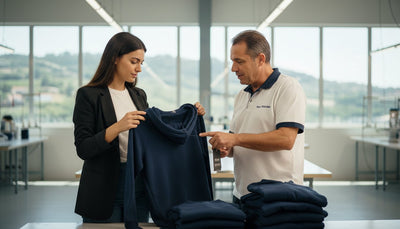
Successful partnerships begin with a Request for Quote (RFQ) that signals you're a serious professional. Your RFQ should include detailed tech packs, material specifications, and projected volumes for the 2026 season. When you provide clear data, the factory doesn't have to guess. Guessing leads to "buffer" pricing where manufacturers add 10% to 15% to the cost just to cover potential unknowns. Learning how to negotiate with clothing manufacturers starts with removing that uncertainty.
Once the initial quote arrives, don't accept it as final. This is your baseline. Review the document to identify where the costs are concentrated. If a quote seems unusually high, ask for a breakdown of labor versus materials. If it's suspiciously low, verify that it meets EU ethical labor standards and OEKO-TEX certifications. A price that's too low often indicates a compromise in quality or ethical transparency that could damage your brand's legacy.
How to Read a Quote Like a Pro
You must distinguish between Cut, Make, Trim (CMT) and Full Package Production (FPP). FPP is convenient because the factory handles everything, but they often add a 5% to 10% markup on the fabrics they source for you. In CMT, you provide the materials, giving you more control over the "fat" in the pricing. Look closely at fabric wastage. While 8% to 12% wastage is standard for premium Portuguese jersey, a quote showing 20% wastage is a red flag you should challenge immediately.
The Art of the Counter-Offer
Effective negotiation is a collaborative effort to find a "win-win" scenario. Use these strategies to refine your costs without compromising the factory's viability:
- Price Brackets: Request quotes for 100, 300, and 500 units. This shows the factory you intend to scale and helps you understand their efficiency levels.
- The If/Then Technique: Use logic to trade value. For example, "If we commit to three styles using the same fabric, can we reduce the low MOQ per style?"
- The Walk-Away Point: Determine your maximum cost per unit based on a 60% gross margin target. If the manufacturer can't meet this while maintaining quality, it's better to walk away than to launch a non-profitable product.
Finalize the deal by getting every detail in a Production Agreement. This document should specify lead times, shipping responsibilities, and defect tolerances. In high-end European manufacturing, a defect rate of 1% to 2% is the standard expectation. Having this in writing protects your investment and ensures your partner is held to the highest industry standards.
Ready to build a profitable partnership with a transparent manufacturer? Explore our custom clothing options to see how we support your brand's growth.
Building a Legacy Partnership in Portugal
When you master how to negotiate with clothing manufacturers, you quickly realize that the lowest price per unit often hides the highest long-term costs. Choosing made in portugal clothing offers a strategic advantage that transforms the negotiation from a price battle into a value-driven partnership. Portugal's textile industry reached an export value of over €6 billion in 2023, a success built on a foundation of ethical labor standards and technical innovation.
Negotiating within the European Union framework provides a level of security that offshore regions can't match. You aren't just buying fabric; you're investing in OEKO-TEX® certified materials and EU labor compliance. These standards act as a safeguard for your brand's reputation. Cultural proximity and shared business ethics simplify the communication process. When you speak the same professional language, you reduce the "miscommunication tax" that often leads to costly production errors and shipping delays.
Quality as a Cost-Saver
The "Right First Time" philosophy is the most effective way to protect your margins. In many low-cost manufacturing hubs, a 5% defect rate is considered acceptable, but for a scaling brand, those rejects represent lost revenue and unhappy customers. High-quality textile selection and precision stitching in Portuguese factories ensure your inventory is ready for the shelf immediately upon arrival.
Investing in premium construction creates a significant return on investment through reduced returns and increased customer lifetime value. As you refine how to negotiate with clothing manufacturers, prioritize craftsmanship over cents. "In the luxury market, the cost of a returned garment is always higher than the cost of premium manufacturing." This mindset shifts your brand from a disposable commodity to a lasting legacy.
Partnering with Athleisurebasics
We specialize in helping startups and scaling brands navigate the complexities of production without the traditional barriers to entry. Our team provides expert consulting to bridge the gap between your initial design vision and a retail-ready product. We understand that flexibility is vital for new founders, which is why we offer low MOQs starting at just 60 pieces per style or color.
Our approach is built on transparency and efficiency. We don't just take orders; we act as your technical partner to ensure every seam and fabric choice aligns with your brand's goals. Whether you're looking for white label solutions or fully custom developments, we provide the infrastructure you need to grow sustainably.
Ready to move from a concept to a physical collection? Submit your project today for a transparent, professional quote and take the first step toward building your brand legacy with a trusted Portuguese partner.
Build Your Legacy with Smart Production Partnerships
The path to a successful clothing line requires shifting from a buyer's mindset to a partner's perspective. By 2026, the global apparel market is expected to reach a valuation of $1.7 trillion, which means demand for high-quality, ethical production will only intensify. Knowing how to negotiate with clothing manufacturers involves focusing on more than just the price per garment. You must leverage professional tech packs and clear communication to secure favorable lead times and flexible payment terms. These tactical levers are what separate a struggling startup from a scaling legacy brand. It's about finding a balance between cost-efficiency and the premium quality your customers expect.
Athleisure Basics supports your vision with a foundation of OEKO-TEX® certified premium fabrics and expert production consulting included in every project. We specialize in low-MOQ manufacturing, allowing you to launch with as few as 60 pieces per style. This approach minimizes your initial investment while ensuring your products meet the highest European quality standards. Ready to launch? Get a custom manufacturing quote from Athleisurebasics today.
You've got the vision and the strategy to succeed. We're here to help you turn those sketches into a profitable reality.
Frequently Asked Questions
Is it possible to negotiate the MOQ for my first order?
Yes, you can negotiate the Minimum Order Quantity (MOQ) by offering to pay a 15% to 25% surcharge on the unit price. Manufacturers often agree to lower their standard 500-unit minimum to 100 units if they see potential for a long-term partnership. It's a strategic trade-off that helps you test the market without over-investing in inventory. Focus on building a roadmap for 2026 that shows how your volume will scale over the next three seasons.
How do I know if a clothing manufacturer's price is fair?
You determine a fair price by requesting detailed quotes from at least 4 different manufacturers with similar quality standards. Use industry reports to benchmark average labor costs in regions like Portugal or Turkey. A fair quote should break down costs for fabric, labor, and finishing. If one quote is 40% lower than others, it often signals a risk to quality or ethical standards. Professional brands prioritize transparency over the lowest possible number.
What should I do if a manufacturer refuses to lower their price?
Shift your focus to non-monetary terms if a factory won't budge on the unit cost. Negotiate for a 30% deposit instead of 50%, or ask for faster 4-week lead times during peak seasons. You can also request free labels or specialized packaging as a value-add. Learning how to negotiate with clothing manufacturers involves finding flexibility in logistics and payment schedules when the raw production cost is fixed. It's about the total value of the partnership.
Does paying early help in negotiating better terms?
Paying early is a powerful lever that can secure a 2% to 5% discount on your total invoice. Manufacturers value cash flow stability and prioritize clients who reduce their financial risk. Offering a 100% upfront payment for a small test run often helps you secure a spot in their production calendar during busy months like September. It demonstrates that you're a reliable partner committed to a professional business relationship. This builds trust for future scaling.
Can I negotiate for better quality control standards?
You should always negotiate for specific Quality Control (QC) protocols, such as the AQL 2.5 standard, during the initial contract phase. Request that 100% of the first 50 units are inspected by a third-party agency before final payment. Setting these expectations early ensures your premium products meet the highest industry standards. Factories are more likely to adhere to strict guidelines when they know a formal inspection is a condition of the balance payment. Don't leave quality to chance.
Should I mention that I am a startup during negotiations?
Mentioning you're a startup is beneficial if you frame your brand as a high-growth partner with a clear 12-month scaling plan. Factories in Portugal often reserve 15% of their capacity for emerging brands that show professional branding and clear technical packs. Don't lead with your lack of experience as a reason for discounts. Instead, show your 2026 marketing strategy to prove you'll be a high-volume client within three production cycles. This inspires confidence in your brand's longevity.
What are the most common mistakes to avoid when negotiating?
The most common mistake is entering discussions without a complete tech pack, which leads to a 30% increase in quoting errors. Avoid being overly aggressive on price, as this often results in the factory using inferior 180gsm fabric instead of the 240gsm you requested. Another error is failing to confirm the landed cost, which includes shipping and duties. Professional brands prioritize transparency and quality over the absolute lowest price point. Precise communication prevents 90% of production delays.
How do I negotiate if I want to use my own fabric suppliers?
Request a Cut, Make, Trim (CMT) agreement if you've already sourced OEKO-TEX certified fabrics from your own supplier. This requires you to coordinate the delivery of all raw materials to the factory 14 days before production starts. Negotiate a clear waste allowance of 3% to 5% for the fabric. Understanding how to negotiate with clothing manufacturers for CMT services ensures you maintain full control over your material quality while leveraging their expert craftsmanship. It's an ideal setup for brands focused on unique textiles.

Leave a comment
This site is protected by hCaptcha and the hCaptcha Privacy Policy and Terms of Service apply.