
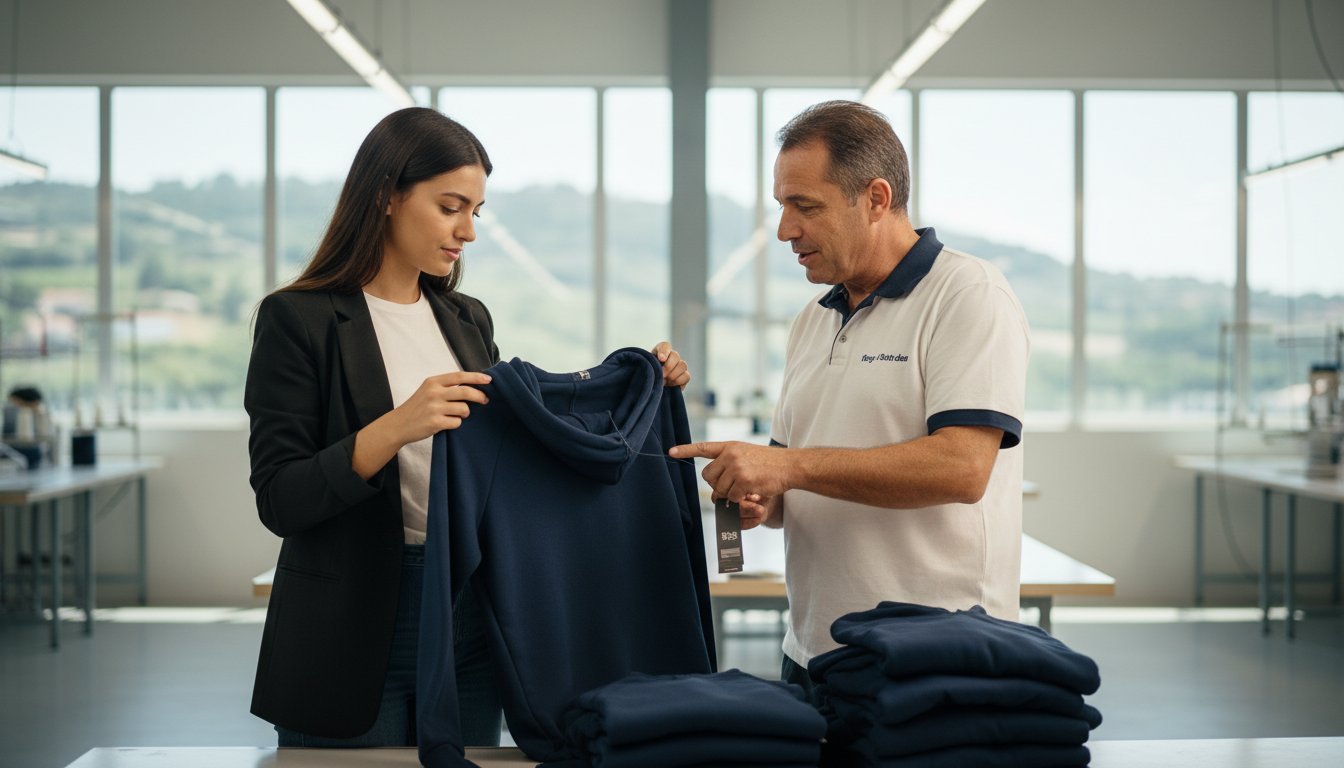
Understanding Factory MOQs: A Strategic Guide for Emerging Apparel Brands
What if the very number that's keeping you from launching your collection is actually the key to your brand's long-term profitability? For many first-time founders, the requirement to order 500 or 1,000 units per style feels like an impossible barrier that leads to high upfront inventory costs and the constant fear of overstocking. Understanding factory MOQs is about more than just reading a price sheet; it's about recognizing the operational logic that drives these numbers. You aren't alone in feeling frustrated when one factory demands a massive commitment while another offers the flexibility you need to scale.
We've helped hundreds of emerging brands transition from a simple vision to a successful market launch by demystifying these production hurdles. This guide will help you master the complexities of Minimum Order Quantities so you can optimize your production budget and secure high-quality manufacturing partnerships. You'll learn the primary drivers behind MOQ variations, specific strategies to lower your production risk, and how to identify a partner that prioritizes premium, low-volume manufacturing. By the end of this article, you'll have a clear roadmap to turn your creative concepts into a profitable legacy without the burden of excess stock.
Key Takeaways
- Identify the critical differences between order, style, and color minimums to effectively manage your initial production budget.
- Gain a strategic advantage by understanding factory MOQs and the hidden role that fabric mills and machine re-tooling play in your manufacturing costs.
- Learn to navigate the quality-cost trade-off to avoid the risks of deadstock fabrics while securing the best unit pricing for your brand.
- Master fabric consolidation techniques that allow you to launch multiple styles while meeting strict textile supplier minimums.
- Discover how flexible, tiered manufacturing options can help you scale your vision from a small collection to a global legacy.
What is Minimum Order Quantity (MOQ) in Apparel Manufacturing?
Minimum Order Quantity (MOQ) is the lowest number of units a manufacturer is willing to produce for a single order. It serves as a vital baseline for factory viability. Without these minimums, the costs of setting up machinery, sourcing raw materials, and managing labor would exceed the revenue generated from the order. For new entrepreneurs, understanding factory MOQs is essential for managing cash flow and inventory risk. This requirement isn't just about volume; it's a reflection of the Economic Order Quantity (EOQ), which helps businesses balance the costs of ordering against the costs of holding stock.
MOQs also act as a professional filter. They help premium manufacturers identify brands that are ready for a serious production partnership. When a factory sets an MOQ, they're ensuring that their high-quality craftsmanship and specialized machinery are used efficiently. It protects the factory's margins while providing the brand with a clear path to scalability. Choosing the right partner means finding a factory whose minimums align with your current growth stage.
The Three Layers of MOQs
Manufacturers typically break down their requirements into three distinct categories. You'll need to account for each when planning your collection to avoid unexpected production hurdles.
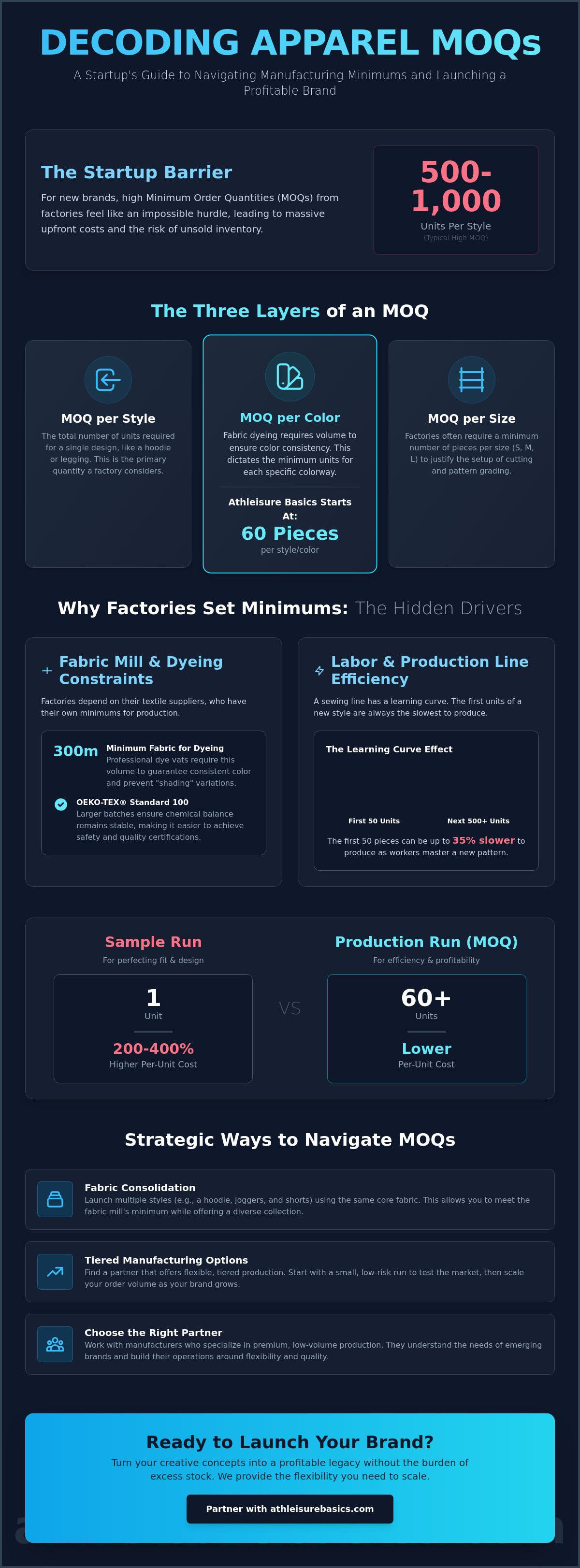
- MOQ per Style: This is the total number of units for a specific design, such as a premium hoodie or technical legging.
- MOQ per Color: Fabric dyeing is a volume-dependent process. Most dye houses require a minimum weight of fabric to ensure color consistency, which dictates how many units you must order in a specific shade.
- MOQ per Size: Cutting and grading patterns for different sizes adds complexity. Factories often require a minimum number of pieces per size to justify the setup of the cutting tables and the use of the CAD software.
For startups, the "per style/color" metric is the most critical. It determines how much variety you can offer in your first drop without overextending your budget. At Athleisure Basics, our white label service starts at 60 pieces per style/color, providing the flexibility you need to launch your brand quickly and efficiently.
MOQ vs. Sample Runs
It's vital to distinguish between a sample run and bulk production. Samples are individual prototypes used to perfect fit and design. Because they require manual attention from master tailors and pattern makers, samples often cost 200% to 400% more per unit than production pieces. Transitioning from a prototype to a production-ready volume is where the real business growth happens. MOQ acts as a tool for production efficiency and unit-cost reduction. By reaching these minimums, you unlock the lower unit prices that make your brand profitable. Ultimately, understanding factory MOQs allows you to plan your inventory with confidence and move from a simple vision to a lasting legacy.
The Anatomy of an MOQ: Why Factories Set Minimums
Understanding factory MOQs starts with recognizing that production is a chain of dependencies. A factory doesn't just decide on a number to be difficult. They calculate it based on raw material availability and operational overhead. Every design requires a unique setup. If the volume is too low, the factory loses money on labor and electricity before the first garment is even finished. These minimums are essentially a "break-even" point where quality and cost-efficiency intersect.
Fabric Mill Minimums and Dyeing Constraints
Factories are often at the mercy of their textile suppliers. Dyeing 300 meters of fabric in a professional vat ensures color consistency across every centimeter. When a brand requests a tiny batch, the mill must use smaller equipment that often produces "shading" or color variance. Premium athleisure blends, specifically those with high elastane content or custom knits, require specialized machinery that won't start for less than a full roll of fabric. This is why achieving OEKO-TEX® Standard 100 certification is far more reliable with larger batches. The chemical balance remains stable throughout the process, ensuring the fabric is safe and high-quality.
Labor and Production Line Efficiency
Sewing is a skill-based process with a steep learning curve. Industry data shows that the first 50 units of a new design are produced up to 35% slower as seamstresses master the specific tension and stitch patterns required for a new style. Factories must amortize the fixed costs of pattern making, grading, and "re-tooling" the line over a specific number of units to remain profitable. Every minute a machine sits idle while a technician adjusts it for a new tech pack is lost revenue. You can see how these steps fit into the the garment production process to better plan your launch timeline.
Beyond labor, factories must manage the risk of "deadstock." If a factory buys 100 meters of fabric but your order only uses 75, that leftover 25 meters becomes waste that occupies warehouse space and eats into their margins. By setting a minimum, they ensure that fabric usage is optimized and quality remains consistent from the first piece to the last. This structure protects both the manufacturer and the brand from the high costs of inefficiency. If you're looking for a partner that balances these requirements with your need for growth, explore our flexible production options to see how we support emerging brands.
- Administrative Overhead: Managing one order for 500 pieces requires the same amount of paperwork and QC scheduling as an order for 50 pieces.
- Pattern Grading: Creating five different sizes for a single design involves technical precision that must be paid for regardless of the total quantity produced.
- Quality Control: Professional factories implement QC checks at multiple stages, which is only cost-effective when spread across a full production run.
Low MOQ vs. Mass Production: The Quality-Cost Trade-off
Choosing between a low minimum order quantity and mass production isn't just about the number of boxes arriving at your warehouse. It's a fundamental decision about your brand's DNA. Understanding factory MOQs requires a clear look at how volume impacts every stitch and seam. In a mass production model, unit costs drop because the factory spreads setup expenses across thousands of items. When you order 5,000 units, the time spent setting up the cutting tables and calibrating sewing machines becomes negligible. At 100 units, those same fixed costs account for a larger percentage of your price.
Professional factories maintain specific MOQs to guarantee consistency and adhere to strict EU standards. They don't just guess at the quality; they follow rigorous technical specifications. While mass production offers the lowest price point, it demands significant capital and increases the risk of holding unsold inventory. For emerging brands, the goal is to find the "sweet spot" where the volume is high enough to ensure professional manufacturing but low enough to protect cash flow.
The Risk of Cheap "Low MOQ" Suppliers
Many suppliers lure startups with "No MOQ" promises, but these deals often come with hidden costs. These factories frequently use deadstock or leftover fabrics from larger production runs. This creates a "one-and-done" problem. If your first 50 hoodies sell out in 48 hours, you might find that the fabric is gone forever. You can't scale a brand on inconsistent materials.
- Inconsistent sizing: Without professional pattern grading, your Medium might fit like a Small in the next batch.
- Lack of transparency: Cheap suppliers rarely provide OEKO-TEX® certifications or proof of ethical labor.
- Durability issues: Lower-tier factories often skip reinforcement stitching to save time on small runs.
Why Premium Low-MOQ in Portugal is Different
Portugal has redefined the manufacturing landscape by offering a sophisticated middle ground. You don't have to choose between massive volume and poor quality. The understanding factory MOQs in this region is built on the concept of "slow fashion" and durability. Factories here provide access to high-end European textiles even for smaller collections, ensuring your brand stands out for its craftsmanship.
When you choose made in portugal clothing, you're investing in a partnership. These facilities use standardized blocks and professional tech packs for every order, regardless of size. This ensures that your fit remains identical from your first 60 pieces to your eventual 6,000. It's a strategic move that balances ethical labor with the flexibility needed to launch and scale a profitable apparel brand without the typical risks of offshore mass production.
Strategic Ways to Navigate Factory MOQs as a Startup
Understanding factory MOQs is often the biggest hurdle for new founders, but these numbers aren't always set in stone. You can lower your entry barriers by focusing on efficiency and smart design choices. Factories are more likely to work with you when you demonstrate that your production plan minimizes their waste and setup time. Success in the early stages depends on your ability to simplify your supply chain before you ever place an order.
Smart Fabric Planning
One of the most effective ways to lower your requirements is through fabric consolidation. Instead of sourcing different textiles for every garment, use the same high-performance fabric across your entire collection. For example, a single 220gsm recycled nylon can work perfectly for leggings, bike shorts, and supportive sports bras. Fabric consolidation can effectively halve your style-level MOQ by meeting the total fabric requirement across several designs.
- Utilize stock fabrics: Ask your partner about "stock fabrics" they keep in-house to bypass the 500-meter minimums often required by textile mills.
- Standardize components: Designing a collection that shares trims, elastics, and threads reduces the number of individual components the factory needs to source.
- Limit colorways: Stick to core, high-demand colors for your first launch. Starting with black, navy, or charcoal allows you to meet fabric minimums more easily than launching with five different seasonal shades.
White Label vs. Custom Manufacturing
Your choice of manufacturing model directly impacts your minimums. For a first launch, choosing white label products is often the most strategic path. These are premium, pre-designed blanks that allow you to add your custom branding without the high costs and risks of initial pattern development. White label orders typically start at 70 pieces, providing a low-risk entry point for new brands.
In contrast, Custom (CMT) manufacturing involves unique designs built from scratch. Because this requires custom patterns, grading, and specific fabric runs, minimums usually start at 250 pieces per style. If you want to explore how these models work in a high-quality European setting, check out our guide on private label portugal for deeper insights into ethical production.
The Importance of Professional Tech Packs
A professional tech pack is your strongest negotiating tool when you're trying to manage factory expectations. It serves as a comprehensive blueprint that eliminates guesswork for the production team. When you provide clear measurements, material specifications, and construction details, you significantly reduce the factory's risk of errors. This professional approach builds trust and shows that you're a serious partner, which often leads manufacturers to offer more flexible terms to help you scale.
Ready to launch your collection with a production partner that supports your growth? Explore our low MOQ manufacturing options and start building your brand today.
Partnering for Growth: The Athleisurebasics Approach to MOQs
We don't view minimum order quantities as a barrier to entry. Instead, we see them as a strategic tool for sustainable growth. For many entrepreneurs, understanding factory MOQs reveals a common industry hurdle: the requirement for massive upfront volume. We've structured our business to remove this obstacle for startups and established brands alike. Our tiered MOQ options are designed to match your specific stage of development, ensuring you never have to overextend your capital on inventory that hasn't been tested in the market.
- White Label Flexibility: You can launch your brand with as few as 70 pieces per style. This is ideal for testing new designs or entering the market quickly with proven silhouettes.
- Custom Manufacturing: We offer professional-grade production starting at 250 pieces. This allows you to create unique, proprietary designs without the 500-piece or 1,000-piece minimums typical of large-scale factories.
- Scalable Infrastructure: As your demand increases, our facilities are equipped to handle your growth, maintaining the same quality standards as you move from hundreds to thousands of units.
Our "Logo to Legacy" philosophy is the foundation of our partnership. We don't just act as a vendor; we act as a guide. By offering lower entry points, we help you manage cash flow during the critical first years of your business. This approach allows you to focus on marketing and community building while we handle the complexities of the supply chain.
Why We Offer Low MOQs in Portugal
Portugal is a global leader in premium textile manufacturing. We've invested heavily in this region to support the next generation of premium athleisure brands. Our production process utilizes Oeko-Tex certified materials, even for small-scale runs. This certification ensures your garments meet the highest safety and environmental standards from the very first piece. We maintain full transparency in our production consulting and sourcing support. You receive the same level of expert craftsmanship and high-quality materials that luxury labels demand, but at quantities that make sense for a growing business.
Next Steps: Moving from Vision to Production
Moving from a creative vision to a physical product requires clear communication and preparation. To prepare your project for a quote, ensure you have your design sketches, tech packs, or reference samples ready. Understanding factory MOQs helps you plan your budget, but our team helps you execute the details. Our Portuguese craftsmanship relies on strict EU ethical standards, providing you with a product you can be proud to sell. We make it easy to transition from a single idea to a professional collection.
Ready to start your production? Get a custom manufacturing quote today and see how our flexible minimums can support your brand's journey.
Scale Your Brand with Strategic Production
Mastering the manufacturing landscape requires understanding factory MOQs and how they directly impact your cash flow. By prioritizing low minimums, you eliminate the risk of holding excess inventory while keeping the flexibility to scale based on real market demand. Strategic sourcing isn't just about finding a supplier; it's about finding a partner that balances small-batch agility with high-end craftsmanship.
Athleisure Basics provides the infrastructure you need to compete at a luxury level. Our production model offers low MOQs starting at 70 pieces, allowing you to launch collections without the burden of mass-production requirements. Every garment features OEKO-TEX® certified fabrics and the prestige of Made in Portugal quality, ensuring your brand stands out for its integrity and superior feel. Moving from a concept to a profitable reality is easier when you have the right technical support behind you.
Launch your brand with premium Portuguese manufacturing. Get a quote today.
Your journey from a single logo to a lasting legacy starts with a single, well-executed production run. We're here to help you build that foundation with confidence and precision.
Frequently Asked Questions
What is a typical MOQ for clothing manufacturers in Europe?
A typical MOQ for clothing manufacturers in Europe ranges between 100 and 500 units per style. Premium manufacturing hubs like Portugal often specialize in smaller batches to support emerging designers and boutique labels. While large factories in other regions may require 1,000 pieces, European facilities focus on high quality craftsmanship and flexibility for brands that value ethical production and superior standards.
Can I negotiate a factory’s MOQ?
You can negotiate a factory's MOQ by offering to pay a higher price per unit or by selecting fabrics already available in their warehouse. Many producers are willing to lower their minimums if you commit to a long term partnership or simplify your design requirements. It's about finding a balance that ensures the factory remains profitable while you manage your inventory risk effectively.
Do MOQs include different sizes (S, M, L, XL)?
MOQs typically include a standard size break of four to five different sizes within the total order quantity. For example, an order of 100 pieces might be split into 20 Small, 30 Medium, 30 Large, and 20 Extra Large units. If you require an extensive range of 10 or more sizes, the factory might increase the minimum to cover the extra cutting and grading labor costs.
Why do custom designs have higher MOQs than white label products?
Custom designs require higher MOQs because they involve unique pattern making, specialized fabric sourcing, and dedicated machine setup times. White label products use existing templates and materials, which reduces the factory's overhead. Understanding factory MOQs helps you realize that custom technical specs often require at least 200 units to justify the development labor involved in creating an entirely new silhouette from scratch.
What happens if I cannot meet the factory’s minimum order quantity?
If you can't meet the factory's minimum order quantity, you will likely face a "small run" surcharge that increases your cost per garment by 20% to 50%. Some high volume manufacturers may decline the project entirely if the volume doesn't cover their operational expenses. In these cases, it's better to look for specialized low MOQ partners who focus on startup growth and small batch production.
Does the MOQ apply per order or per year?
The MOQ almost always applies per style and per color for each individual purchase order. This ensures the factory can efficiently dye fabric and set up production lines for that specific look. While some suppliers might offer a lower per-order minimum if you guarantee a high annual volume, the primary restriction remains the physical setup required for each unique garment design and fabric type.
How does fabric choice affect my final MOQ?
Fabric choice significantly impacts your final MOQ because textile mills have their own minimums for knitting and dyeing. If you choose a custom color, the mill may require a 300 kilogram minimum for that specific fabric, which dictates how many shirts you must produce. Using stock fabrics or OEKO-TEX certified colors already in production allows you to bypass these high textile minimums and launch collections.
Is it better to pay a higher unit price for a lower MOQ?
Paying a higher unit price for a lower MOQ is often the best strategy for emerging brands to test the market without overcommitting capital. Understanding factory MOQs allows you to prioritize cash flow over profit margins during your first few collections. By producing 60 high quality pieces instead of 600, you reduce the risk of unsold inventory and can pivot your designs based on customer feedback.



Leave a comment
This site is protected by hCaptcha and the hCaptcha Privacy Policy and Terms of Service apply.