

The Hidden Costs in Clothing Manufacturing: A 2026 Guide for Emerging Brands
In 2024, a boutique activewear founder in New York finalized a production quote for 200 units, only to receive a follow-up invoice for customs duties and courier fees that depleted their entire marketing budget. It's a common story in an industry where many new brands face significant financial strain during their first production cycle because of a lack of transparency. These hidden costs in clothing manufacturing often include technical pack revisions, trim surcharges, and shipping complexities that factories might not mention upfront. You already know that premium quality is non-negotiable, but you also need a financial roadmap that protects your capital.
We're here to act as your trusted partner, ensuring your transition from a creative vision to a profitable legacy is seamless. This guide reveals the overlooked expenses that frequently surprise emerging designers, allowing you to budget accurately for 2026 and beyond. You'll find a comprehensive checklist of potential costs and a realistic framework for your first production run. Our goal is to provide the expert insight you need to manufacture with confidence, whether you're utilizing low MOQ services or scaling for global distribution.
Key Takeaways
- Learn to distinguish between basic unit quotes and landed costs to ensure your production budget reflects the total financial reality of your brand.
- Identify the common pre-production pitfalls, such as "Sample Purgatory," that can drain your startup capital before your first garment is even produced.
- Discover how strategic sourcing in locations like Portugal can optimize your cash flow through faster time-to-market and favorable trade agreements.
- Protect your profit margins by accounting for hidden costs in clothing manufacturing such as quality defect rates and the essential role of third-party inspections.
- Understand how a low MOQ partnership and expert production consulting can eliminate the risks of unsold inventory and unexpected budget surprises.
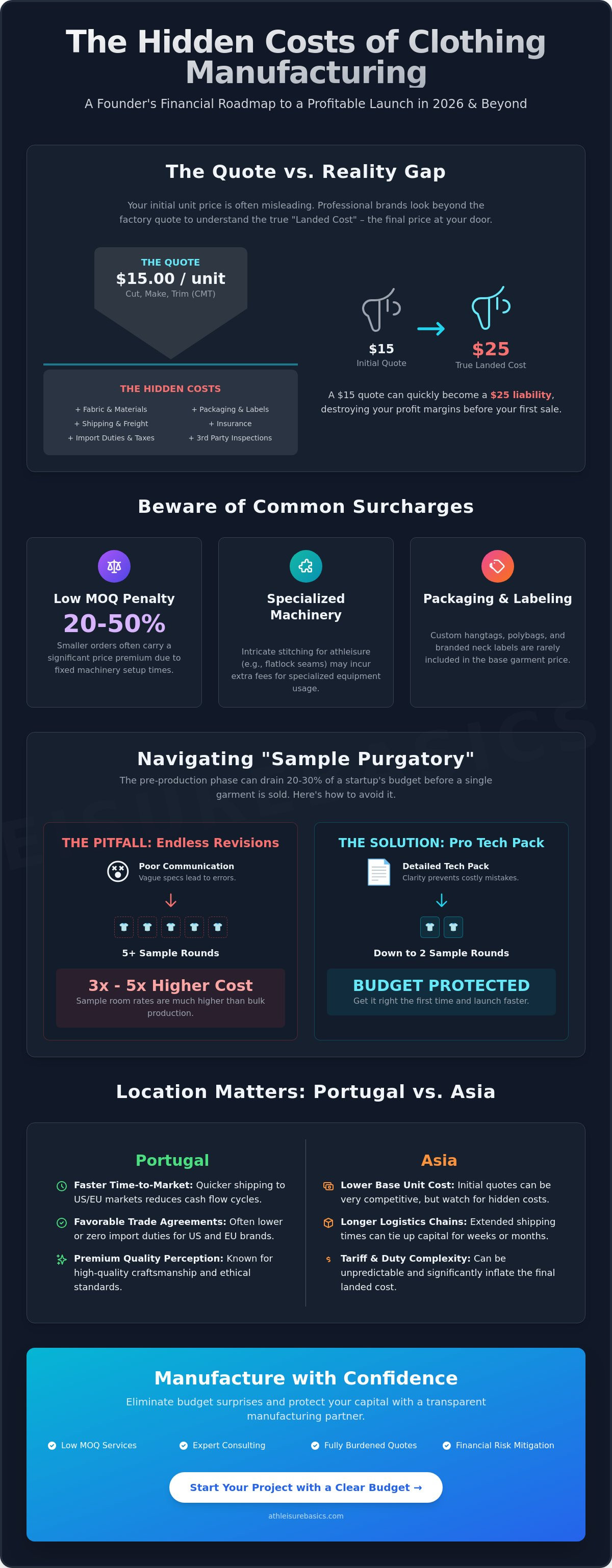
The Quote vs. Reality Gap: Why Your Initial Unit Price is Misleading
When you receive your first quote from a factory, it often feels like a victory. However, that initial number is frequently just the beginning of the story. Many manufacturers quote based on CMT (Cut, Make, Trim), which only covers the labor of assembly. This excludes the cost of fabric, trims, and logistics. If you compare an FOB (Free on Board) quote to an LDP (Landed Duty Paid) estimate, you aren't comparing apples to apples. Landed cost is the total price of a product once it has arrived at the buyer’s door.
Relying on a surface-level unit price leads to hidden costs in clothing manufacturing that can erode your profit margins before your first sale. Professional brands look beyond the "handshake price" to understand the full financial commitment. In 2026, transparency is the hallmark of a premium manufacturing partner. You need to know if your quote includes everything from thread and buttons to the cost of shipping containers and import duties. Without this clarity, your projected $15 hoodie can quickly become a $25 liability.
The Psychology of Under-Quoting in Garment Manufacturing
Factories often use low-ball estimates to secure a lead during the inquiry phase. This tactic is designed to get you through the door, hoping you'll be too committed to switch once the real costs emerge. The fast fashion business model has conditioned the market to expect rock-bottom prices by externalizing environmental and social costs, but for premium brands, these expenses eventually surface in the final invoice. To spot a quote that's too good to be true, compare it against industry benchmarks for ethical production. Always ask for a "fully burdened" cost estimate early in the conversation to ensure your partner is being transparent about the scale of the project.
Common Surcharges That Inflate Your Final Invoice
Surprises on the final invoice are usually the result of overlooked surcharges. These fees are standard in the industry but rarely advertised upfront. Being aware of them allows you to budget accurately and avoid cash flow bottlenecks.
- The Low MOQ penalty: Because setup time for machinery remains the same regardless of volume, smaller orders often carry a 20-50% price premium.
- Specialized machinery fees: For intricate athleisure stitching, such as flatlock seams, factories may charge extra for the use of specialized equipment.
- Packaging and labeling: Custom hangtags, polybags, and branded neck labels are rarely included in the base garment price and can add significant costs per unit.
By identifying these hidden costs in clothing manufacturing early, you position your brand for sustainable growth. A supportive partner will help you navigate these variables, ensuring your vision reaches the market without financial setbacks.
Pre-Production Pitfalls: The Hidden Costs of Sampling and Development
Many founders believe the real spending starts at the production line. In reality, the pre-production phase often consumes 20% to 30% of a startup's initial budget before a single garment is sold. This "Sample Purgatory" occurs when poor communication leads to endless revision cycles. Each new prototype requires fresh pattern adjustments and labor, which are billed at sample room rates. These rates are typically 3x to 5x higher than standard production line costs because they involve manual, one-off construction by senior seamstresses.
Investing in a professional tech pack is the most effective way to protect your bottom line. A detailed specification sheet reduces the number of samples needed from five down to two. If you're unsure where to start, learning how to create a tech pack for clothing ensures your factory has the exact measurements and construction details required to get it right the first time. This clarity prevents the hidden costs in clothing manufacturing from ballooning during the early development stages.
The True Cost of Multiple Sample Rounds
Courier fees represent a significant portion of hidden costs in clothing manufacturing. Sending a single 2kg prototype from a factory in Portugal to a designer in the U.S. can cost $60 to $100 per shipment. When you multiply this by four revision rounds and include return shipping for corrections, the logistics alone can exceed $800 per style. For brands sourcing globally, referencing the CBP Guide for New Importers is vital to understand how duties and entry requirements might affect these frequent shipments. Providing clear, professional design specifications from day one is the only way to minimize these logistical drains.
Material Sourcing and Development Fees
Fabric sourcing isn't just a search; it's a billable service. Factories often charge development fees for the time spent contacting mills and requesting swatches. If you require custom-dyed fabrics to match a specific Pantone shade, expect surcharges of 15% to 25% on top of the base fabric price. Premium certifications like OEKO-TEX® also carry a price premium due to the rigorous testing involved.
Don't overlook Minimum Order Quantities (MOQs) for trims. While you might only need 100 zippers for a small run, the supplier's MOQ might be 500 units. You'll pay for the excess, which then often incurs storage fees if the factory holds the surplus for future seasons. Partnering with a manufacturer that specializes in low MOQ production can help you navigate these overheads without overextending your capital. Managing these small details early prevents your "simple" project from turning into a financial burden.
Logistics, Duties, and Distance: Comparing Portugal vs. Asia
Distance is a silent margin killer. When you manufacture in Asia, you aren't just paying for fabric and labor; you're paying for the "Hidden Distance." This represents the hidden costs in clothing manufacturing that occur when your capital is locked in a shipping container for 40 days. For an emerging brand, cash flow is everything. Waiting six weeks for a shipment to arrive means your money is sitting on the ocean instead of being reinvested into marketing or new designs.
The Shipping and Freight Reality Check
Shipping costs are rarely stable. In 2024, container rates from East Asia to Europe fluctuated by over 200 percent during peak seasons. While sea freight looks affordable on an initial quote, it forces you to commit to inventory months in advance. This lack of agility is a massive risk. If a trend shifts, you're stuck with thousands of units that are already outdated by the time they dock.
Air freight is the common "fix" for these delays, but it often costs 5 to 10 times more than sea transport, instantly erasing your profit. Portugal offers a strategic alternative. Transit times to major European hubs like London, Berlin, or Paris are typically 3 to 5 days by road. This proximity allows you to operate on a "lean" model. You can restock bestsellers in weeks, not months. You also avoid the "Port Congestion" tax, which refers to the compounding storage fees and lost sales caused by unpredictable delays at major international shipping lanes.
Import Duties and Trade Compliance
Navigating customs is a complex, expensive hurdle for many startups. When you import from outside the EU, you face strict "Rules of Origin" and administrative paperwork that often adds 3 to 7 percent to your total landed cost in hidden processing fees. Manufacturing in Portugal eliminates these headaches within the European market. Goods move freely across borders, allowing you to scale without a dedicated logistics department.
For US and UK brands, Portuguese production is equally beneficial. Specific trade agreements help reduce or eliminate many tariffs that would otherwise apply to Asian-made goods. According to McKinsey on Fashion's Climate Costs, brands must also prepare for rising costs associated with carbon footprints and environmental compliance. Shorter supply chains in Europe naturally lower these projected expenses.
Choosing clothing manufacturers portugal provides more than just logistical ease. The "Made in Portugal" label is a globally recognized seal of quality. This allows you to position your brand in the premium tier, justifying higher retail margins that easily absorb the hidden costs in clothing manufacturing that often sink brands relying on budget-grade, long-distance production.
The True Cost of Quality: Compliance, Waste, and Ethical Standards
Ethical manufacturing is an investment in long-term brand equity, not a sunk cost. Choosing to ignore compliance can lead to severe legal fines under evolving EU sustainability regulations and irreversible damage to your brand reputation. When you partner with a high-quality producer, you protect your business from these hidden costs in clothing manufacturing that often sink unprepared startups.
Fabric Waste and Cutting Inefficiencies
Your fabric spend depends heavily on "yield" calculations. Gross usage includes the total fabric ordered, while net usage is the actual material in the finished garment. If a factory lacks precision, you might pay for 20% more fabric than you actually use. High-quality Portuguese factories utilize advanced "marker efficiency" software to nest patterns tightly. This reduces waste significantly. Before the bulk cut, rigorous testing for fabric shrinkage and color fastness is vital. Skipping these tests often leads to entire batches of garments that don't fit or bleed ink, creating massive financial losses that are impossible to recover.
The Price of Ethical and Sustainable Certifications
Certifications like OEKO-TEX® and GOTS increase your initial unit price, but they remove significant market entry barriers in Europe and North America. Understanding the textile quality required for these standards helps you justify premium pricing to your customers. While lower wages in some Asian regions might seem attractive, they often hide the risk of supply chain disruptions and human rights violations. Ethical production in Portugal ensures fair labor practices, providing a stable and reliable supply chain that protects your brand's future. Investing in these standards early prevents the need for a costly brand pivot later.
Ready to build a brand focused on quality and transparency? Partner with Athleisure Basics to ensure your manufacturing process is efficient and ethical.
Navigating Manufacturing Costs with Athleisurebasics: Your Partner in Transparency
Managing a startup budget requires more than just looking at the price per garment. Industry data shows many founders face a 30% loss in their first year due to overstocking. We tackle this by offering a low minimum order quantity (MOQ) starting at 70 pieces. This strategy directly eliminates the hidden costs in clothing manufacturing associated with unsold inventory and expensive warehouse storage fees. It allows you to test styles and colors without committing your entire capital to a single SKU.
Our "Partner, not just Producer" philosophy means we provide production consulting before the first stitch is sewn. We help you avoid budget surprises by reviewing your tech packs and material choices early in the process. By integrating CMT (Cut, Make, Trim) services with sourcing support in Portugal, we ensure every cost is accounted for upfront. This integrated approach reduces shipping delays and communication errors that often lead to hidden costs in clothing manufacturing. Get a transparent custom apparel manufacturing quote today to see how we simplify your overhead.
Reducing Risk for Startups and Emerging Brands
Startups often spend thousands on initial pattern development before ever making a sale. Our white-label service removes this barrier by providing pre-developed, high-quality patterns that are ready for your branding. If you need to test the market quickly, our "Luxury Blanks" allow for rapid deployment with minimal capital outlay. Every garment we produce meets strict EU quality standards and OEKO-TEX® certifications. Manufacturing in Portugal ensures ethical labor practices and superior craftsmanship, protecting your brand from the reputational risks and quality control failures that often plague cheaper production hubs.
Your Roadmap from Logo to Legacy
Technical complexities in athleisure production, such as four-way stretch recovery or moisture-wicking properties, can lead to expensive mistakes if handled incorrectly. We guide founders through these technical hurdles to ensure your vision translates perfectly into a physical product. Getting your production right the first time saves you from the 15% to 20% waste common in poorly managed supply chains. We're committed to helping you scale from a single logo to a lasting brand legacy. Our team provides the expertise needed to navigate fabric weights, stitch types, and trim selection. Explore our custom manufacturing options and start building your brand with a foundation of quality and transparency.
Launch Your Brand with Confidence and Clarity
Building a successful fashion label in 2026 requires more than just a creative vision. It demands a strategic approach to managing the hidden costs in clothing manufacturing. Initial unit prices often mask the true expenses of sampling cycles, international duties, and quality failures that can derail a startup. By choosing ethical production in Portugal, you gain the advantage of EU regulatory compliance and significantly lower logistics risks compared to sourcing from distant markets. Our facility prioritizes transparency, offering you access to premium OEKO-TEX® certified fabrics that meet the highest global safety and environmental standards.
We don't just act as a supplier; we're your partner in growth. We make it easy for startups to enter the market with low MOQ options starting at 70 pieces per style. This low-risk entry point allows you to test your designs without the burden of excessive inventory or wasted capital. By focusing on superior craftsmanship and ethical standards from day one, you're not just making clothes. You're building a sustainable business. It's time to turn your vision into high quality products quickly and efficiently.
Launch your brand with a transparent manufacturing partner—Get a Quote
Your journey from a single logo to a lasting legacy starts with the right foundation. We're here to help you every step of the way.
Frequently Asked Questions
What is the most common hidden cost in clothing manufacturing?
The most common hidden costs in clothing manufacturing are found in logistics, specifically fuel surcharges and residential delivery fees that can add 15% to 25% to your base freight quote. Many founders overlook landed costs, which include insurance and handling fees at the port. These secondary expenses can quickly erode your profit margins if you only budget for the factory's per-unit price.
How much should I budget for sampling before my first production run?
You should typically budget for two to three rounds of sampling to ensure your vision matches the final product. According to industry benchmarks from the Fashion Institute of Technology, sampling costs often range from 200% to 400% of the estimated bulk production price per garment. This investment prevents expensive errors during the full run, where mistakes can cost thousands of dollars in wasted materials.
Why are shipping costs for clothing often higher than expected?
Do I have to pay import duties if I manufacture in Portugal?
You won't pay import duties if your brand is registered within the European Union, as Portugal is a member state. For brands based in the United States, the Harmonized Tariff Schedule determines the specific rate, which typically ranges from 0% to 32% depending on the fabric composition. Manufacturing in Portugal ensures your goods meet EU quality and ethical standards, simplifying the customs documentation process.
What is a tech pack and does it really save me money?
A tech pack is a comprehensive blueprint that includes your garment's measurements, materials, and construction details. It saves you money by reducing the number of sampling rounds needed and preventing production errors that lead to deadstock. Standardized tech packs can reduce communication delays by 40%, ensuring the factory understands your requirements from the very first stitch.
How do Minimum Order Quantities (MOQs) affect the final unit price?
Minimum Order Quantities (MOQs) directly impact your unit price because fixed setup costs, like fabric dyeing and pattern making, are spread across more items. Increasing your order from 50 to 200 pieces can often reduce the per-unit cost by 20% to 35%. While our low MOQ service starts at 60 pieces per style, scaling your volume is the most effective way to improve your overall profit margins.
Is it cheaper to manufacture in China or Portugal in 2026?
Portugal is often the more cost-effective choice for premium brands in 2026 due to rising labor costs in China and potential 25% to 60% import tariffs. While China may offer lower initial quotes, the hidden costs in clothing manufacturing like longer lead times and higher shipping fees often negate those savings. Portugal provides superior quality, ethical manufacturing, and faster turnarounds that help you scale your brand profitably.
What happens if the quality of the final production does not match the sample?
You should refer to your Golden Sample and the signed quality control agreement if the final production doesn't match your expectations. Most professional manufacturers allow for a 2% to 5% defect rate, known as an Acceptable Quality Level. If the issues exceed this threshold, your contract should specify whether the factory will provide a credit or a replacement run to correct the errors.


Leave a comment
This site is protected by hCaptcha and the hCaptcha Privacy Policy and Terms of Service apply.