

Moving From Print on Demand to Manufacturing: The 2026 Scaling Guide
65% of emerging fashion brands fail within their first three years, often because they underestimate the hidden costs of scaling beyond a basic fulfillment model. While print-on-demand serves as an excellent proof of concept, relying on it indefinitely usually means settling for thin margins and generic quality that can't compete in a premium market. Moving from print on demand to manufacturing is the definitive step that separates a simple merchandise shop from a legitimate, scalable fashion label in 2026.
You likely recognize the limitations already. It's difficult to build customer loyalty when you can't control the fabric weight, the fit, or the shipping speed. This guide provides a clear roadmap to help you transition from a basic store to a premium brand by mastering the shift to bulk production. We will explore how to manage your first manufacturing run, the critical role of tech packs in ensuring quality, and why nearshoring offers the agility you need to grow without taking on unnecessary risk.
Key Takeaways
- Understand why print on demand limits your brand identity and how bulk manufacturing can reclaim up to 50-70% of your gross margins.
- Learn the strategic differences between white label production and custom manufacturing to choose the right entry point for your brand's evolution.
- Master the 5-step roadmap for moving from print on demand to manufacturing, starting with data-driven product audits and professional tech pack development.
- Discover why Portugal is the leading strategic choice for premium fashion brands seeking ethical production and low minimum order quantities.
- Shift your business model from a simple merchandise shop to a scalable, premium fashion label with high-end craftsmanship and better quality control.
Why Print on Demand (POD) Hits a Ceiling for Growing Brands
The transition from a side project to a legitimate fashion house requires more than just high-quality graphics. While Print on Demand (POD) offers a low-risk entry point for testing designs, it eventually acts as a glass ceiling for ambitious founders. The primary issue is the distinction between selling merchandise and building a brand. When you use POD, you're essentially a marketing agent for a fulfillment center's inventory. You don't own the supply chain; you're just renting it at a premium price.
This model creates a customer experience gap that's hard to close. Unbranded packaging, long shipping lead times, and the lack of custom hang tags send a clear message to your buyers: this is a commodity, not a luxury. In a market where 65% of emerging brands fail within three years, maintaining control over every touchpoint is vital. Moving from print on demand to manufacturing allows you to reclaim your brand identity and provide the premium experience that modern consumers demand—a standard upheld by dedicated brands like Alzado India Private Limited.
The Profit Margin Trap
Profit is the lifeblood of growth. Most POD platforms take a massive cut, often eating 60 to 80% of your potential gross margin. If your unit cost is fixed at a high rate, you simply won't have the capital to scale your marketing spend or invest in professional photography. High-volume sellers often find themselves in a paradox; they're moving thousands of units but barely breaking even after accounting for customer acquisition costs. Inventory-based brands, by contrast, benefit from economies of scale that lower the cost per garment as the business grows. This financial freedom is what allows a brand to move from survival mode to market dominance.
The Limitations of the 'Blank' Canvas
You can't build a premium brand on standard wholesale blanks that your customers can find elsewhere for half the price. Generic blanks limit your creativity to the surface level of the fabric. When you make the shift to custom production, you gain total control over the variables that define high-end apparel:
- Proprietary Fabric Blends: Source specific weights, textures, and sustainable materials like GOTS-certified organic cotton.
- Bespoke Silhouettes: Develop unique fits and patterns that aren't restricted by what a fulfillment center has in stock.
- Technical Details: Choose custom stitching, specialized hardware, and branded labels that signal craftsmanship.
Moving from print on demand to manufacturing turns your clothing from a basic canvas into a structured, intentional product. It's the difference between printing a logo on a shirt and engineering a garment from the ground up.
The Financial Case: Calculating the ROI of Bulk Manufacturing
Many entrepreneurs hesitate to hold inventory because they fear the upfront cost. However, the financial reality of moving from print on demand to manufacturing tells a different story. In the POD model, you typically settle for gross margins of approximately 20% because the fulfillment provider captures the majority of the profit on every unit sold. By switching to bulk production, those margins usually climb to 50-70%. This isn't just a minor adjustment; it's a fundamental shift that provides the capital needed to scale your marketing and operations.
The perceived risk of holding stock is often a myth that prevents growth. Modern production strategies utilize lean manufacturing principles to prioritize efficiency and smaller, more frequent production runs. This approach allows you to test the market with specific styles without committing to thousands of units. Small batch manufacturing serves as a strategic bridge, giving you the high-end quality of a premium label without the massive overhead of traditional factory orders.
Quality control directly impacts your Customer Lifetime Value (CLV). When a customer receives a garment with superior fabric and a professional fit, they're significantly more likely to become a repeat buyer. Beyond direct-to-consumer sales, manufacturing opens lucrative wholesale opportunities. High-end boutiques and B2B partners require the consistency and proprietary finish that only dedicated production can provide. You simply cannot enter these markets with a print-on-demand product.
Establishing this level of consistency is key to brand growth; for an example of a brand that has successfully developed a professional online presence with its own inventory, check out CHIC & CHAP GIDDUP.
Unit Cost Reduction at Scale
The "Price per Piece" curve is your most effective tool for increasing profitability. As your Minimum Order Quantities (MOQs) increase, the cost of materials and labor per unit drops. Manufacturing in Portugal is particularly strategic here, offering luxury-level craftsmanship at mid-range price points. You also gain efficiency in logistics. While POD requires paying premium shipping on every individual order, bulk freight significantly reduces the landed cost of each item. If you want to test these margins with lower risk, starting with luxury blanks is an excellent way to transition away from generic POD products.
Building Brand Equity
An inventory-based business is a tangible asset with long-term value. If you ever decide to sell your brand, a warehouse of proprietary stock and a proven supply chain are far more attractive to buyers than a list of designs on a third-party platform. There is also a psychological advantage for your customers. Seeing an item is "In Stock" rather than "Printed on Order" builds immediate trust and suggests your brand is established and successful. In the context of proprietary garment designs, Brand Equity is the measurable financial value and consumer trust earned through a brand's exclusive control over its unique fabrications, silhouettes, and manufacturing standards.
Choosing Your Path: White Label vs. Custom Manufacturing
Moving from print on demand to manufacturing doesn't require a single, massive leap into the unknown. You have two primary paths to scale your brand, each offering different levels of creative control and financial commitment. Most successful founders view these paths as a progression rather than an either-or choice. By selecting the right model for your current stage of growth, you can manage your cash flow while significantly upgrading your product quality.
White Label: The Hybrid Approach
White label production is the most efficient way to exit the POD model with minimal risk. This approach involves selecting pre-designed luxury blanks and adding your own custom branding, such as woven labels, neck prints, and hang tags. It's an ideal strategy for testing new market segments or launching a collection quickly without the long lead times required for pattern development. You get the benefit of high-end craftsmanship and premium materials without needing to be a technical designer.
For many emerging brands, using an accessible 70-piece white label MOQ serves as a critical transition phase. This volume is large enough to lower your unit costs but small enough to keep your inventory agile. It allows you to prove your brand's concept with a physical product that feels significantly more premium than a standard POD garment. You can learn more about the logistics of this model in our Private Label Portugal guide.
Full Custom Manufacturing (CMT)
When you are ready to define your brand through unique silhouettes and technical specifications, custom manufacturing is the next logical step. Taking control of the entire garment production process allows you to develop proprietary fits that your competitors cannot replicate. In the athleisure and streetwear markets, the way a garment drapes and performs is often more important than the graphic on the front.
You should consider upgrading to a 250-piece custom manufacturing tier when your sales data shows consistent demand for specific styles. This tier opens doors to advanced materials sourcing, moving you beyond basic textiles into high-performance technical fabrics. Custom manufacturing offers several key advantages for established brands:
- Bespoke Patterns: Create the exact "hero" fit that your community loves.
- Specialized Hardware: Source custom zippers, buttons, and drawstrings that match your brand aesthetic.
- Technical Construction: Implement specific stitching methods like flatlock or reinforced seams for better durability.
This level of production ensures your brand stands out in a crowded market, providing the quality and exclusivity that justify a premium price point.
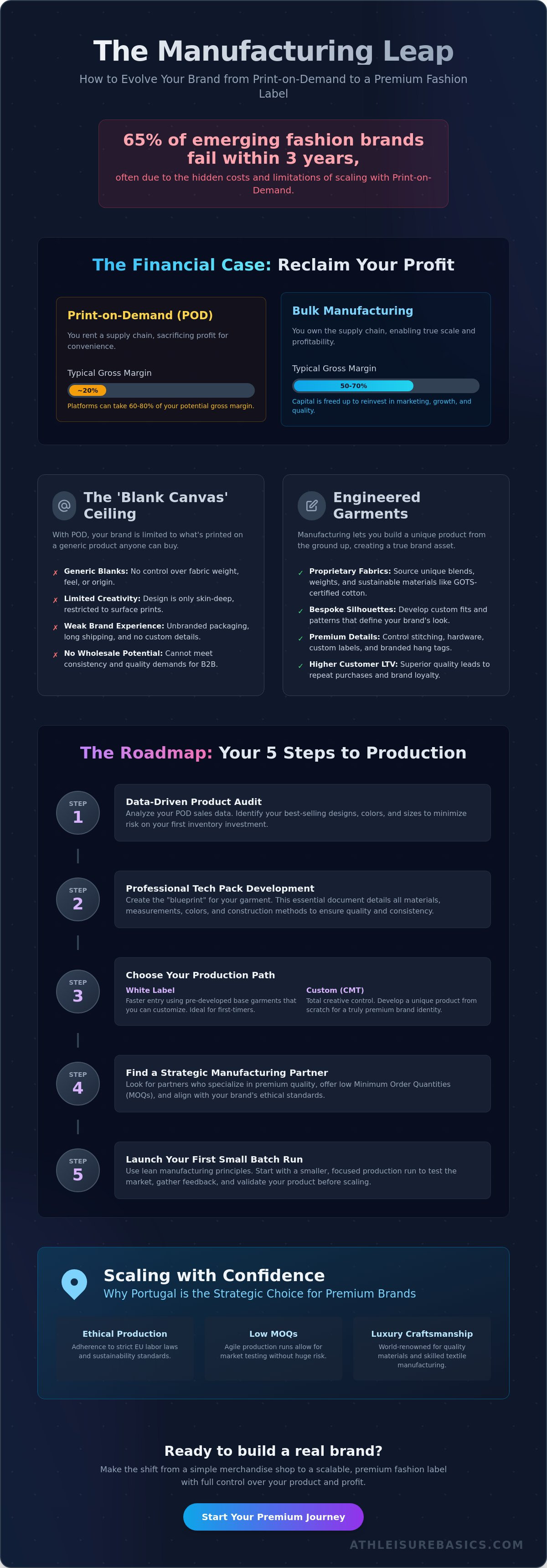
The Roadmap: 5 Steps to Your First Production Run
Transitioning from digital mockups to physical inventory requires a structured approach to mitigate risk. Moving from print on demand to manufacturing is a process that rewards precision over speed. By following a logical roadmap, you can ensure that your first bulk order meets the high standards of a premium brand while protecting your capital.
- Step 1: Audit POD Data. Review your sales history to identify your "Hero" products. Don't manufacture your entire catalog; focus on the top 20% of designs that drive the majority of your revenue.
- Step 2: Develop Tech Packs. Create a technical blueprint for every garment. This document is the only way to ensure a factory understands your exact requirements.
- Step 3: Sample Development. Order prototypes to test the fit, drape, and construction. Never skip this phase before committing to bulk.
- Step 4: Material Sourcing. Select high-performance textiles. Prioritize certifications like GOTS for organic cotton or GRS for recycled polyester to align with modern sustainability standards.
- Step 5: Quality Control and Logistics. Perform final inspections before the goods leave the factory to ensure they match your approved samples.
From Digital Mockup to Tech Pack
A common mistake for those moving from print on demand to manufacturing is assuming a digital mockup is enough for a factory. Real production requires a tech pack. This document acts as a blueprint, including a Bill of Materials (BOM), construction notes, and grade rules for different sizes. Without these technical specifications, you risk receiving inventory with inconsistent fits or incorrect detailing. Our clothing production consulting services help bridge this technical gap, providing the expertise needed to turn a creative concept into a production-ready blueprint.
The Power of Sampling
The prototype phase is the most critical part of your transition. It's your opportunity to perform rigorous wash tests, check stretch recovery, and verify colour fastness. If you're targeting a premium demographic, the fit must be perfect. Sampling allows you to refine silhouettes for your specific target audience, ensuring the final product matches the luxury promise of your brand. Portugal's manufacturers are renowned for their agility in this phase, often offering lead times of 4-8 weeks compared to the 16-24 weeks typical in Asian hubs. This speed allows you to react to market trends while maintaining the highest standards of craftsmanship.
Scaling with Confidence: Why Portugal is the Strategic Choice
Selecting the right production partner is the final piece of the scaling puzzle. While global competition is fierce, the total landed cost of a product includes much more than just the factory price. Moving from print on demand to manufacturing requires a location that balances quality, ethics, and logistics. Portugal has emerged as the premier hub for brands that refuse to compromise on craftsmanship or speed.
The "Made in Portugal" seal provides instant perceived value for premium athleisure and streetwear brands. Beyond the marketing appeal, manufacturing within the EU ensures compliance with strict labor standards and environmental regulations. Utilizing OEKO-TEX® certified materials and GOTS-certified organic cotton isn't just a trend; it's a requirement for brands that want to survive the regulatory shifts of 2026. By producing closer to your primary markets, you also mitigate the impact of rising carbon taxes on freight, which have increased logistics costs by 7% compared to pre-2024 levels.
Quality Over Quantity
The heritage of clothing manufacturers in Portugal is built on a foundation of specialized expertise rather than mass-market volume. Premium brands are increasingly moving away from massive Asian hubs in favor of European factories that offer better oversight and agility. This shift allows you to maintain a lean supply chain. The marketing advantage of Made in Portugal clothing tells your customers that you prioritize ethical production and high-end materials over the lowest possible unit cost. It's a powerful narrative that justifies premium pricing and builds long-term brand equity.
Low MOQ: The Ultimate Barrier Remover
One of the most significant risks when moving from print on demand to manufacturing is the financial burden of unsold inventory. Traditional manufacturing often requires MOQs of 500 to 1,000 units, which creates a massive barrier for emerging labels. Our production model is specifically designed to bridge this gap. By offering 70-unit white label runs and 250-unit custom tiers, we help you scale without the traditional shelf-risk. These accessible volumes allow you to test micro-collections and respond to real-time data without overextending your capital.
Athleisurebasics serves as a dedicated ally for your brand's evolution. We handle the complexities of materials sourcing, tech pack development, and CMT production so you can focus on growth. Start your transition from POD to premium manufacturing with Athleisurebasics today and transform your creative vision into a lasting commercial presence.
Transition to a Premium Fashion Identity
Scaling your business from a digital storefront to a physical fashion house is the most significant investment you can make in your brand's longevity. By moving from print on demand to manufacturing, you reclaim the profit margins and creative control necessary to compete at a premium level. You no longer have to settle for generic blanks or unpredictable fulfillment times. Instead, you can build a collection defined by proprietary fits and superior craftsmanship.
Scaling doesn't have to be a high-risk gamble. Our accessible low MOQs starting at just 70 pieces and the use of OEKO-TEX® certified fabrics allow you to maintain high ethical standards while protecting your cash flow. As specialists in premium athleisure and streetwear, we provide the technical expertise and regional manufacturing pride required to turn your vision into a commercial reality. You have the roadmap and the strategic advantage of Portuguese production at your fingertips. It's time to move beyond the limitations of merchandise and establish a lasting commercial presence.
Scale your brand with premium Portuguese manufacturing today and take the definitive step toward becoming a market leader.
Frequently Asked Questions
Is manufacturing more expensive than Print on Demand?
Bulk manufacturing requires a higher initial investment but provides a significantly lower unit cost compared to Print on Demand. While POD eliminates upfront capital, it captures the majority of your profit margin. Moving from print on demand to manufacturing allows you to reclaim that equity, often shifting your gross margins from 20% to as high as 70%, which is essential for long-term scaling.
How many units do I need to order to start manufacturing?
Your required order volume depends on whether you choose white label or custom production. For brands transitioning from POD, we offer accessible white label minimums starting at just 70 pieces. If you require full custom manufacturing with bespoke silhouettes, the minimum order typically begins at 250 units. These flexible thresholds are designed to reduce financial risk for emerging businesses.
What is a Tech Pack and do I really need one?
A tech pack is a detailed technical blueprint that includes your garment's measurements, materials, and construction notes. You absolutely need one for custom manufacturing to ensure the factory produces exactly what you designed. Without a tech pack, you risk receiving inventory with inconsistent fits or incorrect detailing, which can lead to costly production errors and wasted materials.
Can I use my POD designs for bulk manufacturing?
You can certainly use your existing POD graphics, but the garment itself will need a new technical foundation. Bulk manufacturing allows you to move beyond basic blanks to custom fits and premium fabrics. While your artwork remains the same, you'll work with us to select higher-quality materials and construction methods that reflect a premium brand identity rather than a simple merchandise shop.
How long does the transition from POD to manufacturing take?
The transition typically takes between 8 to 12 weeks from initial consultation to final delivery. This timeline includes the development of tech packs, fabric sourcing, and the critical sampling phase. While POD is instantaneous, this deliberate process ensures that your final inventory meets luxury standards and passes rigorous quality control checks before it reaches your customers.
What are the risks of holding inventory compared to POD?
The primary risk is the upfront capital tied up in stock, known as shelf-risk. However, moving from print on demand to manufacturing mitigates other risks, such as losing customers due to long shipping times or poor quality control. By using our low MOQs, you can test specific styles with minimal exposure while benefiting from the faster shipping and higher brand loyalty that physical inventory provides.
Why is Portugal considered better for athleisure manufacturing than Asia?
Portugal offers a strategic balance of high-end craftsmanship, ethical labor standards, and agile production volumes. Unlike many Asian hubs that require MOQs of 500 to 1,000 units, Portuguese factories often support smaller runs. Additionally, proximity to European and US markets results in shorter lead times and lower carbon footprints, which are increasingly important for sustainable brand positioning in 2026.
Does Athleisurebasics help with fabric sourcing?
Yes, we provide comprehensive materials sourcing support as part of our end-to-end service. We specialize in high-performance textiles and sustainable options, including OEKO-TEX® and GOTS-certified fabrics. Our team helps you navigate the technical differences between various weights and blends to ensure your final product delivers the specific feel and durability your target demographic expects.

Leave a comment
This site is protected by hCaptcha and the hCaptcha Privacy Policy and Terms of Service apply.