
Organic Cotton Clothing Manufacturer Portugal: The 2026 Guide to Ethical Sourcing
If you believe that high ethical standards and low minimum order quantities are mutually exclusive, your brand is already falling behind the 2026 market shift. You've likely experienced the frustration of overseas factories demanding 1,000-unit minimums or providing vague "eco-friendly" certificates that don't pass a basic audit. It's difficult to scale a premium brand when you're stuck between the fear of greenwashing and the financial risk of overstocking.
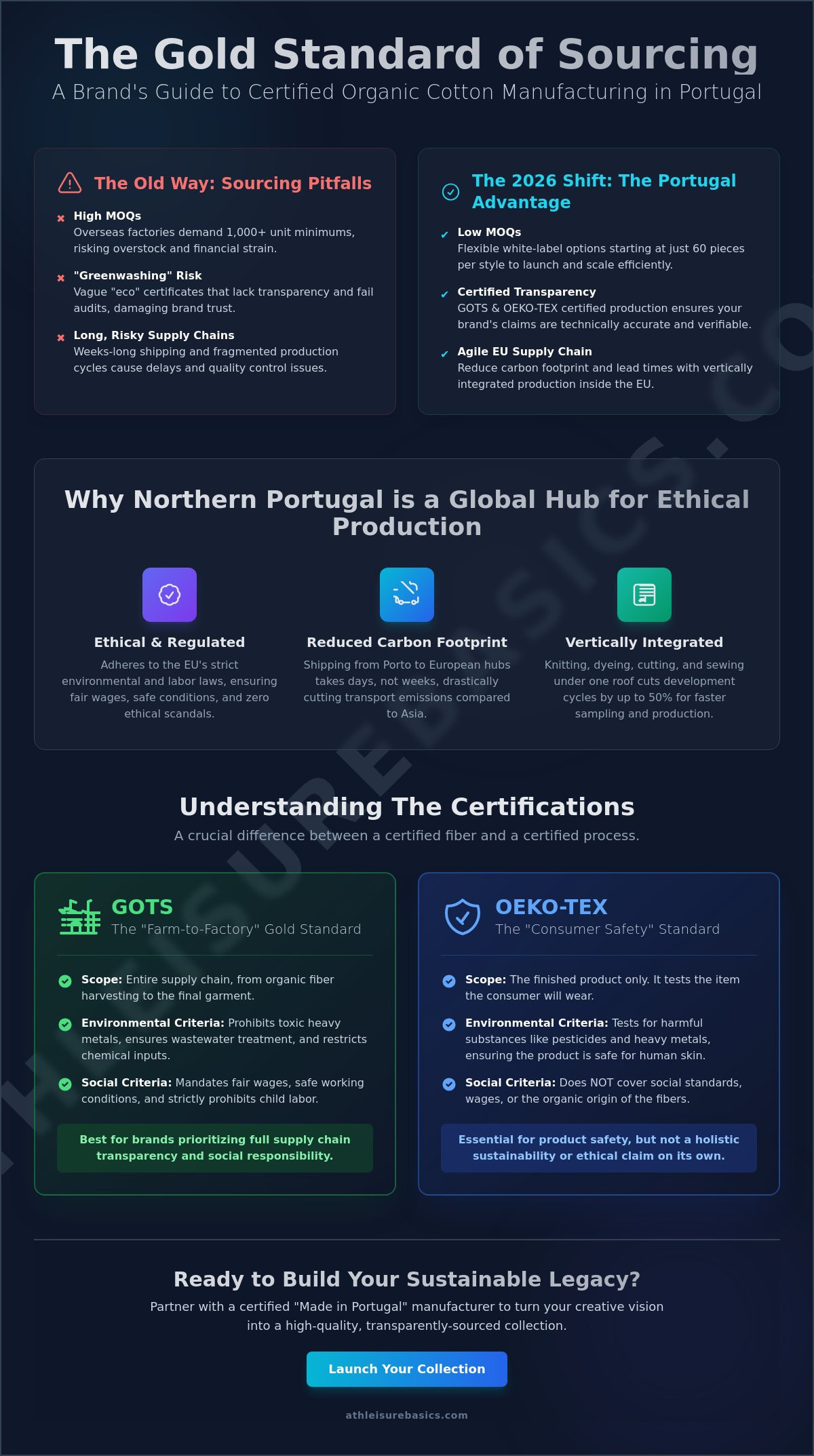
We understand that transparency is no longer a luxury; it's a core business requirement for the modern entrepreneur. This guide shows you how to bypass these barriers by partnering with a premium organic cotton clothing manufacturer portugal. You'll learn how to secure OEKO-TEX and GOTS certified production with flexible white label options starting at just 60 pieces per style. We're providing a complete roadmap to help you transition your sourcing to the EU, ensuring a transparent supply chain that turns your creative vision into a high quality, sustainable legacy.
Key Takeaways
- Learn why Northern Portugal’s textile cluster is the global leader for premium jersey and ethical manufacturing, offering a significantly reduced carbon footprint for European brands.
- Understand the critical differences between GOTS and OEKO-TEX certifications to ensure your brand's sustainability claims are both transparent and technically accurate.
- Decide between custom designs or luxury white-label blanks to find the most profitable path when partnering with an organic cotton clothing manufacturer portugal.
- Master the essential steps of the production roadmap, from creating professional tech packs to choosing the perfect organic interlock or fleece materials.
- Discover how to leverage low-MOQ manufacturing to launch your collection quickly while maintaining the "Made in Portugal" seal of quality and craftsmanship.
Why Portugal is the Global Hub for Organic Cotton Manufacturing
Northern Portugal, specifically the industrial clusters of Barcelos and Guimarães, has solidified its position as the premier global destination for high-end knitwear and jersey production. By 2026, the demand for sustainable luxury has made finding a reliable organic cotton clothing manufacturer portugal a top priority for ambitious brands. This region combines centuries of textile tradition with the most advanced sustainable technologies available today. The result is a manufacturing ecosystem that prioritizes quality over mass consumption.
The shift from Asian manufacturing hubs to Portugal is accelerating among premium labels. Brands are moving production to mitigate supply chain risks and meet the growing consumer demand for transparency. Shipping from Porto to major European fashion hubs like Paris or Berlin takes days rather than weeks, significantly reducing the carbon footprint of each collection. This proximity allows for tighter quality control and the ability to react to market trends with much faster lead times. You can't achieve this level of agility when your stock is stuck in a shipping container for two months.
The Heritage of Portuguese Textile Excellence
The vertical integration found in Portuguese factories is a major logistical win for startups and established labels alike. Most facilities in the Northern region handle everything from knitting and dyeing to cutting and sewing under one roof. This structure allows for faster sampling, often cutting development cycles by 50% compared to fragmented supply chains. Local artisans possess decades of expertise in handling delicate materials. They understand what organic cotton is at a technical level, ensuring that garments maintain their durability and premium feel after years of wear. For a new brand, this expertise reduces the risk of fabric failure and returns.
Ethical Production and Transparency
Operating within the European Union means Portuguese factories must adhere to the world's strictest environmental and labor laws. This includes rigorous wastewater management systems that prevent toxic runoff from dyeing processes. For brands, this eliminates the risk of ethical scandals that often plague offshore production. Workers earn fair wages and operate in safe, regulated conditions, which is a core pillar of the Made in Portugal clothing guide for ethical sourcing. Choosing an organic cotton clothing manufacturer portugal ensures your supply chain is transparent and ready for the increased regulatory scrutiny expected across the industry in 2026. It's about building a brand that's both profitable and principled.
Understanding Organic Cotton Standards: OEKO-TEX vs. GOTS
Defining "organic" in the textile industry requires looking far beyond the farm. While it starts with non-GMO seeds and a total absence of synthetic pesticides, the journey to becoming a finished garment involves complex chemical treatments. For a premium organic cotton clothing manufacturer portugal, the designation "organic" is only the beginning. There is a critical technical difference between a certified fiber and a certified manufacturing process. You might source organic raw cotton, but if the factory uses toxic heavy-metal dyes, the final product loses its ecological integrity.
Portuguese factories have stayed ahead of 2026 sustainability targets by investing in circular water systems. These advanced setups allow facilities to recover and treat up to 95% of the water used during the dyeing process. By recycling water in a closed loop, manufacturers significantly reduce their environmental footprint and ensure that local waterways remain uncontaminated. At Athleisurebasics, we prioritize these high-efficiency systems to ensure your brand's production aligns with modern ethical expectations.
GOTS Certification: The Gold Standard for Social Responsibility
The Global Organic Textile Standard (GOTS) represents the highest level of oversight in the industry. It's a comprehensive "farm-to-factory" certification that covers both environmental and social criteria. To maintain GOTS status, a factory must prove it provides fair wages, safe working conditions, and zero child labor. Since the release of GOTS version 7.0 in 2023, the standard has also tightened requirements for supply chain traceability. Choosing a GOTS-certified organic cotton clothing manufacturer portugal ensures that every person involved in your garment's creation was treated with dignity.
OEKO-TEX Standard 100: Safety for the End Consumer
While GOTS focuses on the production ecosystem, OEKO-TEX Standard 100 is designed for consumer safety. This certification tests every component of the garment, from the thread and buttons to the dyes and linings, for over 100 harmful substances. It's an essential requirement for athleisure brands. During high-intensity exercise, the body's pores open and skin becomes more permeable. If a garment contains residual formaldehydes or pesticides, they can be absorbed through sweat.
Verification is simple but necessary. You should always ask for a factory's specific certificate number and verify its validity on the OEKO-TEX Label Check website. This transparency protects your brand from liability and builds trust with your community. If you're looking to launch a line that balances performance with purity, you can explore our custom clothing options to find the right certified fabrics for your vision.
Custom vs. White Label: Finding the Right Path for Your Organic Brand
The most common question from emerging founders is whether they can actually afford to work with an organic cotton clothing manufacturer portugal. The answer depends on your specific strategy. You don't need a six-figure budget to enter the sustainable market. Portugal offers two distinct paths that balance financial risk with brand exclusivity, making it easier to scale without the traditional barriers to entry.
Low MOQ strategies are the backbone of the Portuguese textile industry. By starting with smaller batches, you avoid the 30% overstock waste common in traditional manufacturing models. This efficiency allows you to reinvest capital into marketing rather than sitting on unsold inventory in a warehouse. It's about being lean and responsive to what your customers actually want.
Choosing between custom and white label isn't just about cost. It's about your timeline and how unique your vision needs to be from day one. Both options utilize the same high-quality organic fibers and ethical labor practices that define the region's reputation.
Custom Organic Manufacturing for Unique Designs
Choose custom production when your brand identity relies on a specific silhouette that doesn't exist elsewhere. This path typically requires a Minimum Order Quantity (MOQ) of 250 pieces per style. While the initial investment is higher, the benefits for your brand identity are significant. You gain full control over proprietary fits and custom fabric weights, such as a heavy 400 GSM fleece or a breathable 160 GSM jersey.
Custom manufacturing also allows you to implement unique sustainable dyes and specialized finishes that define a luxury brand's signature feel. If you've developed a revolutionary new pocket design or a specific oversized drape, custom is your only path. It ensures your product is 100% unique in a crowded marketplace.
White Label Solutions for Fast Market Entry
If you want to launch in weeks instead of months, white labeling is the most effective route. You aren't sacrificing quality for speed. Portuguese luxury blanks are engineered to the same high standards as designer labels, which is a massive upgrade from the standard promotional apparel found in other regions. This approach lets you test the market with premium, pre-designed garments that are ready for your branding.
Starting with premium blanks offers a massive financial advantage for startups. It reduces your development costs by nearly 70% because you're skipping the expensive pattern-making and fit-testing phases. You can focus on building your community while knowing your organic cotton clothing manufacturer portugal is delivering a product that meets strict EU ethical standards. For a step-by-step implementation, check out our Private Label Portugal guide to see how to build your collection efficiently.
- Custom: Best for unique DNA, proprietary fits, and larger launch budgets.
- White Label: Best for speed, testing the market, and preserving capital.
- Hybrid: Many brands start with white label basics and add custom "hero" pieces as they grow.
The Roadmap to Sustainable Production: From Tech Packs to Samples
Launching a premium collection requires a structured path to ensure quality remains consistent from the first sketch to the final delivery. As a leading organic cotton clothing manufacturer portugal, we've refined a five-step roadmap designed to eliminate guesswork and maximize efficiency for growing brands.
- Step 1: Developing a comprehensive tech pack to define every design detail.
- Step 2: Material sourcing to select the ideal organic jersey, interlock, or fleece.
- Step 3: Sample creation and the "fit-test" phase to refine the silhouette.
- Step 4: Bulk production with rigorous quality control checks at every station.
- Step 5: Sustainable packaging and streamlined logistics to your warehouse.
The Critical Role of the Tech Pack
Your tech pack is the blueprint for your entire project. It's impossible for a factory to provide an accurate quote without one because it defines the exact fabric consumption and labor complexity. A professional tech pack must include detailed measurements, a Bill of Materials (BOM), and specific stitching instructions. If you're a first-time founder, you can learn how to create a tech pack for clothing to ensure your technical drawings are factory-ready.
Sourcing Support and Fabric Selection
The "hand-feel" of your garment is what builds customer loyalty. We guide brands through the nuances of textile selection, such as the difference between combed and carded organic cotton. Combed cotton undergoes an extra step to remove short, prickly fibers, resulting in a smoother, more durable fabric that's essential for luxury apparel. We also help you determine the correct fabric weights. A standard high-quality t-shirt typically uses 200 GSM jersey, whereas a premium heavy-duty hoodie requires 450 GSM fleece to achieve that structured, high-end look.
Once your materials are locked in, we move to the sampling stage. This "fit-test" phase is where we catch 95% of potential production errors. You'll see how the organic cotton drapes on a real body and make any necessary adjustments to the sizing before we commit to bulk production. This process ensures that every piece in your 60-piece MOQ meets the highest industry standards.
The final phase involves ethical manufacturing and sustainable logistics. We use OEKO-TEX® certified processes and offer recycled packaging options to ensure your brand's environmental footprint stays low. Whether you're scaling an existing line or starting from scratch, we act as your trusted partner throughout the journey.
Partnering with Athleisurebasics for Your Organic Collection
Choosing an organic cotton clothing manufacturer portugal is a strategic decision that defines your brand's future. Athleisurebasics supports your brand from its first logo to a global legacy. We ensure every stitch meets OEKO-TEX Standard 100 requirements, providing the premium quality your customers expect in 2026. Our operations span Lisbon and Northern Portugal, connecting you directly to Europe's textile heartland. This geographic advantage ensures seamless logistics and faster turnaround times compared to overseas competitors. We've built our infrastructure to bridge the gap between startup flexibility and industrial-scale precision. You get the attention of a boutique studio with the output capacity of a major factory.
Our commitment to ethical manufacturing isn't just a marketing claim; it's a core operational standard. We focus on transparency and superior materials to help you build a brand that stands for something. By manufacturing in Portugal, you benefit from EU labor protections and a heritage of craftsmanship that's difficult to replicate elsewhere. We provide the technical expertise needed to turn your vision into high-quality products quickly and efficiently.
This approach is perfect for labels focused on the coastal lifestyle, where durability and authentic connection are key; you can find out more about how such brands thrive by staying true to their maritime roots.
Low MOQ: Growing With Your Brand
We believe high-quality manufacturing shouldn't be reserved for industry giants. Our white label service starts at just 70 pieces per style and color, while fully custom projects begin at 250 pieces. These low minimums reduce your initial financial risk significantly. You can test new designs or launch frequent collection drops without the burden of excess inventory. We act as a partner, not just a producer. This philosophy means we're invested in your long-term success, providing the same top-notch craftsmanship for a small batch as we do for large-scale orders.
- 70 Pieces: Ideal for white label launches and testing market fit.
- 250 Pieces: Perfect for custom designs with unique tech packs.
- Scalability: We grow with you, moving from small drops to industrial volumes seamlessly.
- Risk Mitigation: Lower inventory requirements mean better cash flow for your marketing efforts.
Ready to Start Your Sustainable Journey?
Launching your collection is straightforward with our structured approach. You'll start by submitting your project details through our website to receive a tailored quote. Once you're ready, you'll have a consultation with our production experts. They'll guide you through fabric selection, technical specifications, and timeline expectations. We demystify the complex manufacturing process so you can focus on building your vision. Our goal is to make ethical sourcing accessible and efficient for every founder. Take the first step toward a profitable, ethical brand today.
Partner with Athleisurebasics for your custom clothing manufacturing and secure your place in the future of sustainable fashion. Our team is ready to help you transition from a simple concept to a market-leading legacy.
Build Your Sustainable Legacy in 2026
Partnering with a specialized organic cotton clothing manufacturer portugal positions your brand at the intersection of luxury and ethics. By utilizing OEKO-TEX® certified fabrics, you ensure every garment meets rigorous safety standards while supporting environmentally conscious production. Portugal's manufacturing sector remains the premier choice for 2026 because it combines centuries of craftsmanship with modern, transparent supply chains. You can launch your collection with confidence, knowing that premium Portuguese quality is within reach even for smaller labels. Our low MOQs starting at 70 pieces eliminate the traditional barriers to entry, allowing you to test the market with minimal risk. We've streamlined the entire process from tech pack development to final production to help you scale efficiently. Your vision deserves a partner that values integrity as much as you do. Let's transform your creative ideas into a professional, high-end collection that stands the test of time.
Launch your ethical clothing brand with Athleisurebasics today
Frequently Asked Questions
Why should I choose an organic cotton clothing manufacturer in Portugal over China?
Portugal offers significantly shorter shipping times and stricter adherence to EU labor laws compared to China. Choosing an organic cotton clothing manufacturer in Portugal reduces your transit carbon footprint by up to 60% for European deliveries. You benefit from premium craftsmanship and a transparent supply chain that aligns with high ethical standards, which is essential for building a modern sustainable brand.
What is the minimum order quantity (MOQ) for organic cotton clothing in Portugal?
Minimum order quantities in Portugal are designed to support growing brands, often starting at 60 pieces per style or color. This low MOQ approach helps startups manage cash flow and prevents the environmental waste associated with overproduction. For complex custom designs, some factories might require 150 pieces, but the flexibility remains much higher than the 500 to 1,000 piece minimums common in Asian factories.
Is organic cotton from Portugal GOTS or OEKO-TEX certified?
Yes, premium Portuguese manufacturers provide both GOTS and OEKO-TEX Standard 100 certifications. The GOTS certification guarantees that at least 95% of the fibers are organic and produced under strict social criteria. OEKO-TEX ensures the final garment is free from 100 known harmful substances. These certifications provide the documented proof your customers need to trust your brand's sustainability claims.
How much does it cost to manufacture a custom organic cotton hoodie in Portugal?
Manufacturing costs vary based on fabric weight, hardware choices, and total volume. While we don't provide fixed price lists, data from the Portuguese Textile and Clothing Association shows that Portugal's competitive advantage lies in value and quality rather than the lowest possible price. You're investing in a premium product that commands a higher retail margin due to its superior durability and "Made in Europe" status.
Can I get samples before committing to a full production run?
You can and should request a physical sample before starting bulk production. This prototyping phase typically takes 2 to 4 weeks and allows you to test the fit, fabric weight, and construction quality. We treat sampling as a collaborative process where we refine your tech pack to ensure the final 2026 collection meets your exact specifications before you invest in inventory.
How long does the production process take from design to delivery?
The entire production cycle usually spans 8 to 12 weeks from the moment you approve your final sample. This timeline includes 4 to 6 weeks for bulk sewing and 1 to 2 weeks for quality control and packaging. Partnering with an organic cotton clothing manufacturer in Portugal allows you to react to market trends 50% faster than brands sourcing from overseas, keeping your inventory fresh and relevant.
Do I need to provide my own fabric for organic clothing manufacturing?
You don't need to supply your own materials because we offer comprehensive sourcing services through our network of local mills. We provide access to a wide variety of certified organic jerseys, loops, and ribs specifically developed for premium athleisure. If you require a custom knit or a specific pantone color, we manage that development process directly with the dye houses to ensure consistency across your entire line.
What is the difference between organic cotton and recycled cotton for athleisure?
Organic cotton is grown without synthetic chemicals, resulting in longer, stronger fibers that feel softer against the skin. Recycled cotton is created by shredding existing fabric, which shortens the fibers and often requires a 50% blend with virgin fibers to maintain garment integrity. For high-end athleisure, organic cotton is the preferred choice because it offers better breathability and a more luxurious hand-feel for the wearer.



Leave a comment
This site is protected by hCaptcha and the hCaptcha Privacy Policy and Terms of Service apply.