

Reducing Risk in Apparel Production: A Strategic Guide for Growing Brands in 2026
With U.S. apparel import tariffs climbing to 31.5% by late 2025, the financial margin for error in your supply chain has effectively vanished. You've likely experienced the frustration of unpredictable lead times or the dread of opening a shipment only to find quality defects that render your stock unsellable. It's a common struggle for growing brands. Communicating with distant factories often feels like a gamble where your entire startup budget is the primary stake, and reducing risk in apparel production has become a necessity for survival.
Mastering risk mitigation is your most vital tool for protecting your brand's reputation and financial stability in 2026. This article provides a strategic roadmap to help you secure a predictable production schedule and high quality garments that match your tech packs perfectly. You'll learn how to navigate new mandates like the mandatory EU Digital Product Passport and why smart MOQ management is the key to long term security. We'll also examine how nearshoring to hubs like Portugal can slash lead times from twenty weeks down to as little as four, giving you the professional agility to scale with total confidence.
Mastering the complexities of garment manufacturing requires a proactive approach to identifying and neutralizing potential threats to your business. Here is how you can secure your supply chain in 2026:
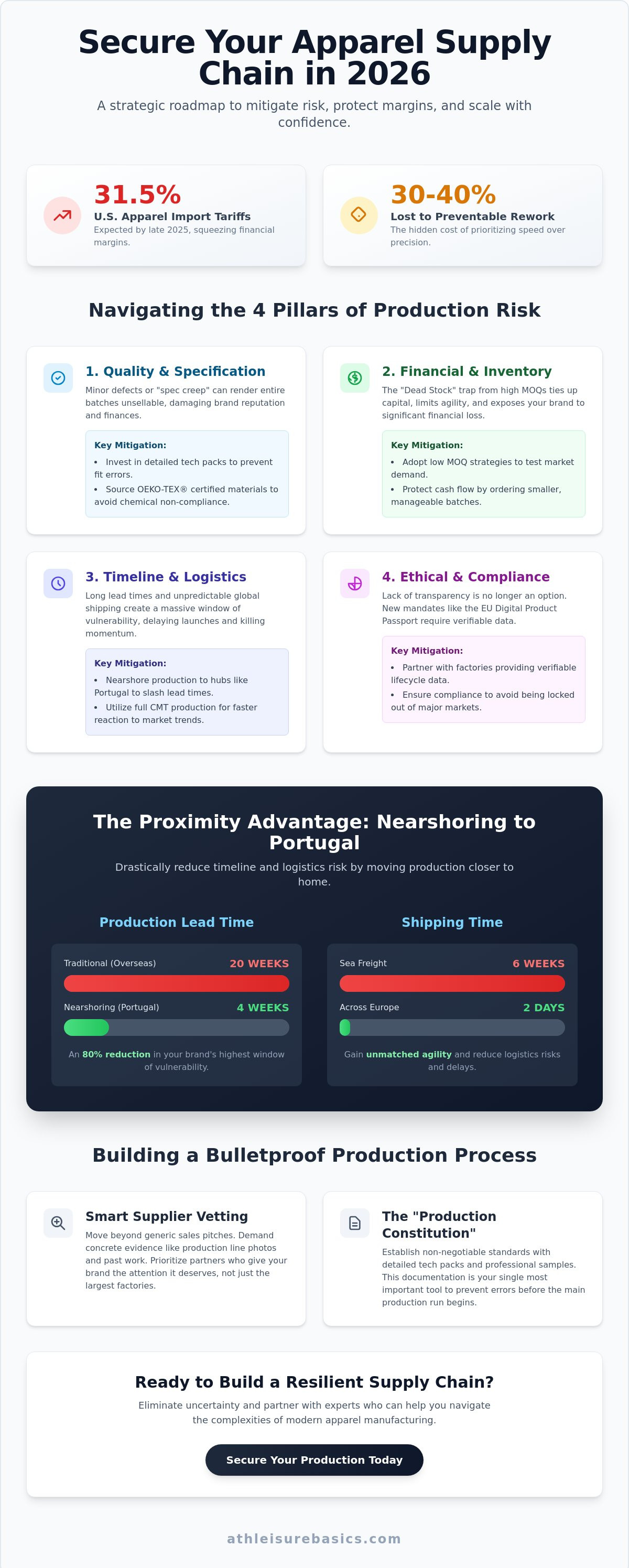
- Identify the four core pillars of operational risk, including Quality, Financial, Timeline, and Ethical. This helps prevent the 30% to 40% of production costs often lost to preventable rework while reducing risk in apparel production.
- Prioritize manufacturing partners who provide concrete production evidence and photos over generic sales pitches. This ensures your brand receives the dedicated attention it deserves.
- Establish a "Production Constitution" by investing in detailed tech packs and professional sample creation. These steps are essential to eliminate fit errors before the main run begins.
- Adopt low MOQ strategies to protect your capital. This approach allows you to test market demand with small batches rather than risking your entire budget on high volume inventory.
- Leverage the Portugal advantage for immediate brand premiumization. Proximity reduces logistics risk with shipping times as short as two days across Europe compared to six weeks for sea freight.
Navigating the 4 Pillars of Apparel Production Risk in 2026
Effective risk management in garment manufacturing is about far more than avoiding a few loose threads. It's a comprehensive strategy to protect your margins and brand reputation. In 2026, reducing risk in apparel production involves navigating four core pillars: Quality, Financial, Timeline, and Ethical risks. Many emerging brands make the mistake of focusing only on the lowest unit price. However, industry data suggests that 30% to 40% of total production costs are frequently lost to preventable rework. This happens when factories prioritize speed over precision, leading to errors that require expensive corrections or result in entire batches being discarded.
The hidden cost of "cheap" production is often the highest risk a brand can take. A low unit price usually masks vulnerabilities like poor material integrity or unstable labor practices. By 2026, transparency has shifted from a marketing buzzword to a mandatory requirement for consumer trust. With new regulations like the EU Digital Product Passport coming into play, reducing risk in apparel production requires a partner who provides verifiable data on every stage of the manufacturing lifecycle. If you can't prove how your garment was made, you risk being locked out of major commercial markets.
Quality and Specification Risks
Quality defects can range from minor fabric pilling to major pattern misalignments that render stock unsellable. These issues often arise through "spec creep," where communication barriers lead to a slow drift away from your original design. This is why professional tech pack development is non negotiable. To mitigate chemical non compliance risks, it's best to source materials with OEKO-TEX® certifications. These standards ensure your products are free from harmful substances, protecting both your customers and your brand from legal liability and expensive recalls.
Financial and Timeline Volatility
The "Dead Stock" trap is perhaps the most dangerous financial risk for growing brands. High minimum order quantities (MOQs) create massive exposure by forcing you to buy more inventory than you can reliably sell. This ties up your cash flow and limits your ability to pivot. Logistics risks also remain a major concern, which is why "Made in Europe" production has become a strategic hedge against global shipping delays. Production Lead Time is the window of highest brand vulnerability. By utilizing full CMT production in closer proximity, you can shorten this window and react faster to market demands without overextending your budget.
Supplier Vetting: Moving Beyond the 'Generic Sourcing Promise'
Relying on a manufacturer’s website copy is one of the fastest ways to compromise your supply chain. True verification requires looking past polished sales pitches and demanding concrete evidence of production. Ask for high resolution photos of current production lines, examples of past work for brands in your niche, and detailed breakdowns of their internal quality control processes. Research into mitigating risk when selecting international suppliers highlights that active verification of a factory's technical capability is the primary safeguard against future failure. Supplier vetting is a cornerstone of reducing risk in apparel production, ensuring you don't become a "small fish" in a massive pond.
Many emerging brands fall for the 'Tier 1' factory myth, believing that the largest manufacturers are the safest choice. In reality, the biggest factories often prioritize high volume clients, leaving smaller brands with slower response times and less oversight. A factory that produces 50,000 units a month might not give your 500 unit run the attention it requires. Evaluate communication early; a factory’s response time during the quoting stage is a direct predictor of their reliability during production. If they take a week to answer a simple email now, they'll likely be silent when a production disaster occurs later.
Analyze every quote for what is missing. A low price that excludes packaging, trims, or logistics support often masks much higher final costs. Red flags include vague lead times or a refusal to explain how they handle material shrinkage. Transparency in pricing is essential for financial security.
The Partnership Model vs. The Transactional Model
A transactional approach treats manufacturing as a one-off purchase, but a partnership model treats it as a long-term strategic asset. This makes choosing a clothing manufacturer a fundamental branding decision. Having "boots on the ground" or working with a partner that provides regional production oversight ensures your standards are met daily. Athleisurebasics bridges this gap by aligning your creative vision with industrial execution, turning a complex process into a manageable workflow. To see how a strategic partnership can stabilize your supply chain, consider how expert production consulting can streamline your path to market.
Compliance and Ethical Auditing
In 2026, ethical compliance is a legal necessity. Reducing risk in apparel production means ensuring your supply chain is free from modern slavery and labor exploitation. EU-based factories, particularly those in Portugal, offer built-in compliance with strict 2026 labor laws and environmental regulations. Always request updated certifications such as OEKO-TEX® to verify material safety. With the EU’s Digital Product Passport (DPP) mandate now in effect for textiles, working with a compliant partner ensures your garments meet the traceability requirements needed for global retail.
Technical Precision: How Documentation Prevents Production Disasters
A tech pack is more than a design file; it's your "Production Constitution." Without a comprehensive document that specifies every stitch, seam, and trim, your brand is vulnerable to costly misinterpretations. While some manufacturers treat tech packs as simple measurement charts, they actually serve as your primary legal and technical safety net. If a specific detail like thread weight or seam allowance isn't documented, you lose the technical standing to request a free rework. Understanding how to create a tech pack for clothing is the first step in ensuring your industrial execution matches your creative vision. This level of detail also allows you to manage social risks in your own supply chain by defining expectations for material origins and labor standards before the first stitch is cast.
Reducing risk in apparel production requires establishing Acceptable Quality Limit (AQL) standards before the first run begins. AQL is a statistical tool used to define the maximum number of defects that are considered acceptable in a production lot. By setting these thresholds early, you provide the factory with a clear definition of "success." This prevents the common frustration of receiving a shipment where 5% of the items have minor flaws, only to find you have no recourse because a quality standard was never formally agreed upon.
The Sampling Phase: Your Last Line of Defence
The sampling process is a hierarchical filter designed to catch errors before they scale. Proto samples verify the basic design and aesthetic. Size sets ensure the pattern works across all body types, which is where "fit risk" is most commonly mitigated. Finally, the Pre-production (PP) sample must be made using the exact bulk fabric and trims. The "Golden Sample" strategy involves approving a final version that the factory keeps as their physical reference point. If the bulk production doesn't match this sample, the factory is responsible for the discrepancy.
Material Sourcing and Fabric Testing
Material risk can bankrupt a small brand if fabrics shrink, bleed, or torque after the first wash. Professional fabric testing for color fastness and shrinkage is a mandatory requirement for premium garment manufacturing. Sourcing support is equally critical to manage the risk of fabric shortages mid-run. Working with established material suppliers ensures that the fabric you test in the sampling phase is the exact fabric that arrives for bulk production, protecting you from "fabric switching" or unexpected stockouts that could stall your entire season.
Inventory and Financial Risk: The Power of Low MOQ Strategies
High minimum order quantities (MOQs) are often the primary reason emerging fashion brands fail within their first three years. If you commit to a 2,500 unit run of an unproven design, you aren't just buying clothes; you're betting your entire operational budget on a single market assumption. Reducing risk in apparel production requires a shift toward low MOQ strategies that prioritize survival over the lowest possible unit price. A 250 unit run might have a higher cost per garment, but it dramatically lowers your financial exposure. If the design doesn't resonate with your audience, you're left with a manageable surplus rather than a warehouse full of dead stock that drains your cash flow.
Agile Manufacturing in 2026
The "Test and Scale" model is the new industry standard for resilient brands. Instead of placing one massive order, start with a small batch of perhaps 70 pieces to gauge consumer interest. Once you have data driven proof of demand, you can move to bulk production with confidence. Rapid re ordering capability is far more valuable than a low initial unit price. If you can replenish your best sellers in weeks rather than months, you capture more revenue with significantly less inventory risk. You must balance your Cost of Goods Sold (COGS) against the "Cost of Risk," which is the potential loss if your inventory doesn't sell.
Protecting Your Cash Flow
Managing your liquid capital is just as important as the garments themselves. Standard industry practices for risk sharing typically involve split payment terms, such as a 50% deposit and 50% upon shipping. This keeps the factory motivated and protects your capital during the production cycle. Always budget for an "Unexpected 10%" buffer. This reserve covers minor shipping fluctuations, currency exchange shifts, or small technical adjustments. Engaging with expert production consulting services can help you avoid the expensive "beginner mistakes" that often derail new ventures. By aligning your financial strategy with flexible production volumes, you build a brand that is built to last.
The Portugal Advantage: Why Proximity is Your Best Risk Mitigation Tool
Manufacturing thousands of miles away from your primary market introduces "Proximity Risk," a factor often overlooked by emerging labels. When your supply chain stretches across oceans, a simple misunderstanding can take weeks to rectify. Reducing risk in apparel production is significantly easier when you choose a manufacturing hub like Portugal. The "Made in Portugal" mark serves as an immediate quality seal, mitigating the risk of negative brand perception. It signals to your customers that you prioritize craftsmanship and ethical standards over the lowest possible production cost. Simple errors become disasters when they happen half a world away.
Logistics risk is another critical area where proximity provides a massive advantage. While sea freight from Asia can take six weeks or longer, shipping from Portugal across Europe typically takes only two days. This speed allows you to react to market trends in real time rather than waiting months for inventory to arrive. Shared time zones and cultural standards further reduce the chance of communication errors. Athleisurebasics acts as a premium partner in this ecosystem, providing the local oversight and technical expertise needed to de-risk your brand's growth journey. Proximity allows for rapid sampling and faster feedback loops.
The EU Regulatory Safety Net
Operating within the EU provides a robust legal framework that protects your business. Intellectual Property (IP) protection is strictly enforced, ensuring your unique designs aren't leaked or copied. Design security is a major concern for growing brands, and Portuguese manufacturing offers a level of safety that is difficult to find in other global hubs. For companies extending their reach into the South American market, Marcas Express offers specialized assistance in trademark and patent registration. These high standards also serve as a vital hedge against future "greenwashing" regulations and the mandatory Digital Product Passport requirements of 2026. Portuguese factories are recognized global leaders in the development and production of sustainable athleisure textiles. This commitment to material integrity ensures your brand remains compliant as regulations evolve.
Conclusion: Your Path to a Risk-Free Production Run
A "Partnership First" approach is the most effective way to secure your brand's future. By choosing collaborators who align with your quality standards and ethical values, you move away from the volatility of transactional manufacturing. This article has outlined how documentation, supplier vetting, and smart MOQ management form a shield around your margins. Before you commit to your first clothing production run, ensure you have verified your tech packs, secured your samples, and confirmed your factory's compliance certifications. Reducing risk in apparel production is a continuous process of documentation and verification. Start your low-risk production journey with Athleisurebasics today.
Secure Your Supply Chain for 2026 and Beyond
Success in the fashion industry requires a shift from transactional sourcing to strategic partnership. By prioritizing technical documentation and adopting low MOQ strategies, you protect your capital and ensure your creative vision translates perfectly to the final garment. Reducing risk in apparel production isn't just about avoiding defects; it's about building a resilient foundation that allows your brand to pivot and scale with confidence. Leveraging the proximity and high standards of Portuguese manufacturing provides the ultimate hedge against global volatility and regulatory changes.
Athleisurebasics is dedicated to supporting your journey from concept to market entry. We provide expert production consulting and full CMT services that emphasize quality and transparency. With low MOQs starting at 70 pieces and OEKO-TEX® certified fabrics, we make premium production accessible for emerging ventures. Our commitment to premium Portuguese craftsmanship ensures your brand stands out in a competitive marketplace. Scale your brand with low-risk, premium manufacturing in Portugal—Get a quote today. Your vision deserves a manufacturing partner as invested in your growth as you are.
Frequently Asked Questions
What are the biggest risks for a startup clothing brand in 2026?
The primary risks in 2026 include non compliance with the new EU Digital Product Passport (DPP) mandates and financial instability caused by high inventory requirements. Brands also face significant logistics volatility and rising import tariffs which can quickly erode profit margins. Transitioning to a transparent, data driven supply chain is now essential to avoid legal penalties and maintain consumer trust in an increasingly regulated global marketplace.
How do I know if a clothing manufacturer is reliable?
A reliable manufacturer demonstrates transparency by providing concrete production evidence such as real time photos of their facility and verified client references. They maintain consistent response times during the quoting phase and provide detailed breakdowns of their quality control checkpoints. Partners who are willing to explain their material sourcing standards and internal rework protocols are far more likely to support your brand's long term growth than those offering vague promises.
Can a tech pack really prevent production errors?
A tech pack serves as your primary technical contract and is the most effective tool for reducing risk in apparel production. It eliminates ambiguity by providing exact specifications for measurements, materials, and construction methods. When every detail is documented, the factory has a clear blueprint to follow, which significantly reduces the likelihood of misinterpretation. Without this documentation, you have no technical grounds to demand reworks if the final product deviates from your vision.
Why is manufacturing in Portugal considered lower risk than in Asia?
Portugal offers significantly shorter lead times of 4 to 8 weeks compared to the 12 to 20 weeks typical in Asian production hubs. This proximity reduces logistics risk and allows brands to react faster to market shifts without overextending their inventory. Additionally, Portuguese factories operate under strict EU labor and environmental regulations, providing built in ethical compliance and higher quality standards that are essential for premium brand positioning in 2026.
What is a 'Golden Sample' and why do I need one?
A Golden Sample is the final, approved version of a garment that serves as the master reference for bulk production. You need one to establish a physical quality benchmark that the factory must match exactly during the manufacturing process. By keeping a sealed Golden Sample, you create an objective point of comparison for final inspections. If the bulk shipment arrives with discrepancies, this sample provides the proof needed to resolve disputes or request replacements.
How does Low MOQ (Minimum Order Quantity) reduce financial risk?
Low MOQ strategies reduce financial risk by allowing you to test market demand with smaller capital outlays. Instead of tying up your entire budget in a single large order, you can produce as few as 70 units to validate a design's commercial viability. This approach protects your cash flow and prevents the accumulation of dead stock. It also gives you the agility to refine your products based on real customer feedback before scaling up.
What should I do if my production run has quality defects?
If your production run has defects, you should immediately document the issues with clear photos and compare them against your Golden Sample and tech pack specifications. Refer to the agreed upon Acceptable Quality Limit (AQL) standards to determine if the defect rate exceeds the professional threshold. A reputable manufacturer will have a protocol for handling rework or providing credits. This is why reducing risk in apparel production requires establishing these quality benchmarks before the first stitch is cast.
How can I protect my clothing designs from being stolen by a factory?
Protecting your designs starts with choosing manufacturing hubs like Portugal that operate under robust EU Intellectual Property (IP) laws. You should also ensure you have signed non disclosure agreements and maintain detailed records of your tech pack development. Working with a reputable production partner who values long term collaboration over transactional gains is the best way to ensure your designs remain exclusive to your brand and are not leaked to competitors.



Leave a comment
This site is protected by hCaptcha and the hCaptcha Privacy Policy and Terms of Service apply.