

How to Launch a Clothing Brand Successfully: The 2026 Founder’s Guide
In 2026, the success of your fashion venture depends more on the integrity of your supply chain than the size of your advertising budget. You’ve likely felt the weight of high minimum order quantities and the technical complexity of fabric sourcing. You understand that a great design only succeeds if it’s backed by ethical, reliable production. Learning how to launch a clothing brand successfully today requires moving beyond the fast fashion mindset and focusing on operational agility and premium craftsmanship.
It’s natural to feel overwhelmed by the technical demands of tech packs or the search for a trustworthy manufacturing partner. This guide provides a clear, professional roadmap to help you bridge the gap between a creative concept and a finished product. We will explore how to secure high-quality materials, navigate new EU sustainability mandates like the Digital Product Passport, and build a scalable partnership that supports your long-term growth. You’ll gain the specific tools and industry insights needed to turn your vision into a market-ready reality that thrives in the modern apparel landscape.
Key Takeaways
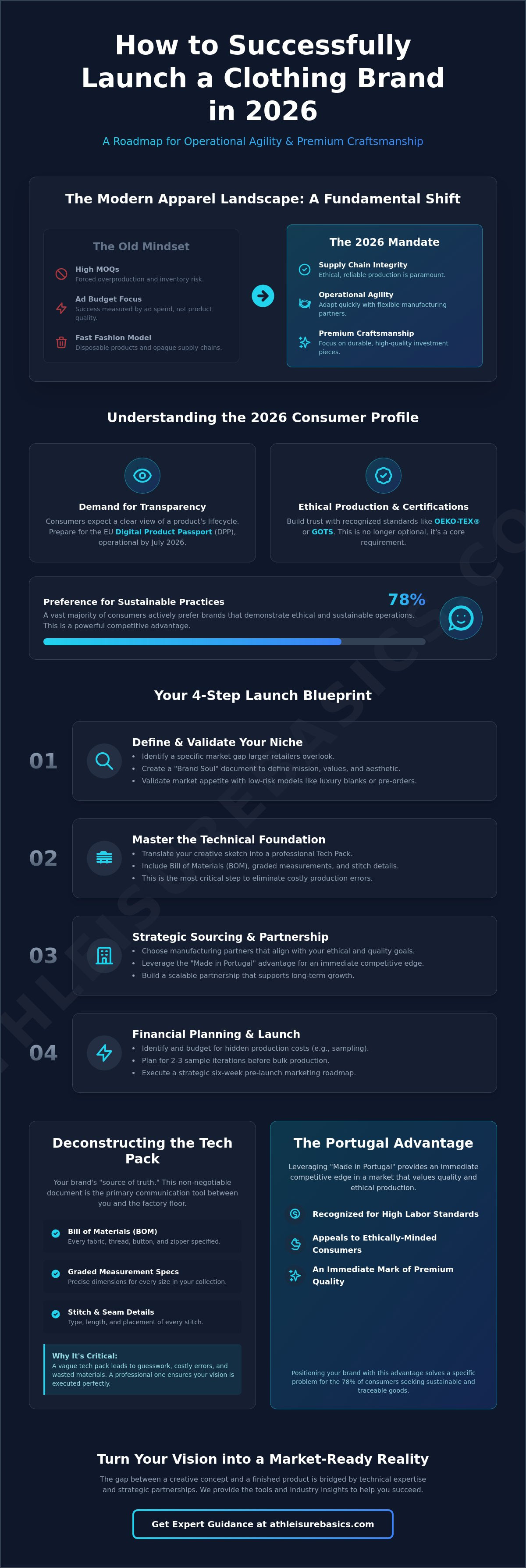
- Identify high-potential market gaps and develop a "Brand Soul" document to ensure your aesthetic remains consistent as you scale.
- Master the technical requirements of tech pack development to eliminate production errors and maintain premium quality standards.
- Discover the Portugal Advantage and learn how to launch a clothing brand successfully by choosing manufacturing partners that align with ethical and operational goals.
- Navigate the financial landscape of 2026 by identifying hidden production costs and executing a strategic six-week pre-launch marketing roadmap.
Defining Your Brand Vision and Validating Your Niche
Launching a fashion business in 2026 requires a data-driven approach to market entry. Success begins with identifying a specific gap that larger retailers overlook. You might focus on sustainable athleisure for petite frames or high-performance workwear for women in technical trades. Avoid the trap of trying to appeal to everyone. A narrow focus allows you to build a dedicated community before you even begin production. This targeted strategy is essential for anyone learning how to launch a clothing brand successfully.
Start by conducting quantitative market research. Analyze competitor reviews to find recurring complaints. If customers frequently mention "thin fabrics" or "inconsistent sizing," you've identified a clear opportunity. Document these findings in a "Brand Soul" document. This internal guide defines your mission, values, and visual aesthetic. It ensures every decision remains consistent as you grow. To validate your concept without high initial risk, consider starting with luxury blanks or a pre-order model. For those launching themed or matching sets, partnering with a specialist like Adorb Custom Tees allows you to test market appetite before committing to a full collection.
The 2026 Consumer Profile: What They Demand
Competitive Analysis and Positioning
Map your competitors on a price versus quality matrix to find your Unique Selling Proposition (USP). Your USP should solve a specific problem, such as "guaranteed non-pilling knitwear" or "traceable organic cotton." Leveraging the "Made in Portugal" advantage provides an immediate competitive edge. Portugal is recognized for high labor standards, which appeals to the 78% of consumers who prefer brands with sustainable practices. This strategic positioning allows you to master the fundamentals of fashion design while building a brand that stands for more than just style. Understanding these market dynamics ensures your business is built on a professional, scalable foundation.
Mastering the Technical Foundation: From Sketch to Tech Pack
A creative sketch is an excellent starting point, but it isn't enough to secure a professional manufacturing run. To translate your vision into a physical garment, you must develop a comprehensive technical blueprint. This phase is arguably the most critical step in learning how to launch a clothing brand successfully. Without precise technical specifications, a factory is forced to guess your requirements, which leads to costly production errors and wasted materials.
Your tech pack serves as the primary communication tool between your brand and the production floor. It should include a detailed Bill of Materials (BOM), graded measurement specs for all sizes, and specific stitch details. While you focus on these technicalities, don't lose sight of the broader commercial strategy. Aligning your production goals with the financial projections found when writing a business plan ensures that your technical choices remain profitable and sustainable.
Creating a Professional Tech Pack
Developing a high-quality document requires extreme attention to detail. You can find specific guidance on how to create a tech pack for clothing to ensure you don't miss essential components. Many new founders make the mistake of providing vague technical drawings. This often results in incorrect seam placements or mismatched hardware. Whether you use standard spreadsheets or specialized PLM software, your goal is to provide a "source of truth" that leaves no room for interpretation. If you find this process daunting, our experts provide tech pack development services to help you get it right the first time.
The Sampling and Prototyping Process
The sampling phase is where your technical drawings meet industrial feasibility. It's rare for a first prototype to be perfect. You should budget for at least two to three iterations before moving to bulk production. Start with a proto sample to check the basic construction and fit. Once the design is finalized, move to a size set to ensure the grading is consistent across your entire range. Never skip the "wear test" during this stage. You need to know how the garment performs during real-world use to maintain high standards of premiumization. Providing clear, constructive feedback during fitting sessions is the best way to foster a collaborative partnership with your manufacturer.
Strategic Sourcing: Finding the Right Manufacturing Partner
Selecting a production partner is the most consequential decision you'll make after finalizing your initial designs. While many entry-level guides suggest Print on Demand (POD) services, these often lack the quality control and margin potential required for a premium label. To understand how to launch a clothing brand successfully, you must look toward industrial manufacturing partnerships that offer scalability without compromising on craftsmanship. Once you develop your tech and spec packs, your priority shifts to vetting factories based on their technical capability, ethical standards, and responsiveness.
Why Manufacture in Portugal?
Many premium labels are moving their production to Europe to gain a competitive edge in both quality and logistics. The reputation of clothing manufacturers Portugal is built on decades of expertise in luxury jersey and technical apparel. Beyond craftsmanship, nearshoring offers significant financial advantages. With US tariffs on Chinese apparel reaching 35% as of late 2025, European production has become a more financially competitive option for North American brands. Shorter lead times and reduced carbon footprints also help you meet the sustainability demands of the 2026 consumer, where 78% of shoppers prefer brands with documented ethical practices.
Navigating Minimum Order Quantities (MOQs)
Managing inventory risk is a major hurdle for new founders. Traditional factories often demand thousands of units per style, but modern European hubs offer more accessible entry points. You can leverage private label Portugal services to launch with lower barriers, often starting with as few as 50 to 300 pieces. This flexibility allows you to test the market without overextending your capital. For custom CMT (Cut, Make, Trim) work, expect a threshold of around 70 pieces for simple items, while complex outerwear may require higher volumes to maintain unit cost efficiency.
Establishing clear communication protocols is equally vital for a long-term partnership. A factory's responsiveness during the sampling phase is a reliable indicator of their future performance. Pricing for CMT in Portugal remains transparent, typically ranging from €2 for basic items to €50 for complex jackets. Vet your partners by asking for their ethical certifications and proof of labor standards. A reliable partner doesn't just sell a service; they act as a technical collaborator invested in your brand's long-term commercial presence. This relational framing ensures you aren't just a number in a production queue but a valued partner in the entire lifecycle of a business.
Financial Planning: Budgeting for a Profitable Launch
Precise financial planning differentiates a hobby from a sustainable business. To understand how to launch a clothing brand successfully, you must look beyond the initial production invoice. Founders often overlook "soft costs" like duty fees, international shipping, and professional photography. These expenses can quickly consume your margins if they aren't integrated into your initial Cost of Goods Sold (COGS) calculations. A structured framework ensures you maintain liquidity as you move from your first prototypes to your first commercial sale.
Apply the "Rule of Three" as a foundational pricing framework. Your target retail price should generally be three to four times your production cost. This buffer allows you to offer wholesale pricing to boutiques while maintaining a healthy profit for your direct-to-consumer (DTC) channel. Cash flow management is particularly critical as you transition from your first launch to your second collection. You'll often need to fund the production of new styles before you've fully recouped the investment from your initial release. Factoring in the 21% flat federal tax rate for C-Corporations or the 15.3% self-employment tax for 2026 is essential for accurate year-end projections.
The Reality of Startup Costs
A realistic budget for starting a clothing line in 2026 requires a clear allocation strategy. Successful founders typically dedicate 70% of their capital to manufacturing and sourcing, with the remaining 30% reserved for marketing and digital operations. Digital infrastructure costs are a fixed reality. Shopify Basic plans currently range from $29 to $39 per month, and transaction fees of up to 2.0% apply if you use third-party gateways. Investing in high-end craftsmanship early is a pragmatic choice. It reduces the rate of returns and builds the brand equity necessary for long-term growth.
Pricing Strategies for Premium Brands
Move toward value-based pricing rather than simple cost-plus models. In the luxury athleisure market, consumers pay for performance, ethics, and brand story. Use psychological pricing markers, such as $85 or $125, to align with premium market expectations. It's also vital to build a "marketing buffer" into your unit price. This covers the cost of influencer seeding, where a single mid-tier post now averages $1,200, and allows for seasonal promotions without dipping into your core profits. If you need assistance refining your financial roadmap, our team offers production consulting services to help you optimize every part of your launch budget.
Execution and Scaling: Launching Your First Collection
The final phase of your journey focuses on market entry and operational growth. Learning how to launch a clothing brand successfully requires a strategic shift from technical development to commercial execution. You've already secured your manufacturing partner and finalized your tech packs. Now, you must build the momentum necessary to clear your initial inventory and fund your next production cycle. A successful launch isn't a single day; it's a structured sequence of events designed to build community and trust.
The Pre-Launch Marketing Engine
A six-week pre-launch roadmap is essential for generating initial sales velocity. Start by sharing "Behind the Scenes" content from your production facility in Portugal. This transparency highlights the premium craftsmanship of your collection and satisfies the modern consumer's demand for ethical production. Many successful founders in 2026 use a "drop" model to create scarcity. This approach drives immediate action and helps you manage inventory more efficiently.
Professional photography is a non-negotiable investment during this stage. You need a mix of aspirational lookbook shots for brand storytelling and clean e-commerce photography for your digital storefront. Digital marketing budgets are rising. Many brands now allocate over 40% of their total budget to digital channels to remain competitive. High-quality visuals ensure your paid ads and influencer seeding efforts yield a professional image that justifies your premium pricing.
Post-Launch Logistics and Scaling
The work doesn't end when the production boxes arrive at your facility. Quality control remains a priority. Conduct a final inspection of every garment to ensure it meets the standards defined during the sampling phase. Your unboxing experience is your first physical touchpoint with the customer. It's also vital to stay ahead of regulatory changes. For example, the EU Packaging and Packaging Waste Regulation (PPWR) begins general application on August 12, 2026. This requires brands to use packaging designed for recyclability and to follow specific labeling standards.
Analyze your sales data immediately after the launch to identify which sizes and styles performed best. This data is critical for your next production run. As you grow, you may transition from using luxury blanks or white label clothing to full custom clothing manufacturing. This shift allows for greater creative control and unique brand signatures. Scaling from your first 100 pieces to 1,000 or more is a logistical challenge that requires a reliable manufacturing partner. A collaborative relationship ensures that your supply chain remains agile and supportive as your commercial presence expands.
Build Your Legacy in the Fashion Industry
The journey from a creative concept to a market-leading label requires more than just aesthetic vision. This process demands a rigorous technical foundation, a transparent supply chain, and a strategic approach to financial scaling. By prioritizing detailed tech packs and choosing ethical manufacturing partners, you mitigate the risks that often hinder new entrepreneurs. Understanding how to launch a clothing brand successfully in 2026 means embracing the shift toward premiumization and sustainable production standards.
Athleisurebasics serves as a dedicated collaborator positioned in the heart of Portugal’s textile industry. We specialize in low MOQ premium manufacturing and use OEKO-TEX® certified materials to ensure your products meet the highest global standards. Whether you need full CMT production or expert consulting, we provide the industrial expertise required to turn your vision into a lasting commercial presence. It's time to move beyond the planning phase and start building a brand that stands for quality and integrity.
Ready to manufacture your vision? Start your premium production journey with Athleisurebasics today.
Your path to a thriving fashion business starts with a single, well-executed collection. We're here to help you navigate every technical choice with confidence and capability.
Frequently Asked Questions
How much does it really cost to launch a clothing brand in 2026?
A professional setup in 2026 typically requires a budget between $8,500 and $24,500 for a small initial collection. This estimate covers professional tech pack development, multiple sampling rounds, and a small-batch production run. You must also allocate funds for e-commerce infrastructure and digital marketing. While these figures represent a significant investment, they ensure your business is built on a scalable, industrial foundation rather than a fragile hobbyist model.
Can I start a clothing brand with no design experience?
You don't need formal design training to enter the fashion industry. Success depends on your ability to define a clear brand vision and translate it into professional technical documentation. Many founders partner with technical specialists to develop tech packs and material specifications. This collaborative approach allows you to focus on brand strategy while ensuring your garments meet high-end craftsmanship standards from the very first sample.
What is the best country for high-quality clothing manufacturing?
Portugal is widely considered the premier location for high-quality, ethical apparel manufacturing. The region offers a strategic advantage due to its decades of textile expertise and strict EU labor standards. With US tariffs on Chinese apparel reaching 35% in late 2025, Portuguese factories provide a more financially competitive and reliable alternative. This is especially true for premium brands targeting Western markets that value transparency and material integrity.
How do I find a manufacturer with low minimum order quantities?
Finding low MOQ partners requires researching factories that specifically cater to emerging labels. Many Portuguese manufacturers offer flexible production volumes, with requirements ranging from 50 to 300 pieces per style. This accessibility is a central component of how to launch a clothing brand successfully. It allows you to manage inventory risk while maintaining the high standards of quality associated with premium European production hubs.
Is it better to start with a wide range or a single hero product?
Starting with a single hero product or a small capsule collection is generally the most pragmatic strategy for new founders. This approach allows you to validate your niche and refine your production process without overextending your capital. Once you establish a community and analyze sales data, you can scale your operations. You'll then be able to introduce additional styles with greater confidence and lower financial risk.
What documents do I need to provide to a clothing factory?
The tech pack is the most important document you will provide to a factory. It must include a comprehensive Bill of Materials, graded measurement specifications, and detailed stitch instructions. Providing a complete technical blueprint minimizes production errors and ensures the final garment matches your creative vision. A professional tech pack acts as the "source of truth" throughout the entire manufacturing lifecycle and protects your investment.
How long does the garment production process usually take?
The production timeline typically spans three to five months from initial concept to final delivery. The sampling phase usually takes two to four weeks per iteration, while bulk production requires six to twelve weeks depending on complexity. Choosing nearshoring options like Portugal can significantly reduce these lead times. This operational agility is vital for maintaining a consistent market presence and reacting quickly to consumer demand.
How do I ensure my clothing brand is ethically produced?
Ethical production is guaranteed by choosing manufacturing hubs with transparent labor laws and verified environmental certifications. Look for partners that hold OEKO-TEX® or GOTS certifications to verify material integrity and worker safety. By July 2026, the EU Digital Product Passport registry will also mandate digital records of a product's lifecycle. These standards help you demonstrate a genuine commitment to sustainability and ethical craftsmanship to your target audience.


Leave a comment
This site is protected by hCaptcha and the hCaptcha Privacy Policy and Terms of Service apply.