

Sustainable Activewear Production: The 2026 Guide for Emerging Brands
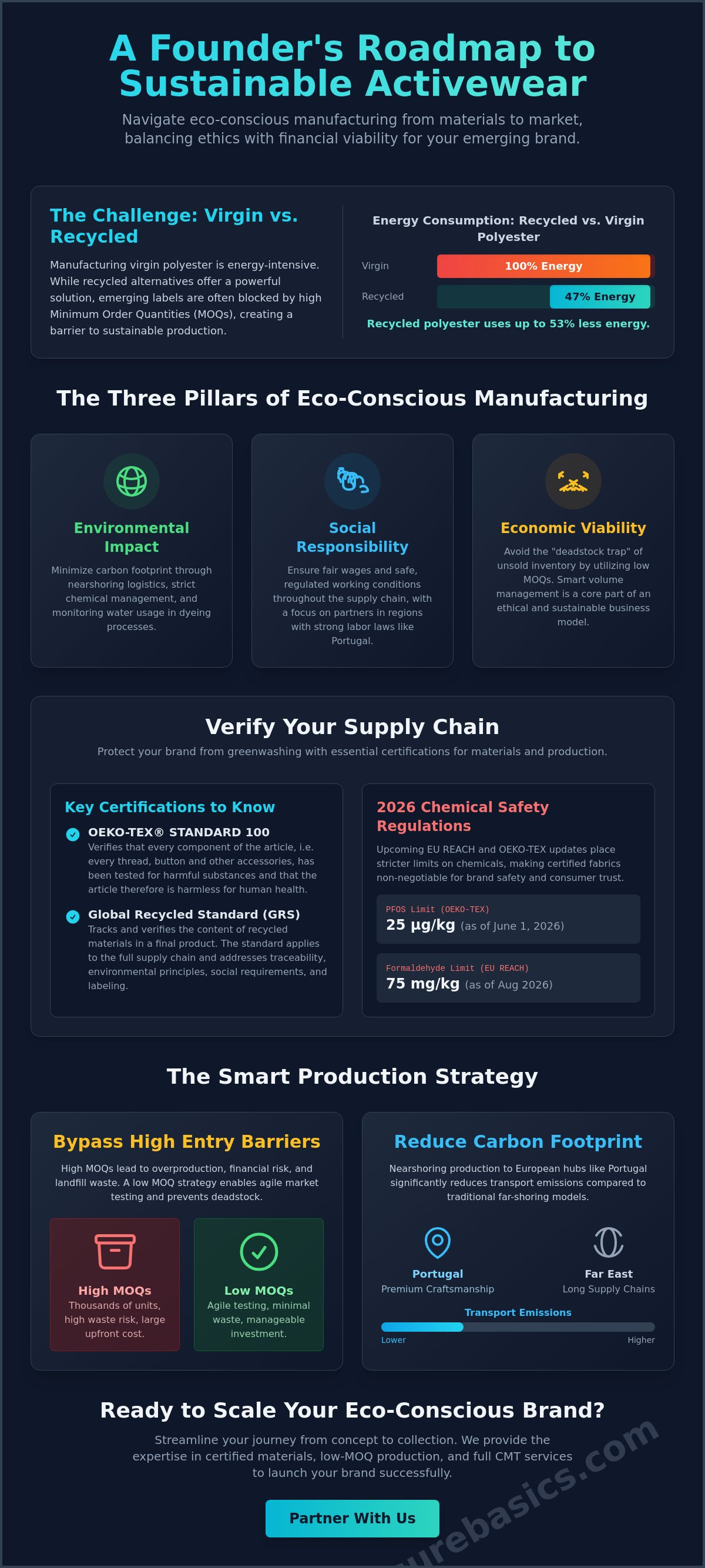
Did you know that manufacturing recycled polyester uses up to 53% less energy than virgin materials, yet many emerging labels are still blocked by massive minimum order requirements? It's a common struggle to find a partner who balances high-end technical construction with the low MOQs necessary for a lean startup. You shouldn't have to choose between ethical integrity and financial viability when scaling your sustainable activewear production.
We understand the pressure of meeting the 2026 EU Digital Product Passport requirements while avoiding the trap of factory greenwashing. You're likely looking for a way to ensure your garments meet the new GOTS 8.0 standards without committing to thousands of units upfront. This guide provides a clear roadmap to mastering eco-conscious manufacturing. You'll learn how to secure a reliable European partner, manage the latest OEKO-TEX regulations, and launch a premium collection with inventory levels that actually make sense for your growth. We'll preview the essential steps for sourcing certified materials and managing a full CMT production cycle that positions your brand as a leader in the ethical apparel market.
Key Takeaways
- Learn how to balance certified recycled materials with ethical labor standards to ensure your brand meets the highest industry benchmarks.
- Understand the critical role of OEKO-TEX® and GRS certifications in verifying your supply chain and protecting your business from greenwashing risks.
- Master sustainable activewear production by leveraging nearshoring in Portugal to reduce transport emissions while maintaining premium craftsmanship.
- Discover how to bypass high entry barriers by utilizing low minimum order quantities that allow for agile market testing without excess waste.
- Identify the essential components of a professional tech pack and full CMT production to streamline your transition from concept to a commercial collection.
Defining Sustainable Activewear Production for Modern Brands
Sustainability in the fitness apparel industry has evolved far beyond the simple use of recycled polyester. For brands launching in 2026, sustainable activewear production represents a comprehensive strategy that integrates material integrity with social accountability and operational efficiency. It's no longer enough to market a "green" product; you must demonstrate a commitment to the entire lifecycle of the garment. This shift is driven by a global movement toward Sustainable fashion, which prioritizes long-term ecological balance over short-term profit margins. Emerging labels must now consider circularity, meaning garments are designed to be durable, repairable, and eventually recyclable.
The Three Pillars of Eco-Conscious Manufacturing
Expertly managed production rests on three essential foundations. Environmental impact focuses on minimizing the carbon footprint of logistics and ensuring strict chemical management. This includes monitoring water usage during dyeing and ensuring that no hazardous substances leach into the environment. Social responsibility ensures that every individual in the supply chain receives fair wages and works in safe, regulated conditions. This is particularly vital in regional hubs like Portugal, where labor standards are strictly enforced and workers' rights are protected by law. Finally, economic viability addresses the waste inherent in traditional manufacturing. By utilizing low minimum order quantities (MOQs), emerging brands can avoid the trap of deadstock. High production volumes often lead to unsold inventory that eventually ends up in landfills. Managing your volume is a core component of an ethical business model.
Why 'Fast Fashion' Activewear is Failing the Market
The traditional model of cheap, disposable performance wear is losing its appeal as the market matures. Consumers in the fitness space are increasingly prioritizing longevity and technical quality over low prices. They've recognized the hidden costs of planned obsolescence, where garments lose elasticity or seam strength after just a few washes. This "buy less, buy better" mentality is a direct response to the environmental toll of mass-market manufacturing. Modern entrepreneurs are responding by focusing on premium craftsmanship that stands the test of time. We define sustainable production as a holistic commitment to the entire garment production process, ensuring every decision from fiber selection to final assembly minimizes waste and maximizes durability. By focusing on quality over quantity, brands can build trust with an audience that values transparency and principled manufacturing.
Beyond Recycled Polyester: Essential Eco-Certifications and Materials
Choosing the right materials is the most critical decision in sustainable activewear production. While recycled polyester is a common starting point, modern brands must look deeper into how these fibers are processed and verified. The Environmental Impact of the Clothing Industry highlights how traditional synthetic production relies on energy-intensive processes and toxic chemicals. To combat this, 2026 standards prioritize transparency through rigorous third-party verification. You need to ensure your chosen textile options offer the high-performance compression your customers expect without relying on harmful chemical finishes.
OEKO-TEX® and Chemical Safety in Performance Wear
Activewear sits directly against the skin for extended periods. When you sweat, your pores open, making the fabric's chemical composition a matter of health as much as ecology. As of June 1, 2026, OEKO-TEX Standard 100 has implemented stricter PFOS limits of 25 µg/kg. These regulations ensure that garments are free from substances like formaldehyde, which faces a new EU REACH limit of 75mg/kg starting in August 2026. Using certified fabrics builds immediate trust with premium consumers who value safety. We help brands navigate these complexities through our materials sourcing support, ensuring every fabric in your line meets these evolving safety benchmarks.
Recycled Nylon and Polyester: The Performance Standard
The Global Recycled Standard (GRS) is the benchmark for verifying the origin of recycled fibers. It tracks the material from the source to the final product, ensuring that "recycled" isn't just a marketing claim. High-quality recycled nylon, often sourced from abandoned fishing nets or post-consumer waste, offers durability that rivals virgin synthetics. These fibers provide the essential snap-back and moisture-wicking properties required for high-intensity training—to see how high-performance apparel supports intentional movement, check out Evora Training. Consider these factors when selecting your performance fabrics:
- Durability: Recycled fibers maintain tensile strength through repeated wash cycles, preventing premature garment failure.
- Circular Design: Brands are increasingly exploring biodegradable elastane alternatives to improve end-of-life recyclability.
- Texture and Feel: Modern mills can now achieve brushed, buttery-soft hand-feels using 100% recycled content.
Verifying these claims requires a partner who understands the technical nuances of garment construction. It's not just about the fiber; it's about how that fiber is knitted and finished to prevent pilling or transparency. By focusing on certified materials, you protect your brand from the risks of greenwashing while delivering a product that truly performs. Our team provides the expert guidance needed to select materials that align with your brand's ethical standards and technical requirements.
Nearshoring in Portugal: Reducing Carbon Footprints through Regional Manufacturing
Logistics often represent the invisible weight in a brand's environmental impact. While sourcing recycled fibers is a vital first step, the carbon cost of transporting finished goods across the globe can quickly undermine your ecological goals. Shipping from distant manufacturing hubs involves long-haul sea freight or high-emission air freight, both of which contribute significantly to global warming. For brands prioritizing sustainable activewear production, nearshoring has become the strategic solution. By moving manufacturing closer to your primary market, you drastically reduce the distance your garments travel. Portugal has emerged as the premier European hub for this transition, offering a sophisticated infrastructure that balances high-end technical capability with geographical proximity.
The 'Made in Portugal' Advantage for Ethical Brands
Portugal's textile industry operates under strict European Union labor regulations. These laws ensure that every individual involved in your production is protected by fair wage standards and rigorous safety protocols. In 2026, the minimum wage for a garment worker in Portugal is approximately €870 per month, with an average labor cost of €9.80 per hour. These figures provide a transparent baseline for ethical auditing that is often impossible to verify in overseas factories. Choosing made in portugal clothing gives your brand a powerful, verified marketing claim. It tells your customers that your garments are produced in a region that respects human rights and environmental limits. This heritage of craftsmanship is now paired with modern innovation, ensuring that factories consistently meet OEKO-TEX® essential eco-certifications for chemical safety and material integrity.
Logistics and the Carbon Math of Nearshoring
The environmental math of nearshoring is straightforward. Road and rail transport within Europe generate a fraction of the emissions produced by international shipping routes. With international shipping rates expected to increase by 5.9% in 2026, producing regionally is also a protective measure for your bottom line. Beyond the carbon savings, shorter lead times allow for a more agile business model. Instead of committing to massive shipments months in advance, you can manage more frequent, smaller restocks. This responsiveness is a core tenet of sustainable activewear production because it prevents the accumulation of deadstock. When you produce only what the market demands, you eliminate the waste associated with unsold inventory. This lean approach reduces your brand's market risk while ensuring your supply chain remains as clean as your finished products.
Navigating MOQs and Tech Packs for Sustainable Collections
High minimum order quantities (MOQs) represent the single greatest barrier to entry for eco-conscious startups. Traditional manufacturing hubs often require orders of 1,000 units or more per style, which forces new brands into a cycle of overproduction and potential deadstock. This creates a significant environmental burden and financial risk. True sustainable activewear production requires a more agile approach. By leveraging lower volumes, you can test specific designs and technical fabrics without committing to thousands of unsold garments. This lean methodology ensures that every piece produced has a clear path to a consumer, effectively eliminating the waste associated with mass-market manufacturing.
The Role of the Tech Pack in Sustainable Production
A professional tech pack serves as the technical blueprint for your entire collection. Precision at this stage is essential for reducing material waste during the sampling process. When technical specifications are vague, factories often produce multiple incorrect samples, consuming energy and textiles unnecessarily. A comprehensive tech pack includes your Bill of Materials (BOM), precise grade rules for sizing, and detailed construction instructions. These documents ensure that your manufacturing partner understands exactly how to execute complex seams and compression zones on the first attempt. If you're transitioning from a rough sketch to a finished product, our team provides the tech pack development services needed to bridge that gap and ensure production-ready accuracy.
Strategies for Low-Volume Sustainable Launches
Launching a collection doesn't require massive inventory risks if you choose the right production model. For brands seeking rapid market entry with minimal waste, private label portugal services offer a streamlined path. This allows you to select proven, high-performance silhouettes and customize them with your unique brand identity. You can also maximize your budget by choosing versatile styles that work across multiple seasons, updating your line with new colorways rather than entirely new patterns. In 2026, our white-label MOQs start as low as 70 pieces per style, while custom designs typically require 250 to 300 pieces. Accessible 70-piece MOQs enable ethical experimentation for new brands by allowing them to validate sustainable concepts with minimal upfront investment. This flexibility ensures you can scale your operations based on real-time market demand rather than speculative projections.
Success in the premium activewear space depends on the strength of your technical foundation. Whether you're developing a custom compression legging or a high-performance recycled hoodie, your production documents must be flawless. Clear communication through professional tech packs and manageable order volumes allows you to maintain high standards of quality and sustainability. Ready to refine your technical specifications? Explore our closing production consulting services to ensure your collection is optimized for efficient, low-waste manufacturing.
Scaling Your Eco-Conscious Brand with Athleisurebasics
Building a successful fitness label requires a manufacturing partner that understands the nuances of the entrepreneurial journey. We don't just provide factory space; we offer a collaborative framework designed to help you master sustainable activewear production. Our commitment to OEKO-TEX® certified fabrics and Portuguese craftsmanship ensures your products meet the highest global standards for safety and quality. By centralizing your operations with a single partner, you gain end-to-end support that covers everything from initial materials sourcing support to final CMT production. This integration reduces the communication gaps that often lead to errors and waste in traditional supply chains.
Custom Manufacturing vs. White Label Solutions
We provide two distinct paths for market entry and expansion. For brands seeking a unique market edge through proprietary patterns and specialized technical features, our custom manufacturing services require a manageable MOQ of 250 pieces per style. This allows you to innovate without the burden of massive inventory. Conversely, if your goal is a rapid launch, you can leverage our curated collection of luxury blanks. These white-label solutions offer a 70-piece MOQ, providing the speed and flexibility needed to test new market segments with minimal risk. We've seen many startups successfully scale from their first 70-piece order to full custom lines as their community grows and their brand identity solidifies. If you are looking for inspiration from a brand that has successfully navigated this journey to create a high-end consumer experience, you can discover JC London.
Your Next Steps Toward Sustainable Production
Transitioning from a concept to a commercial presence is a structured process. Your next step involves preparing your designs for a professional quote, which requires clear technical specifications. If your tech packs aren't yet finalized, our production consulting services can remove the guesswork and ensure your designs are optimized for efficient manufacturing. This early-stage collaboration prevents costly mistakes and ensures your sustainable activewear production remains profitable. Partnering with a reputable clothing manufacturer in Portugal aligns your brand with a legacy of ethical labor and environmental responsibility. We invite you to initiate contact and discover how our regional expertise can transform your vision into a premium, market-ready collection.
Build Your Sustainable Activewear Brand with Confidence
Success in 2026 depends on your ability to combine technical performance with verified ethical standards. Mastering sustainable activewear production is no longer a distant goal for emerging labels. By choosing regional manufacturing in Portugal, you secure a supply chain that respects both human rights and environmental limits. Prioritizing OEKO-TEX® certified fabrics and utilizing low MOQs starting at 70 pieces allows you to scale efficiently without creating textile waste. These strategic choices protect your brand from the risks of greenwashing and overproduction while ensuring premium quality.
The transition from a creative concept to a commercial presence is a structured journey. You don't have to navigate technical complexities alone. We're committed to providing the transparency and craftsmanship your premium brand deserves. Launch your sustainable collection with Athleisurebasics today and take the first step toward a lasting market presence. Your vision for a principled, high-performance activewear line is ready to become a reality. We look forward to being your partner in this growth.
Frequently Asked Questions
What is the minimum order quantity (MOQ) for sustainable activewear?
Minimum order quantities depend on whether you choose custom manufacturing or white label services. For custom clothing manufacturing, MOQs typically start at 250 to 300 pieces per style and color. If you opt for white label clothing, you can launch with as few as 70 pieces. These low thresholds allow emerging brands to test the market without the risk of creating excess inventory or waste.
Is recycled polyester as durable as virgin polyester for gym wear?
Recycled polyester matches the performance and structural integrity of virgin fibers in every technical category. It provides the same essential compression, moisture-wicking, and stretch recovery required for high-intensity training. Modern textile engineering ensures that these recycled fibers maintain their shape and color through repeated wash cycles. This makes them a reliable choice for premium activewear that prioritizes both longevity and environmental responsibility.
How do I know if an activewear manufacturer is truly ethical?
You can verify a manufacturer’s ethical standing by looking for regional certifications and adherence to strict labor laws. Factories located in the European Union, particularly in Portugal, must comply with regulated wage standards and workplace safety protocols. It is important to ask for transparency regarding their production processes and check for third party certifications like OEKO-TEX® or GRS to ensure they meet international social and environmental benchmarks.
What certifications should I look for in sustainable performance fabrics?
The most important certifications for sustainable activewear production are OEKO-TEX® Standard 100 and the Global Recycled Standard (GRS). OEKO-TEX® ensures that the finished fabric is free from harmful chemicals, which is vital for garments sitting directly against the skin. GRS verifies the recycled content of the fibers and monitors the environmental and social practices of the mills to prevent greenwashing in your supply chain.
Can I produce sustainable activewear in small batches in Europe?
Yes, producing in small batches is a core advantage of the European manufacturing landscape. Portugal has become a global hub for high-end activewear because its factories specialize in flexible production volumes for emerging brands. This nearshoring model allows for faster turnaround times and significantly lower transport emissions compared to large scale manufacturing in Asia. It supports a lean business model that avoids overproduction.
How much does it cost to start a sustainable activewear line?
The cost of starting your line is influenced by your choice between custom designs and white label solutions. Custom production requires an investment in tech pack development and sample creation, while white label services allow for a faster launch with lower upfront expenses. You should also factor in materials sourcing and logistics. Some industry professionals report that international shipping rates are expected to increase by 5.9% in 2026.
What is the difference between GRS and OEKO-TEX certifications?
GRS and OEKO-TEX® serve different but complementary roles in sustainable activewear production. The Global Recycled Standard (GRS) tracks and verifies the recycled content of the fibers from the source to the final product. OEKO-TEX® Standard 100 focuses on consumer safety by testing the finished textile for harmful substances. Using fabrics that carry both certifications ensures your collection is both ecologically responsible and safe for high-performance use.
How long does the sustainable production process take in Portugal?
The production timeline in Portugal varies based on the complexity of your collection and whether you are developing custom samples. The process generally includes tech pack refinement, sample creation, and the final CMT production phase. Shorter lead times are a hallmark of Portuguese manufacturing, though you should always account for seasonal demand and shipping schedules. Regional production typically offers a much faster path to market than overseas alternatives.



Leave a comment
This site is protected by hCaptcha and the hCaptcha Privacy Policy and Terms of Service apply.