
What Does Cut Make Trim (CMT) Mean? The Definitive Guide for Apparel Brands
Choosing the wrong manufacturing model doesn't just eat your margins; it can strip away the creative control that defines your brand. You've likely heard the term used in factory meetings and wondered, "what does cut make trim mean" for your daily operations and your workload. It's natural to feel overwhelmed by technical jargon, especially when you're unsure whether you need to source the fabric yourself or if the factory manages the entire supply chain.
Our goal is to empower your entrepreneurial journey by simplifying these complex industrial processes and providing the clarity you need to scale. This guide will help you master the technicalities of CMT manufacturing so you can decide if this high-control production model is the right strategic fit for your clothing line. We'll provide a clear decision framework to choose between CMT and Full Package Production, explore the workflow in detail, and outline exactly what you must prepare before contacting a factory to ensure a seamless transition from concept to finished product.
Key Takeaways
- Understand exactly what does cut make trim mean by exploring the three core stages of garment assembly: cutting, sewing, and finishing.
- Evaluate the trade-offs between CMT and Full Package Production (FPP) to determine which model balances your need for quality control with your logistical capacity.
- Learn why a comprehensive tech pack and pre-sourced materials are non-negotiable requirements before any factory begins the cutting process.
- Discover why sourcing premium CMT services in Portugal provides a competitive edge through high-end craftsmanship and strict adherence to ethical EU labor standards.
- Gain a clear roadmap for preparing your brand to engage with manufacturers, ensuring a smooth transition from design concept to a market-ready collection.
What is CMT Manufacturing? Defining Cut, Make, and Trim
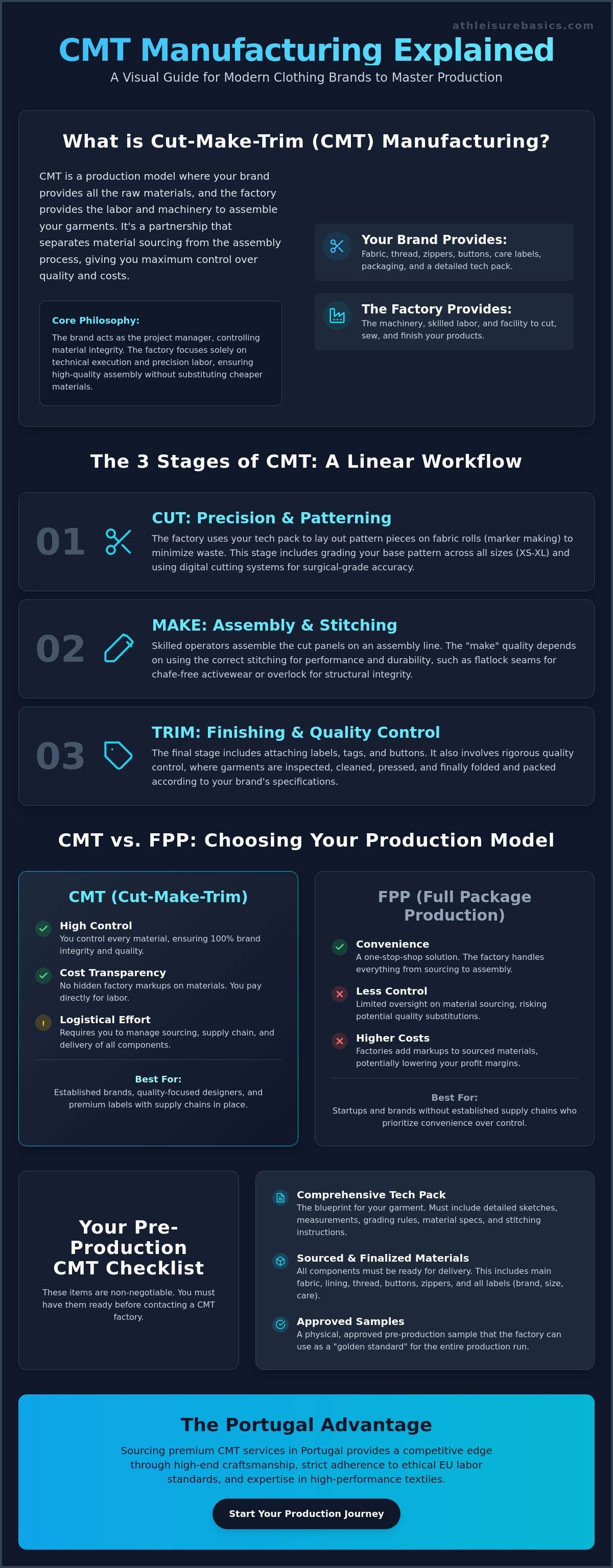
At its core, CMT is a specific service within the textile industry that focuses exclusively on the assembly phase of production. The acronym stands for Cut, Make, and Trim. This manufacturing model creates a clear division of labor: the factory provides the technical skill and machinery, while your brand provides the raw ingredients. It's a collaborative partnership where you maintain ownership over the materials and the factory handles the physical transformation of those materials into a finished collection.
When you ask "what does cut make trim mean" in a practical, day-to-day sense, it means the brand is responsible for delivering every component, from fabric rolls to the smallest care label, to the factory door. The manufacturer's role is strictly limited to processing these items based on your exact specifications. This model is a staple for luxury and boutique brands because it offers total transparency. You know exactly which mill produced your fabric and which studio handled the stitching, ensuring no hidden substitutions occur during production.
CMT differs significantly from Full Production (FPP) models. In FPP, the factory acts as a one-stop shop, handling sourcing, development, and assembly. With CMT, that sourcing burden shifts to the designer. While this requires more logistical work on your end, it eliminates the markups factories often place on materials, potentially offering better margins for brands with established supply chains.
The Core Philosophy of the CMT Model
The heart of CMT is precision labor. Because the factory doesn't manage procurement or material costs, they focus entirely on the quality of the "make." This requires the brand to step into a project manager role. You maintain high standards for textile quality by selecting your own materials, which prevents the factory from using cheaper alternatives to pad their profits. It's a model built on technical execution and material integrity rather than logistical convenience.
Who is CMT Manufacturing Best For?
CMT isn't the right choice for every business, but it's the definitive standard for specific types of apparel ventures that prioritize control. You should consider this model if you fall into one of these categories:
- Established brands: Companies with reliable fabric supply chains already in place that want to keep their material costs separate from labor.
- Quality-focused designers: Emerging entrepreneurs who have secured specific, high-quality OEKO-TEX® fabrics and want to ensure their integrity is maintained throughout the sewing process.
- Premium labels: Brands aiming for a high-end price point, particularly those utilizing "Made in Europe" craftsmanship to justify luxury positioning.
Ultimately, CMT rewards preparation. If you have the resources to manage your own sourcing, this model provides the highest level of oversight over your product's feel, durability, and ethical origin.
Breaking Down the 3 Stages: Cut, Make, and Trim
To fully grasp what does cut make trim mean, you must look at it as a linear assembly line where every millimeter matters. The order of these stages isn't just a suggestion; it's a structural requirement for production consistency. If the cutting is imprecise, the assembly fails. If the assembly is rushed, the final finishing cannot hide the structural flaws. This three-step workflow ensures that the final garment matches your original vision with mathematical accuracy.
Phase 1: Precision Cutting and Pattern Placement
The process begins with "marker making," where the factory arranges your pattern pieces on fabric rolls to ensure minimal waste. Factories use your tech packs as a blueprint to guide this placement. This stage also includes grading, which is the technical process of scaling your base pattern to fit your entire size range, from XS to XL, without losing the intended silhouette. Advanced digital cutting systems translate your tech pack data into surgical-grade precision, virtually eliminating human error in the complex paneling of high-performance athleisure.
Phase 2: The Art of the 'Make' (Assembly)
The "Make" phase is where your garment takes its final shape on the assembly line. Skilled operators use specialized machinery to join panels based on your stitching requirements. For activewear, the choice of stitch is vital for both comfort and performance. Flatlock stitching is the premium standard for leggings because it creates a smooth, chafe-free seam, while overlock stitching is often used for structural seams in less sensitive areas. Handling technical, high-stretch fabrics requires a level of dexterity that only experienced labor can provide, directly impacting the garment's durability and premium feel.
Phase 3: Trimming, Finishing, and Quality Control
The "Trim" phase is often the most overlooked, yet it's where your brand identity is solidified. This stage involves attaching all hardware, such as zippers, buttons, and drawstrings, as well as your custom brand and care labels. Organizations like the National Council of Textile Organizations highlight the technical evolution of these manufacturing stages within the global supply chain. Once assembly is complete, garments undergo final pressing and steaming to remove wrinkles and set the shape for the retail shelf.
The most critical part of this final stage is the 100% inspection rule. Every single garment is checked for loose threads, crooked seams, or sizing inconsistencies before packaging. This rigorous quality control is the manufacturer's final responsibility in the CMT model, ensuring that every piece meets your high standards. If you're ready to move from design to physical product, our full CMT production services provide the expert oversight needed to launch a flawless collection.
CMT vs. FPP: Choosing the Right Production Model
Deciding between these two models is a pivotal strategic moment for any apparel business. While you now understand what does cut make trim mean from a technical standpoint, the commercial implications are equally vital. CMT is essentially a labor-only contract. You pay for the factory's skill and machinery, but you own the supply chain. FPP, or Full Production Package, is an all-inclusive service where the factory sources everything on your behalf, providing a finished product without the sourcing burden.
Cost analysis reveals a distinct trade-off. CMT typically offers a lower unit price on the factory invoice because you aren't paying a sourcing markup. However, your logistical costs will be higher. You must account for shipping fabric to the factory, managing multiple vendor relationships, and the time spent on procurement. FPP consolidates these costs into one higher unit price, which simplifies budgeting for smaller teams but reduces your direct control over material margins.
Risk management is where the models diverge most sharply. In a CMT setup, if your fabric arrives at the factory with defects, the responsibility lies with you. If the factory cuts flawed material that you provided, you still pay for the labor. In FPP, the factory is responsible for the fabric quality, offering a single point of accountability that many new brands find reassuring. Despite this risk, CMT offers a level of agility that FPP cannot match. Since you control the sourcing, you can change fabric suppliers for a new season without having to move your entire production to a new factory.
When to Choose CMT (Cut, Make, Trim)
CMT provides unparalleled flexibility and oversight. It is the ideal choice if:
- You have a trusted fabric mill: You've already established a relationship with a supplier and want to maintain that direct connection.
- You produce technical apparel: Your designs require unique, high-performance materials that standard factories don't stock or understand.
- You demand total transparency: You need to verify the ethical origin of every yard of fabric to meet your brand's sustainability standards.
When FPP (Full Production Package) is Better
FPP is designed for efficiency and speed. This model works best when:
- You are a startup: You don't have the bandwidth to manage five different suppliers and want to focus on brand growth.
- You prefer a single point of accountability: You want one partner to manage the entire garment production process from start to finish.
- You are using standard fabrics: Your designs utilize common materials that the factory can source easily and at a competitive volume price.
The Pre-Production Checklist: What You Need Before CMT
Mastering the technical definition of what does cut make trim mean is only your first step. The success of this model depends entirely on your pre-production precision. Since the factory provides only the labor, you must provide the exhaustive blueprint and every physical component required for assembly. A single missing detail or a delayed shipment of labels can halt an entire production run, leading to costly idle time and missed launch dates.
Before you contact a factory, you must ensure your patterns are production-ready for industrial machines. This includes grading your patterns for your full size range and creating a comprehensive Bill of Materials (BOM). The BOM is a detailed inventory of every thread, zipper, button, and brand label needed to complete the garment. Without these elements, the "Cut" and "Trim" stages of the process cannot begin.
Why Tech Packs are the 'Contract' of CMT
In a CMT partnership, the Tech Pack serves as your technical contract. It eliminates "Assumption Errors" by documenting every design choice in writing. If a specific stitch type or reinforcement is not in the tech pack, the factory won't do it. Your Tech Pack must include spec sheets and tolerances, which define the acceptable measurement deviations for your size range. A Tech Pack is the ultimate communication tool between designer and manufacturer.
Logistics: Managing the Supply Chain
Logistical oversight is your primary responsibility in the CMT model. You must coordinate the arrival of fabric rolls from your chosen mills to the factory floor well before the cutting date. This requires calculating your "Yield" with high accuracy. Yield is the total amount of fabric required based on your pattern markers and anticipated waste. If your yield calculations are off, you may end up with incomplete sets or wasted capital.
Don't let a missing zipper or a delayed shipment of care labels stop your whole production. Managing "Trims" logistics is just as vital as sourcing the primary fabric. Every item on your BOM must be present and accounted for to ensure the assembly line moves without interruption. If you need professional support to get your designs ready for the factory floor, our team provides expert tech pack development to ensure your brand is built on a foundation of technical excellence.
The Portugal Advantage: Premium CMT for Modern Brands
Choosing where to execute your production is just as critical as understanding what does cut make trim mean for your daily operations. For brands that prioritize quality and ethical integrity, clothing manufacturers in Portugal have become the definitive gold standard. Unlike manufacturing hubs in low-wage regions, Portugal operates under strict EU labor laws and environmental regulations. This ensures your brand is built on fair practices and transparency, which is increasingly vital as new rules like the EU Digital Product Passport take effect in 2026.
Strategic proximity to Europe's top fabric mills significantly reduces the carbon footprint of your CMT logistics. Instead of shipping materials across oceans, you can source premium textiles from neighboring regions. This proximity also shortens lead times. Portuguese factories typically offer lead times of 4 to 8 weeks, whereas Asian hubs often require 12 to 20 weeks. With the Portuguese textile industry exporting €5.5 billion in 2025, the region's infrastructure is optimized for high-efficiency, premium production.
Quality and Craftsmanship in Portuguese Factories
Northern Portugal is home to a deep heritage of textile expertise. With over 130,000 professionals employed in the sector, the region offers a level of technical proficiency that is difficult to replicate. Factories here specialize in technical athleisure and high-stretch luxury fabrics, providing the dexterity required for the complex assembly stages of the CMT model. The 'Made in Portugal' label serves as a powerful marketing asset. It signals to your customers that they are investing in high-end craftsmanship and principled manufacturing standards.
Partnering with Athleisurebasics for Your Production
Athleisurebasics bridges the gap for emerging brands by offering flexible production volumes that remove traditional barriers to entry. We support startups with accessible minimum order requirements, such as 70 pieces for white label collections or 250 pieces for custom designs. This allows you to scale at a pace that suits your business growth without the risk of overstocking. Our commitment to OEKO-TEX® certified materials ensures your products meet modern sustainability mandates and technical performance requirements.
We position ourselves as your dedicated ally, simplifying the transition from a technical tech pack to a market-ready garment. By choosing a partner that values material integrity and ethical standards, you secure a long-term foundation for your brand. Ready to start your production run? Contact Athleisurebasics for a custom quote today.
Scaling Your Brand with Precision Manufacturing
Mastering the technicalities of the CMT model is a transformative step for any emerging apparel brand. Control is your greatest asset. By maintaining oversight of your material sourcing and partnering with a factory that excels in technical assembly, you ensure your collection meets the highest standards of luxury and durability. Success in this model hinges on your preparation, particularly the development of exhaustive tech packs and the coordination of high-quality material deliveries. Now that you understand what does cut make trim mean for your production workflow, you can confidently choose the path that aligns with your strategic goals.
Portugal remains the premier destination for brands seeking ethical, high-end craftsmanship without the prohibitive barriers of large-scale manufacturing. At Athleisurebasics, we simplify this journey by offering premium Portugal-based production with accessible low MOQs starting at 70 pieces. Our commitment to OEKO-TEX® certified fabric options ensures your collection is as principled as it is performant.
Launch your premium clothing line with Athleisurebasics' expert manufacturing services. We're dedicated to helping you transition from a small idea to a lasting commercial presence with ease and security.
Frequently Asked Questions
Is CMT cheaper than FPP manufacturing?
CMT often results in a lower unit cost on the factory invoice because you avoid the markups manufacturers place on sourced materials. However, you must account for the logistical expenses of managing your own supply chain. For brands with established fabric relationships, this model typically offers better long-term margins. It's a strategic choice that rewards designers who have the capacity to manage their own procurement and vendor coordination.
Do I need to provide the patterns for CMT?
Yes, providing production-ready, graded patterns is a standard requirement for this manufacturing model. The factory expects you to deliver the technical blueprints for every size in your range. While some manufacturers offer pattern development as a separate consulting service, the core definition of the model assumes the brand supplies the patterns. This ensures your unique silhouette and fit standards remain entirely under your creative control.
What happens if the factory wastes too much fabric during the 'Cut' stage?
Fabric waste issues are typically managed through agreed-upon consumption rates established in your production contract. You should calculate your anticipated fabric yield before the cutting begins. If a factory exceeds the industry-standard waste percentage without a technical justification, they may be held liable for the cost of the wasted material. Modern facilities utilize digital marker making to ensure your fabric rolls are used with maximum efficiency.
Can a CMT factory help me with fabric sourcing?
A traditional factory focuses solely on labor, but many modern partners offer materials sourcing support as an additional service. While the fundamental answer to what does cut make trim mean implies the brand handles procurement, collaborative manufacturers often provide mill recommendations. This partnership ensures your chosen textiles are compatible with the factory's machinery and meet the technical requirements for high-performance apparel assembly.
How do I know if my tech pack is ready for a CMT factory?
Your tech pack is ready when it contains every technical specification, measurement, and material detail required for assembly without further clarification. It must include a comprehensive Bill of Materials, graded spec sheets, and clear stitching instructions. If a manufacturer can understand your design's construction entirely from the document, it is production-ready. We recommend a professional technical review before the first physical cutting takes place.
What is the typical MOQ for CMT manufacturing in Portugal?
Minimum order quantities in Portugal are remarkably flexible, often starting as low as 250 pieces for custom production runs. This regional advantage allows emerging brands to scale their operations without the burden of massive inventory. Some specialized partners even accommodate white label orders starting at 70 pieces. This accessibility makes Portugal an ideal hub for boutique ventures that prioritize premium quality over high-volume, low-cost production.
Does CMT include labels and packaging?
How long does a typical CMT production run take?
A typical production run in Europe takes between 4 and 8 weeks once all raw materials are delivered to the factory floor. This timeline is significantly faster than many global hubs, where lead times can extend to 20 weeks. The total duration depends on your collection's complexity and the factory's current capacity. Understanding what does cut make trim mean in terms of lead times helps you plan your seasonal launches with greater accuracy.



Leave a comment
This site is protected by hCaptcha and the hCaptcha Privacy Policy and Terms of Service apply.