

Apparel Manufacturing for E-commerce Brands: The 2026 Strategic Guide
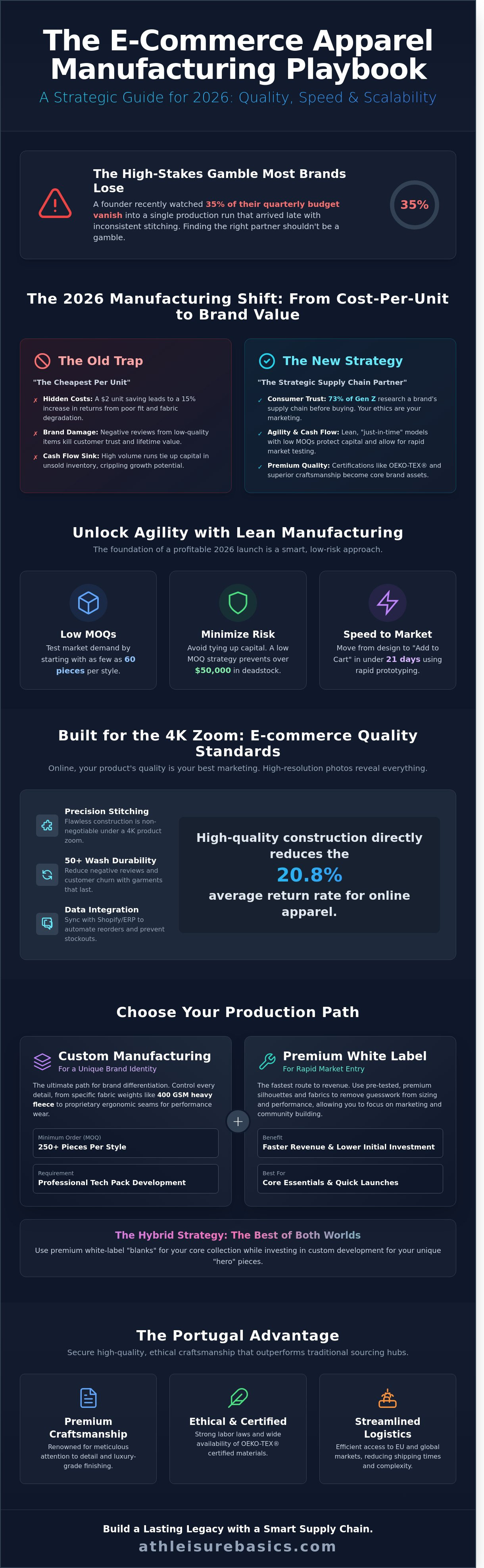
Last October, an emerging brand founder watched 35% of their quarterly budget vanish into a single production run that arrived three weeks late with inconsistent stitching. It's a story we hear too often in this industry. You likely agree that finding the right apparel manufacturing for e-commerce brands shouldn't feel like a high-stakes gamble with your company's future. You want to focus on growth and design, not chasing factory managers or worrying about whether your 2026 launch will meet the highest industry standards.
In this strategic guide, you'll learn how to secure a reliable production partnership that scales with your vision while maintaining premium quality and low risk. We'll show you how to leverage low MOQs and ethical manufacturing to protect your cash flow and build a lasting brand legacy. We'll break down the shift toward European craftsmanship, the importance of OEKO-TEX® certifications, and the exact steps to transition from a simple logo to a profitable, high-end e-commerce powerhouse.
Key Takeaways
- Master the transition to lean, "just-in-time" production models to minimize inventory risk and maximize scalability in the 2026 market.
- Evaluate the strategic trade-offs between custom manufacturing for unique brand identities and premium white-label solutions for rapid market entry.
- Leverage the "Portugal Advantage" to secure high-quality, ethical craftsmanship and streamlined logistics that outperform traditional global sourcing hubs.
- Follow our professional operational checklist to prepare non-negotiable assets like tech packs, ensuring your first production cycle is efficient and error-free.
- Discover how specialized apparel manufacturing for e-commerce brands bridges the gap between startup flexibility and luxury-grade quality to help you build a lasting legacy.
Navigating Apparel Manufacturing for E-commerce Brands in 2026
Modern standards in the global apparel manufacturing industry have evolved far beyond the simple assembly of fabrics. For founders in 2026, your manufacturer acts as a strategic supply chain partner rather than a distant vendor. Success no longer depends on high-volume factory runs that clog warehouses with unsold inventory. Instead, the focus has shifted toward lean, "just-in-time" models that prioritize agility and cash flow. Apparel manufacturing for e-commerce brands in 2026 is about speed to market and the ability to pivot based on real-time data.
Many founders fall into the "cheapest per unit" trap. While a $2.00 savings on a t-shirt seems attractive on a spreadsheet, it often leads to a 15% increase in customer returns due to poor fit or fabric degradation. These hidden costs make "cheap" production the most expensive mistake a digital-first brand can make. In 2026, 73% of Gen Z consumers research a brand's supply chain before purchasing. This means your ethical story, such as using OEKO-TEX® certified materials or Portuguese craftsmanship, is a core part of your marketing toolkit. Your manufacturer's certifications are now as important as your Instagram aesthetic.
The Rise of Lean Manufacturing
Low MOQs are the foundation of a profitable 2026 launch. By starting with as few as 60 pieces per style, you can test market demand without risking $50,000 in deadstock. Using "Luxury Blanks" for rapid prototyping allows you to move from design to "Add to Cart" in under 21 days. This small-batch approach creates a sense of exclusivity that drives full-price sales. It's a pragmatic way to scale. You don't need to be a giant to have a premium supply chain; you just need to be smart with your initial volumes.
Digital-First Production Standards
E-commerce customers can't touch your products, so they rely on high-resolution zoom features. Your stitching must be flawless under a 4K lens. High-quality construction directly reduces return rates, which currently average 20.8% for online apparel. Mastering apparel manufacturing for e-commerce brands means prioritizing durability over sheer volume.
- Precision Stitching: High-resolution photography reveals every loose thread; quality is your best marketing.
- Durability: Garments that survive 50+ washes reduce negative reviews and customer churn.
- Data Integration: Modern factories provide real-time updates that sync with your inventory management systems.
Custom vs. White Label: Which Path Fits Your E-commerce Strategy?
Deciding how to produce your line is a pivotal moment for any founder. The choice between custom manufacturing and white labeling affects your cash flow, speed to market, and long-term brand equity. While custom builds a unique identity, white label offers a faster route to revenue. Balancing these options is essential for maintaining the global competitiveness of the U.S. manufacturing industry and ensuring your brand can scale in a crowded digital space. Choosing the right partner for apparel manufacturing for e-commerce brands means looking beyond the first order and planning for your 2026 growth targets.
Custom manufacturing provides the highest level of brand differentiation. You control the specific fabric weight, such as a heavy 400 GSM fleece, and the exact ergonomic seams for performance wear. This path is for brands that won't settle for "off the shelf" fits. Conversely, white labeling uses pre-tested, premium silhouettes. It removes the guesswork from sizing and fabric performance, allowing you to focus on marketing and community building. Many founders find that a hybrid model offers the best of both worlds. You can use luxury blanks for your core essentials while investing in custom development for your "hero" pieces.
When to Choose Custom Manufacturing
Custom manufacturing is the right choice if your brand relies on a unique technical vision or patented fabric needs. If you're designing a specific pocket configuration for utility wear or a proprietary recycled blend, you need full control. This path typically requires managing a 250 piece MOQ per style. Success here depends heavily on professional tech pack development. A precise tech pack acts as your blueprint, reducing the risk of errors during the 3 to 5 month production cycle. It's a significant financial commitment, but it creates a "moat" around your brand that competitors can't easily copy.
The Startup Shortcut: White Label & Luxury Blanks
White labeling is the ultimate "startup shortcut" because it lowers the barrier to entry. You can launch a professional collection with as few as 70 pieces per style. This drastically reduces your inventory risk and allows for a faster testing phase. Don't mistake white label for low quality. When you source from premium European factories, you're using patterns that have already been perfected over years of production. You can maintain a high-end feel through several customization options:
- Intricate Embroidery: High-density stitching for a 3D luxury effect.
- Screen Printing: Using puff inks or water-based dyes for unique textures.
- Private Labeling: Custom neck tags and hem labels that make the garment truly yours.
By utilizing these "semi-custom" techniques, you create a product that feels bespoke without the 6 month lead times. If you're ready to see how these options can work for your business, you can explore our production options to find the right fit for your current stage of growth.
The Portugal Advantage: Quality, Ethics, and EU Logistics
Portugal has evolved into the central hub for apparel manufacturing for e-commerce brands that value quality over mass production. The region offers a strategic alternative to traditional manufacturing hubs by combining artisanal skill with modern efficiency. While Asian manufacturing often requires 12 to 20 weeks for production and shipping, Portuguese facilities typically deliver finished goods in 4 to 8 weeks. This agility allows you to run a leaner business model with less capital tied up in sitting stock. Our partners in Portugal specialize in Low MOQ production, making it easier for new founders to scale without the risk of excess inventory.
Proximity and Speed-to-Market
Shipping from Portugal to the UK or the US East Coast takes between 2 and 5 days via air freight. This speed allows brands to react to viral trends without the 90-day wait times typical of overseas production. Working in European time zones eliminates the 12-hour communication lag, making real-time troubleshooting possible during your standard business hours. You'll find that sampling cycles are remarkably efficient; most factories turn around a prototype in 10 to 15 days. This agility means you can move from a concept to a live collection in approximately 45 days. Reducing the distance your goods travel also cuts transportation-related carbon emissions by roughly 35%, helping you meet 2026 sustainability targets.
Premium Craftsmanship and Textiles
The "Made in Portugal" label acts as a hallmark of excellence for technical apparel and luxury streetwear. Portuguese clothing manufacturers leverage a deep heritage in textile engineering to produce high-performance fabrics that outperform standard commodity cottons. Most facilities are OEKO-TEX® certified, meaning they meet rigorous safety and environmental standards from the yarn to the finished zipper.
- Expertise in Technical Fabrics: Specialized clusters handle complex blends for high-end leggings and moisture-wicking tops.
- Ethical Labor Standards: All production follows strict EU labor laws, ensuring fair wages and safe working conditions.
- Durability: Portuguese textiles are known for high GSM weights and superior pilling resistance.
Choosing Portugal gives you access to specialized clusters that handle everything from organic fabric knitting to precision embroidery under one roof. It's a choice that resonates with the 72% of luxury consumers who now demand transparency in the supply chain. By manufacturing here, you align your apparel manufacturing for e-commerce brands with EU labor protections, turning your production process into a powerful marketing asset. For brands prioritizing Direct-to-consumer product sales, this alignment with ethical standards is a significant competitive advantage. It’s about building a legacy based on quality rather than just chasing the lowest unit cost.
Operational Checklist for E-commerce Production Runs
Moving from a design concept to a bulk production run is the most critical transition for any startup. Success in apparel manufacturing for e-commerce brands requires a shift from creative exploration to rigid operational discipline. You'll want to follow a structured roadmap to avoid the 15% to 20% waste margin that often plagues unguided first production cycles. By establishing clear protocols before the first stitch is sewn, you protect your capital and your brand reputation.
Mastering the Tech Pack
A tech pack is the blueprint that prevents manufacturing disputes. This document must go beyond basic sketches to include graded spec sheets, a comprehensive Bill of Materials (BOM), and exact stitching instructions. Many founders fail to define "tolerances," which are the acceptable deviations in physical measurements. If you don't specify a +/- 1cm tolerance for a waistband, you lose the legal ground to reject garments that arrive poorly sized. Ensure your documentation includes Pantone TCX codes and specific thread weights to maintain consistency across different production batches.
The Sampling and Approval Process
You should never skip the "Golden Sample" phase. This final pre-production sample (PPS) serves as the definitive version of what your customer will receive. It's best to approve this sample at least 45 days before your scheduled marketing launch to account for shipping or customs delays. When you provide feedback to your partner, stay technical. Instead of saying a garment "feels tight," specify that the "cross-shoulder measurement needs a 1.5cm increase." This precision reduces the number of revision cycles, which typically cost between $50 and $150 per iteration and can delay your launch by weeks.
To ensure your first run meets professional standards, follow this non-negotiable checklist:
- Labeling Compliance: Verify that care labels meet FTC requirements in the US or EU textile regulations, including fiber content and country of origin.
- Quality Control (QC): Require an AQL 2.5 (Acceptable Quality Limit) inspection. This industry standard ensures that a statistically significant percentage of your goods are checked for defects before leaving the factory floor.
- E-commerce Packaging: Request individual polybags, preferably compostable, with scannable SKU barcodes. This is essential for 3PL (Third-Party Logistics) efficiency and prevents inventory errors.
- Logistics Planning: Factor in transit times early. Sea freight usually takes 30 to 40 days for international delivery, while air freight takes 5 to 7 days but costs 3 to 4 times more.
Managing these logistics effectively ensures your apparel manufacturing for e-commerce brands stays profitable as you scale. Your goal is to create a repeatable system where quality is a guarantee rather than a surprise. When you treat your manufacturer as a strategic partner, you're better equipped to handle the complexities of global supply chains.
Ready to move from design to delivery? Launch your collection with a trusted manufacturing partner that simplifies the production process for growing brands.
Building a Legacy with Athleisurebasics
Choosing the right partner for apparel manufacturing for e-commerce brands determines whether a label survives its first year or scales into a market leader. Athleisurebasics eliminates the traditional trade-off between small-scale flexibility and luxury-tier quality. We specialize in helping entrepreneurs move from a simple concept to a finished product that rivals established high-end brands. By utilizing our private label Portugal solutions, you gain access to the same craftsmanship used by top European fashion houses. We provide full CMT (Cut, Make, Trim) production services, ensuring every garment meets the highest industry standards before it reaches your customer's doorstep.
Our commitment centers on three pillars: ethical production, premium materials, and low MOQs. We understand that cash flow is critical for startups. That's why we offer white label services starting at just 60 pieces per style or color. This low barrier to entry allows you to test 2026 market trends without the risk of overstocking or wasting capital. Every piece is manufactured in Portugal under strict EU labor laws. This gives your brand a transparent, ethical story that resonates with modern consumers who demand accountability. We don't just act as a factory; we function as your strategic partner, guiding you from "logo to legacy" with a focus on long-term brand health.
Specialized Athleisure Expertise
Modern activewear requires more than just standard sewing. We focus on high-performance, OEKO-TEX® certified fabrics that ensure safety and durability. Our technical capabilities include:
- Seamless construction for maximum comfort during high-intensity movement.
- Advanced embroidery and durable flatlock stitching that withstands 50+ wash cycles without losing integrity.
- Technical consulting to refine your tech packs, which can reduce material waste by up to 15% during the sampling phase.
Our team provides the technical bridge between your creative vision and a production-ready design. We help you select the right GSM (grams per square meter) and fabric blends to ensure your 2026 collection feels premium and performs under pressure.
Get Started with Your 2026 Collection
Launching your next collection requires a structured approach to meet seasonal retail deadlines. When you submit your project through our portal, our production experts review your designs within 48 hours. During your initial consultation, we'll discuss fabric sourcing, lead times, and cost-effective scaling strategies tailored to your specific goals. We help you navigate the complexities of apparel manufacturing for e-commerce brands so you can focus on marketing and community building.
Launch Your 2026 Apparel Collection with Confidence
Success in the 2026 market demands a shift toward ethical production and lean inventory management. You've seen how the strategic choice between white label and custom manufacturing defines your brand's trajectory. By sourcing from Portugal, you align your business with EU quality standards and sustainable practices that modern consumers demand. Navigating apparel manufacturing for e-commerce brands doesn't have to be a high-risk gamble when you have the right operational roadmap in place.
Athleisurebasics helps you bridge the gap from vision to reality. We provide expert production consulting for startups to ensure your designs are market-ready from day one. You'll gain access to OEKO-TEX® certified fabrics and the flexibility of low MOQs starting at 70 pieces per style. This data-driven approach minimizes waste and protects your capital as you scale. Your brand's legacy starts with a single, high-quality production run that reflects your commitment to excellence.
Start your premium apparel journey with Athleisurebasics today.
It's time to turn your creative vision into a profitable reality; we're ready to help you build something lasting.
Frequently Asked Questions
What is the minimum order quantity (MOQ) for e-commerce apparel manufacturing?
Our standard minimum order quantity (MOQ) for apparel manufacturing for e-commerce brands starts at 60 pieces per style and color. This low entry point allows startups to test the market without heavy inventory risk or massive upfront investment. For custom designs involving complex fabrics, MOQs typically range from 100 to 300 units. By keeping these numbers low, we help you scale sustainably while maintaining premium quality standards across every garment.
How much does it cost to start an apparel line for an e-commerce brand?
You can expect to invest between $5,000 and $15,000 to launch a professional apparel line with a 5-piece collection. This budget covers tech packs, sampling, raw materials, and initial production runs of 50 units per style. Costs vary based on fabric choices and embellishments like embroidery or specialized printing. Investing in high-quality craftsmanship early ensures your brand builds a loyal customer base from the very first drop.
Why should I choose a manufacturer in Portugal over China?
Choosing a manufacturer in Portugal provides access to EU labor protections and superior craftsmanship that factories in China often lack for small batches. Shipping from Portugal to most European hubs takes 3 to 5 business days, compared to 30 days for sea freight from Asia. You benefit from 100% transparent supply chains and ethical manufacturing practices that align with modern consumer expectations for luxury and sustainability.
What is the difference between CMT and Full Package manufacturing?
CMT stands for Cut, Make, Trim, where you provide the fabric and the factory only handles the sewing process. Full Package manufacturing is a turnkey solution where the factory sources all materials, develops patterns, and manages the entire production cycle. For most apparel manufacturing for e-commerce brands, Full Package is the more efficient choice because it simplifies logistics and ensures all components meet the same quality standards.
How long does the garment production process take from design to delivery?
The garment production process typically takes 12 to 18 weeks from the initial design phase to final delivery. This timeline includes 4 weeks for tech pack development and sampling, 8 weeks for bulk production, and 2 weeks for quality control and shipping. Planning your 2026 collections at least 6 months in advance ensures you hit seasonal launch dates without paying for expedited freight or rushing the craftsmanship.
Do I need a tech pack to start manufacturing my clothing designs?
You definitely need a professional tech pack to start manufacturing your clothing designs accurately. A tech pack acts as a blueprint, containing measurements, material specs, and stitching details that prevent costly errors during production. If you don't have one, our team helps you develop these documents. This ensures your vision translates perfectly into a physical product that meets international sizing standards and your specific brand requirements.
Can I customize white label apparel with my own brand tags?
You can easily customize white label apparel with your own brand tags, neck labels, and screen-printed logos. This approach allows you to launch a premium collection in as little as 4 weeks using pre-developed patterns. It's a cost-effective way to build brand equity while utilizing proven fits that've already passed rigorous quality tests in the European market. Most brands use this to test new categories quickly.
What certifications should I look for in an ethical clothing manufacturer?
Look for OEKO-TEX Standard 100 and GOTS certifications to ensure your clothing is free from harmful chemicals and ethically produced. These labels guarantee that 100% of the materials meet strict safety and environmental criteria. Working with a factory that holds these certifications protects your brand reputation. It also provides the transparency that 75% of modern e-commerce shoppers now demand from their favorite clothing labels.


Leave a comment
This site is protected by hCaptcha and the hCaptcha Privacy Policy and Terms of Service apply.