
How to Calculate Garment Production Cost: A 2026 Guide for Emerging Brands
What if the reason 82% of emerging fashion labels fail within their first 24 months isn't a lack of creativity, but a single overlooked line item on a spreadsheet? It's a common trap for founders who focus on the vision but lose track of the math. Learning how to calculate garment production cost with precision is the difference between building a profitable legacy and running out of capital before your second collection ever launches.
You've likely felt that familiar anxiety when comparing a quote from a factory in China to one in Portugal, wondering if hidden fees will eat your margins. It's difficult to scale when you're unsure if your unit price accounts for every button, label, and shipping mile. This guide promises to help you master the math behind your clothing line, covering everything from raw materials to final landing. We'll preview how MOQs affect your bottom line and explain the vital differences between CMT and FPP pricing models. You'll finish this article with a clear cost sheet template and the confidence to negotiate with any factory as a true industry insider.
Key Takeaways
- Learn to distinguish between "Factory Gate" and "Landed" costs to ensure your retail-ready product remains profitable after accounting for international shipping and duties.
- Master how to calculate garment production cost by identifying "silent killers" like sampling fees and learning how to amortize them across your first production run.
- Understand the inverse relationship between order volume and unit price to strategically leverage low MOQs while maintaining healthy profit margins.
- Discover how to build a standardized 2026 cost sheet using hard data from your tech pack to ensure every material and labor expense is accurately accounted for.
- Evaluate the long-term ROI of premium production in Portugal to reduce the "Cost of Poor Quality" and build lasting brand equity through superior craftsmanship.
Understanding the Components: What Actually Makes Up a Garment Quote?
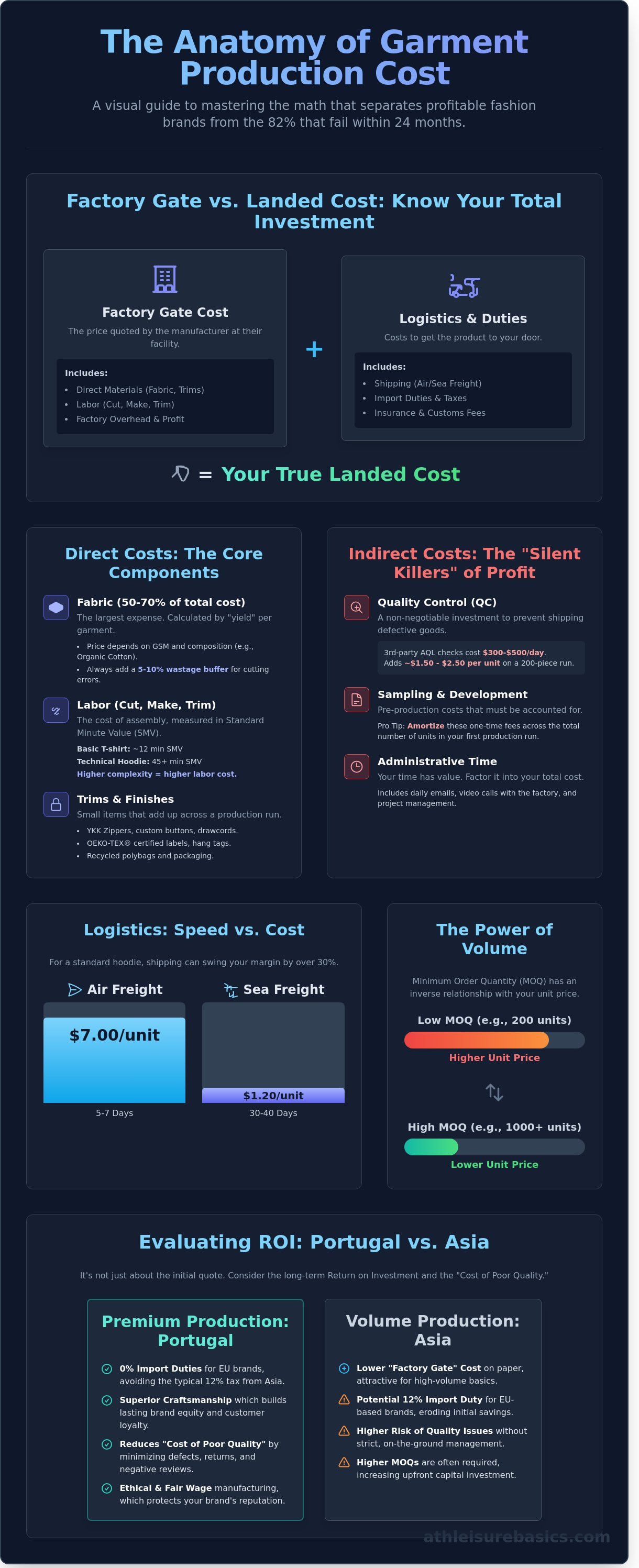
Calculating garment production cost isn't just about the price of fabric. It represents the total sum of every input required to deliver a retail-ready product to your warehouse. For emerging brands, understanding your Cost of Goods Sold (COGS) is the difference between a profitable launch and an unexpected loss. Many founders focus on the "Factory Gate" cost, which is the price quoted by the manufacturer at their facility. However, you must account for the "Landed" cost. This figure includes shipping, duties, and insurance to get the goods to your door. A quote that seems 20% lower than others often excludes essential items like recycled polybags or premium labels, leading to budget creep later.
Every project starts with a Bill of Materials (BOM). Think of this as the DNA of your garment. It lists every single component, from the main fabric to the specific thread count. Learning how to calculate garment production cost effectively begins with a detailed BOM to ensure no hidden fees surprise you during the bulk production phase. At Athleisure Basics, we prioritize transparency in this document so you can scale your brand with confidence.
Direct Materials: Fabric and Trims
Fabric usually accounts for 50% to 70% of your total cost. You calculate consumption based on the "yield," which is the amount of fabric used per garment. We always recommend adding a 5% to 10% wastage buffer to account for cutting errors or fabric defects. The fabric weight, measured in Grams per Square Meter (GSM), and the composition, such as 100% organic cotton, directly dictate the raw material price. Don't overlook trims. High-quality buttons, YKK zippers, and OEKO-TEX® certified labels add cents that turn into hundreds of dollars across a 500-unit run. Choosing premium materials from the start ensures your product meets the highest industry standards.
Labor Costs: Cut, Make, and Trim (CMT)
CMT refers to the service fee for cutting the fabric, sewing the piece, and finishing it with a final press. Manufacturers determine this using Standard Minute Value (SMV). This metric calculates exactly how many minutes it takes to assemble one unit. A basic t-shirt might have an SMV of 12 minutes, while a technical hoodie with hidden pockets and reinforced stitching can exceed 45 minutes. Complex designs increase labor costs exponentially because they require specialized machinery and highly skilled operators. When you learn how to calculate garment production cost, remember that ethical manufacturing in Portugal ensures these labor costs reflect fair wages and superior craftsmanship, which ultimately protects your brand legacy.
The Hidden Drain: Factoring in Indirect Production Expenses
Profit margins don't just vanish. They're often eroded by indirect expenses that founders overlook during the initial planning phase. When you're learning how to calculate garment production cost, focusing only on the "cut and sew" price is a mistake. Professional brands look at the total cost of ownership. This includes the key elements of costing like quality control, administrative time, and communication overhead. These "silent killers" can add 15% to 25% to your final per-unit price if you aren't careful.
Quality control (QC) is a non-negotiable investment. Hiring a third-party inspector for a final AQL (Acceptable Quality Level) check might cost $300 to $500 per day. On a small run of 200 leggings, that's an extra $1.50 to $2.50 per piece. While it seems high, it prevents the 100% loss associated with shipping defective goods to customers. You'll also spend significant time managing the production cycle. Whether it's daily emails or video calls with the factory, your time has a value. Don't forget to factor in these administrative hours when finalizing your budget.
Landed Costs: Shipping, Duties, and Logistics
Logistics can swing your margins by 30% depending on your choices. Air freight is fast, often taking only 5 to 7 days, but it costs significantly more than sea freight. For a standard hoodie, air shipping might cost $7.00 per unit, while sea freight could be as low as $1.20. Manufacturing in Portugal offers a massive advantage for EU-based brands. You'll avoid the 12% import duties typically applied to garments coming from Asia. This makes "Made in Portugal" not just a mark of quality, but a strategic financial decision. Always calculate the inland transportation from the port or factory to your specific fulfillment center to get a true landed cost.
Sample Development and Tech Packs
Precision starts before the sewing machines turn on. A professional tech pack for clothing is your blueprint. It typically costs between $200 and $500 per style, but it can reduce production errors by 20%. Think of it as insurance. You should also amortize your sampling costs. If you spend $600 on three rounds of samples and then produce 300 units, you must add $2.00 to the cost of each garment in that first run. It's better to partner with an ethical manufacturer who provides clear pattern-making and grading fees upfront. This transparency ensures you know exactly how to calculate garment production cost without facing surprise invoices at the end of the season.
The MOQ Impact: How Volume Dictates Your Unit Price
Every brand owner must grasp the inverse relationship between quantity and cost to remain profitable. High volume spreads fixed costs across more units, while low volume concentrates them. In 2026, a boutique run of 100 organic cotton hoodies might cost $32.00 per unit. That same garment drops to $16.50 when produced in a mass order of 2,000 units. This 48% price difference stems directly from factory efficiency and labor allocation. Finding your "Sweet Spot" means balancing this unit price against the risk of sitting on unsold inventory. Most emerging brands find success starting with 70 to 250 pieces per style to test the market without over-leveraging capital.
Understanding how to calculate garment production cost requires looking beyond the fabric. You're paying for the factory's time. When you order 100 units, the time spent on administrative work, pattern digitizing, and shipping logistics is the same as it would be for 1,000 units. Consequently, the smaller the order, the higher the percentage of "non-sewing" costs baked into each item. To stay competitive, aim for the highest volume your current cash flow and storage capacity can safely support.
Setup Costs and Machine Downtime
Factories lose money when machines aren't running. Every time a technician changes thread colors or recalibrates tension settings for a specific fabric, the production line stops. This downtime is why low MOQs carry a premium. You can mitigate these fees by choosing white label clothing options that utilize standardized patterns and pre-set machinery. Additionally, a full size range (S-XL) is more expensive than a single-size run. A five-size spread requires five different pattern placements and frequent adjustments, often adding 15% to 20% to your initial labor quote compared to a more focused size offering.
Fabric Minimums and Surcharges
Raw material sourcing is a critical factor in how to calculate garment production cost accurately. Textile mills typically require "Greige" (unfinished) fabric minimums of 500 meters or more. If you only need 100 meters for a small capsule, you'll likely face a "small dye lot surcharge." These surcharges can increase fabric costs by 25% to 40% per meter. To protect your margins, consider these strategies:
- Use Stock Fabrics: Utilize materials already held in the manufacturer’s warehouse to bypass mill minimums.
- Deadstock Usage: Source high-quality leftover fabrics from larger luxury runs, which is ideal for limited 50-piece drops.
- Standardize Colors: Use the same fabric color across multiple styles (e.g., leggings and sports bras) to meet bulk dyeing thresholds.
By 2026, ethical production standards in regions like Portugal have made low-volume manufacturing more accessible, but the mathematical reality of MOQs remains. Partnering with a factory that specializes in flexibility allows you to scale from small batches to mass production as your community grows.
Step-by-Step: Creating Your 2026 Garment Cost Sheet
Precision is the foundation of a profitable clothing line. You can't rely on guesswork when learning how to calculate garment production cost. You need a standardized template that tracks every cent from the first stitch to the final delivery. Before you start the math, gather your tech pack and verified factory quotes. This ensures your data is grounded in reality rather than estimates. In the 2026 market, transparency in your supply chain is as much a financial tool as it is a marketing asset.
Smart founders always apply a 3% to 5% Buffer Factor to their final calculations. This small percentage protects your margins against sudden currency fluctuations or minor production hurdles that inevitably arise. By building this into your cost sheet from the start, you ensure your brand stays resilient. Reviewing the final figure against your target retail price is the ultimate reality check. If the numbers don't support a healthy markup, you'll need to adjust your materials or design before the first roll of fabric is cut.
Phase 1: Raw Material and Labor Entry
Your first step involves inputting the fabric cost per meter. You must calculate the consumption rate, or yield, which is the exact amount of fabric used per garment including natural waste. For a standard premium hoodie, this might be 1.5 meters of heavy fleece. Next, add the CMT (Cut, Make, Trim) labor costs provided by your manufacturer. Don't forget to sum up every trim, label, and individual polybag. These small items, like OEKO-TEX® certified zippers or woven neck labels, often account for 10% of the total unit cost if they aren't tracked diligently.
Phase 2: Adding Overheads and Logistics
True production costs go far beyond the factory floor. You need to distribute your initial pattern-making and sampling fees across your total order quantity. If a master pattern costs $400 and you produce 100 units, you must add $4 to each garment's cost. Estimate your shipping and duty per unit based on weight and volume. This calculation gives you the Total Landed Cost (TLC). The TLC is your true baseline because it tells you exactly what you've spent to get a finished product into your warehouse and ready for sale.
Phase 3: Calculating Markup and Margin
Understanding the difference between markup and margin is vital for your long-term strategy. While markup is a percentage added to your cost, margin is the percentage of the final selling price that represents profit. Most premium brands aim for a 4x to 6x multiplier from their production cost to the MSRP. As you review these figures, evaluate the garment production process to find cost-saving opportunities without sacrificing quality. High-quality Portuguese manufacturing often provides better value through durability and ethical appeal, which justifies a higher price point to your customers.
Portugal vs. Asia: Evaluating the ROI of Premium Production
Don't be fooled by the low unit prices typically offered by mass-market hubs. While a factory quote from Asia might look attractive on a spreadsheet, it rarely accounts for the long-term brand equity or the hidden expenses that erode your margins. Mastering how to calculate garment production cost means shifting your focus from price-per-piece to the total cost of ownership. In the 2026 market, premium brands are winning by prioritizing European craftsmanship over bottom-barrel pricing.
Choosing EU manufacturing significantly reduces your Cost of Poor Quality (COPQ). This metric includes the price of fabric waste, repairs, and the administrative burden of managing defects from a distance. When you manufacture in Portugal, you're investing in a "Made in Portugal" label that serves as a powerful marketing asset. By 2026, 74% of premium consumers report that transparency and ethical origins are primary drivers in their purchasing decisions. This label isn't just a tag; it's a seal of trust that justifies a higher retail markup.
The Quality Dividend
Superior durability is the hallmark of clothing manufacturers in Portugal, particularly for high-performance athleisure. These factories utilize advanced stitching techniques and OEKO-TEX® certified materials that withstand 50 or more wash cycles without losing shape. This craftsmanship directly impacts your bottom line by lowering return rates. Brands moving production to Portugal often see a 15% to 20% reduction in returns compared to low-cost alternatives. Additionally, the strict EU labor laws provide built-in ethical compliance, acting as a vital risk-mitigation strategy for your brand's reputation.
Speed to Market and Agility
Proximity is your greatest financial ally. Shipping from Portugal to major European or North American hubs typically takes 3 weeks by road or air, whereas sea freight from Asia often stretches to 8 weeks or more. This 5-week difference is critical for your cash flow. Instead of placing massive, risky inventory bets six months in advance, you can utilize smaller, more frequent drops. This strategy keeps your inventory lean and improves your turnover rate by 25% annually. Production Agility is the ability to restock bestsellers within a single season. By leveraging a local partner, you can react to real-time sales data rather than guessing what your customers want months before they buy it. This flexibility ensures you're never stuck with deadstock or missing out on a viral trend because of a slow boat.
Turn Your 2026 Vision into a Profitable Reality
Mastering the math behind your brand is the difference between a hobby and a scalable business. You now understand that volume dictates your unit price and why indirect expenses can drain your budget if they're left unchecked. By choosing expert manufacturing in Portugal, you secure OEKO-TEX® Certified Premium Fabrics and ethical standards that justify a higher retail margin. It's clear that learning how to calculate garment production cost is about more than just spreadsheets; it's about building a foundation for growth. We're here to support you with low MOQ options starting at 60 pieces per style. This flexibility allows you to test the market in 2026 without the risk of heavy overstock. Your journey from a simple logo to a lasting legacy starts with transparent data. Stop guessing your margins and start building with a partner who values craftsmanship. Get a Transparent Production Quote for Your Brand. You've done the hard work of planning; now it's time to create something extraordinary.
Frequently Asked Questions
What is the most expensive part of garment production?
Fabric and raw materials typically account for 50% to 70% of the total production cost for any given style. For premium athleisure, high-performance OEKO-TEX® certified fabrics represent the largest single investment in your bill of materials. You must also account for labor costs, which vary by region; European craftsmanship in Portugal ensures superior quality despite higher hourly rates compared to Asian manufacturing hubs.
How much should I budget for garment sampling in 2026?
Budget between $150 and $500 per style for initial prototypes throughout 2026. This cost covers professional pattern making, tech pack refinement, and the physical construction of the sample. While sampling fees are often 2 to 3 times the bulk production price, they're an essential investment to ensure your vision meets the highest industry standards before you commit to a full production run.
Can I reduce my production costs without lowering quality?
You can reduce costs by optimizing your fabric yield and choosing standard trims that are readily available. Consolidating your designs to use the same fabric across multiple styles allows you to negotiate better bulk rates with mills. Working with a partner that offers low MOQs helps you avoid excess inventory, which is a hidden cost that often drains a startup brand's capital.
What is the difference between CMT and FPP pricing?
CMT pricing only covers the labor and finishing, while FPP includes everything from fabric sourcing to final packaging. CMT requires you to manage your own supply chain, which increases complexity and logistical risks for new founders. FPP is the preferred choice for emerging brands because it provides a predictable, all-in price that simplifies the process of how to calculate garment production cost accurately.
How does fabric wastage affect my final unit cost?
Fabric wastage, which usually ranges from 10% to 15%, directly increases your unit cost by requiring more raw material than the final garment uses. Efficient marker making and pattern placement are critical to minimizing this loss during the cutting phase. If your factory reports a 20% wastage rate, your material costs will rise by exactly that margin, making precision a key factor in your overall profitability.
Why do European factories have higher MOQs for custom designs?
European factories often set MOQs of 300 to 500 pieces for custom designs to cover the setup costs of specialized machinery and ethical labor standards. These minimums ensure that the production line runs efficiently while maintaining the premium craftsmanship Portugal is known for. At Athleisure Basics, we offer flexible options starting at 60 pieces per style to help you scale without heavy financial risk.
Is it cheaper to provide my own fabric to the manufacturer?
Providing your own fabric is rarely cheaper because you lose the manufacturer's bulk purchasing power and incur additional shipping fees. Factories often charge a handling fee of 5% to 10% for customer-supplied materials to cover storage and inspection. Unless you have an exclusive contract with a specific textile mill, it's more cost-effective to use your manufacturer's established supply chain for premium materials.
How do I calculate the landed cost of my clothing order?
To calculate the landed cost, add the unit production price, shipping fees, customs duties, and insurance for the entire shipment. If your unit cost is $20 and your total logistics fees equal $5 per piece, your landed cost is $25. Understanding these numbers is vital when learning how to calculate garment production cost to ensure your retail margins remain healthy and sustainable as you grow.



Leave a comment
This site is protected by hCaptcha and the hCaptcha Privacy Policy and Terms of Service apply.