

Clothing Production Cost Breakdown 2026: A Founder’s Guide to Budgeting
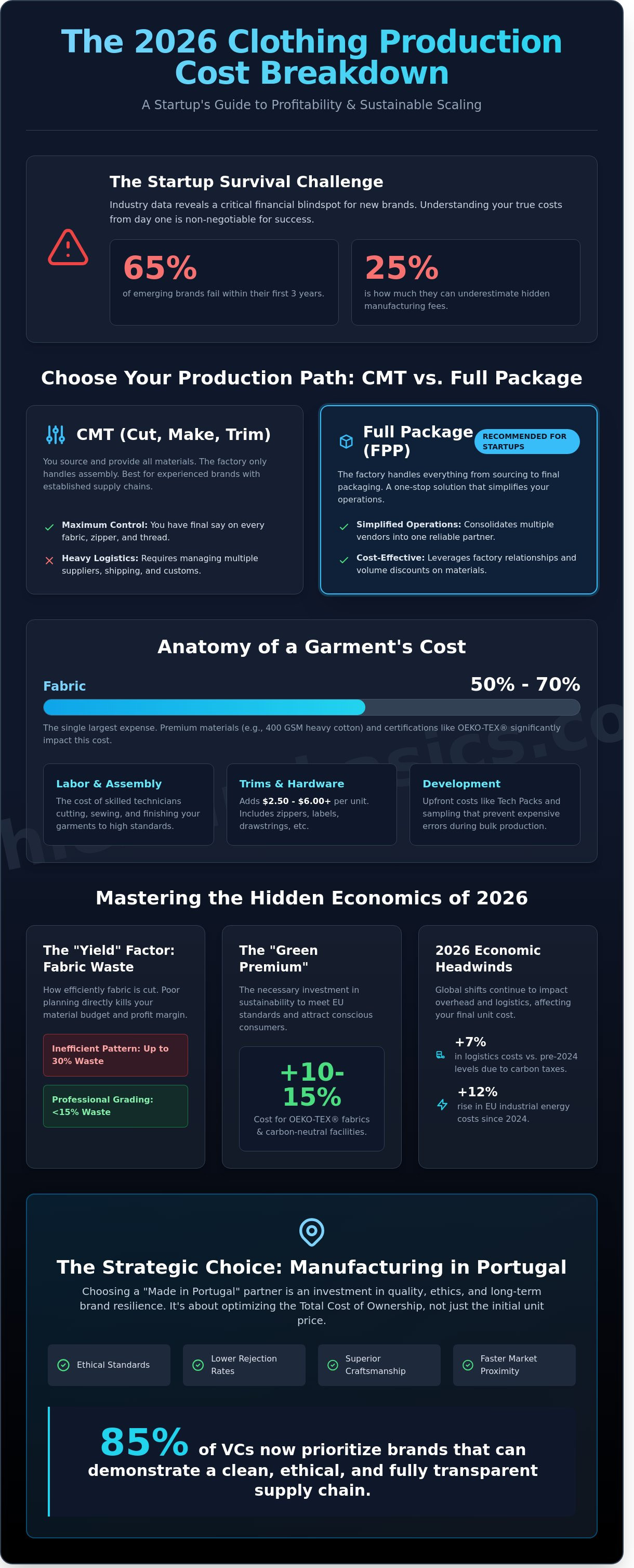
Industry data from 2024 reveals that 65% of emerging fashion brands fail within their first three years because they underestimate hidden manufacturing fees by as much as 25%. It's a staggering figure that highlights the danger of entering the market without a precise financial roadmap. You've likely felt that same frustration when reviewing a vague factory quote that leaves you guessing about your actual margins. It's hard to build a legacy when you're worried about invisible costs draining your bank account before you even ship your first order.
We believe transparency is the foundation of a successful partnership. This guide provides a comprehensive clothing production cost breakdown 2026 to ensure your budget remains resilient and your brand stays profitable. You'll learn exactly how to allocate your startup capital while mastering the critical differences between CMT and Full Package production. We're going to deconstruct every expense from premium fabric sourcing to ethical labor costs in Portugal, giving you a spreadsheet-ready framework to lower your per-unit costs and scale your vision with confidence. Whether you're planning a low MOQ launch or preparing to scale, these insights will help you turn your creative vision into a sustainable business.
Key Takeaways
- Master the shifting economics of the apparel industry with a comprehensive clothing production cost breakdown 2026 to ensure your budget remains realistic and resilient.
- Learn how to optimize material spend by mastering "Yield" efficiency and selecting OEKO-TEX® certified fabrics that meet premium industry standards.
- Discover why upfront investments in Tech Packs and sampling prevent thousands of dollars in production errors and protect your brand’s bottom line.
- Navigate the "Volume Trap" by calculating your true break-even point and leveraging low MOQs to scale efficiently without the risk of excessive inventory.
- Explore how manufacturing in Portugal provides a superior Total Cost of Ownership through ethical standards, lower rejection rates, and faster market proximity.
Understanding the Core Pillars of Apparel Manufacturing Costs
The 2026 apparel landscape requires a fundamental shift in how founders approach their budgets. It's no longer just about finding the lowest unit price. Shifting global trade policies and a 12% rise in EU industrial energy costs since 2024 have forced a reassessment of traditional factory overhead. Founders must look beyond the price tag to build a resilient brand. This starts with a clear view of how money moves through the supply chain.
Successful founders categorize expenses into two distinct buckets to maintain clarity. Direct costs include raw materials, hardware like zippers or buttons, and the physical labor required for assembly. Indirect costs cover everything else, such as factory rent, equipment maintenance, and your own marketing spend. Understanding the core components of manufacturing costs allows you to identify exactly where to optimize without sacrificing the premium quality your customers expect.
Choosing a "Made in Portugal" partner influences your initial budget by prioritizing craftsmanship and ethical compliance. While the upfront cost might be higher than sourcing from discount regions, the reduction in defects and shipping delays saves you money long-term. Transparency in your clothing production cost breakdown 2026 is vital for investor confidence. In the current venture capital climate, 85% of investors prioritize brands that can demonstrate a clean, ethical, and fully transparent supply chain from the first prototype.
CMT vs. Full Package Production
Cut, Make, Trim (CMT) is a model where you source and ship your own fabric and trims to the factory. They only charge for the labor of cutting and sewing. This offers maximum control but adds heavy logistics management to your plate. Full Package Production (FPP) is different. The factory handles everything from fabric sourcing to final packaging. For a 2026 startup, FPP is often the most cost-effective route. It simplifies your clothing production cost breakdown 2026 by consolidating multiple vendors into one reliable partner. We offer white label services starting at 60 pieces per style, which allows you to launch quickly with minimal risk.
The 2026 Economic Impact on Textiles
Logistics costs have stabilized but remain 7% higher than pre-2024 levels due to new carbon taxes on freight. Factory overhead in Europe now reflects strict sustainability mandates that require investment in water recycling and solar energy. These shifts aren't just regulatory hurdles; they're baked into the pricing of every premium garment. You'll often hear this referred to as a "Green Premium" in industry circles.
The Green Premium in 2026 manufacturing represents the 10% to 15% additional cost associated with sourcing OEKO-TEX® certified materials and utilizing carbon-neutral production facilities to meet EU environmental standards.
The Deep Dive: Raw Materials and Labor Economics
Understanding your clothing production cost breakdown 2026 starts with the physical components. Fabric typically accounts for 50% to 70% of your total manufacturing budget. You aren't just paying for the material visible on the finished garment; you're paying for the weight, measured in Grams per Square Meter (GSM), and the specific composition. Premium 400 GSM heavy cotton costs significantly more than a standard 180 GSM jersey. Choosing OEKO-TEX® certified textiles ensures your brand meets European safety standards. This certification usually adds a 10% to 15% premium to the raw material price, but it's a non-negotiable for brands targeting the conscious consumer market in 2026.
The "yield" factor is a hidden profit killer that many founders overlook. Yield refers to how much fabric is actually used versus how much is wasted during the cutting process. Inefficient patterns can waste up to 30% of your total material spend. Professional grading and marker making are essential to keep this waste below 15%. Don't underestimate the cost of trims and hardware either. Items like custom YKK zippers, woven neck labels, and silicone-dipped drawstrings can easily add $2.50 to $6.00 to your unit cost. These small details often define the perceived value of a luxury or technical brand.
Fabric Sourcing and Surcharges
Premium textiles often come with strict Minimum Order Quantities (MOQs). For 2026, expect MOQs for custom-dyed fabrics to start at 300 to 500 meters per color. If you can't meet these volumes, deadstock fabric is a cost-effective alternative, though it limits your ability to restock the same look later. Understanding what is a textile and how different weaves impact durability will help you negotiate these surcharges more effectively. Custom-dyed materials provide brand consistency but require higher upfront capital.
Labor Intensity and Garment Complexity
Labor costs are calculated by the "SAM" (Standard Allowed Minutes). A basic organic cotton tee might take 12 minutes to assemble. A technical hoodie with flatlock stitching and heat-pressed pockets can take 65 minutes. Manufacturing in Portugal ensures fair wages and ethical standards, protecting your brand's reputation from future audits. Portuguese craftsmanship utilizes specialized machinery for activewear that mass-market factories lack. This precision justifies the higher price point compared to low-cost regions. To see how these variables fit your specific budget, you can submit your project for a detailed review by our production team.
Beyond the Fabric: Factoring in Development and Hidden Costs
Many founders focus solely on the price per piece. They ignore the heavy lifting required before the first sewing machine starts. A professional tech pack costs between $500 and $2,000. While this feels like a high upfront expense, it acts as your primary insurance policy. A single measurement error in a bulk order of 500 hoodies can waste over $10,000 in unsellable inventory. This document is the foundation of any accurate clothing production cost breakdown 2026.
Adding sizes isn't a simple click of a button. Moving from a single sample size to a full range from XS to XXL requires pattern grading. This process typically adds $150 to $400 per style to your development budget. You also have to consider compliance testing. By 2026, international safety standards and the EU Digital Product Passport will require more rigorous material verification. Budgeting $500 to $1,500 for laboratory testing ensures your line meets OEKO-TEX® or REACH standards, preventing costly legal delays at the border.
The Price of Perfection: Sampling Cycles
Don't expect your first prototype to be shelf-ready. Most successful brands require 2 or 3 rounds of samples. Factories usually charge a markup of 2x or 3x the bulk production price for these individual items. You'll also deal with "courier fatigue." Shipping a single garment from a manufacturer in Portugal to an office in London or New York costs between $60 and $120 per trip. You can significantly reduce these expensive iterations by understanding how to create a tech pack for clothing. A precise tech pack allows the factory to get it right the first time, potentially saving you $1,500 in shipping and prototype fees.
Logistics, Duties, and Import Taxes
Your "landed cost" is the only number that dictates your profit margin. This includes the unit price plus freight, insurance, and local port handling fees. For European brands, manufacturing in Portugal offers a massive financial advantage: zero import duties. This keeps your clothing production cost breakdown 2026 lean, as importing from outside the EU often triggers a 12% tax on the total shipment value. Additionally, 2026 regulations will likely mandate eco-friendly packaging. Certified compostable mailers and recycled hangtags now add roughly $0.50 to $1.10 per unit to your final costs. Planning for these "hidden" logistics early prevents your margins from disappearing during the final delivery phase.
Strategic Budgeting: Optimizing MOQs and Production Volume
Founders often fall into the "Volume Trap" during their first production cycle. It's tempting to chase a $10 unit price by ordering 1,000 pieces, but this requires a $10,000 upfront commitment. If the market doesn't respond to that specific fit or color, you're left with dead stock. In contrast, producing 70 pieces at $25 per unit costs only $1,750. While the unit price is higher, you save $8,250 in capital. This liquidity is vital for your clothing production cost breakdown 2026, as it allows you to pivot based on real customer feedback rather than guesses.
Inventory carries heavy hidden costs that many budgets overlook. Storing 1,000 units in a third-party logistics (3PL) facility typically costs $15 to $22 per pallet monthly. When you add insurance and the 6% cost of tied-up capital, your "cheap" $10 leggings can actually cost $13 within a year. Low-volume production eliminates these storage fees and ensures your cash remains available for growth. Testing market fit with white label services is a pragmatic way to validate a style before you invest in expensive custom molds or proprietary fabrics.
Low MOQ vs. Bulk Manufacturing
Startups should value speed to market over the lowest unit cost. A 70-piece run can be produced and shipped in approximately 45 days, whereas a 250-piece custom order might take 90 to 120 days. Reducing your lead time by 50% means you can launch two collections in the time it takes a competitor to launch one. If you want to accelerate your timeline, explore private label Portugal options. These services provide pre-vetted patterns and high-quality fabrics, allowing you to bypass the lengthy technical design phase.
Calculating Your Retail Markup
Your clothing production cost breakdown 2026 must support a retail markup of 2.5x to 4x to remain profitable. For a Direct-to-Consumer (DTC) brand, a $30 production cost should result in a $75 to $120 retail price. This margin covers your marketing, shipping, and returns. If you plan to sell via wholesale, you'll need even higher markups because retailers typically take a 50% cut of the final price. To calculate Gross Margin for apparel, subtract the total cost of goods sold from the total revenue and divide that number by the total revenue.
Ready to launch your collection without the risk of overstock? Explore our low MOQ manufacturing options and start building your brand today.
Why Portugal is the Strategic Cost Choice for 2026 Brands
Smart founders look beyond the initial factory quote to find the hidden expenses that sink new brands. When calculating your clothing production cost breakdown 2026, you must account for the Total Cost of Ownership (TCO). Manufacturing in Portugal reduces your rejection rates to less than 3%, while factories in lower-cost regions often see defects in 12% of their stock. High quality saves you money by protecting your retail margins and reducing customer returns.
Proximity to the European and UK markets is another fiscal advantage. Shipping from Asia can take 45 days, forcing you to hold massive inventory to avoid stockouts. Portuguese production offers 4 to 6-week lead times. This agility means you can restock bestsellers quickly without tying up 60% of your capital in warehouse storage. Additionally, the "Made in Portugal" label carries significant brand equity. It justifies a 25% higher retail price point compared to generic imports, directly improving your bottom line.
Athleisurebasics acts as your trusted partner in this region. We focus on transparent pricing that helps emerging founders avoid the "middleman markup." By working directly with our Portuguese facilities, you get luxury-tier craftsmanship without the inflated costs typically associated with high-end European manufacturing.
Reducing Risk with EU Manufacturing
Choosing Portugal eliminates the 10% to 25% tariffs often referred to as the "China Tax" and avoids the unpredictable shipping delays seen in 2024 and 2025. You gain full visibility into the garment production process, which is vital for maintaining premium standards. Ethical certifications like OEKO-TEX® aren't just extra costs; they're valuable marketing assets. Consumers in 2026 demand transparency, and Portuguese factories provide it by default, saving you the expense of third-party audits.
Next Steps: Getting Your Production Quote
Ready to scale? Before contacting a factory, ensure you have your tech packs, desired quantities, and fabric specifications ready. Having these details organized prevents "scope creep" in your budget. Athleisurebasics supports startups from "Logo to Legacy," offering low MOQs starting at 60 pieces per style. We provide clear, itemized quotes so your clothing production cost breakdown 2026 remains predictable and profitable.
Don't leave your margins to chance. Whether you're launching a new capsule or scaling a proven winner, we make it easy to manufacture with confidence. Contact Athleisurebasics today for a custom manufacturing quote or a consultation to finalize your 2026 production strategy.
Launch Your 2026 Collection with Precision and Confidence
Navigating the apparel landscape requires a firm grasp of your clothing production cost breakdown 2026. Success in the coming years depends on balancing premium OEKO-TEX® certified fabrics with ethical labor practices that protect your brand reputation. Founders who prioritize transparency and high-tier craftsmanship early on will avoid the expensive pitfalls of low-quality manufacturing. By focusing on raw material integrity and labor economics, you're not just making clothes; you're building a sustainable business model.
Manufacturing in Portugal offers a distinct competitive edge for brands aiming to scale efficiently. You can access elite EU quality standards while maintaining flexibility through low MOQs starting at just 70 pieces per style. This strategic choice allows you to test the market without the financial burden of overproduction. It's time to move beyond guesswork and secure a manufacturing partner that understands your vision for growth and quality. We're here to help you bridge the gap between a creative concept and a profitable reality.
Get a Custom Apparel Manufacturing Quote Today and take the first step toward launching your premium collection with a trusted partner.
Your journey from a single logo to a lasting fashion legacy starts with a single, well-planned step.
Frequently Asked Questions
What is the average cost to produce a premium hoodie in 2026?
A premium hoodie produced in Portugal in 2026 typically costs between $22 and $38 per unit for a bulk order of 100 pieces. This pricing reflects the use of high-quality 400 GSM organic cotton and ethical labor practices. Your specific clothing production cost breakdown 2026 will vary based on customizations like heavy embroidery or specialized garment dyes, which can add $4 to $7 to the base price.
Why are sampling costs so much higher than bulk production unit costs?
Sampling costs are usually 3 to 5 times the bulk unit price because they require individual attention from master tailors and pattern makers. When a factory produces one item, they must stop high-speed machinery and manually set up equipment, which is inefficient for their workflow. You're paying for the technical expertise required to translate your vision into a physical prototype that meets 100% of your specifications.
How does MOQ affect my clothing production cost breakdown?
Minimum Order Quantities (MOQs) directly impact your unit price by spreading fixed setup costs across more garments. An order of 50 pieces might have a unit cost 40% higher than an order of 500 pieces due to screen printing setups and fabric sourcing minimums. We focus on low MOQ options to help startups balance a healthy clothing production cost breakdown 2026 with the need to manage initial cash flow.
What hidden costs should I budget for when manufacturing in Portugal?
You should budget an additional 8% to 12% of your total production invoice for shipping logistics, customs duties, and mandatory quality inspections. While Portugal offers superior EU craftsmanship, international freight costs have risen by 15% since 2024. Accounting for these expenses early prevents budget shortfalls. It's also wise to set aside a 5% contingency fund for unexpected fabric testing or trim adjustments during the development phase.
Is it cheaper to use a white label service or custom manufacturing?
White label services are generally 25% cheaper than custom manufacturing because they eliminate the need for original pattern making and grading. You save on development fees since you're using pre-tested silhouettes that are already optimized for production efficiency. Custom manufacturing is essential for unique designs, but white label is the most cost-effective way for new founders to launch a high-quality collection with minimal financial risk.
How much should a tech pack cost to develop in 2026?
Developing a professional tech pack in 2026 costs between $300 and $650 per style depending on the design complexity. A simple t-shirt falls at the lower end, while technical outerwear requires more detailed construction notes and graded measurement charts. This document is a vital investment. It serves as your legal contract with the factory and prevents expensive production errors that could cost thousands of dollars to fix.
Does OEKO-TEX certification increase production costs significantly?
OEKO-TEX certification typically adds 5% to 10% to your fabric costs compared to non-certified alternatives. This premium covers the rigorous laboratory testing required to ensure every thread and button is free from harmful chemicals. While it increases your initial investment, it significantly boosts your brand value. Modern consumers are willing to pay a 20% higher retail price for garments that guaranteed to be safe and ethically produced.
What is a healthy profit margin for a startup clothing brand?
A healthy gross profit margin for a startup ranges between 60% and 75% to ensure long-term business sustainability. If your total landed cost for a sweatshirt is $35, you should aim for a retail price of at least $110. This margin covers your marketing spend, e-commerce hosting, and the returns that typically average 15% in the apparel industry. Maintaining these margins allows you to scale from a small project to a legacy brand.



Leave a comment
This site is protected by hCaptcha and the hCaptcha Privacy Policy and Terms of Service apply.