
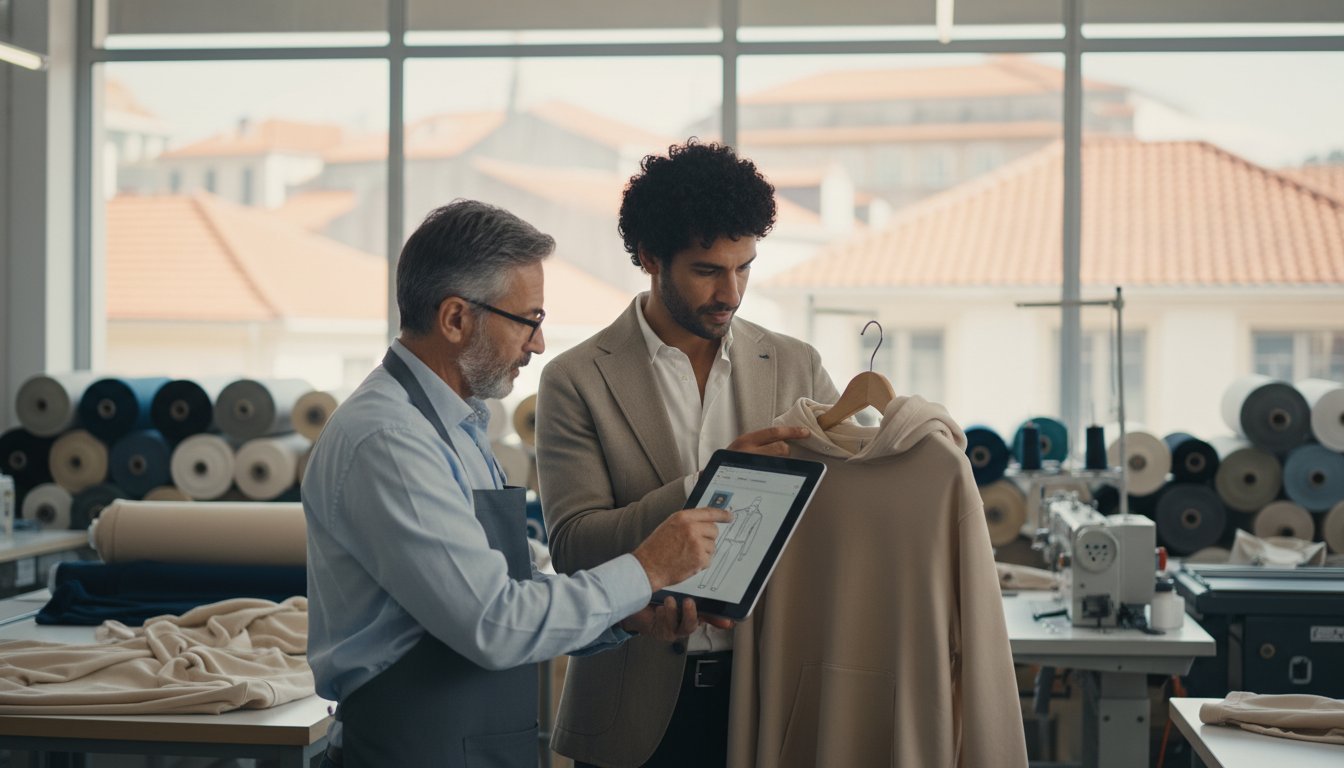
Avoiding Clothing Manufacturing Mistakes: The 2026 Founder’s Guide
For every 10 aspiring fashion founders who launch a collection, 7 will face a critical production error that wipes out their entire initial marketing budget before they even make a sale. It's a harsh reality, but your brand doesn't have to be part of that statistic. You've likely spent months perfecting your vision, only to feel paralyzed by technical terminology or the fear of receiving a shipment of low-quality samples. It's frustrating when you're trying to build a premium brand but feel like you're guessing through the manufacturing process, especially when avoiding clothing manufacturing mistakes is the difference between a successful launch and a total loss.
We're here to change that. This guide provides a clear, actionable roadmap for 2026 that empowers you to lead your production with confidence. You'll learn how to bridge the communication gap with factories, protect your budget from hidden costs, and ensure every piece meets the highest industry standards. We'll look at the exact steps needed to transform your initial sketches into high-quality final products that your customers will love, helping you scale from a logo to a legacy.
Key Takeaways
- Transition from a designer mindset to a production-ready founder by treating your factory as a strategic partner rather than a simple vendor.
- Eliminate production errors by replacing vague sketches with professional tech packs that serve as the essential blueprint for your brand’s superior quality.
- Protect your capital and scale sustainably by avoiding clothing manufacturing mistakes related to high MOQs and often-overlooked landed costs.
- Ensure a perfect fit across your entire range by mastering the multi-stage sampling process, from initial proto samples to comprehensive size sets.
- De-risk your 2026 launch by leveraging the proximity and ethical compliance of Portuguese manufacturing to ensure a transparent, high-standard supply chain.
Why Most New Brands Fail: The Mindset Shift Required for Production
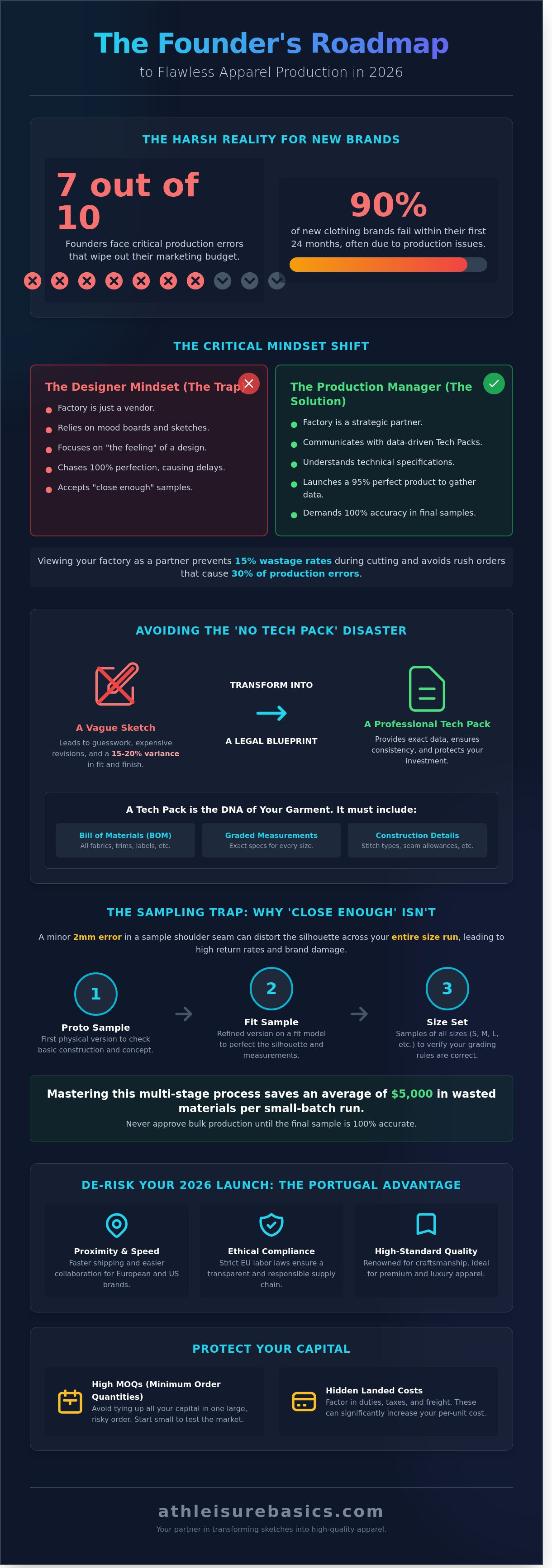
Success in the apparel industry doesn't depend on your eye for color. It depends on your ability to translate that eye into industrial reality. Data shows that 90% of new clothing brands fail within their first 24 months because they treat production as an afterthought. Avoiding clothing manufacturing mistakes requires you to stop thinking like a consumer and start thinking like a plant manager. Your factory is a strategic partner, not a generic vendor. If you view them as a simple service provider, you miss the collaborative expertise that prevents 15% wastage rates during the cutting phase.
The 'First Drop' trap is another common pitfall. Founders often spend 12 months obsessing over a single button choice, leading to analysis paralysis. While quality is paramount, perfectionism shouldn't delay your market entry. A 95% perfect product that is actually in the hands of customers provides more data than a 100% perfect prototype sitting on your desk. Validation happens in the market, not the studio. You must know when your design is ready for the floor based on technical specs, not just a feeling that it's finished.
Moving from Designer to Production Manager
Factories operate on data, not inspiration. A mood board doesn't tell a seamstress which needle gauge to use. You must provide clear, non-emotional technical specifications to succeed. This involves understanding the fundamental textile manufacturing process to ensure your fabric choices align with machine capabilities. Expect lead times of 60 to 90 days for custom orders. Planning for these cycles prevents the rush orders that cause 30% of production errors. Clear communication means sending a tech pack with exact measurements, not a photo of a vintage shirt with the caption "make it like this."
The True Cost of 'Almost Right' Garments
Accepting a sample that is 'close enough' is a recipe for a 100% loss. Minor discrepancies in the fit or finish compound when you scale to 500 units. A 2mm error in a shoulder seam might seem small during the sampling phase, but it results in a distorted silhouette across an entire size run. This leads to high return rates and can destroy your brand's reputation before you've even scaled. Investing time to master the garment production process is your best defense against early brand death. Quality control starts before the machines turn on, and avoiding clothing manufacturing mistakes at the source saves an average of $5,000 in wasted materials for every small-batch production run.
- Data-Driven Decisions: Use tech packs to eliminate guesswork.
- Partnership Mentality: Treat factory staff as your extended team.
- Prototyping Discipline: Never approve bulk production until the final sample is 100% accurate.
Technical Pitfalls: Avoiding the 'No Tech Pack' Disaster
A tech pack is the DNA of your garment. It serves as a comprehensive blueprint that includes your Bill of Materials (BOM), graded measurements, and exact construction details. Many founders believe a physical sample or a hand-drawn sketch is enough to begin production, but this is a critical error when avoiding clothing manufacturing mistakes. Without these technical documents, you're essentially asking a factory to guess your intentions, which leads to expensive revisions and wasted fabric.
Professional factories in the U.S. textile and apparel industry and European hubs like Portugal require standardized data to ensure consistency. When you provide a tech pack, you're setting a baseline for quality that protects your investment. It's the difference between receiving a shipment of premium apparel and a box of unsellable defects.
Why a Sketch is Not a Blueprint
A sketch shows how a garment looks, but it doesn't explain how it's built. Leaving details up to a factory's interpretation results in a 15% to 20% variance in fit and finishing. Tech packs serve as a legal contract for quality standards; if the factory deviates from the specified stitch count or seam type, you have the documentation to demand a correction. Relying on a manufacturer's "intuition" is a gamble that rarely pays off for a growing brand. If you're feeling overwhelmed by the technical side, exploring custom clothing options with a partner can help bridge the gap between your vision and production-ready files.
The Role of Tolerances and Omissions
Precision is the hallmark of luxury manufacturing. A professional tech pack must include "Tolerances," which define the acceptable margin of error for measurements, usually +/- 1cm for standard knits. Without these, a size Medium might arrive with the dimensions of a Small, and you'll have no recourse for a refund. Common omissions that stall production include:
- Thread Specifications: Forgetting to define thread weight or fiber type (e.g., polyester vs. nylon).
- Label Placement: Missing exact coordinates for neck labels or care tags.
- Packaging Details: Failing to specify polybag thickness or folding instructions.
Material Sourcing: Hand-feel vs. Technical Performance
Choosing fabric based on a single swatch or a photo is a mistake that 45% of first-time founders make. You must verify technical performance through wash-testing and shrinkage analysis before committing to bulk. A fabric that feels soft might have a 7% shrinkage rate, which will ruin the fit after the first home wash. Ensure certifications like OEKO-TEX® are verified at the source to guarantee your products meet EU safety and ethical standards. This level of diligence ensures your brand delivers the premium quality your customers expect in 2026.
The Sampling Trap: Why One Round is Never Enough
Many founders treat sampling as a quick formality to check off a list. In reality, it's the most critical phase for avoiding clothing manufacturing mistakes. A single "perfect" sample doesn't guarantee a perfect production run. You need a structured, multi-stage approach to ensure your vision translates to every single garment in a 500-unit order. Relying on one round of samples is how brands end up with inventory they can't sell.
- Step 1: Proto Sample. This is your initial "rough draft" to test the basic fit and silhouette. Expect errors here; it's the time to fix proportions and design lines before moving forward.
- Step 2: Size Set. You must see how your grading works across the entire size curve. A pattern that looks great in a Medium often fails in an XXL or an XS due to improper scaling, which accounted for 40% of e-commerce returns in 2024.
- Step 3: Pre-Production (PP) Sample. This is the final "gold standard." It must be made using the exact fabric, trims, and machinery intended for bulk production.
Skipping these steps often results in "seam twist," where the side seams of a shirt migrate toward the front after the first wash. This happens when fabric grain lines aren't properly aligned during the cutting phase, a mistake that a rigorous sampling process catches before you've paid for bulk fabric.
Treating Sampling as Product Engineering
Think of your fit session as an engineering audit. When testing on a live model, use a 1cm tolerance rule. Anything beyond that deviation requires a pattern adjustment. Your fit session checklist should include checking the range of motion to see if fabric pulls, verifying the fabric drape against the intended silhouette, and confirming a stitch density of at least 4 stitches per centimeter for durability.
Provide technical feedback using annotated photos and specific measurements. It's vital to avoid "scope creep" by finalizing all design elements during the PP stage. Changing a zipper type or pocket placement once bulk production begins increases your defect rate by approximately 22% according to recent 2025 supply chain data.
Communication Barriers with Overseas Factories
Time-zone delays represent a massive hidden cost for new founders. A simple question sent to a factory in East Asia at 9:00 AM might not get an answer until the following day, potentially stalling production for 24 hours. This is a major factor in avoiding clothing manufacturing mistakes related to lead times. It's why clothing manufacturers Portugal have become the preferred choice for EU and US brands entering 2026. The alignment in business hours and high English proficiency levels reduce the risk of "lost in translation" errors. Having a local "boots on the ground" contact ensures that technical specifications are followed exactly as written in your tech pack, providing a layer of security that remote management cannot match.
Strategic Business Mistakes: MOQs and Hidden Costs
Cash flow management is the primary reason 90% of apparel startups fail within their first two years. A common trap in avoiding clothing manufacturing mistakes is chasing a low unit price by accepting high Minimum Order Quantities (MOQs). While a factory might offer a 20% discount if you order 1,000 units instead of 200, the capital tied up in dead stock can paralyze your business. If 40% of that inventory remains unsold after six months, your actual cost per sold unit effectively doubles. Your goal isn't just production; it's liquidity.
Founders often overlook the marketing capital required to move physical goods. For every $1 spent on manufacturing, you should ideally set aside $3 for customer acquisition. Producing 500 premium hoodies is useless if you don't have the $15,000 needed for ad spend and influencer partnerships to sell them. Focus on mastering one core product first. Scaling your SKUs from two to ten before you've proven market fit for a single design is a fast track to bankruptcy.
- Dead Stock Risk: Every unsold garment is cash you can't use for next season's growth.
- Marketing Ratios: Budget 3x your production cost for digital marketing and brand awareness.
- SKU Bloat: Each new color or size adds complexity to your logistics and increases the chance of stock imbalances.
Calculating True Landed Cost
Your factory invoice is just the starting point. To avoid financial surprises, you must calculate the landed cost for every item. This includes duty rates, which vary significantly by region. For example, importing synthetic apparel into the US can trigger duties as high as 32%, whereas EU rates often hover around 12%. Don't forget to add $0.80 to $2.00 per unit for polybags, hangtags, and internal logistics. The unit price you see on an initial quote is typically only 60% of the real cost to get that product into your customer's hands.
White Label vs. Custom: Choosing the Right Path
Choosing the wrong production method is a frequent hurdle when avoiding clothing manufacturing mistakes. For first-time founders, private label Portugal services offer a lower-risk entry point. By using luxury blanks, you can test market demand with MOQs as low as 60 pieces per style. This allows you to validate your brand identity without the high development costs of full custom Cut, Make, and Trim (CMT) production. Once you achieve a consistent sell-through rate of 85% on your blanks, you can confidently transition to custom designs and higher volume manufacturing. This phased approach protects your capital while you build your legacy.
The Portugal Solution: De-risking Your 2026 Production
Choosing the right manufacturing hub is the final, most critical step in avoiding clothing manufacturing mistakes. For founders launching in 2026, the geographic and regulatory advantages of Portugal offer a massive safety net. Short supply chains aren't just about speed; they're about precision. When your factory is in the same or a similar time zone, communication errors drop by an estimated 30%. Shipping from Porto to major European cities takes 3 to 5 days by road, compared to the 35 to 45 days required for sea freight from Southeast Asia. This proximity allows for rapid prototyping and tighter quality control, ensuring that small errors don't turn into a thousand-unit disaster.
Operating within the European Union provides a layer of regulatory safety that's hard to replicate elsewhere. You won't have to worry about the sudden ethical scandals or labor violations that often plague opaque supply chains. Portuguese factories adhere to strict EU labor laws and environmental protections, which means your brand is protected against the reputational risks that could sink a startup in its first year.
Why 'Made in Portugal' is a Mark of Quality
Portugal has established itself as the global epicenter for technical jersey and fleece. For activewear brands, this means access to OEKO-TEX® Standard 100 certified fabrics that are free from harmful substances. Using these premium materials is a proven strategy for avoiding clothing manufacturing mistakes related to skin irritation or fabric degradation. Additionally, manufacturing in Portugal can lower a European brand's carbon footprint by up to 40% compared to Asian production, a metric that 73% of Gen Z consumers now prioritize when making a purchase.
Partnering for Success: Our Consulting Approach
At Athleisurebasics, we don't just act as a factory; we function as your strategic partner. We've seen how startups struggle with technical details, so we guide you through building comprehensive tech packs and sourcing the highest industry standard materials. We're committed to your growth through our low MOQ philosophy. While many manufacturers demand 500 units per style, our white label service starts at just 60 pieces per style and color. This flexibility reduces your inventory risk and frees up capital for marketing and scaling.
We believe in turning your vision into high-quality products efficiently. Our team is ready to help you navigate the complexities of the 2026 market with a focus on craftsmanship and ethical standards. Don't let your brand become another statistic of manufacturing failure.
Ready to start your journey? Get a custom manufacturing quote for your project and let’s build your legacy together.
Build Your 2026 Legacy with Smarter Production
Launching a successful label in 2026 requires a shift from guesswork to absolute precision. Success hinges on mastering technical details and vetting your supply chain before the first stitch is sewn. You shouldn't overlook the technical pitfalls of skipping tech packs or assume a single sampling round will yield retail-ready results. Many founders face setbacks because they ignore these logistical hurdles. Avoiding clothing manufacturing mistakes is entirely possible when you prioritize transparency and local EU quality standards over high-risk alternatives.
Portugal stands as the premier destination for de-risking your production. By choosing a Portuguese partner, you secure access to premium OEKO-TEX® certified materials and ethical craftsmanship. We specialize in supporting startups with low MOQs starting at 70 pieces per style, allowing you to scale without the burden of excessive inventory. Our expert production consulting bridges the gap between your initial vision and a high-quality finished product. It's time to turn your creative concepts into a profitable, sustainable reality.
Launch your brand with a trusted Portuguese partner—get a quote today
Your journey from a simple logo to a lasting legacy starts with the right foundation. We're ready to help you build it.
Frequently Asked Questions
Can I start a clothing brand without a tech pack?
You cannot effectively start a professional clothing brand without a tech pack. This document acts as your product's blueprint, containing precise measurements, material specifications, and construction details. Without one, 90% of factories will either reject your project or produce incorrect samples. A complete tech pack reduces communication errors by 40% and ensures your vision translates accurately into a high quality physical garment.
What is a 'low MOQ' and why is it important for startups?
A low Minimum Order Quantity (MOQ) refers to production runs starting at small volumes, typically between 50 and 100 pieces per style. This is vital for startups because it preserves cash flow and minimizes the risk of unsold inventory. By utilizing low MOQs, founders can test 3 to 5 different designs in the market without committing to the 500 unit minimums often required by larger overseas factories.
Why is manufacturing in Portugal better than manufacturing in China?
Manufacturing in Portugal offers superior quality control and ethical transparency compared to China. Portugal strictly follows EU labor laws and OEKO-TEX environmental standards, ensuring 100% fair treatment of workers and sustainable practices. Logistics are also significantly faster; shipping from Porto to London takes 3 days, while sea freight from China often exceeds 35 days. This proximity is essential for avoiding clothing manufacturing mistakes related to long lead times and communication gaps.
What are the hidden costs in clothing manufacturing?
Hidden costs often include import duties, fabric wastage fees, and specialized packaging. Import taxes can add 12% to your total cost, while shipping and insurance typically account for another 5% to 8% of your total budget. Don't forget that pattern making and sample revisions usually cost 2 to 3 times the bulk production price per unit. Budgeting an extra 15% for these unforeseen expenses is a smart way to protect your profit margins.
How many samples do I need before I can start bulk production?
You typically need 2 to 3 sample rounds before approving bulk production. The process begins with a proto sample for design, followed by a fit sample to perfect sizing, and concludes with a Pre-Production (PP) sample. Skipping these stages is a common error, but following this sequence is the best method for avoiding clothing manufacturing mistakes in the final run. Statistics show that 85% of production errors are caught during the second sampling stage.
What happens if my bulk order has quality issues?
If your bulk order arrives with defects, your recourse depends on the Acceptable Quality Level (AQL) specified in your contract. Most professional factories in Portugal operate under an AQL 2.5 standard, meaning they'll replace or credit items if defects exceed 2.5% of the total order. It's vital to perform a third party inspection before the final 30% payment is released to ensure the goods meet your specific standards.
How do I find a reliable clothing manufacturer for my startup?
Find a reliable partner by searching verified directories like Europages or attending trade shows like Première Vision. Look for manufacturers that specifically mention "startup support" and "low MOQ" on their websites. You should vet at least 5 candidates by asking for their OEKO-TEX certifications and recent client references. A manufacturer that responds to your initial inquiry within 48 hours is usually a good indicator of their future communication reliability. The same principles apply when sourcing for other product lines like accessories; for a B2B specialist in leather goods, for example, you can check out Adnan Lederwaren.
Is it better to do custom manufacturing or white label starting out?
White label is better for founders who want to launch in under 6 weeks with minimal upfront development costs. This method uses pre-existing patterns, allowing you to start with as few as 60 pieces. Custom manufacturing is the right choice if your brand requires unique silhouettes or proprietary fabrics. While custom production takes 4 to 6 months to develop, it provides the 100% original design DNA needed for premium luxury positioning.



Leave a comment
This site is protected by hCaptcha and the hCaptcha Privacy Policy and Terms of Service apply.