

Calculating Landed Cost of Goods for Apparel: A 2026 Guide for Brands
What if that "affordable" factory quote is actually a 20% loss by the time the shipment reaches your warehouse? In 2026, many emerging brands find their profit margins destroyed by the 10% Section 122 tariff or unexpected fuel surcharges that weren't in the original budget. It's a common source of anxiety, especially when you're trying to decode the difference between FOB and DDP while ocean freight rates fluctuate. You shouldn't have to guess whether a production run is actually profitable.
We understand that mastering the logistics of manufacturing feels like a moving target. This guide simplifies the process by giving you a repeatable formula for calculating landed cost of goods for apparel, ensuring every hidden fee is accounted for before you sign a contract. You'll learn how to protect your margins against the latest customs duties and set retail prices that reflect your brand's true value. We'll walk through the specific components of a 2026 cost sheet, from Harbor Maintenance Fees to the latest insurance rates, so you can scale your operations with total financial clarity and confidence.
Key Takeaways
- Identify why factory quotes are only the beginning and how to avoid the "unit price trap" that erodes your profit margins.
- Discover how strategic geography and European trade benefits can significantly lower your total expenses compared to traditional sourcing hubs.
- Master a repeatable, step-by-step formula for calculating landed cost of goods for apparel to ensure every garment is priced for long-term growth.
- Explore the six critical pillars of fashion logistics, including CMT production fees and the impact of 2026 freight volatility on your bottom line.
- Learn how low minimum order quantities and transparent quoting help you maintain agility and reduce the capital tied up in inventory.
Beyond the Unit Price: Why Landed Cost Dictates Apparel Profitability
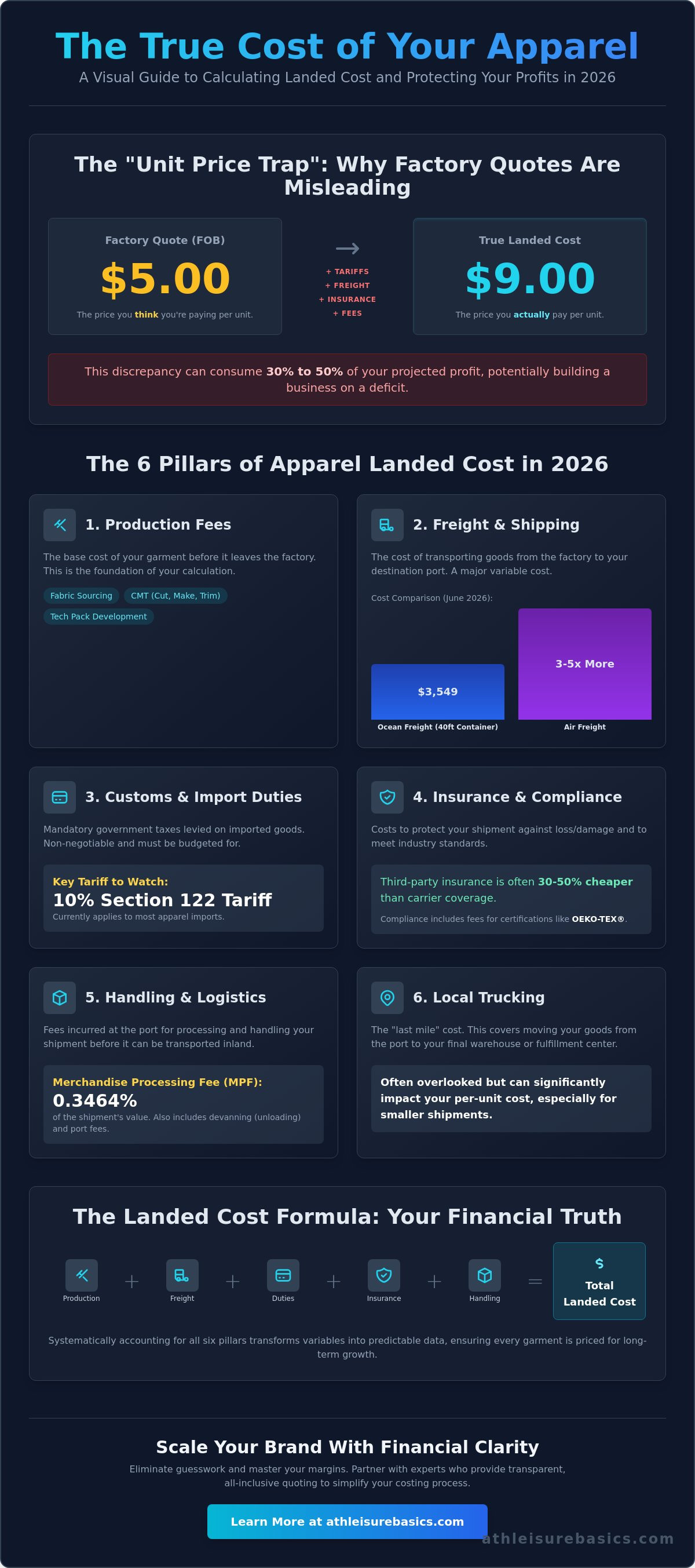
Many brand owners start their journey by focusing on a factory's price per unit. It is a logical starting point, but it's often a financial mirage. While a factory quote might state a clean five dollars per t-shirt, the reality of global logistics in 2026 often pushes that final figure closer to nine dollars once you account for tariffs, insurance, and freight. This discrepancy is known as the "Unit Price Trap." If you set your retail margins based on the initial quote rather than the final arrived price, you aren't just losing money; you're potentially building a business on a deficit.
The foundational definition of landed cost includes the item's purchase price plus every expense required to get it to your warehouse. In the current market, you cannot set retail prices based on Free on Board (FOB) terms. FOB only covers the cost until the goods are on the ship. Between that ship and your door, a web of 2026 Section 122 tariffs, Harbor Maintenance Fees, and rising fuel surcharges can easily consume 30% to 50% of your projected profit. Mastery of calculating landed cost of goods for apparel is what separates hobbyist brands from sustainable, profitable enterprises. It dictates your true break-even point and ensures your marketing spend doesn't outpace your actual earnings.
Landed Cost vs. COGS: Clearing the Confusion
There is often debate about whether these terms are interchangeable. While Cost of Goods Sold (COGS) traditionally includes the manufacturing price, materials, and direct labor, landed cost includes the entire journey. For your 2026 tax reporting and internal accounting, you must categorize shipping and duties as part of your inventory asset value until the item is sold. Landed cost is the "Total Truth" of your inventory investment. It tells you exactly how much capital is tied up in every box sitting on your shelves.
The Hidden Dangers of Guestimating Costs
In a volatile economy where oil prices have surpassed $100 per barrel, "rounding up" your estimates is no longer a safe strategy. Guesswork leads to two dangerous outcomes: overpricing yourself out of the market or selling at a loss without realizing it until your bank account runs dry. Unexpected fuel surcharges from ocean carriers can wipe out a small brand's margin overnight if they aren't factored into the original costing model. Maintaining transparency during the garment production process is vital. When you work with partners who provide detailed breakdowns, you eliminate the "hidden" fees that usually hide in vague factory quotes. Professionalism in costing builds the security you need to scale with confidence.
The 6 Pillars of Apparel Landed Cost in 2026
To build a resilient brand, you must look at the six pillars that form the foundation of your final bill. Each pillar represents a specific stage where costs accumulate, often invisibly. By systematically calculating landed cost of goods for apparel, you transform these variables into predictable data points that protect your bottom line.
- Production Fees: This includes fabric sourcing, CMT (Cut, Make, Trim) labor, and tech pack development. It's the base cost of your garment before it ever leaves the factory floor.
- Freight and Shipping: You must choose between speed and cost. In June 2026, the Drewry World Container Index reached $3,549 per 40-foot container. While air freight is faster, it remains three to five times more expensive than ocean transport.
- Customs and Import Duties: These are mandatory taxes paid to the government. You can find current benchmarks through official U.S. customs duty rates, which currently include a 10% Section 122 tariff on most apparel imports.
- Insurance and Compliance: Protecting your shipment is vital. Third-party insurance is often 30% to 50% cheaper than carrier coverage. Compliance also includes fees for certifications like OEKO-TEX®.
- Handling and Logistics: Don't overlook port fees or "devanning" costs, which is the price of unloading your container. In 2026, the Merchandise Processing Fee (MPF) is 0.3464% of the shipment's value.
- Local Trucking: This is the "last mile" cost of moving goods from the port to your final warehouse or fulfillment center.
If you're feeling overwhelmed by these variables, our clothing production consulting services can help you map out a transparent costing strategy from day one.
Understanding HTS Codes for Athleisure
Harmonized Tariff Schedule (HTS) codes determine your specific duty rate. For athleisure brands, the distinction between synthetic fibers and cotton blends is critical. A mistake in classifying leggings as "trousers" instead of "athletic wear" can result in significant overpayment. Accurate textile identification ensures you pay the lowest legal rate and avoids the delays of a customs hold. Classification isn't just paperwork; it's a financial strategy.
The Cost of Quality Compliance
Investing in OEKO-TEX® or GOTS certifications might feel like an added expense, but it functions as a "protective" landed cost. In 2026, ethical production standards are increasingly used to bypass intensive customs audits. Brands that prioritize material integrity often see faster clearance times and lower risk of fines. Factoring in professional quality control (QC) inspections before the goods leave the factory prevents the most expensive landed cost of all: a shipment of unsellable, defective inventory.
Sourcing Strategy: How Geography Impacts Your Final Bill
Geography isn't just a logistical detail; it's a strategic lever for margin protection. While traditional sourcing hubs in Asia often offer the lowest unit prices, the distance creates a "volatility tax" that many emerging brands struggle to manage. When you're calculating landed cost of goods for apparel, the shipping route you choose determines your risk profile for the entire season. Shifting production closer to your primary market, a strategy known as the "Proximity Pivot," can drastically reduce the variables that typically inflate your final invoice.
Manufacturing in Europe offers a level of predictability that long-haul logistics cannot match. For instance, working with clothing manufacturers in Portugal allows brands to utilize the EUR.1 certificate. This document proves the origin of the goods and can lead to significant duty reductions or exemptions for intra-EU trade. Beyond taxes, the shorter lead times mean you can respond to market trends in weeks rather than months. This agility reduces your reliance on expensive air freight, which currently costs three to five times more than sea transport, and helps you avoid the "stockout" traps that plague long-distance supply chains.
Inventory carrying costs are another hidden factor. High minimum order requirements (MOQs) in Asian hubs often force brands to tie up massive amounts of capital in "buffer" inventory. In contrast, European production often supports lower MOQs. This allows you to keep less stock on hand, improving your cash flow and reducing the total capital tied up in landed inventory. When you account for the interest on that capital, the "cheaper" unit price from a distant factory often loses its appeal.
The Portugal Advantage for 2026
Portugal has solidified its position as a premium manufacturing hub for 2026. Brands benefit from zero duties within the EU and simplified VAT procedures that streamline the accounting process. Shipping distances to the UK and the East Coast of the US are significantly shorter than routes from Shanghai or Ho Chi Minh City. This proximity reduces the likelihood of weather-related delays or geopolitical disruptions. Additionally, the high standard of Portuguese craftsmanship naturally leads to lower return rates. Since returns are a major "hidden" landed cost, producing a higher-quality garment from the start protects your long-term profitability.
Hidden Volatility in Long-Haul Logistics
Long-haul shipping remains vulnerable to sudden price spikes and port congestion. In June 2026, many brands importing from Asia have faced rising fuel surcharges as oil prices surpassed $100 per barrel. These fluctuations are difficult to predict and even harder to budget for. There's also an increasing "environmental tax" to consider. As carbon footprint regulations tighten, the emissions from a 40-day ocean journey from Asia are becoming a financial liability. Nearshoring isn't just about saving time; it's about insulating your brand from the rising costs of global instability.
The Step-by-Step Landed Cost Formula for Fashion Brands
Mastering your finances requires a shift from estimation to precision. To protect your brand's longevity, you must move beyond the factory quote and account for the journey your garments take. By calculating landed cost of goods for apparel using a standardized formula, you ensure that every retail price you set is backed by logistical reality. This process involves five distinct steps that aggregate your total investment into a single, actionable unit price.
- Step 1: Calculate Total Production Cost. Start with the sum of your materials, CMT (Cut, Make, Trim) labor, and sourcing support. Don't forget to include the initial investment in tech pack development, as this is a foundational production expense.
- Step 2: Add All Shipping and Freight Charges. Use the door-to-door rate, not just the port-to-port fee. This must include the "last mile" delivery from the arrival port to your warehouse.
- Step 3: Calculate Duties. Apply the specific HTS code rate for your garment type. For 2026, many US-bound shipments from non-treaty countries face a 10% Section 122 tariff, plus specific rates for synthetic or cotton blends.
- Step 4: Add Insurance, Handling, and Processing Fees. Include the 0.3464% Merchandise Processing Fee (MPF) and any third-party insurance premiums. Factor in bank fees for international wire transfers or currency conversions.
- Step 5: Divide by the total number of units. The resulting figure is your true Landed Cost per unit.
Accuracy at this stage is the difference between scaling a brand and struggling to stay afloat. If you need assistance refining your initial cost sheets, you can book a clothing production consulting session to ensure your financial model is robust.
Practical Example: 250 Custom Hoodies
Imagine you are producing a run of 250 custom hoodies in Portugal. At this volume, your fixed costs have a higher impact on the per-unit price. If your flat-rate shipping fee is $500, that adds $2 to every hoodie. If you were to scale that same run to 1,000 units, the shipping cost per hoodie drops to just $0.50. After adding a hypothetical 12% duty rate and handling fees, a hoodie that costs $15 at the factory gate might result in a $21 landed cost. This 40% increase illustrates why you cannot ignore the pillars of logistics when setting your retail margins.
Common Calculation Mistakes to Avoid
Partnering for Profit: How Athleisurebasics Simplifies Your Costing
The complexity of global logistics in 2026 requires more than just a spreadsheet; it requires a manufacturing partner who prioritizes financial transparency. At Athleisurebasics, we believe that calculating landed cost of goods for apparel should be a collaborative process rather than a guessing game. We provide detailed, line-item quotes from the very beginning of our relationship. By breaking down fabric costs, CMT labor, and sourcing support fees upfront, we eliminate the "unit price trap" and allow you to build a retail strategy based on facts rather than estimates.
Our operational model is designed to protect your startup capital. One of the most significant components of landed cost is the capital tied up in inventory. By offering accessible minimum order quantities (MOQs), we help you maintain a lean supply chain. This reduces your inventory carrying costs and lowers the total financial risk associated with every production run. Whether you are developing a new concept or scaling an existing line, our expertise ensures that every cent of your budget is optimized for growth.
Custom vs. White Label: Which Costing Model Fits You?
Choosing the right production path is a strategic decision that directly impacts your landed cost. Custom clothing manufacturing offers total creative control but involves higher development expenses, such as tech pack creation and multiple sampling rounds. If speed to market is your priority, our white label services provide a faster shortcut. This model significantly lowers your initial development costs because the patterns and fit have already been perfected.
Our 70-piece MOQ for white label products is a powerful tool for protecting your cash flow. It allows you to test the market with premium garments without the burden of high-volume financial commitments. For brands looking to leverage the prestige of European manufacturing, our private label Portugal services offer a balance of high-end craftsmanship and logistical efficiency. This approach ensures your landed costs remain competitive while maintaining the quality standards your customers expect.
Ready to Scale Your Athleisure Brand?
Take the first step toward a more predictable and profitable supply chain. Contact us to discuss your project requirements and receive a breakdown tailored to your specific needs. Get a Custom Apparel Manufacturing Quote Today and start calculating landed cost of goods for apparel with total confidence.
Securing Your Brand's Financial Future
Building a sustainable fashion brand requires moving beyond the initial allure of low factory quotes and embracing the data-driven reality of logistics. By mastering the process of calculating landed cost of goods for apparel, you've gained the ability to navigate 2026's complex tariff landscape and rising freight costs with total confidence. You now understand that every choice, from fabric selection to manufacturing geography, is a strategic lever that determines your final profitability.
We are committed to supporting your growth through expert production consulting for startups and access to high-end, OEKO-TEX® certified materials. Our flexible manufacturing model, including low MOQs starting at 70 pieces, is designed to minimize your financial risk and maximize your operational agility. Request a Transparent Production Quote from Athleisurebasics to receive a detailed breakdown that removes the mystery from your costing. Your journey toward a successful commercial presence starts with a partner who values transparency as much as quality. We look forward to helping you scale with precision.
Frequently Asked Questions
How do I find the correct HTS code for my apparel items?
You find the correct HTS code by searching the official Harmonized Tariff Schedule on the USITC website or by consulting your customs broker. Classification depends heavily on material composition, such as the specific percentage of synthetic fibers versus cotton in your leggings or hoodies. Using the wrong code is a primary cause of overpaying duties or facing shipment delays at the port.
Is landed cost the same as Cost of Goods Sold (COGS)?
Landed cost is a broader metric than Cost of Goods Sold. While COGS typically covers direct manufacturing expenses like fabric and CMT labor, landed cost represents the total truth of your inventory investment. It includes every dollar spent to move the product from the factory floor to your warehouse, making it the most accurate figure for calculating landed cost of goods for apparel.
What is the difference between FOB and DDP shipping terms?
FOB (Free on Board) means the manufacturer handles costs only until the goods are loaded onto the vessel, leaving you responsible for freight, insurance, and duties. DDP (Delivered Duty Paid) requires the seller to handle all logistics and taxes until the goods reach your door. DDP offers more convenience for new brands but often carries a higher hidden service margin built into the price.
How much should I budget for shipping and duties as a percentage?
You should typically budget between 25% and 45% of your unit production price to cover shipping and duties. In June 2026, ocean freight rates have fluctuated around $3,549 per container, and the 10% Section 122 tariff applies to most apparel imports. Monitoring these shifting benchmarks is essential for maintaining your profit margins throughout the year.
Can manufacturing in Portugal really be cheaper than Asia when considering landed cost?
Portugal is often more cost-effective when you factor in duty exemptions via the EUR.1 certificate and significantly shorter shipping windows. While Asian unit prices might appear lower, the "volatility tax" of long-haul freight and the requirement for massive MOQs often make European sourcing the more profitable choice. Nearshoring reduces the capital tied up in transit and minimizes the risk of stockouts.
What happens if I miscalculate my landed cost before launching?
Miscalculating your costs often results in setting a retail price that sits below your true break-even point. This error can lead to a successful launch that actually drains your cash reserves with every sale made. Precise calculating landed cost of goods for apparel ensures your marketing spend is supported by genuine margins rather than optimistic estimates.
Does a low MOQ increase my per-unit landed cost?
A low MOQ does increase the per-unit allocation of fixed shipping and handling fees because these costs are spread across fewer garments. However, this is usually offset by the reduction in total capital tied up in stock. Lowering your inventory volume reduces storage fees and the risk of heavy markdowns, which protects your overall business health and cash flow.
How do trade agreements like the EU-UK deal affect landed cost in 2026?
The EU-UK Trade and Cooperation Agreement allows for duty-free trade only if the apparel meets specific Rules of Origin requirements. In 2026, garments must undergo significant transformation within the EU to qualify for these benefits. You must ensure your manufacturer provides the necessary origin documentation to avoid unexpected 12% duty hits when the goods cross the border.



Leave a comment
This site is protected by hCaptcha and the hCaptcha Privacy Policy and Terms of Service apply.