
How Low MOQ Manufacturing Reduces Inventory Risk for Clothing Brands
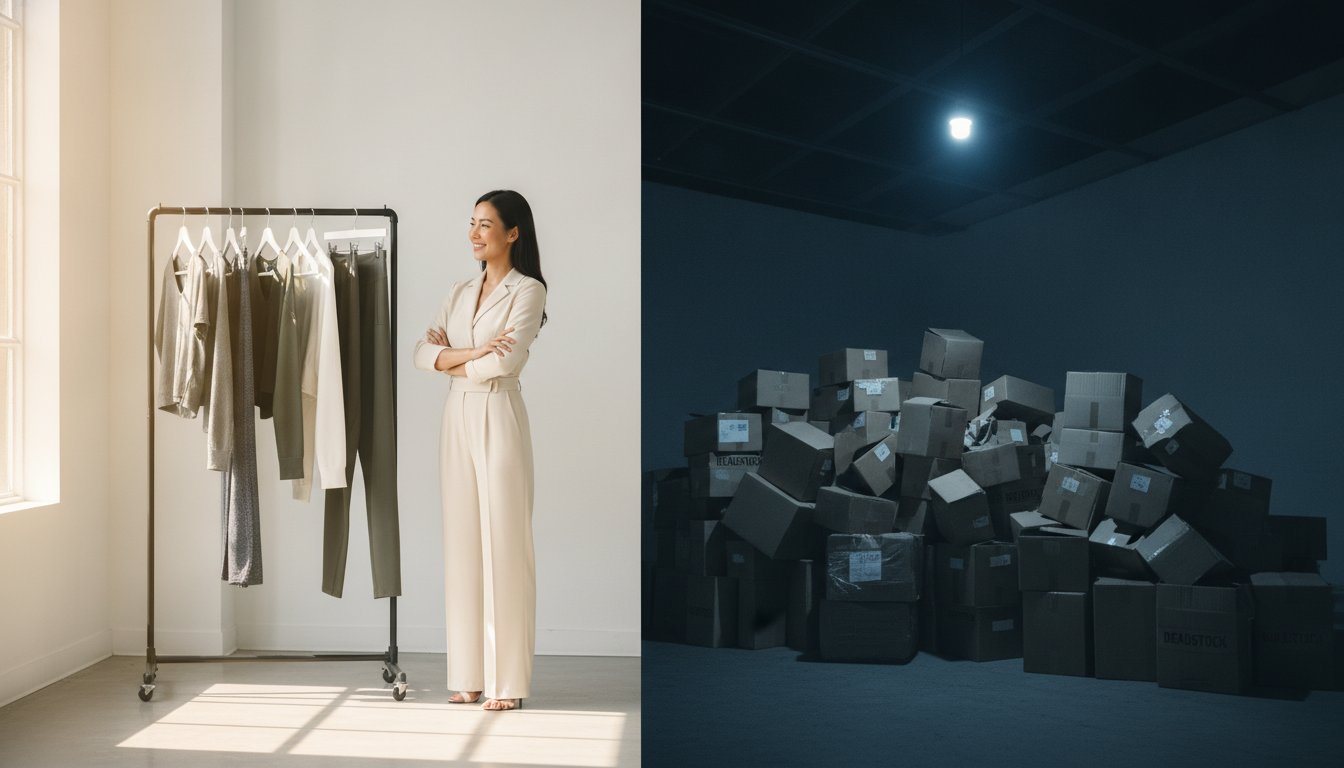
Statistics show that 65% of emerging fashion brands fail within their first three years, often because they underestimate the financial burden of bulk production. It's a scenario many founders know all too well; precious capital is locked away in stacks of unsold garments while warehouse fees continue to climb. Learning how low moq manufacturing reduces inventory risk is no longer just an option for new labels. It's a strategic necessity for any entrepreneur who wants to maintain a healthy cash flow while navigating the unpredictable nature of fashion trends.
You likely realize that committing to hundreds of units in a single color or size is a massive gamble for a growing business. We're here to show you how small batch production protects your investment, eliminates the burden of deadstock, and empowers you to scale with operational agility. This guide covers how to test the market with multiple styles and how to secure a high-quality manufacturing partner that supports your growth from the very first sample. You'll discover how to transition from concept to finished product without the traditional barriers to entry.
Key Takeaways
- Learn how to unlock frozen capital by shifting away from high-volume orders that tie up your budget in unsold boxes.
- Discover how low moq manufacturing reduces inventory risk through a Minimum Viable Product (MVP) approach that prioritizes market data over guesswork.
- Compare the benefits of White Label and Custom manufacturing to find the ideal balance between brand identity and manageable production volumes.
- Identify the hidden costs of high-volume manufacturing, including storage fees and carrying costs that can drain your brand's profitability.
- Explore why ethical manufacturing and premium certifications like OEKO-TEX® act as a secondary layer of risk mitigation for your business.
Understanding the Link Between MOQ and Inventory Risk
High Minimum Order Quantities (MOQs) are often framed as an efficiency tool for factories, but for an emerging brand, they represent a significant financial obstacle. Traditional manufacturing models are designed to maximize factory throughput, forcing brands to commit to large volumes before a single item is sold. This creates an immediate imbalance. As your order volume increases, your break-even anxiety grows exponentially. You aren't just buying clothes; you're betting your brand's survival on a specific trend, color, and size run.
Understanding how low moq manufacturing reduces inventory risk is essential for long-term viability. By lowering the entry barrier, brands can focus on effective inventory management without the pressure of moving thousands of units immediately. In 2026, the market moves faster than ever. Consumers demand constant novelty and ethical transparency. Agile manufacturing allows you to pivot based on real-time sales data rather than outdated projections. This shift toward lower volumes and faster turns is the only way to remain competitive in a landscape where consumer preferences change overnight.
What is Inventory Risk in the Apparel Industry?
Inventory risk is the delta between produced units and market demand. In the apparel sector, this risk often manifests as deadstock. This is unsold inventory that sits in a warehouse, consuming space and draining capital. Fashion has a high obsolescence factor. Trends that are popular today might be forgotten by the time a 1,000-unit production run arrives from an overseas factory. When brands are forced to liquidate this stock at a 70% discount just to clear warehouse space, they don't just lose money. They damage their brand equity and perceived value by training customers to wait for a clearance sale.
How Low MOQs Act as a Financial Safety Net
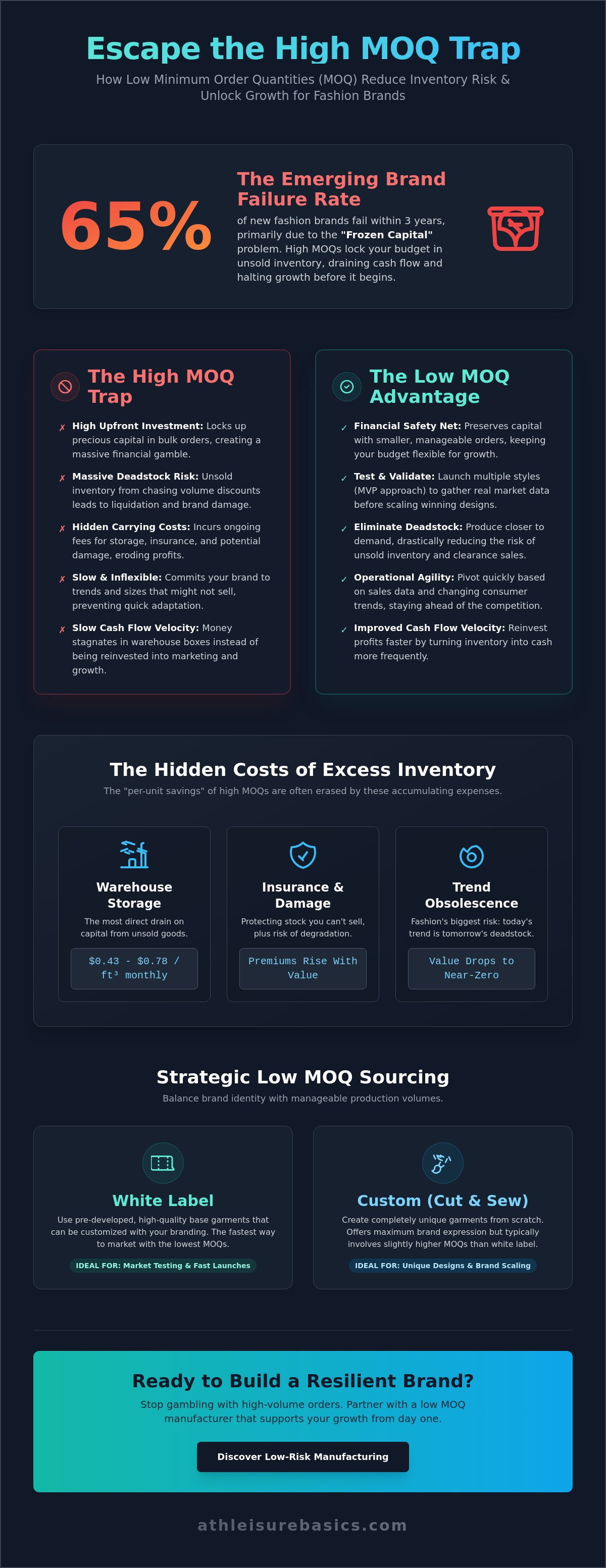
Low MOQ models function as a strategic insurance policy for your capital. Statistics show that 65% of emerging fashion brands fail within their first three years, and a primary driver is the frozen capital problem. When you reduce your initial capital outlay, you keep your budget flexible for marketing and growth. If a specific design doesn't resonate with your audience, your cost of failure is limited to a few dozen pieces rather than a few thousand. This approach allows you to treat your first few collections as market research. You can test multiple styles, gather customer feedback, and only scale the designs that prove their worth. This is how low moq manufacturing reduces inventory risk while providing the agility needed to grow a sustainable business.
Financial Mechanics: How High MOQs Drain Brand Capital
Founders often fall into the trap of chasing the lowest possible per-unit price. On a spreadsheet, committing to 1,000 units to save two dollars per garment looks like a savvy business move. However, this narrow focus ignores the Total Cost of Ownership (TCO). When you prioritize volume discounts over liquidity, you create the "Frozen Capital" problem. This is money that is physically locked in boxes, sitting on warehouse shelves, unavailable for marketing, photography, or payroll. Understanding how low moq manufacturing reduces inventory risk starts with recognizing that cash in the bank is always more valuable than excess fabric in a storeroom.
Low MOQ production improves your cash flow velocity. This is the speed at which you can deploy capital, convert it into inventory, sell that inventory, and return the cash to your business for reinvestment. By opting for smaller runs, you ensure that your money is constantly moving rather than stagnating. This financial agility is what allows a brand to survive its first year and scale into its second. If you're unsure where to start, our clothing production consulting services can help you calculate a sustainable production volume for your current stage.
The Hidden Costs of Carrying Excess Stock
The expenses don't stop once the manufacturing invoice is paid. High-volume orders trigger a chain reaction of hidden fees. Based on 2026 industry data, warehouse storage costs in the U.S. average between $0.43 and $0.78 per cubic foot per month. If you are storing pallets, you can expect to pay around $20.17 per pallet monthly. When you add insurance premiums and the risk of physical degradation, such as dust or moisture damage, the "savings" from a high MOQ order quickly evaporate. For a detailed breakdown of these industry standards, explore our guide on clothing manufacturing moq.
Opportunity Cost: What Else Could That Money Do?
The Agility Advantage: Testing Trends Without Deadstock Debt
Actual sales figures provide a level of clarity that theoretical market research simply cannot match. For an emerging athleisure brand, the Minimum Viable Product (MVP) approach is the most effective way to validate a new design. Instead of committing your entire budget to a single silhouette based on a hunch, you can launch a small batch to see how the market reacts. This real-world data informs your next move, allowing you to double down on what works and quickly abandon what doesn't. This iterative process is how low moq manufacturing reduces inventory risk by ensuring your capital is always tied to proven demand.
Agility also means offering your customers more variety without increasing your total volume. If you have a production budget for 500 units, a traditional factory might force you to buy 500 identical black leggings. With a flexible partner, you could split that same volume into five different colors or three distinct styles. This strategy allows you to capture a broader audience and identify which specific aesthetic resonates most with your early adopters. You're no longer just selling a product; you're conducting a live market test that pays for itself.
Trend Testing and Seasonal Flexibility
Low volumes empower you to take creative risks that would be too dangerous at a larger scale. You can experiment with bold, seasonal colors or innovative silhouettes, like high-compression flared leggings, without the fear of being stuck with thousands of unsold items. This "Short-Cycle" benefit allows you to launch fresh drops every 8 weeks rather than adhering to the rigid twice-a-year schedule of legacy brands. To see how these tests integrate into your timeline, review our detailed guide on the garment production process. This speed to market ensures your brand stays relevant and responsive to cultural shifts as they happen.
Iterative Design: Listening to Your Early Adopters
Small batches serve as a high-fidelity feedback loop. When you release an initial run of 70 pieces, you gain invaluable insights into fit, fabric performance, and customer satisfaction. If users report that a waistband needs more elasticity or a pocket is slightly too low, you can implement those changes in the next production round. How low moq manufacturing reduces inventory risk is most apparent here; it prevents you from being stuck with a design flaw across 2,000 units. Customer feedback loops are shorter with agile production. By the time you scale to 500 or 1,000 units, you're producing a refined, "vetted" garment that you know your audience loves. This commitment to continuous improvement builds trust and reduces the likelihood of high return rates or brand-damaging reviews.
Strategic Sourcing: White Label vs. Custom Low MOQ Production
Not every brand needs a fully bespoke pattern to succeed in its first year. Choosing between White Label and Custom production is a strategic decision that dictates your financial exposure and your speed to market. Understanding how low moq manufacturing reduces inventory risk involves matching your production method to your current level of market validation. By selecting the right entry point, you ensure that your capital is protected while you build your brand's presence.
White Label: Launching with Speed and Security
White Label manufacturing, with a minimum order quantity of just 70 pieces, offers the ultimate safety net for new entrepreneurs. You leverage pre-tested patterns and high-quality luxury blanks that have already been vetted for fit, performance, and durability. This significantly reduces the technical risk associated with garment construction. Using OEKO-TEX® certified fabrics ensures your products meet premium standards without the long lead times of custom development. It's the most efficient way to test your brand's voice and audience resonance. If you're ready to explore these options, our guide on private label portugal provides a comprehensive roadmap for getting started.
Custom Manufacturing: Differentiating Without Overextending
As your brand matures and your customer base grows, you'll naturally want to implement unique design features that define your brand DNA. Custom manufacturing typically requires a 250-piece MOQ. While this is a step up from White Label, it remains well below the thousands of units demanded by traditional global hubs. You can effectively manage this volume by splitting the 250 units across a full size run or a few core colors. This allows for total design exclusivity without the burden of massive inventory debt. We support this middle-ground for emerging luxury brands, providing the technical expertise needed to transition from basic styles to complex, custom silhouettes.
The journey from a small concept to a lasting commercial presence is a marathon, not a sprint. Many successful labels start with White Label to build cash flow and then transition to Custom production once they have consistent sales data. This tiered approach ensures you never overextend your finances or your warehouse space. We specialize in helping emerging labels navigate this growth with confidence. Consult with our team today to determine which production model aligns with your brand's current trajectory and long-term goals.
Partnering for Profit: Why Athleisurebasics is the Low-Risk Choice
While low order volumes provide the initial safety net, the location and standards of your factory determine your brand's long-term resilience. Choosing a manufacturing partner in Portugal offers distinct advantages over distant global hubs. Proximity to major European and US markets significantly shortens lead times, allowing you to react to market shifts within weeks rather than months. This geographical edge is a key component of how low moq manufacturing reduces inventory risk; you aren't just ordering fewer items, you're ordering them closer to the point of sale. Shorter shipping distances also mean fewer opportunities for supply chain disruptions, ensuring your stock arrives when your customers expect it.
Our consultative approach further mitigates operational hazards. We don't just execute orders; we provide tech pack development to ensure every stitch aligns with your vision. According to industry data, a professional tech pack can reduce the average number of sampling rounds from 4.5 to 1.8. This efficiency saves you thousands in pre-production costs and prevents the kind of bulk errors that lead to unsellable deadstock. By getting the blueprint right the first time, you protect your capital from the hidden fees of manufacturing mistakes.
Premium Quality as a Long-Term Risk Strategy
The perceived savings of "cheap" manufacturing often vanish when you're faced with high return rates or a tarnished reputation. Using OEKO-TEX® certified materials and ethical labor standards acts as a secondary layer of protection for your business. When your customers receive a garment that feels premium and stands up to intense wear, your return rate drops and your brand equity grows. This level of quality is what justifies the 2.5x to 4x markups necessary for direct-to-consumer profitability. The "Made in Portugal" label serves as a powerful trust signal, telling your audience that your brand values integrity over cost-cutting. Explore our guide on made in portugal clothing to understand how regional excellence translates to business security.
Ready to Minimize Your Manufacturing Risk?
Scaling a brand requires a partner that grows with you at your own pace. Whether you're starting with 70 units of White Label clothing to test a new audience or moving into 250-piece custom runs for a signature collection, our infrastructure is built to support your journey. We help you move from a small idea to a lasting commercial presence by removing the traditional barriers to entry and providing end-to-end service models. By leveraging how low moq manufacturing reduces inventory risk, you can keep your brand agile, your cash flow healthy, and your growth sustainable.
Take the first step toward a leaner, more profitable supply chain. Partner with Athleisurebasics for low-risk, high-quality production and secure your brand's future today.
Secure Your Brand's Future with Agile Production
Understanding how low moq manufacturing reduces inventory risk transforms your supply chain from a financial liability into a strategic asset. By prioritizing liquidity over bulk discounts, you protect your capital and maintain the agility needed to respond to real-time market data. This approach effectively eliminates the threat of deadstock and allows you to refine your designs through iterative customer feedback loops without the burden of high-volume debt.
Our infrastructure is specifically designed to support startup growth through accessible production volumes and technical expertise. We provide Portugal-based ethical production and utilize OEKO-TEX® certified premium fabrics to ensure your brand is built on a foundation of quality and transparency. This commitment to craftsmanship mitigates the risk of high return rates and establishes long-term trust with your audience from the very first collection.
Take the first step toward a leaner, more profitable business model. Launch your brand with low-risk White Label manufacturing starting at 70 pieces. Your journey from a small idea to a lasting commercial presence is within reach when you have a partner committed to your success.
Frequently Asked Questions
Does low MOQ manufacturing always result in a higher price per unit?
Low MOQ manufacturing usually carries a higher per-unit cost compared to mass production because the factory cannot spread setup costs across thousands of items. However, you must consider the total financial picture. By avoiding large upfront investments in unsold stock, you preserve capital for marketing and growth. This is fundamentally how low moq manufacturing reduces inventory risk; you pay a small "agility premium" to avoid the massive debt of deadstock.
How do I know if my clothing brand is ready for custom manufacturing?
Your brand is ready for custom manufacturing when you have consistent sales data and a clear understanding of your unique design requirements. If your customers are asking for specific features that aren't available in white label blanks, it's time to move to the 250-unit level. At this stage, you have enough market validation to justify the slightly higher commitment while still maintaining a manageable risk profile.
What is the difference between white label and private label for inventory risk?
White label manufacturing involves using pre-tested luxury blanks where you simply add your branding, representing the lowest possible entry risk. Private label typically refers to custom-made garments based on your specific tech packs. For inventory risk, white label is superior for testing new markets because it offers the lowest minimums, often starting at just 70 pieces, and the fastest turnaround times to market.
Can I still get high-quality fabrics with a low MOQ order?
You can absolutely secure high-quality fabrics with low MOQ orders by partnering with manufacturers that specialize in premium segments. We utilize OEKO-TEX® certified materials even for our smallest production runs. Because we focus on luxury and performance wear, we maintain a library of high-end fabrics that are accessible to emerging brands without the need for massive material minimums or custom fabric weaves.
How does manufacturing in Portugal reduce my supply chain risk?
Manufacturing in Portugal reduces supply chain risk through shorter shipping distances and high ethical standards. Proximity to major European and US markets means you can restock faster and avoid the long lead times associated with overseas shipping. Additionally, Portuguese factories are known for their craftsmanship and strict adherence to EU labor and environmental regulations, which protects your brand's reputation from potential ethical controversies.
What happens if I can't meet even a low MOQ of 70 pieces?
If you can't meet the 70-piece minimum, we recommend focusing on luxury blanks or utilizing our clothing production consulting services to refine your business plan. Starting with a very small, curated selection of high-end blanks allows you to build a following without any manufacturing commitment. Once you have a small community of buyers, transitioning to a 70-piece white label run becomes a much safer financial step.
How often should I restock when using a low MOQ model?
Restocking frequency should be dictated by your sales velocity and marketing calendar. Many agile brands find success with a "drop" model, restocking or launching new styles every 8 to 12 weeks. This rhythm keeps your inventory fresh and allows you to adjust quantities based on real-time demand. It's a proactive way to ensure your capital is always tied to products that are actively selling in the current season.
Is low MOQ manufacturing sustainable for long-term growth?
Low MOQ manufacturing is highly sustainable for long-term growth because it allows for a tiered scaling strategy. As your brand matures, you can move from white label to custom manufacturing while still keeping your risk manageable. This model ensures you don't overextend during growth phases. It's a proven method for building a stable, profitable business that can pivot as trends and consumer demands evolve over time.


Leave a comment
This site is protected by hCaptcha and the hCaptcha Privacy Policy and Terms of Service apply.