

Clothing Brand Label Requirements: A 2026 Compliance Guide
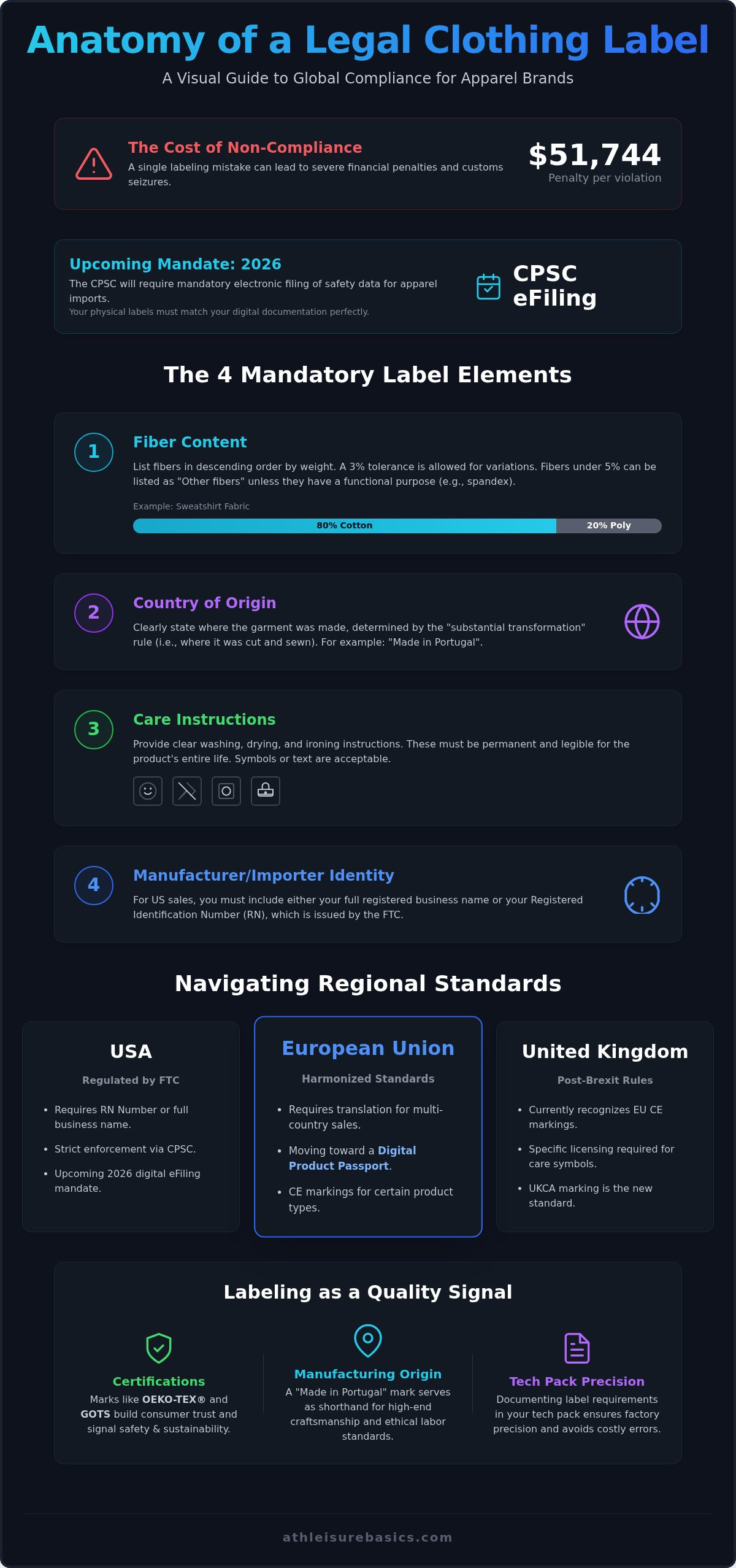
Did you know that a single oversight in your garment labels can now result in a penalty of up to $51,744 per violation? It's a sobering reality for any emerging business, especially with the 2026 CPSC eFiling mandate requiring digital safety data at the moment of entry. You've invested significant capital into your collection; the last thing you need is a customs seizure or a legal hurdle because of confusing clothing brand label requirements.
We understand that the shift toward Digital Product Passports in the EU and new EPR laws in California makes compliance feel like a moving target. This guide provides the clarity you need to move forward with confidence. We'll provide a comprehensive checklist for fiber content, country of origin, and care instructions to ensure your production is legally sound from day one.
You'll learn the critical differences between US and EU standards, how to prepare your tech packs for factory success, and why choosing ethical, certified manufacturing in Portugal can simplify your entire compliance journey.
Key Takeaways
- Master the four mandatory elements for US compliance and stay ahead of the new 2026 CPSC eFiling mandates to avoid penalties of up to $51,744.
- Understand how to adapt your labeling for global markets, including EU language regulations and the transition toward the Digital Product Passport.
- Learn how to document specific clothing brand label requirements within your tech packs to ensure factory precision and avoid customs seizures.
- Discover how manufacturing in Portugal provides a strategic advantage by meeting rigorous EU standards and utilizing OEKO-TEX® certified fabrics.
- Identify the nuances of UK compliance, including the current recognition of CE markings and the specific licensing required for care symbols.
Why Clothing Brand Label Requirements are Non-Negotiable
For any apparel entrepreneur, the label is the final checkpoint before a product reaches the consumer. It isn't just a piece of fabric; it's a legal contract. Meeting clothing brand label requirements ensures your products move smoothly through global supply chains. Failing to meet these standards can lead to catastrophic financial losses. Regulatory bodies like the Federal Trade Commission (FTC) in the US and the European Commission in the EU set these rules to protect consumers from fraud and safety risks. Beyond the law, modern shoppers are more informed than ever. They look for transparency in fiber content and ethical origins. A clear, accurate label builds the trust necessary for long-term brand loyalty.
The Cost of Non-Compliance in 2026
International borders are stricter than they used to be. As of July 8, 2026, the U.S. Consumer Product Safety Commission (CPSC) requires mandatory electronic filing of safety data for apparel imports at the time of entry. If your labels don't match your digital documentation, customs officials can seize or destroy your inventory. This leads to missed launch dates and wasted capital. Incorrect care instructions also damage your reputation. If a garment shrinks or bleeds because the label was wrong, you'll face high return rates and negative reviews. In the United States, the Textile Fiber Products Identification Act is the primary federal law that mandates the disclosure of fiber content, country of origin, and manufacturer identity on textile products. Violating these rules can result in penalties as high as $51,744 per violation.
Labeling as a Quality Signal
A label is also a powerful tool for premium positioning. Certifications like OEKO-TEX® or GOTS are no longer just optional features. They've become standard expectations for luxury and performance brands. When a customer sees these marks, they know the fabric is safe and sustainably produced. We emphasize the "Made in Portugal" mark because it serves as a shorthand for high-end craftsmanship and ethical labor standards. By integrating these details into your garment production process, you transform a mandatory requirement into a competitive advantage. Adhering to strict clothing brand label requirements is a mark of a professional operation. High standards in labeling reflect the high standards of your overall production. Clear, professional tags signal to the buyer that your brand is authoritative, principled, and ready for the global market.
The 4 Mandatory Elements of a Legal Clothing Label
To sell legally in major markets, your garments must carry specific data. These clothing brand label requirements aren't suggestions; they're rigid standards. Every label must include fiber composition, country of origin, care steps, and manufacturer identity. Missing just one of these elements can lead to customs delays or retail rejections. While the placement of these labels can vary, the information they contain must be permanent and legible for the life of the product. Professional brands treat these requirements as a technical specification, ensuring every detail is verified before the first production run begins.
Fiber Content: Accuracy and Tolerances
Fibers must be listed in descending order by weight. If a sweatshirt is 80% cotton and 20% polyester, cotton must appear first. The law allows a 3% tolerance for most fibers to account for natural variations in spinning and weaving. This means if you claim 100% cotton, the lab test must show at least 97% cotton content. When you are labeling textiles with specialized finishes like water-repellent coatings or antimicrobial treatments, you must ensure the base fiber percentages remain accurate. "Other fibers" can only be used for materials making up less than 5% of the total weight, provided they don't have a specific functional significance like elasticity or warmth.
You must also clearly state where the garment was made. This is determined by the "substantial transformation" rule. If fabric is cut and sewn in Portugal, it is legally "Made in Portugal." For US sales, you also need a Registered Identification Number (RN). This number identifies the business responsible for the product. If you don't have an RN, you must list your full registered business name. You can find detailed guidance on these filings in the official FTC labeling requirements. For EU markets, requirements often include a registered business address within the member state to ensure accountability.
Care Instructions: ASTM vs. ISO Symbols
Care labels must provide at least one safe method of cleaning. In the US, brands typically use ASTM symbols. International markets prefer ISO symbols. While they look similar, small differences can lead to confusion during the washing process. You must test your garments before finalizing these instructions. A label that says "Tumble Dry Low" is a liability if the fabric actually requires air drying to maintain its shape. We recommend wash-testing final samples multiple times to check for shrinkage or color bleeding. Accurate care labeling protects the longevity of your product and reduces customer returns. If you're unsure how to translate lab results into compliant symbols, our clothing production consulting services provide the technical oversight needed to avoid these costly errors.
Navigating Regional Standards: US vs. EU vs. UK
Success in the global apparel market depends on your ability to adapt to varying clothing brand label requirements across different jurisdictions. While the fundamental elements of fiber and origin are universal, the technical execution changes once you cross a border. Brands selling in the US, EU, and UK face distinct regulatory frameworks that dictate everything from the language used on the tag to the specific registration numbers required for customs clearance. Understanding these nuances is the difference between a seamless product launch and a shipment held indefinitely at a port of entry.
The European Union's Language Rule
In the EU, compliance is governed by Regulation No 1007/2011. The most critical rule is that labels must be translated into the official language of the member state where the garment is sold. If you plan to sell in France, Germany, and Italy, your labels must include the mandatory fiber names in French, German, and Italian. To manage these long labels without sacrificing wearer comfort, many premium brands use soft satin booklet labels or printed transfers. It's also vital to prepare for the upcoming Digital Product Passport (DPP), which will eventually store this data digitally via a QR code on the physical label.
The US Market and the FTC
The Federal Trade Commission (FTC) focuses heavily on the Registered Identification Number (RN). While non-US brands can apply for an RN, many choose to list their full registered business name and address instead. Location is also strictly regulated; the country of origin must be placed in a prominent position, typically the center back of the neckline. If your garment contains wool or fur, you must follow even more stringent disclosure rules under the Wool Products Labeling Act. These clothing brand label requirements are designed to prevent consumer deception and ensure that every material is accurately represented at the point of sale.
Post-Brexit regulations have introduced the UKCA (UK Conformity Assessed) marking for certain apparel categories. While the UK has extended the recognition of the EU's CE mark until December 2027, the UKCA mark will become mandatory for most relevant goods from January 2028. This divergence means brands must keep a close eye on UKFT updates to ensure their labels remain compliant in Great Britain. Choosing a manufacturing partner within the EU simplifies this complex landscape. Our expertise in made in portugal clothing provides an inherent advantage, as Portuguese factories already operate under rigorous EU standards, ensuring your products are born compliant with some of the world's strictest textile laws.
Documenting Labeling Specs in Your Tech Pack
A label is only as accurate as the instructions provided to your manufacturing partner. To ensure your clothing brand label requirements are met during production, you must document every technical detail within your technical package. This documentation serves as the master blueprint, removing any ambiguity about where a label is placed or how it is attached. In professional manufacturing, a dedicated Labeling Page is a standard requirement. It prevents costly errors like labels being sewn upside down, placed in the wrong seam, or positioned in a way that causes wearer discomfort. Every specification must be locked in before the sampling phase begins to ensure the final product is both compliant and comfortable.
Integrating Labels into Your Tech Pack Design
Your tech pack should contain a dedicated section for labeling artwork and placement callouts. You can use a guide for clothing brand tech packs to learn how to map out these specifications effectively. Each page should provide clear instructions on:
- Font size and color: Specify the exact Pantone colors and minimum font heights to ensure long-term legibility.
- Attachment method: Detail if the label requires a four-side stitch, a loop fold in the side seam, or a single-edge stitch at the neckline.
- Label hierarchy: Clearly distinguish between the main brand label, the size tab, and the mandatory care and content label.
Choosing the Right Label Material for Athleisure
For high-performance activewear, the choice of material is as critical as the fabric itself. Tagless or heat-press transfer labels are often preferred because they eliminate the "itch factor" during intense physical movement. If you choose physical labels, satin or soft-woven materials are the industry standard for luxury finishes. It is essential that your labels are OEKO-TEX® compliant to match the premium standards of your base fabrics. This ensures that no harmful chemicals are introduced to the skin through the label material. Balancing legal compliance with consumer comfort is a hallmark of a mature, quality-conscious brand. If you're looking to professionalize your production documents, our tech pack development services provide the technical oversight needed to ensure your labels are both legally compliant and production-ready.
Durability is the final piece of the compliance puzzle. All mandatory information must remain legible for the entire life of the garment. This means your labels must withstand repeated washing, drying, and friction without fading or fraying. When specifying materials in your tech pack, ask for wash-test reports for printed labels to verify ink durability. High-quality production in Portugal typically utilizes advanced printing and weaving techniques that meet these rigorous standards, protecting your brand from future compliance audits or customer dissatisfaction.
How Athleisurebasics Simplifies Brand Compliance
Understanding the legal landscape is only the first step toward a successful product launch. Executing these clothing brand label requirements without error requires a manufacturing partner who treats compliance as a core technical specification. We provide the infrastructure and expertise needed to navigate these complexities, allowing you to focus on scaling your business while we manage the technical details. By positioning ourselves as a dedicated ally, we remove the friction often associated with international trade and regulatory audits. Our goal is to empower emerging entrepreneurs by simplifying industrial processes and mitigating the risks of global expansion.
White Labeling: The Fast Track for Startups
For emerging brands looking for operational agility, our private label portugal services offer a streamlined path to market entry. We utilize luxury blanks that already meet base compliance standards for material integrity and safety. You can customize these premium garments with your own branding and size labels while we ensure the mandatory care and content data remains accurate. Our low minimum order quantities (MOQs) starting at 70 pieces allow you to test new markets without the heavy overhead of large-scale compliance management. This model provides a sense of security for businesses transitioning from a small idea to a lasting commercial presence.
Our Full-Service Production Support
If your vision requires custom manufacturing, we offer end-to-end support through our technical development and sourcing teams. We source OEKO-TEX® certified labels that match the high standards of our fabrics, ensuring your entire garment is free from harmful substances. Our quality control teams conduct rigorous checks to verify that every item is legally retail-ready before it leaves our facility. This structured approach ensures your clothing brand label requirements are integrated into the production lifecycle from the very first sample. You'll benefit from direct communication with our Portuguese factory to manage complex labeling layouts or multi-language requirements for the EU market.
Our production consulting services offer the expert guidance needed to navigate shifting regional laws, such as the 2026 CPSC eFiling mandates. We help you develop accurate tech packs that serve as a quality seal for your brand. By manufacturing in Portugal, you ensure your products meet strict EU environmental and labor standards, which serves as a powerful differentiator against global competitors. This commitment to material integrity and ethical production is central to our value proposition. Reach out to our team today to initiate your production journey and secure a knowledgeable collaborator for your brand's long-term development.
Secure Your Brand's Future in the Global Market
Adhering to clothing brand label requirements is no longer just about avoiding fines; it's about building a transparent, professional business that global consumers can trust. As the industry moves toward digital passports and stricter eFiling mandates in 2026, your attention to detail during the tech pack phase will define your operational success. You've seen how regional differences in the US, EU, and UK can impact your supply chain. Now is the time to turn that knowledge into a competitive advantage by partnering with a manufacturer that prioritizes regulatory precision and ethical integrity.
We're here to help you manage these industrial complexities with ease. Our expertise in premium Portuguese craftsmanship ensures your garments meet the highest EU standards from the very first stitch. Whether you're utilizing our OEKO-TEX® certified production for custom designs or taking advantage of our low 70-piece MOQ for white label collections, we provide the security you need to scale. Don't let legal hurdles slow your momentum. Launch your compliant apparel line with Athleisurebasics today and move forward with the confidence of an industry insider. Your journey from a small idea to a lasting commercial presence starts with a partner invested in your success.
Frequently Asked Questions
Do I legally need a label on every piece of clothing I sell?
Yes, you are legally required to have a permanent label on every garment intended for sale. These clothing brand label requirements ensure consumers know exactly what they are buying and how to maintain it. While some small items like socks or hosiery may have labeling on the packaging, standard apparel must have a label attached to the garment itself to meet FTC and EU regulations.
Can I use 'Made in Europe' instead of a specific country like Portugal?
No, you must specify the exact country of origin rather than using a broad regional term like "Made in Europe." For items produced in our facilities, the label must state "Made in Portugal." This specificity is required by both the FTC in the United States and various EU member state laws to ensure supply chain transparency and accurate customs documentation during the entry process.
Is it mandatory to have care symbols, or is text sufficient?
In the United States, you may use either care symbols or written words, provided they are clear and accurate. However, for international sales, symbols are highly recommended because they bypass language barriers. If you sell within the EU, you must often provide care instructions in the official language of the target market, making standardized ISO symbols a more efficient choice for global clothing brand label requirements.
What is an RN number and do I need one if I sell outside the US?
An RN (Registered Identification Number) is a number issued by the FTC to US-based businesses involved in the manufacturing or importation of textile products. You don't strictly need one if you sell exclusively outside the US. If you are a non-US brand selling in America, you can list your full registered business name and address on the label instead of an RN number to satisfy federal requirements.
Are there different labeling requirements for children's clothing?
Yes, children's clothing is subject to much stricter safety and labeling standards, including mandatory tracking labels. These must include the manufacturer's name, production date, and batch location to facilitate recalls if necessary. You must also ensure compliance with the Consumer Product Safety Improvement Act (CPSIA) in the US, which covers lead content and flammability standards beyond standard adult apparel rules to protect younger consumers.
Can I print my brand label directly onto the fabric?
Yes, printing your brand and care information directly onto the fabric is a popular "tagless" option for performance wear and athleisure. This method, often called a heat-press transfer, must still meet all legal requirements for legibility and permanence. The print must be durable enough to remain readable throughout the entire lifespan of the garment, despite repeated washing and wear during the product's use cycle.
What happens if my fiber content label is slightly inaccurate?
The FTC allows a 3% tolerance for fiber content accuracy, but significant deviations can lead to heavy penalties. If your label is found to be intentionally misleading or falls outside this tolerance, you could face fines of up to $51,744 per violation. Inaccurate labels also risk customs seizures and damaging your brand's reputation for quality and transparency, which is why we recommend rigorous laboratory testing of all fabric batches.
Do I need to list the country of origin for the fabric or the finished garment?
You must list the country where the finished garment was "substantially transformed," which usually means where it was cut and sewn. While you don't legally have to list the origin of the raw fabric, you must be clear about the garment's assembly location. For example, a shirt made in Portugal using Italian fabric would be labeled "Made in Portugal" to satisfy standard global origin requirements and customs declarations.



Leave a comment
This site is protected by hCaptcha and the hCaptcha Privacy Policy and Terms of Service apply.