
Article: Streetwear Clothing Manufacturer Europe: 2026 Guide

Streetwear Clothing Manufacturer Europe: 2026 Guide
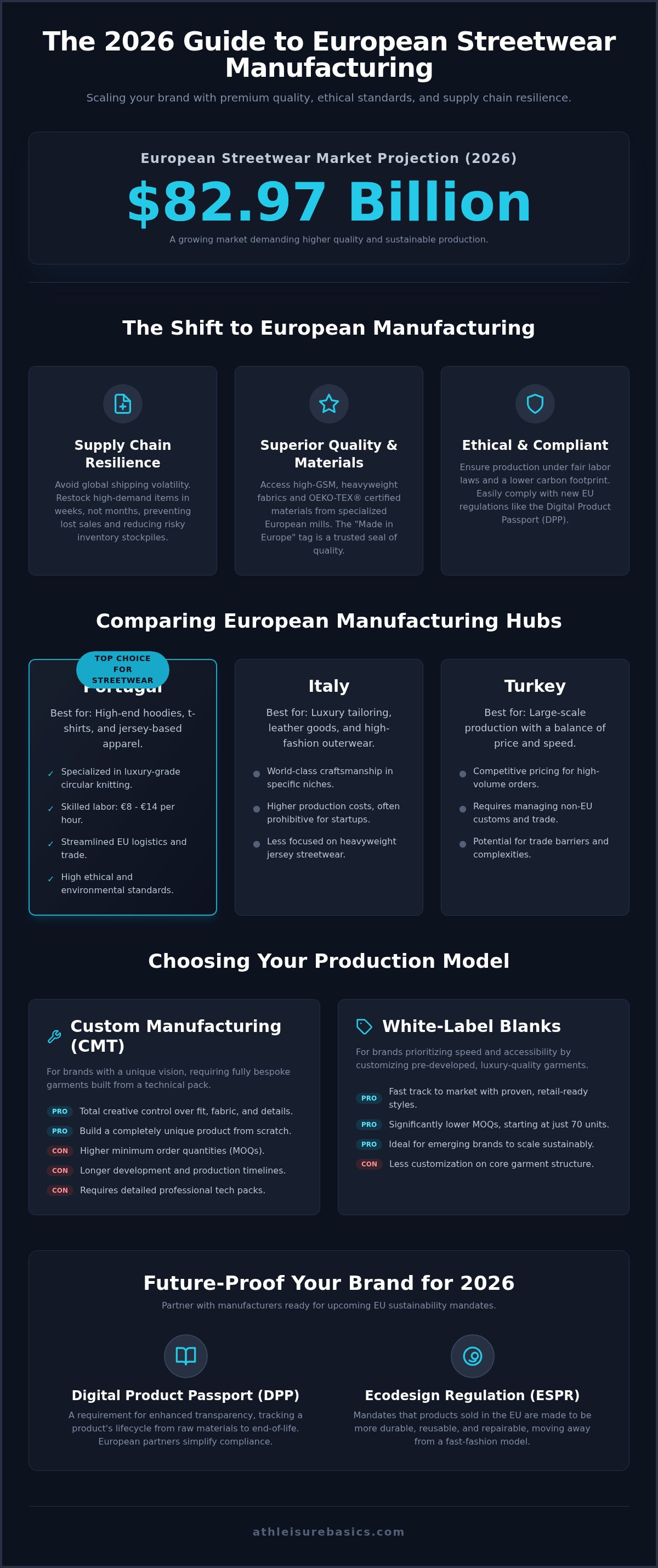
With the European streetwear market projected to hit $82.97 billion in 2026, the race to capture market share is more competitive than ever. You likely know that high minimum order quantities and poor communication with overseas factories can stall a startup before it even launches. Finding a reliable streetwear clothing manufacturer in Europe is now a strategic necessity for brands that prioritize speed, ethics, and premium craftsmanship. It's about moving from a simple concept to a finished, retail-ready product without the typical risks of international shipping and quality control issues.
We believe that building a successful label shouldn't require a massive starting budget or complex industrial knowledge. This guide shows you how to partner with elite European facilities to secure retail-ready quality and ethical production standards. We'll explore the benefits of Portuguese manufacturing, explain how to navigate new 2026 EU regulations like the Digital Product Passport, and compare custom CMT versus white-label solutions. By the end of this guide, you'll have a clear roadmap to help you scale your brand with confidence and operational agility.
Key Takeaways
- Understand why Portugal's technical expertise in circular knitting makes it the premier destination for high-end streetwear hoodies and tees in 2026.
- Learn how to select the right streetwear clothing manufacturer europe by comparing bespoke custom manufacturing with the speed of white-label luxury blanks.
- Master the production blueprint by developing professional tech packs and sourcing OEKO-TEX® certified materials to meet upcoming EU sustainability regulations.
- Discover how low minimum order quantities, starting at just 70 units for white label, allow emerging brands to scale sustainably without high upfront costs.
- Prepare for 2026 industry shifts, including the Digital Product Passport, by partnering with manufacturers that prioritize transparency and ethical labor standards.
Streetwear Clothing Manufacturer Europe: The 2026 Landscape
The European streetwear market is projected to reach $82.97 billion in 2026. This massive growth is driven by a fundamental shift in how brands view their supply chains. A streetwear clothing manufacturer europe is more than just a sewing facility; it's a technical partner that manages the entire lifecycle of a garment. This partnership covers everything from sourcing sustainable raw materials to the final shipping of retail-ready collections. In the current market, the role of the manufacturer has expanded to include compliance with complex new regulations and high-end construction techniques.
We're seeing a definitive move away from disposable fast fashion toward "slow Streetwear." In 2026, longevity and heritage take precedence over fleeting trends. A European origin is now a critical marketing asset for premium brands. The "Made in Europe" tag serves as a quality seal that justifies higher price points and builds consumer trust. It tells your audience that their clothing was produced under fair labor laws and with a significantly lower carbon footprint than items transported across oceans. This regional pride is a powerful tool for brand storytelling and long-term customer loyalty.
Why Brands are Moving Production Back to Europe
Supply chain resilience is a top priority for emerging labels. Nearshoring to a streetwear clothing manufacturer europe allows brands to avoid the volatility of long-distance shipping and global trade tensions. Speed to market is the primary advantage; you can restock high-demand items in weeks rather than months. This agility prevents lost sales and reduces the need for massive, risky inventory stockpiles.
Quality has become the ultimate differentiator in a saturated market. Streetwear enthusiasts in 2026 demand heavyweight, high-GSM fabrics that hold their shape after multiple washes. European mills specialize in these premium textures and provide access to OEKO-TEX® certified materials. New EU regulations like the Ecodesign for Sustainable Products Regulation (ESPR), which came into force on July 19, 2026, make sustainability a legal necessity. Working with a European partner simplifies the adoption of the Digital Product Passport (DPP). This ensures your brand stays compliant with transparency laws without slowing down production.
Comparing European Manufacturing Hubs: Portugal, Italy, and Turkey
Portugal is the undisputed leader for streetwear essentials like premium jersey, hoodies, and t-shirts. It offers a sophisticated balance of technical expertise and efficiency. With skilled labor costs for garment workers ranging from €8 to €14 per hour in 2026, Portugal provides luxury-level quality without extreme overhead. The infrastructure is specifically optimized for high-end circular knitting and complex garment dyeing.
Italy remains the premier choice for luxury tailoring, high-fashion outerwear, and premium leather goods. While the craftsmanship is world-class, the costs are often prohibitive for startups focusing on jersey-based streetwear. Turkey offers a competitive balance of price and speed. It's an excellent option for large-scale production, though brands must manage customs complexities and potential trade barriers that don't exist within the EU single market. For most growing streetwear brands, Portugal represents the most scalable and reliable entry point into European manufacturing.
The Portugal Advantage for Streetwear Production
Portugal has earned its reputation as the "Silicon Valley" of textile manufacturing through decades of specialization and infrastructure investment. By 2026, the country's textile and clothing exports reached €5.499 billion, reflecting its dominance in the premium market. If you're looking for a streetwear clothing manufacturer europe, the Portuguese cluster offers unparalleled technical expertise in circular knitting. This is the specific machinery required to perfect the heavy, durable jersey used in modern hoodies and tees. Unlike generalist factories, Portuguese facilities focus on high-end finishing and the structural integrity that streetwear enthusiasts demand.
Ethical Standards and EU Regulations
Manufacturing within the EU provides a level of security and transparency that's difficult to replicate overseas. Portugal's national minimum wage rose to €870 per month in 2026, ensuring that your garments are produced by workers who receive fair compensation under regulated labor laws. Data from the European Apparel and Textile Confederation confirms that the region remains a global leader in ethical industrial practices. Portuguese factories also lead the way in environmental compliance, utilizing advanced water treatment systems and renewable energy to minimize their footprint. The "Made in Portugal" mark has become a powerful marketing asset, signaling to consumers that your brand values quality over cost-cutting. You can learn more about these advantages in our Made in Portugal Clothing guide.
Sourcing Premium Streetwear Textiles
The quality of a streetwear garment is often judged by its weight and texture. This is measured in GSM (Grams per Square Metre). In 2026, the standard for premium streetwear has shifted toward much heavier weights; a luxury hoodie typically requires a fabric above 400 GSM, while a high-end tee should exceed 240 GSM. These weights provide the structured, boxy silhouette that defines the current aesthetic. To understand how different fibers contribute to this feel, you should review our guide on What is a Textile?.
Certification is another non-negotiable factor. Most elite Portuguese manufacturers utilize OEKO-TEX® certified fabrics, ensuring that every piece of skin-contact apparel is free from harmful chemicals. This commitment to safety is a core requirement for brands navigating the new EU Green Claims Directive. If you're ready to transition from concept to production, we recommend partnering with a consultant who understands these technical nuances to ensure your first collection meets retail standards.
Custom Manufacturing vs. White Label: Which is Right for You?
Choosing a production model is the most consequential decision you'll make when partnering with a streetwear clothing manufacturer europe. It dictates your initial capital requirements, design flexibility, and speed to market. Most brands choose between two primary paths: white label or custom manufacturing. While both models result in premium, retail-ready apparel, they serve different stages of a brand's growth lifecycle. Understanding the business logic behind each will help you allocate your budget effectively while maintaining high quality standards.
White label production involves adding your branding to pre-developed luxury blanks. These aren't generic t-shirts; they're high-GSM, expertly fitted garments that a manufacturer has already perfected through rigorous testing. This model provides a "fast-track" to market. Conversely, custom manufacturing, also known as full CMT (Cut, Make, Trim), offers total creative control. You specify every detail, from unique fabric weights and bespoke measurements to specialized hardware and pocket placements. This level of detail is what eventually separates a legacy brand from a temporary trend.
The Startup Path: Starting with White Label
For emerging labels, white label is often the most pragmatic choice. It removes the technical burden of garment development and focuses your energy on marketing and design. In Portugal, low MOQs for white label start at just 70 pieces. This accessibility allows you to test the market with multiple styles without incurring heavy debt or sitting on excess inventory. You can still create a distinct identity through high-end customization options. These include screen printing, high-density embroidery, and custom-woven neck labels. To explore how this model works in a professional setting, read our guide on Private Label Portugal.
The Scaling Path: Moving to Custom Production
As your brand matures and your community grows, you may find that pre-developed blanks no longer satisfy your specific creative vision. This is when you transition to custom production, which typically requires MOQs of 250 pieces or more per style. Custom manufacturing allows you to build a unique "brand fit" that customers can recognize by touch and silhouette. Success at this level relies on a professional Tech Pack, which acts as the industrial blueprint for your garment. The European textile and clothing industry maintains rigorous standards for these technical documents, ensuring that your vision is executed with precision. Selecting a streetwear clothing manufacturer europe that supports both models allows your production to grow seamlessly as your brand scales.
5 Steps to Partnering with a European Manufacturer
The transition from a creative vision to a physical product requires a highly structured approach. Partnering with a streetwear clothing manufacturer europe ensures you have a collaborator who understands these technical milestones. While many brands rush to see a finished product, the most successful ones follow a disciplined five-step sequence to ensure consistency and quality. This process mitigates risks and ensures that your capital is invested wisely in retail-ready inventory.
- Step 1: Concept and Tech Pack development. This serves as the industrial blueprint for your garment.
- Step 2: Sourcing and material selection. Choosing the right GSM, texture, and OEKO-TEX® certifications is vital.
- Step 3: Sampling and prototyping. This validates the fit and finish before bulk investment.
- Step 4: Bulk production and quality control. This stage maintains high standards across the entire run.
- Step 5: Logistics and shipping. Navigating the final mile to your warehouse efficiently.
Preparing Your Tech Pack
A tech pack is the most critical document in your production journey. It must include detailed measurements, a Bill of Materials (BOM), and specific stitching instructions. A clear tech pack prevents 90% of production errors by removing ambiguity during the sewing process. It serves as a binding contract between you and the factory, ensuring that the final result matches your original design exactly. If you're new to this technical side of fashion, you can review The Garment Production Process for a deeper look at these requirements.
Mastering the Sampling Phase
Sampling is where your concept meets reality. You'll typically start with a proto sample, which focuses on the basic fit and silhouette using available fabrics. Once the fit is perfected, you move to a pre-production (PP) sample. This version uses the exact fabric, dyes, and trims intended for the final run. It's the final "gold standard" that the factory must match during bulk production.
Effective feedback is essential during this stage. Be specific with your measurements and provide visual references for any requested changes. You shouldn't ever skip the sampling stage to save time; doing so often leads to costly bulk errors that are impossible to fix. If you need help refining your designs before you start, you can contact our production consultants to ensure your tech packs are factory-ready.
Bulk production follows sampling approval. In Portugal, skilled garment workers ensure high-end craftsmanship, but rigorous quality control (QC) checks are still mandatory at the mid-point and end of the run. Finally, logistics in 2026 are streamlined within the EU. This allows for fast shipping from Portuguese hubs to major European cities, significantly reducing the lead times and carbon footprint compared to overseas manufacturing. This proximity allows your streetwear clothing manufacturer europe to restock your bestsellers with an agility that distant competitors can't match.
Athleisurebasics: Your Partner for Premium Streetwear in Portugal
Athleisurebasics operates at the intersection of high-end craftsmanship and operational accessibility. As a premier streetwear clothing manufacturer europe, we recognize that the primary barrier for emerging labels is often the prohibitive entry cost found in traditional manufacturing. We've structured our services specifically to remove these hurdles, providing a collaborative environment where startups can thrive. By basing our operations in Portugal, we offer direct access to the technical expertise and ethical standards that define the 2026 fashion landscape.
Our collaborative approach treats your brand's success as our own. We don't just act as a factory; we function as a knowledgeable partner that simplifies the transition from a creative concept to a finished, retail-ready product. This includes leveraging our location in the heart of the Portuguese textile cluster to source the finest OEKO-TEX® certified materials and implement advanced finishing techniques that established luxury brands use.
Our Low MOQ Philosophy
We prioritize scalability through a tiered production model that respects your brand's current growth phase. For labels looking for a fast-track to market, our white label service offers luxury blanks with minimum order quantities starting at just 70 pieces. If your vision requires a bespoke silhouette, our custom manufacturing services begin at 250 pieces. This flexibility ensures you don't have to overextend your capital on unsold inventory or high storage costs. Our pricing remains transparent and direct; because you work with us at the factory level, there are no hidden middleman fees to inflate your unit costs.
End-to-End Support for Your Brand
Our partnership extends far beyond the sewing line. We provide comprehensive clothing production consulting services to help you navigate the complexities of material sourcing and production logistics. We specialize in athleisure and streetwear jersey, ensuring that every hoodie and tee meets the structural standards of the premium market. Whether you need assistance with tech pack development or advice on navigating the new EU Digital Product Passport requirements, our team acts as a dedicated extension of your brand.
Initiating your first production run shouldn't be a journey into the unknown. We simplify the process by offering full CMT production and expert guidance at every milestone. To start your project, you can submit your designs or select from our range of luxury blanks to begin the sampling process. By choosing Athleisurebasics as your streetwear clothing manufacturer europe, you're securing a partner invested in your long-term commercial success and brand integrity.
Launch Your Premium Streetwear Brand in 2026
Building a successful brand requires a fundamental shift from transactional sourcing to strategic partnership. You've seen how Portugal's technical expertise in circular knitting and heavyweight jersey provides a foundation for luxury-level quality that resonates with modern consumers. By choosing a streetwear clothing manufacturer europe that prioritizes ethical labor and OEKO-TEX® certified materials, you ensure your brand meets the rigorous 2026 EU sustainability standards while maintaining high craftsmanship standards.
Whether you start with 70-piece white label minimums to test the market or scale with custom CMT production, the key is maintaining operational agility. Our 100% Made in Portugal approach removes the logistical risks of overseas shipping and gives you the capability to restock bestsellers in weeks rather than months. This proximity is a critical advantage for labels that value speed to market and supply chain transparency.
Ready to bring your vision to life? Get a Custom Apparel Manufacturing Quote Today and start building your legacy with a partner dedicated to your long-term success. The tools to build a scalable, ethical, and premium clothing brand are within your reach, and we're here to help you navigate every technical step of the journey.
Frequently Asked Questions
What is the typical MOQ for streetwear manufacturers in Europe?
European streetwear manufacturing is known for flexibility. While Asian factories often demand 500 units or more, a streetwear clothing manufacturer europe typically offers much lower entry points. You can start with 70 pieces for white label or 250 for custom designs. This allows you to test the market without the risk of holding excessive inventory.
How much does it cost to produce a streetwear collection in Portugal?
Portugal provides a strategic price-to-quality ratio. While labor costs for skilled garment workers are €8 to €14 per hour, your total budget depends on fabric GSM and customization complexity. The lack of import duties within the EU often makes it more cost-effective than importing from non-EU hubs. You'll find that the premium construction justifies the initial investment through higher retail margins.
Do I need a tech pack to start manufacturing in Europe?
You definitely need a tech pack for custom production. It's the industrial blueprint that specifies every measurement and stitch. Without it, factories can't guarantee the fit you want. It's the best way to prevent bulk errors and ensures your vision is executed with precision. Every professional manufacturer requires this document before they begin the sampling phase.
How long does the streetwear production process take in Portugal?
Expect a 10 to 14 week window for a full production run. This covers everything from initial sampling to final quality control. Working with a streetwear clothing manufacturer europe means your goods reach major cities in days, not months, which is a massive advantage for inventory management. You'll be able to react to market trends and restock bestsellers much faster than competitors sourcing from overseas.
Is European clothing manufacturing really more sustainable than Asia?
European production is significantly more ethical and transparent. Factories follow strict EU labor laws and the new ESPR environmental regulations that took effect in 2026. Nearshoring also lowers your carbon footprint by keeping the supply chain within the continent. This alignment with the EU Green Claims Directive is vital for brands that want to market themselves as principled and sustainable.
What is the difference between CMT and FPP manufacturing?
CMT (Cut, Make, Trim) means you provide the fabric and the factory handles the sewing and finishing. FPP (Full Package Production) is an end-to-end service where the factory manages everything from fabric sourcing to shipping. Most startups choose FPP or white label models for their simplicity. It allows you to focus on marketing while the manufacturer handles the technical complexities of the supply chain.
Can European manufacturers handle custom screen printing and embroidery?
Yes, European facilities excel at premium finishes. You can request high-density embroidery, screen printing, or custom garment dyeing to give your collection a luxury feel. These details are what help your brand stand out in a saturated market. Most manufacturers don't include these in the base price, so you'll need to specify your requirements in your tech pack to get an accurate quote.
Why is Portugal preferred for streetwear over other EU countries?
Portugal is the regional leader for jersey and circular knitting. It has the infrastructure and specialized machinery needed for the heavy hoodies and tees that define modern streetwear. The country's minimum wage of €870 ensures fair labor standards without the extreme overhead of France or Italy. The proximity of mills and sewing facilities creates an efficient cluster that other regions simply can't match.


Leave a comment
This site is protected by hCaptcha and the hCaptcha Privacy Policy and Terms of Service apply.